Transcript:
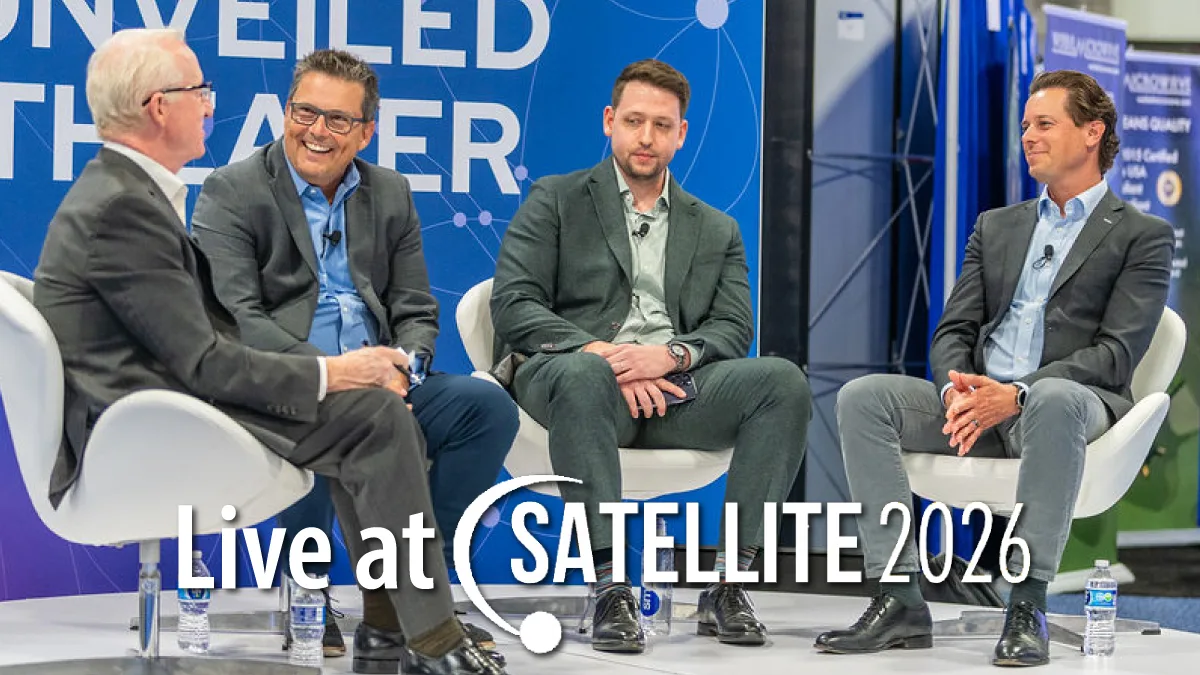
John Gilroy: Welcome to Constellations, the podcast from Kratos. My name is John Gilroy, and I’ll be your moderator. Joining me on stage is Blane Boynton of SES, Andrew Cavalier of ABI Research and Greg Quiggle of Kratos to unpack how the satellite industry is weaving 5G NTN into long-term strategy, how competitive pressure is accelerating ground system transformation, and how early implementations point towards commercial readiness. Gentlemen, ready to jump in?
Greg Quiggle: We are.
Andrew Cavalier: Absolutely.
John Gilroy: First question is to Andrew. He came the furthest, came from Singapore, so we got to give you the first question here.
Andrew Cavalier: Sure.
John Gilroy: Can you set the stage for us regarding 5G NTN in the satellite industry? So what’s happening, man?
Andrew Cavalier: Absolutely. So it’s been a few years since Rail 17, right? In 2022 when it was frozen, a number of operators have come out looking forwards to try to take on this standard, particularly Skylo. And devices were certified, what, two years after the release, right? So it took about two years to commercialization. We’re past that now and we see Release 19 has been frozen. So now we now see NR-NTN is on the horizon and that’s just the path towards 6G. So now we see a number of operators, big ones, SpaceX just announced recently they’re going to be doing NR-NTN with the next generation Starlink mobile two, Gen two, right? Iridium’s already said they’re coming out doing NB IoT based off of the Rail 17/18 standard. And then we also see some other operators like AST and Link, and SES even, basically posturing about going into the standard as well.
Andrew Cavalier: So there’s a lot of movement happening. Chip set vendors are moving, adopting the standard into the chip sets and going into commercial devices. And then we see MNOs, Deutsche Telecom, T-Mobile, going into partnerships with satellite operators to bring these services to their customers. That’s in IoT, that’s in direct to device for your smartphones. We’re seeing commercialization happening and we’re on the road to 6G. Yes, I could say.
John Gilroy: Good, good. Blane, how have recent 5G NTN standardization updates and customer need influenced your long-term network strategy?
Blane Boynton: So there’s been good progress, I would say, in reducing some of the 5G NTN components to practice. We can actually buy at least one system on a chip today that could be integrated into an NTN capable modem. And what our vision in the long run is, for me, a bit of back to the future. So I came from the Gogo acquisition, Gogo Inflight, right? And Gogo operated an air to ground network based on EVDOB. So the core handle, mobility management, subscriber management, all of these functions that frankly are difficult. And when Gogo made the shift from air to ground to satellite, we were dumbfounded with the amount of work. It was very complicated. We had to go rebuild software to do very basic things that the EVDOB core in 1999 or early 2000s was handling for us. So we’re excited to see the convergence. We’re excited to simplify, really, our network deployment by relying on these massive scale cores that are frankly very good at mobility management, very good at subscriber and call control and basic functions that the satellite industry had to go build themselves.
Blane Boynton: And every time we have a system boundary or a platform boundary, we have to build those functions differently. So if I use three or four different legacy platform providers, I probably have three or four different implementations of how to handle a call or how to generate a billing record. So the convergence for us represents a simplification opportunity, and then the ability, in the future, to jump on the massive scale manufacturing of 5G by leveraging the chips that we believe will become available, will provide us a great opportunity to reduce the cost at the UE. And those are two big pain points of satellite. The UE is complicated, expensive, right? And then the network management piece has just been a bear. Yep.
John Gilroy: Yeah. No, Greg, a lot of strategy questions here because we’re in an incipient stage of this whole revolution here. So with 5G NTN strategies beginning to materialize into POCs, proof of concepts, what are some of the big questions that satellite operators want to have answered?
Greg Quiggle: So I would probably group that into three areas, John. I think the most common would be, kind of as Blane was just talking about, most of the operators are coming from 20 to 30 years of proprietary systems. So what they’re really interested in is, how does 5G compare to those systems? How does it compare from a performance standpoint, from an SLA standpoint, from a mobility standpoint, from an efficiency standpoint? And so there’s a large learning process that’s happening. And the reality of it is, as with anything else, there’s pros and cons to that discussion. Many of the things that have been purposely developed in our industry over the last 30 years largely work out of box with 5G. Things like handover, things like authentication, things like a subscriber activation, all of these things were custom features that now with 5G, largely just work out of standards. So that’s the first is just how does the new implementation compare to these legacy platforms that have been used for decades.
Greg Quiggle: I would tell you the second kind of along with that is what kind of new business models then does that allow them to unlock? And the two big ones that come up on a regular basis, one is roaming. So now when all of the operators use a common standard, it opens the door for terminals to move between different constellations and different operators. The very, very common theme that the second is because now the standard aligns so closely with the mobile network operators, you also have service plans around hybrid offerings. So very, very common for me to get into discussions and questions about how would a single terminal leverage both terrestrial wireless and satellite based on coverage and/or usage profile. So I would say that’s the second.
Greg Quiggle: Distant third is ecosystem, right? When you jump into 5G or 3GPP in general, it’s a much broader set of customers and partners and operators. So it’s a lot of new relationships and not a lot of new learning, right? And how can I leverage those to really advance my business at a level that I really couldn’t have done before?
John Gilroy: Andrew, I mentioned that you live in Singapore now. I spent Christmas in Africa. It gives you a different perspective on all of this technology, especially land locked in the United States, and that’s why I want to get your perspective on this. So what are the most promising early use cases beyond direct to device that you think will scale first in this brave new 5G NTN world?
Andrew Cavalier: Yeah. So I mean, the three things I would say is high device count, low data rates and always on. Those are kind of the first things that we’re seeing that are really adopting the standard out there. So we’re looking at a lot of IoT use cases in particular with the current standard, right? So that’s across agriculture, maritime, aviation for drones, for safety, right? Tracking cargo, rail, right? There’s a lot of different verticals or areas that are using the standard already or implementing it in. But I think when we’re looking at the NR-NTN standard, we’re going to see that accelerate into particular domains as well, particularly where there’s more devices that need to be connected, right? So if you’re looking at maritime, for example, we were already seeing some companies out in China demonstrating examples of what might be a parallel to this technology. It hasn’t been fully realized yet in terms of it aligning to the standard, but they’re using what basically looks like NR-NTN in deployment, right? So there is movement already happening out there as we speak.
John Gilroy: Yeah, good. Blane, how are you approaching interoperability testing with terrestrial MNOs and what lessons learned, or what have you learned from these early trials?
Blane Boynton: So it’s a bit early, I think, to have a real clean list of lessons learned. We’ve done some limited interoperability experimentation, I would say, but we’re missing a couple components in order to do really meaningful interoperability testing. We need a modem. It’s really hard. It’s really hard to go do anything at scale without a modem. And we’ve worked with Kratos over the course of the last couple years on a virtualized approach to the modem, and it’s allowed us to learn, but we’re a bit stuck. We’re at a place where we need industry to shorten this cycle between freeze or ratification and hardware availability. Greg and I were talking. We was at MWC a couple years ago speaking to some of the larger chip makers, and the story is, well, show us volume and we’ll get you a modem.
John Gilroy: Yeah.
Blane Boynton: Well, the satellite industry, volumes are not automotive and are not…
John Gilroy: Direct to device.
Blane Boynton: Yeah, direct to device. So we’re in a bit of a slow mode, I guess, and we’re pushing hard to close that gap. We’ll do it with an imperfect solution, I would guess. But I don’t have a real clean set of lessons learned for you. We’re not quite there yet.
John Gilroy: Imperfect solution. I see every booth here probably has some type of an imperfect solution.
Blane Boynton: That’s the nature of development, right?
John Gilroy: I mean, how can you even keep up what’s going on? Well, I want to ask our friend here, Andrew, how he keeps up. As more MNOs explore partnerships with satellite operators, what types of roaming and service level agreements are emerging as potential industry templates?
Andrew Cavalier: Yeah. So we’re seeing a few templates already out there actually. So we have the roaming partnership agreement where the user’s device will switch between the MNO network and then they need to change the satellite network on basically a type of prompt on their phone. And it’s a very not a seamless, not a continuous, it’s discontinuous type of service. And that’s really kind of one of the earliest models that we saw. Now we have a more seamless model that we’re starting to see come out where the device will switch basically without the user even knowing, right? It’ll go between the cellular network and the satellite network, but critically, the satellite network is integrated with the cellular network in this case. It’s acting as a gNodeB in space. It’s acting as a part of the RAN and it’s helping basically be a part of a single network, not just a distributed or broken apart network like the previous model I just explained. And then we have the MVNO kind of Skylo model that’s wholesaling to the telcos, right?
John Gilroy: So Blane, I was taking notes of your last comment and I wrote down, “We need a modem.” Now this could be a t-shirt from 40 years ago, or for today, maybe that should be your t-shirt, “We need a modem”. We’re seeing major telcos partner with LEO constellations for direct to device services. So how does this trend influence the competitive landscape for traditional satellite operators?
Blane Boynton: If you are a LEO operator, you’re going to need a direct to device strategy. I think that’s a certainty. The LEO spacecraft are best suited, for a number of reasons, to serve the direct to device use case. The question of how well and at what scale is still open, I think. And you see constellations being lowered to be more suitable for that use case. I wanted to jump on Andrew’s last answer a little bit because we have a couple use cases that are deployed today that could be better soon as a result of interoperability. And if you look at sponsored connectivity and mobility, okay? So let’s say connectivity on airplanes or connectivity on cruise ships. These are areas where MNOs want to connect with customers.
John Gilroy: Yep.
Blane Boynton: On the airplane construct in particular, T-Mobile has been a sponsor of in-flight connectivity for a while. You see AT&T now sponsoring free connectivity on American Airlines. It would be great if that integration was a standards based roaming instead of a bespoke integration, which is what we’ve done in the past, right? So as Gogo, we had to do a direct integration with T-Mo’s AAA. That is not the way you want to do scaled roaming, but we did it, it worked, and it was great, and it was seamless. As we go through the future, connecting telcos and MNOs with otherwise unreachable customers, that’s a huge opportunity, and it’s not that far off. Today it’s just painful to do it.
Greg Quiggle: Yeah, there’s actually a variant of the standard. It’s called IAB. And that actually would enable that level of integration to happen. So the gNodeB on the airplane, if you will, is basically providing an extension of services to the UE from a gNodeB in space. So it’s kind of like nested gNodeBs. So that’s a… When you look at a cruise ship where you don’t have access beyond satellite when you’re out at sea, or if you look at an in-flight entertainment situation, that type of implementation is a good example where instead of everyone trying to approach that in their own unique way, you can, again, leverage the work that’s being done across many companies, coordinate it so you can do it at scale. And that ultimately leads to a better experience for the customer.
Blane Boynton: So as a product guy, what I like is you have real world problems, you have implementations in the world today that could be made better, simpler, faster, and you can provide real value to customers. So it’s there. And what I’ve been impressed, and I’m, I guess, a 5G neophyte on stage, I’ve been impressed at the depth of thought in the standard, and the standard contemplates some very sophisticated use cases. And connecting MNOs, for instance, with more customers in a consistent way, that’s a desirable thing.
Greg Quiggle: So I think that’s why it’s going to go somewhere. The way that magic happens, it’s the 3GPP organization, right? And I get the question all the time, right? DVB was a standard 20 years ago, right? And nobody followed it. And why isn’t 5G just the next thing? And the difference is the level of investment and commitment. You go to these quarterly 3GPP plenaries, and then, by the way, there’s dozens of working groups that are sub meetings outside of that. They all meet quarterly. You show up, it’s thousands of individuals, hundreds of member companies, and they literally do the hard work. They roll up the sleeves and they debate those use cases. And through that debate, you get different concepts of how you solve a problem. And then ultimately, the plenary process drives you to align on it.
Greg Quiggle: So instead of each individual company trying to innovate on their own and solve the problem uniquely, it’s more about the industry innovating. And that’s the level that we need in our industry for some of the smaller operators to be able to compete with the mega constellations that can write, frankly, much bigger checks, right?
John Gilroy: You mentioned 20 years, so I got to jump in this comment, that’s for sure.
Greg Quiggle: I’m really old, John.
John Gilroy: Yeah. You’ve seen a lot of evolution over the years. We know that.
Greg Quiggle: Yeah.
John Gilroy: So as ground systems evolve towards virtualization and cognitive operations, what new competitive differentiators are emerging for your customers?
Greg Quiggle: So a big thing that’s a trend, actually somewhat independent of 5G, is virtualization of ground systems. If I were to walk back into a gateway 20 years ago, I would see racks and racks and racks of hardware, typically all very specialized purpose, right? And sometimes they support different base band systems. Sometimes they support carrier monitoring systems, right? Sometimes they support management systems, but they’re all unique, right? So when you’re an operator in that environment, what that means is it’s very costly to scale. So nowadays, what’s happened is really the whole industry has moved to virtualization as a way to dramatically reduce cost in any of these use cases by consolidating the infrastructure that you run on. So Kratos is a good example of that, right? We do our base band systems. It’s the same infrastructure that we can use for earth observation down links. It’s the same infrastructure that we use for carrier monitoring. It’s the same infrastructure we use for satellite command and control. So through that to the operator, it allows them to dramatically reduce their cost base, which is really important at a time that we’re talking about scale as an industry.
John Gilroy: Blane, I’ve been taking notes and you got another T-shirt here, buddy, 5G neophyte. A lot of people don’t have that. I’ll order one of those t-shirts too. So how do you see the ecosystem evolving? Chipset vendors, device manufacturers, MNO, satellite operators, how do they support mass market NTN adoption?
Blane Boynton: So we are seeing operator adoption of 5G. Andrew mentioned a future SpaceX constellation. SES is very much committed to a 5G NTN future. As the components become available to build and scale networks, I believe we’ll see deployment. I don’t think it’s a question of if. I think it’s a question of when. I see the need there. I see the capabilities brewing. I see the willingness on the part of a few folks in industry to push it a little bit. I’m pretty bullish and I believe we’ll see something meaningful soon. So for me, that’s 12 or 18 months. I think we’re going to see a meaningful NTN deployment. It probably won’t be massive scale, but I would expect to see a satellite operator serving customers on an NTN-eque infrastructure inside that timeline. Yeah.
John Gilroy: So Andrew, you’re a young guy, and me and Greg have seen things over the years. We’ve seen adoption up and go, move, and move forward, and it’s not linear. It’s just kind of stop and go, stop and go. So my question to you is, beyond technology, what business or ecosystem risks are most likely to slow down 5G NTN deployment if the industry doesn’t collaborate effectively? I better shout that from the stage.
Andrew Cavalier: Yeah. I mean, you pointed out just that, right, is collaboration. And the fact is that fragmentation is really kind of what we’ve seen at the beginning of the standard, right? We saw a number of operators want to go to market fast and bring a solution to the market, but it wasn’t aligned with the standards, right? And as a result, that gives a bit of mixed signals, right? When you have an ecosystem of partnerships that need to collaborate and come together to really get the solution out and working, it sends mixed signals, right? You talk to chipset vendors, device OEMs or telcos, a lot of them, during that period up to this point, kind of had their head scratching because they’re trying to figure out exactly what was the play. And so that kind of mixed signal fragmentation where the operators are kind of choosing different paths here is definitely one of the big things for me that I’ve been seeing, right?
Andrew Cavalier: Alongside that, it’s a bit of a chicken and eggs thing as well, right? Because the chipset vendors would say, “Well, we’re ready to go,” But there’s no capacity up online, right? There’s no constellation maybe outside of Skylo, at the time, with their partners, EcoStar and the other operator, right? So it just goes to show that for them, they weren’t sure if they should even adopt or make the production of these chips right away yet because there’s no service that can be launched. So this was something that also was… I could see that being an issue as well, right? So I think there needs to be common ground and communication that’s… These kind of dialogues that we’re having now between all the players in the ecosystem to help get the solution out to the market, right?
Greg Quiggle: Just to add to that a little bit, I would tell you that the other thing, it’s easy with something like 5G to get sucked into the technology. We don’t spend enough time talking about problems that we need to solve, right? So the technology gets adopted when there’s a unique need with a customer base and it can provide the solution to it. So what’s something that an operator really needs to do today that they can’t without it? And then that creates the vacuum that brings it. So a really good example that gets talked about a lot is roaming across different constellations, right? 5G inherently solves that problem. It’s no different than the way your device talks to different cell towers on the terrestrial network, right? The way that it does adjacent cell search, the way that it authenticates with a core, the way that the roaming transaction is completed. All of that is built in, right?
Greg Quiggle: So when you look at the complexity of something like a multi-orbit network, there’s a unique problem that you’re solving and resilience for the operator. So to me, just to kind of add, I think it’s focused a little bit less on the tech. The tech is there, right? You can implement it. What’s the problem you’re solving?
Blane Boynton: I think there’s an internal problem for operators too, which you’ve been around our networks, certainly bandwidth sharing, efficient frequency planning, efficient use of the space segment in general is not a thing historically, right? So from an operator standpoint, cost to serve’s got to keep coming down and cost to serve means efficient space segment use. There’s a huge opportunity in 5G, just the nature of how the system is architected, how bandwidth is allocated to simplify and be more efficient with the space segment side of things. So for an operator standpoint, that’s also very desirable.
John Gilroy: So Greg, when I speak to software developers in the last six, seven months, usually AI is always paired with automation. It seems to be yin and yang or gun and a holster or something, always together. So what role do you see AI in automation playing in future 5G NTN ground system, especially as networks become more software defined?
Greg Quiggle: So right off the bat, it goes back to what the point that Blane just made, right? You have to reduce the cost per bit to be able to compete at scale. And a part of that is certainly efficiency, just straight up efficiency. Secondly, it’s about really maximizing the utilization of the network. So as you look at even a small global 5G network, you could easily have thousands of cells, right? I mean, you could easily have tens of thousands of terminals that are traversing the globe using those cells. So optimizing that at scale on a regular basis requires a significant amount of automation. You simply can’t do it the way that you could 10 years ago when the world was covered by wide-beam satellites, you had three and you had a dozen beams, right? You could actually have a small group of professionals swivel chairing to constantly optimize the network.
Greg Quiggle: So I think that’s the primary benefit for AI, it’s the ability for you to optimize or tune the network in pseudo real time for peak efficiency, peak resiliency, peak performance. It’s also to be able to proactively detect outages before they happen, right? Once they’ve already happened, customers are out, and now you’re on the clock. If you can use AI as a way to predict those outages, oftentimes in places that are hard to reach in our industry, right? You want to go to a site, it’s not uncommon, it requires a helicopter ride. So the more that you can proactively detect an outage in an area like that, the better overall experience you’re going to provide to a customer. And funny enough, the standards community sees it too. We mentioned 6G briefly. One of the big themes of 6G, it’s actually to build in many of the enablers for AI in the RAN.
John Gilroy: This is a podcast and everyone can get a transcript of this podcast. And I’m sure if you looked at the transcript, you’d see 5G NTN all over the place, you know, pop up, pop up, pop up. And we’ve talked about that a lot, but one thing we haven’t talked about is… Simon Sinek says, “Start with why,” Well, I want to start with when. So I’m going to ask each one of you the when question. So start with you, Blane. When… So how soon do you think the first commercial 5G NTN deployment will actually be operational? And any predictions on who might be the first NTN, non D2D and non IoT implementation in the industry? So when?
Blane Boynton: So I gave a number earlier, I think I said 12 to 14 months, and we have intention to provide a solution in that timeline for a non D2D use case.
Andrew Cavalier: Well, that’s news for me. I changed my answer. So my original answer was going to be probably SpaceX, right? But I’m backpedaling now and maybe I’ll side with Blane here and say probably it’ll be SES.
John Gilroy: Oh, good, good, good. Greg?
Greg Quiggle: Yeah, I think that’s the right timeframe. We’ve already… And I guess as a part of it, you also want to specify what type of NTN.
John Gilroy: Yeah.
Greg Quiggle: If it’s MB IoT, frankly, it’s been production available for a very long time.
John Gilroy: Sooner.
Greg Quiggle: For, I would say, years, not months, and deployed at scale. If it’s NR-NTN that we’re talking about, I would tell you it’s roughly a year. We’ve already… We did our first over the air testing on geo satellites and on Neo satellites more than a year ago and really proved the tech at that point. So now it’s really about, it’s the polish to get something to a hardened state and it’s finding the right customers to deploy it with.
John Gilroy: Well, it’s exciting because we’ll be back next year and we’ll find out if your predictions are…
Blane Boynton: Are we going to play the recording back?
John Gilroy: Yes, we will.
Blane Boynton: We have this podcast.
John Gilroy: Well, last year, Blane, you said what’s going on.
Blane Boynton: Another T-shirt.
John Gilroy: Yeah.
Blane Boynton: It’ll either be I did it or I didn’t.
John Gilroy: Well, then we give you the T-shirts. That’s how you win the t-shirt if you [inaudible 00:27:43] correctly. Well, gentlemen, I think you’ve given the audience a real good idea of this 5G NTN concept. I’d like to thank our guest, Blane Boynton from SES, Andrew Cavalier from ABI Research, and Greg Quiggle from Kratos. Thank you, gentlemen.
Blane Boynton: Thanks a lot.
Andrew Cavalier: Thank you.