Transcript:
John Gilroy: The views expressed in this podcast or on www.constellationspodcast.com, do not officially represent the views of the U.S. Military or the United States government. The appearance of U.S. Department of Defense, DoD visual information, does not imply or constitute DoD endorsement.
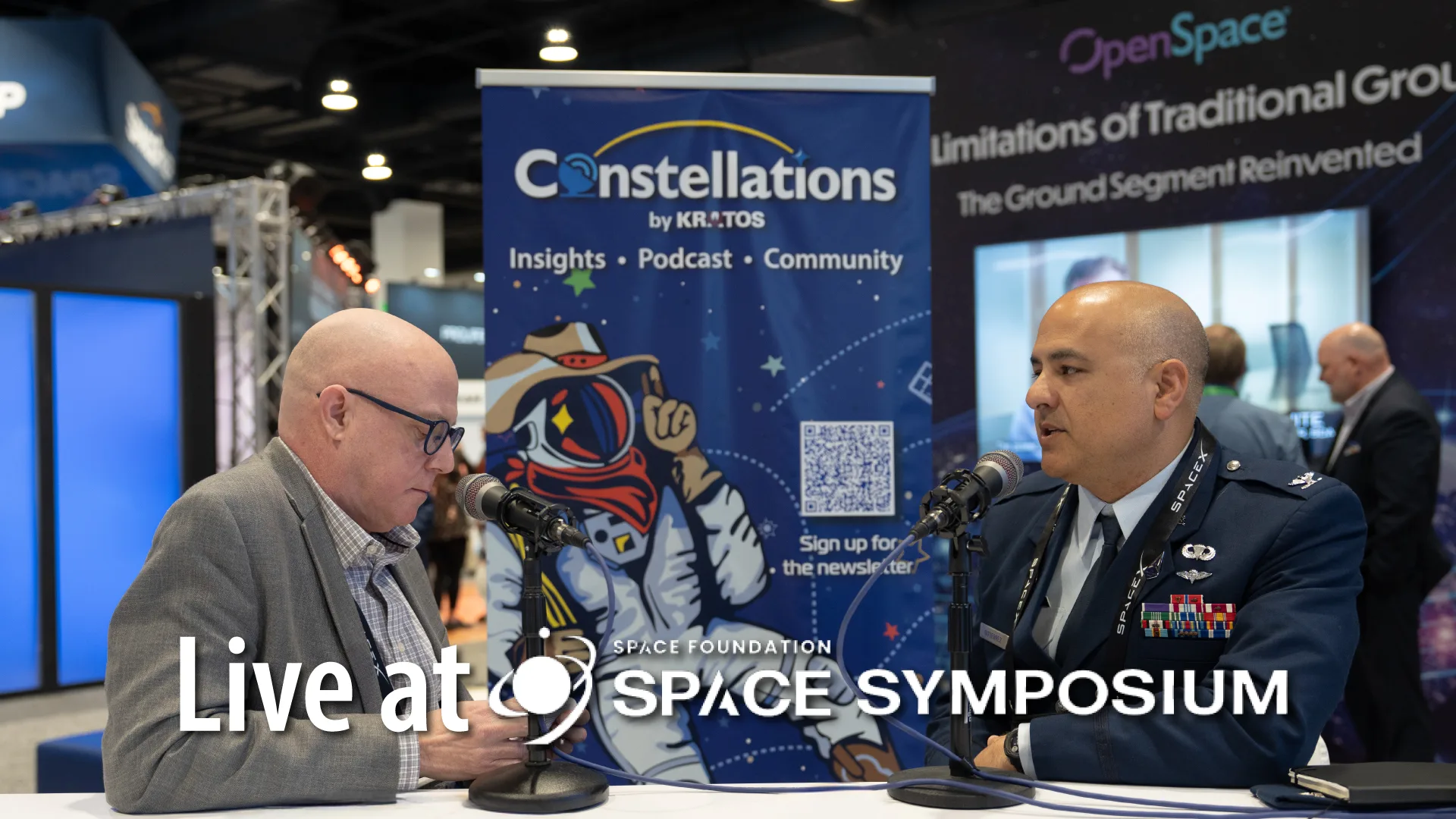
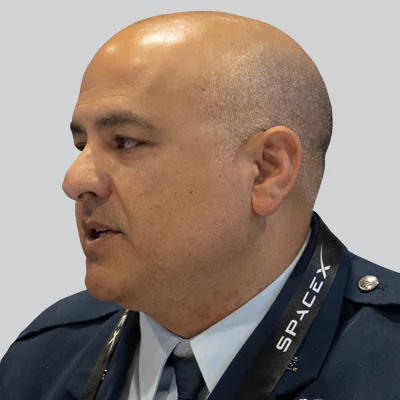
Jason Meyers: Welcome to Constellations, the podcast from Kratos. I’m Jason Meyers, your moderator and managing editor of Constellations. We’re recording today from the exhibit floor of Space Symposium and today we’re exploring how US Space Force is preparing for a future where space is contested, congested, and indispensable to every military operation. We’re joined by Colonel Eddie Gutierrez, the Deputy Commander of Mission Delta 3. Mission Delta 3 is responsible for training and presenting combat-ready space electronic warfare forces to protect and defend critical space capabilities. Colonel Gutierrez brings a career spanning operational leadership capability development and joint service integration, experience that uniquely positions him to talk about how the Space Force is adapting to new threats and accelerating the way it fields EW capabilities. Eddie, welcome. It’s great to have you with us.
Colonel Gutierrez: All right. Thank you for having me today.
Jason Meyers: Mission Delta-3 plays a central role in delivering electronic warfare capabilities to the force. Based on your experience leading operational units, what aspects of EW integration demand the most attention right now?
Colonel Gutierrez: So actually the whole spectrum of EW demands attention. We fight across the entire spectrum. As we deploy our forces, they’re there to support the joint force and the joint force has a lot of needs and so we want to make sure we meet those needs across the full spectrum of operations from phase zero all the way to conflict. And what you can see is everything that we do from our EW side is provide those. When the joint force needs electronic warfare forces, they call on our war fighters to provide that to them. We have a very professional and robust training. Our guardians are ready and willing to go into the fight and they are there supporting our joint forces as we continue to win.
Jason Meyers: Great. So you’ve served in assignments to bridge operations, acquisitions and strategy. How has that combination shaped the way you approach capability development for contested space environments?
Colonel Gutierrez: So what has really helped me in the position I’m in today is delivering at the pace of the threat. And in the mission delta ourselves is I’m not doing large capability development. I’m right there with the war fighters from our acquisition side and we see the challenges that they have that they’re dealing with. And what we’re able to do is iterate quickly. We’re able to partner more quickly with our industry and then we’re able to turn on those threats in order to defeat them. I think it’s a great combination between having the operators and the acquirers and the Mission Delta. The CSO had a very good vision in implementing this and what we’ve done on the Mission Delta side has really helped us achieve those goals that he had set forth with the unity of effort and the unity of command. We just have that partnering with Colonel Fernandez, who’s the mission Delta three commander. We talk daily and he tells me stuff that he needs solved and I’m able to take what he’s most demands are and turn around to my team and be like, “Let’s solve these problems today.” Because that’s what needs to happen. We don’t have time to wait. We’re trying to turn on capability in six months or less, not years. And so changing that mentality within our acquirers and also changing the mentality in our operators to understand that they have this ability within their own organization over the last two years, we’ve really moved the ball forward.
Jason Meyers: Great. So looking at the current threat environment, what operational challenges stand out to you as most important for EW units to prepare for?
Colonel Gutierrez: So we’re preparing our guardians for a near pure fight. That’s what we do is we always look at our competitor and what we want to do is be ready for that when that happens. Our first thing is deterrence and I want everybody to realize is that we are ready for that and we want to make sure that our weapon systems and our guardians both hand in hand are ready for that engagement. We don’t ever want war, but if war is called upon us, we have to be ready for it. And I think that’s where we’re driving our formations to. And Colonel Fernandez has that as his main goal is from our guardian standpoint is like, what are you doing to make yourself better every day in order to be ready for that? And so even though we never want it, we have to be always ready.
Jason Meyers: What challenges do guardians face when executing EW effects in an environment where satellites may shift roles, payloads or apertures mid-mission? And how are you helping them adapt at that level of constant change?
Colonel Gutierrez: So targeting is a big key. What we want to make sure is we focus on that we affect the end user of what we’re going after and that’s what we provide is that we’re able to do that. We will get better at our dynamic targeting piece to that, but right now we are winning in the spectrum across the board. So we had Midnight Hammer and Absolute Resolve where our EW forces played a critical role in our ability for the joint force to execute those operations. And so we don’t go to the fight without EW. When you start it, any conflict, even in the competition phase, electronic warfare is playing a key role.
Jason Meyers: All right. Modern space operations require adaptation as you’ve talked about rapid adaptation. How do you think about building units and processes that can quickly adjust without losing discipline or rigor?
Colonel Gutierrez: So what we’re trying to get to ultimately, is I’m trying to make an EW operator. And so ES support, EA, the functions are the same. It might happen differently at the weapon system, but ultimately what we’re trying to do is reduce the training burden on our operators and having a common interface in order for them to execute their missions. I think if you’re able to train to a baseline and you’re not weapon system specific so much, but more of how I’m employing the weapon system and how I’m executing in order to support the joint force will really allow us to be more flexible in our abilities. And then I don’t have to worry about if I need to fill a hole with an EW operator, I have those behind them that I don’t have to go and retrain somebody that they’re able to perform those same functions across the board.
Jason Meyers: All right. So your career includes time spent directly supporting joint force operations. How do you see space-based EW influencing joint operations over the next few years?
Colonel Gutierrez: So we will not go to war, in my opinion, without EW. And those who own the spectrum will own their abilities to provide long range fires, communicate across the force and provide that intelligence that is required in order for us to engage our adversaries. EW is definitely in the multi-domain fashion. It’s just one of the pieces for the multi-domain fight and our ability to win in that domain sets conditions for all of our other joint force partners to execute.
Jason Meyers: Great. So there’s a lot of discussion about resilience in space systems. From your operational perspective, what does resilience actually mean for the units executing missions?
Colonel Gutierrez: So we’ll be resilient in the way of a number of systems that we have proliferated across the globe. We’ll be able to provide effects globally. We’ll be able to operate anywhere in the world with how we’re moving out with our EW forces. While we don’t want to be is stagnant. We want to make sure that we have different areas where we can operate our EW formation. We don’t want us to get stuck in one spot. We want to be able to function whatever we’re doing in any AOR at any time and that’s our goal is to build that globally focused EW posture. We have to really focus on the AOR and contact, but we’re globally focused at the same time. We have to set conditions across the globe in order to ensure that the conditions within the AOR are achieved.
Jason Meyers: So you’ve worked with both government and industry partners throughout your career. What would you say makes a partnership genuinely useful for advancing EW capabilities?
Colonel Gutierrez: Common vision is one and delivering on outcomes is another. I think what we have to work better both from, and I’ll say it’s three legs here. It’s the operational side, it’s the acquisition side, and it’s the industry side. And if all three of those are humming at the same cadence, they all understand the same needs and we’re all working towards the same goal, we’ll continually win. Every one of my vendors that I work with or industry partners, I’m their customer and I tell them, “I’m not a customer.” This is a partnership that I like to build with all of my OEMs is that, if you don’t win developing and delivering capability, it means I don’t win in the fight. And so if we try to make this transactional, then we’re never going to get there. And so a partnership is key is that we’re all on the same team. We’re all working towards that same common denominator of whatever that is and everybody is solely focused on that, then we can just move mountains. We did a lot of that recently with the Bounty Hunter weapons system. I got a requirement from Colonel Fernandez and General Miller at the time to say remote bounty hunter in six months and I understood what the requirement was. We went to our industry partners and we sat there and we did it with COLSA. We delivered a remote capable system in six months. Other things that we did is moving to fielding the Meadowlands weapons system sooner. We pushed the timeline a year earlier than what was currently depicted and all that was doing was sitting our operators, our acquirers and our industry partners in the same room, all aligning our functions on the outcome at hand and that is just delivering kit to the war fighter. And when we do those things, we can move mountains. We can move rapidly, can move through the acquisition process quickly. We can understand requirements from the operator down to the industry level without people asking a bunch of questions. But once you do that, you just don’t understand the power that you have.
Jason Meyers: So as Space Force refines how it acquires and fields systems, what improvements or adjustments would you like to see that would help operational units the most?
Colonel Gutierrez: So I will say the Department of War has put out a lot of guidance for us to get after it and I think they put off the guardrails of acquiring systems with the standup of the PEA structures and putting a single person solely focused on delivering on outcomes. I felt like early on in my acquisition career, we’re very process driven and process focused. They would show you the life cycle chart and everybody would point to it and be like, “This takes years…” And they’d point to all that. That is completely out the door. You don’t have to do any of that stuff anymore. You can move out smartly. We have enough professionals within our formation that we know what right is. The policy and regulations that they put on us that they took away, we just have to get out of our own way sometime and be a little bit more able to take risk and understand the risks that you’re taking and not be afraid. And I think we can continue to do that and we execute that way in Mission Delta 3 and I know a lot of others do that and the other Mission Deltas and even in SSC and SUPARCO is that once we get the workforce to understand that we’re there to support them, we’re there to remove barriers, we have been given the leeway to go and execute and we get that alignment, we can move very quickly. The only thing that was holding us back and forth was process.
Jason Meyers: All right, last question for you. Looking ahead, where do you see the biggest opportunities for Mission Delta three to evolve its mission or expand its impact?
Colonel Gutierrez: So we’re continually changing in Mission Delta three and I think if you stay stagnant in our missionary, we won’t win. And so we’re looking to address the threat picture throughout the entire spectrum. One, we have embedded our Intel squadron with a 37 TIS, part of the Mission Delta construct. They’re there providing us real time intel of what’s going on. We’re seeing what’s happening in the spectrum. And so we have to continually evolve. And I always tell folks that if you go back to the joint pub and you look up there and says, “Hey, what’s electro-magnetic warfare?” That’s what Mission Delta 3 does. We do the entire spectrum and we’re going to execute across that in order to support the joint force. So when we say like, “Where are we looking to grow?” It’s not that we’re looking to grow in our mission set per se, it’s like we’re more trying to grow and making our weapon systems better in order to support that contested environment and making our operators more dangerous and more lethal in that they have that mission command mentality that when everything goes awry, they know commander’s guidance and intent and they can get after it. They can go and execute the mission, they can defeat our adversaries. And I think that’s really what we’re trying to evolve to.
Jason Meyers: Great. Well, thanks a lot for sharing your perspective with us today. I appreciate your time.
Colonel Gutierrez: All right. Thank you very much too.