



4 Takeaways: NASA’s Next Lunar Phase Is Coming into Focus

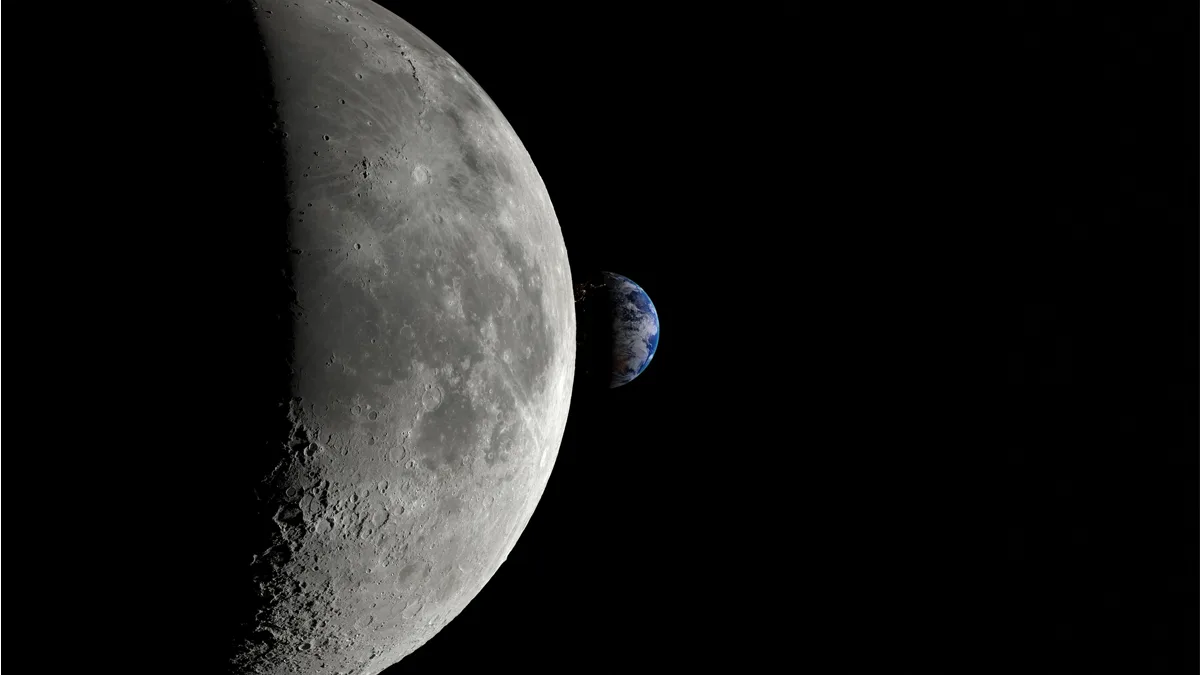
NASA’s announcement of the Artemis III crew on June 9 comes at a pivotal moment for the agency, as the success of Artemis II and a shifting global space landscape accelerate plans for a long‑term human presence on the Moon.
The momentum is real, according to Space Foundation’s Heather Pringle – and the next era of lunar exploration will depend on sustained capability, commercial partnership and disciplined execution.
Read our top four takeaways from our conversation with Space Foundation CEO Heather Pringle, or listen to the full episode.
Takeaway 1: The success of Artemis II is fueling momentum toward a permanent Moon base.
The near-perfect success of the Artemis II mission, from launch to splashdown, reflected years of dedicated planning, collaboration and engineering prowess, Pringle said. Now, NASA, the U.S. and its international partners are leveraging the momentum of Artemis II with sights set on the big picture – establishing a Moon base.
“It’s the next step in the path to getting permanent lunar presence on the Moon. The fact that Artemis was so successful really increases the momentum, it increases the excitement. And again, there are opportunities for other companies [and] other nations to become part of where we are going. And so I’m really excited about this next phase of Artemis.”
Pringle, who was at the historic April 1 launch, noted that the tone on-site was grounded yet confident.
“The administrator really laid out, ‘Hey, here’s the vision, here’s how we want to approach each of the different phases. We’re going to focus on how we approach it.’” Pringle said.
“The room felt serious, it felt ready to tackle it. And then as far as the launch, that was magic,” she said.
Takeaway 2: Lunar strategy has moved beyond flags and footprints.
Nations’ approach to Moon missions has shifted since the Cold War era. The previous century of lunar exploration was centered on getting there and proving it with a patriotic symbol. But in this next era of exploration, success will be defined by who has staying power, Pringle said.
“The Apollo era was an opportunity to beat the Russians. It was about flags and footprints – can we accomplish it as a nation? So it was symbolic as much as it was geopolitical,” said Pringle. “Now as we look at the Artemis era … it’s about sustained presence. And so that’s a different mindset. You can’t just do a touchdown; you can’t do a fly-by. You have to think differently.”
Takeaway 3: Commercial capability and cross‑agency coordination are becoming central to the U.S. lunar strategy.
The government is signaling a much stronger reliance on commercial space companies, with both NASA and the Space Force outlining commercial plans and an Executive Order that directly instructs agencies to “rely on the commercial space.” That message is intended to be clear: industry is needed, the objectives are laid out and solutions must come with speed and credible capability – factors that will determine which companies matter most in this next phase, said Pringle.
From there, the focus widens beyond industry alone, she said.
“We’re seeing a greater synergy across multiple sectors of the government. So the Department of Commerce, NASA, NOAA and the military and the intelligence community are all coming together to really accelerate American leadership in space,” Pringle said.
Takeaway 4: Deep‑space progress hinges on nuclear capability, real testing and execution
Leaders across the space community are increasingly pointing to nuclear power and propulsion as the technologies most likely to shift how missions are designed and operated beyond Earth, said Pringle. While AI is accelerating spacecraft design and data analysis, nuclear systems are emerging as the long‑duration enabler for operations farther from Earth, she said.
“Nuclear power and propulsion [are essential for] the ‘survive the night’ aspect, so that is what enables us to be in the long game,” Pringle said.
At the same time, the expansion of human activity deeper into space will require a clearer understanding of what sustained presence actually demands. Those insights won’t come from theory but from real missions and incremental learning – much like the evolution that happened aboard the ISS as long‑term habitation became routine, Pringle noted.
Policy will also shape the pace of progress, particularly as more nations and companies enter the field. Interoperability and shared standards are becoming foundational needs, supported by the December Executive Order, which Pringle described as a comprehensive starting point. But the next phase of lunar exploration depends less on new directives and more on follow‑through, said Pringle.
“As part of the Artemis generation, I’m excited about where we are and where we’re going,” she said.
For more, listen to the full episode.