



Closer to the Action: The Next Phase of On-Orbit Inspection

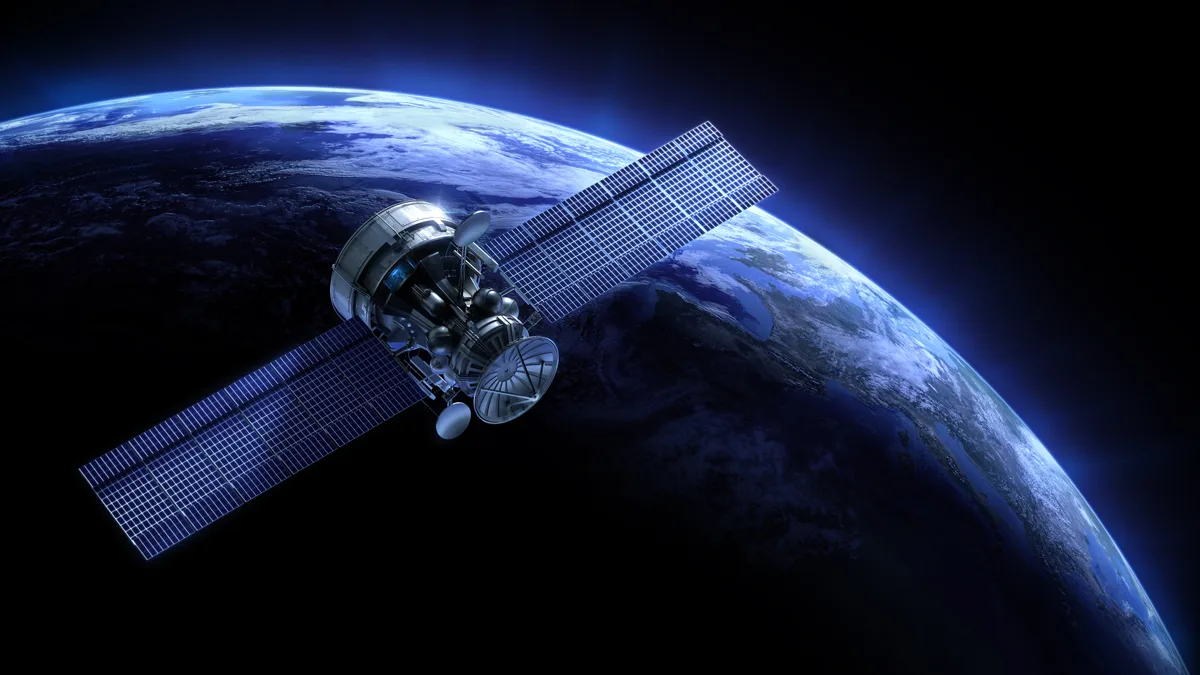
Understanding the condition of a satellite, as well as what is happening around it, has traditionally been derived from afar. As orbital environments become more complex and increasingly contested, that approach is starting to break down.
This breakdown becomes even more pronounced at higher orbits, where many high-value commercial and government satellites sit.
At geosynchronous orbit, roughly 35,000 kilometers above Earth, resolution limits begin to break down. Two nearby satellites can merge into a single point of light. That makes relative motion difficult to resolve. “You don’t know what’s going on,” said Dr. Gordon Roesler, president of innovation advisory Robots in Space LLC.
Efforts to address these constraints have been underway for years, including the development of systems designed to operate directly within the orbital environment.
Roesler previously served as program manager for DARPA’s Robotic Servicing of Geosynchronous Satellites (RSGS) program, which, in partnership with the U.S. Naval Research Laboratory’s Naval Center for Space Technology, developed a robotic inspection and servicing payload set to launch in summer 2026 via the Northrop Grumman MRV spacecraft bus.
Dual-Use Technology
The DARPA program was structured as a public-private partnership to allow commercial operators to use government-developed robotics, according to Roesler. “Why did we do that? Because in geostationary orbit there are five times as many commercial satellites as government satellites,” Roesler said.
“We started building that payload in 2017 and it’s just going to launch this year. That’s nine years,” he said, calling the payload “possibly the most complicated robot ever built.”
Once in orbit, the payload will perform inspection, repair and attachment of external modules to existing satellites. The system includes dual robotic arms, around 16 cameras and interchangeable tools designed for close-proximity manipulation, Roesler said.
The first Mission Robotic Vehicle will service satellites in geostationary orbit for eight to 15 years, generating valuable data, said Roesler.
“You’re going to see growth in this technology area because it enables so many things both on the commercial side and on the defense side.” Dr. Gordon Roesler, Robots in Space
Other companies are now developing similar robotic satellites, Roesler said. “You’re going to see growth in this technology area because it enables so many things both on the commercial side and on the defense side,” he said.
For example, you could add modules that provide close-range situational awareness or even defensive tools like decoys, said Roesler.
“I think it’s pretty obvious that this technology has a lot of good uses,” he said.
Innovating a Secure Orbit
While the robotic servicer will be the first U.S. payload in orbit of its kind, China launched a comparable satellite in 2021 and has already been performing missions, noted Roesler.
“So, we’re behind in this technology,” he said.
While the RSGS servicer will be used for commercial applications, the technological advancements of rival powers have the Space Force on notice.
“Our adversaries are fielding more and more technologies to disrupt space superiority” -Sahil Desai, Fortastra
“Our adversaries are fielding more and more technologies to disrupt space superiority,” said Sahil Desai, vice president of product at defense space manufacturer Fortastra. “I was recently at an event with General Saltzman where he said, essentially, that securing space is table stakes – because without space, there is no joint force.”
Consequently, nurturing commercial innovation in space – and protecting those assets – is increasingly a priority for the Space Force, Desai said.
“There’s a critical emerging role in the Space Force: not only protecting defense assets, but also commercial assets. All of that is at risk,” he said.
Closing the Distance in Threat Detection
Against that backdrop, limitations in current sensing approaches are becoming harder to ignore, especially as competitors field systems designed to exploit gaps in awareness in a progressively contested orbital space.
Telemetry and logs remain useful, but they can’t provide a complete operational picture, said Desai. Effective assessment, attribution and deterrence signaling require information sources beyond what a single spacecraft records, he said.
“A lot of today’s technology is about sensing and detecting from a distance. But in any real engagement, eventually you have to get close. You have to be able to engage – physically or electromagnetically,” he said.
Fortastra, which builds maneuverable satellites for security applications, focuses on closing distance to at-risk assets and delivering effects quickly against threats, said Desai. Maneuvering is only one factor; proliferation is the other, Desai said.
“If you only have a small number of capable systems and not enough to traverse orbits quickly, that’s a major gap,” he said. “We’re looking at proliferative maneuverability: getting a large number of assets into space and maneuvering them effectively to create a deterrent against growing on-orbit aggressors.”
Watching Versus Interacting
These pressures are driving a shift in how spacecraft are designed and deployed, with emerging systems beginning to separate into two categories: those that observe and those that intervene.
On the observational side, small inspection satellites are being designed to hover near high-value spacecraft and monitor nearby objects. Similar capability could be embedded directly onto satellites through attached sensor modules.
On the observational side, small inspection satellites are being designed to hover near high-value spacecraft and monitor nearby objects. Similar capability could be embedded directly onto satellites through attached sensor modules. That approach avoids propulsion requirements, according to Roesler. “It’s probably cheaper just to attach it,” he said.
More complex systems move into direct interaction, said Roesler. Robotic servicing spacecraft are being developed to dock with satellites, inspect them at close range and perform physical operations such as attaching modules or correcting mechanical issues, Roesler said.
“The more missions you want the spacecraft to have, the more stuff you have to put on it,” he said.
When Failure Becomes a Servicing Case
The value of proximity inspections becomes clearest when satellites fail.
Deployment issues occur infrequently, but when they do, the impact can be significant, said Roesler. “Once every couple of years, this seems to happen,” Roesler said, pointing to anomalies in solar panel and antenna deployment of commercial satellites that have resulted in insurance payouts in the hundreds of millions of dollars.
From the ground, operators can often detect that something is wrong, but they cannot intervene. A servicing spacecraft changes that dynamic by physically approaching and attempting repair.
From the ground, operators can often detect that something is wrong, but they cannot intervene. A servicing spacecraft changes that dynamic by physically approaching and attempting repair, Roesler said.
“If a robot could go up and assist in that deployment, you save everything,” he said. “Everybody’s happy.”
Failure could become incredibly costly once data centers enter the picture as high-value space assets, said Desai. AI data centers highlight the scale of the risk: they demand enormous investment yet could be disrupted or destroyed relatively easily, with major economic and strategic consequences, he said.
Companies are already investing billions of dollars toward having substantial compute power in space, said Desai. “High-value, compute-heavy infrastructure is moving into orbit. As that happens, the need to defend that infrastructure becomes more acute.”
“Any state or non-state actor with access to space could threaten such infrastructure. We’ve already seen parallels on Earth, from the Houthis striking civilian targets to Iran attacking both military sites and civilian facilities like oil infrastructure,” Desai continued. “As more commercial capability moves into space – internet constellations like Starlink or Kuiper, space-based data centers, commercial communications and commercial PNT – the threat surface grows.”
Autonomy Under Constraint
As spacecraft operations shift from passive observation toward closer interaction with orbital assets, questions about control and decision-making become central – particularly in the context of AI and autonomy.
Despite its complexity, the RSGS robotic payload contains zero AI – for good reason, said Roesler.
“Today’s AI does not have predictable outputs; when we’re moving close to another satellite, reaching out with robot arms, we want everything to be very predictable,” he said.
The payload does contain some automation, said Roesler, noting that artificial intelligence and automation are two very different things.
Autonomy is a broad and sometimes vague term, said Desai, agreeing with Roesler. “I think of [autonomy] in layers,” Desai said. “There’s mission autonomy – someone in the Space Force wants an effect achieved and issues a command. There’s the layer where that command is translated into tasks for satellites. And then there’s onboard autonomy – the spacecraft perceives, interprets and executes.”
For example, when the robotic satellite approaches the customer satellite, it will stop a couple of meters away. Then the arm will reach out and dock with the ring, Roesler said.
“That final motion is completely automated, including the authority to abort if the client satellite starts to move,” said Roesler.
In the event that one of the satellite’s thrusters fires, or its reaction wheels turn, the servicer’s arm will automatically withdraw and the whole satellite will back away without any command from the ground, he said.
“Why did we design it this way? Because operators can get confused. There are time delays in communication. Links can drop out. And the operator may not have a good enough perspective to know exactly what the safest direction is to back out. So we automate those parts: the final plunge of the arm and the abort sequence,” he said.
Desai argued that both AI and autonomy will play a significant role in satellite operations sooner than we think, noting that just a few years ago people were skeptical that self-driving cars would be achievable and now they’re already in use, but he echoed Roesler’s thoughts that the technology isn’t quite there yet.
“There are still no clear standards for autonomous systems, and meaningful progress will require more on-orbit testing rather than relying mainly on simulation,” Desai said. For safety, the most useful metric would be an “intent-match” measure – autonomy that can interpret an operator’s objective and carry it out reliably, whether maintaining a safe orbit or protecting another spacecraft, without continual human input, he said.
As orbits become more crowded and operators tap into autonomy, sensing techniques will continue to evolve.
As orbits become more crowded and operators tap into autonomy, sensing techniques will continue to evolve, Desai said. “We’re going to see a lot more sensing and a lot more sensors in space. You’ll need to track and understand all the resident space objects around you, which is why the government is investing heavily in proliferated architectures and space situational awareness,” he said.
A Workforce of Robotic Satellites
Long-term expansion of space activity will also benefit from autonomous and robotic servicing payloads, particularly as missions venture out into higher orbits and deep space, according to Roesler.
If something goes wrong on a spacecraft’s exterior, sending astronauts outside to check the damage is risky and expensive. A robot could handle inspection and manipulation much more safely and efficiently, making robotics ideal for external work on deep-space missions, Roesler said.
On planetary surfaces, robots are even more essential. Tasks like moving material, constructing radiation shielding from local regolith or preparing a safe building site shouldn’t fall to astronauts, Roesler argued. Robots can excavate, transport material and assess subsurface stability before habitats are built, he said.
“The workforce, the labor force – as we expand into the solar system – is going to be almost completely robotic,” Roesler said. Humans will remain focused on oversight, management and scientific work, while robots will handle the more “blue-collar” tasks. “The dull, dirty and dangerous jobs ought to be done by robots,” he said.
That framing extends beyond satellite servicing to broader applications like in-space manufacturing, infrastructure maintenance and planetary operations, Roesler said.