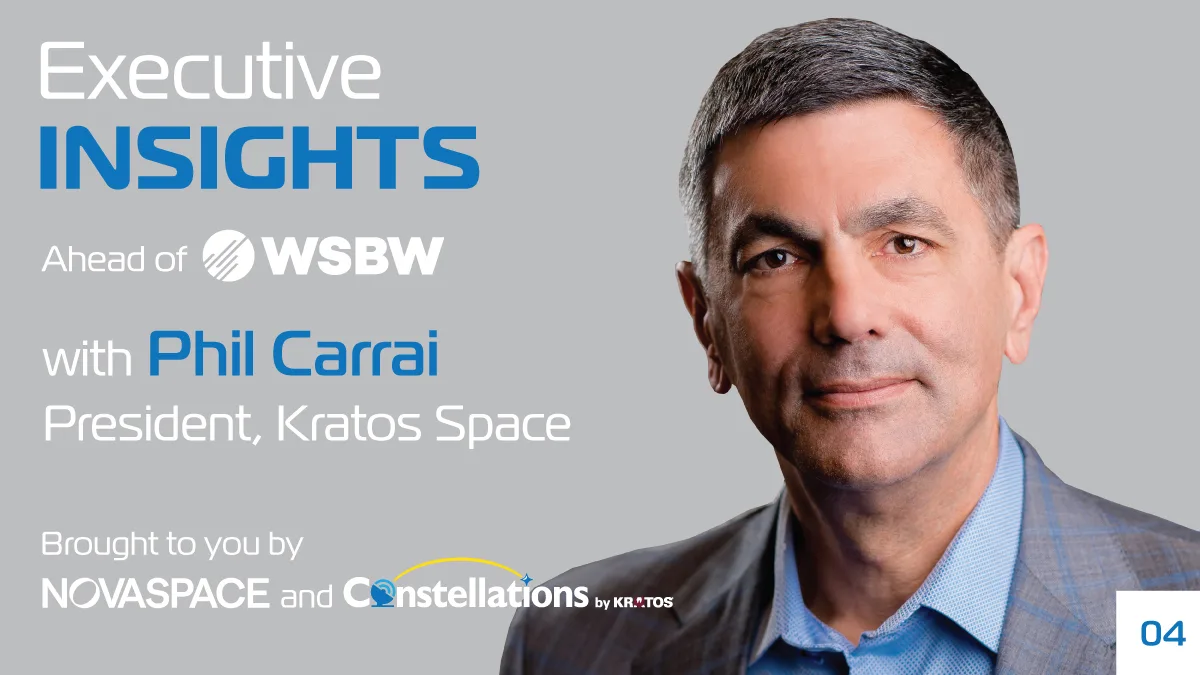
Transcript:
John Gilroy: Welcome to Constellations Executive Insights, a limited podcast series in partnership with Novaspace. My name is John Gilroy, and I sat with five industry executives who are at the head of some of the most innovative and forward‐thinking companies. If you’re like me and wants to know what gets them excited, what challenges they’re currently focusing on, and what their predictions are for the future, stay tuned. In this episode, I’m sitting with Phil Carrai, president of Kratos Space. Phil, thank you for joining our Executive Insights limited series. It’s an exciting time for the space industry, can you share one recent development you are most proud of for Kratos?
Phil Carrai: Yeah, thanks very much, it’s a pleasure to be here with you. Most recently, we announced that we’ve conducted a 5G NTN test over GEO with our partner Intelsat, we think that’s substantial. 5G, we believe, is the future of satcom, and certainly for mobility, air mobility, aero, ground mobility, internet of things, we think that connecting to the terrestrial infrastructure in a seamless way is the future of satcom, whether it be a GEO, MEO, or LEO, and the fact that we did what we think is the first demonstrable proven 5G space to ground from GEO demonstration is a substantial piece along our journey, and we think which will eventually be the industry’s journey to a more fully integrated telecom/satcom infrastructure
John Gilroy: Between legacy companies and new entrants the space industry is getting more crowded and competitive. Looking ahead over the next three to five years, what do you think will separate the winners from the rest?
Phil Carrai: Yeah, great question, especially if you look at public markets today and valuations in private markets. Good news, there’s a lot of money out there looking for new and innovative solutions for problems that exist today, both in the commercial sector for regions that currently aren’t well served, and in addition to that imaging and sensing marketplace, which has really kind of exploded in the last four or five years certainly, and then on the government side, governments writ large, both in the US and globally. Demand for satellite and satcom and imaging and sensing solutions appears very strong. Still very oriented in the imaging and ISR side to governments, again, governments in general. So, that’s the good news, there’s a lot of activity, a lot of money, a lot of energy going into finding new and innovative solutions. I think what separates the winners from the losers here are, one, it’s the basics. A well‐defined business plan that is demonstrable, and what I mean by that is that there’s real value that you’re providing, you’re matching the customer spend patterns, not necessarily what your investor base would like you to do, but how the customer actually spends, when they spend, their cash flow, and their timing, that you’re matching that in the way that they want to buy, they want to procure, I think that’s one piece of it. I think real delivery against that is another thing. I think when markets get frothy, PowerPoint tends to get funded as well as demonstrable product and kit. I think the survivors is always have been the people who get there with product and kit, and can demonstrate capability that works. I think the third piece is things that fit into, whether it’s the government’s business, their mission, if it’s the commercial business, their business, things that fit into the structures that they want to move into, so mission‐oriented or business‐oriented deliveries will, I think those are the guys who are going to make it. Those are the companies that will make it in the coming markets. I do think because it’s so frothy there’s just a lot of activity. We saw this in the 2020 timeframe too with the emergence of SPACs, a lot of money, a lot of activity, but the people who make it tend to be the people who deliver real capability, who match how their customer spends, and their business model can survive how their customer spends, and the third piece is that it’s integrated with how the customer operates, whatever that end business is, whether it’s providing broadband access to consumers, or broadband access to airplanes, or imaging and sensing the governments. That I think, those three things are really key in terms of how do you pick winners from losers.
John Gilroy: Sometimes leadership means changing your mind and evolving with new information or new realities. Where would you say your thinking has changed the most during your career in the space industry?
Phil Carrai: That’s a great question. I think interestingly, two major pivot points for me, they were kind of driven by, you could argue, the same company. The first was the assumption that launch was always going to be expensive and limited. You could argue launch sites, which is a big issue, are limited still, but launch, expensive and limited, it’s sort of been turned upside down by the emergence of SpaceX. And so, access to space, that, really every level, and the cost of that access has changed dramatically from 2015, 2014, 2016. And that’s enabled much of what we’re seeing at the space layer, and then the ground system layer, which obviously is what we do, is a direct result of that additional capacity in space. So, I think that’s one that caused you to rethink. You had something that was, you were running an equation and part of that equation had a very tight constraint, and that constraint has been not eliminated, but certainly expanded quite a bit. I think the second is the emergence of the mega constellations, specifically LEO, and so there you go, everybody immediately goes to Starlink. Prior to that, it was OneWeb, and it wasn’t nowhere near the sort of monumental change I think that has happened since Starlink has been deploying. Kuiper is going to come, the Chinese are going to put their constellations up [inaudible 00:06:13] and others. And so, if you go back into the ’15, ’16 timeframe, still a lot of discussion is what’s the economics look like for a commercial LEO constellation? Can you make it work given the number of spacecraft you need for certainly broadband access, consumer broadband access? Now, I argue it’s still, you look at the math, you still need many other revenue streams to make it work, you’re seeing that even with Starlink and SpaceX with the number of government contracts that they have as sort of anchors. It’ll be the same, I believe, with the Chinese, and we’ll see probably a similar sort of thread. You saw an announcement with Kuiper and NBN in Australia as another example of a sort of a government‐funded, government‐supported component of that, right? But given the scale, I don’t think what we thought back in the ’15 timeframe, which was I don’t know how the economics ever close, that argument’s kind of been turned upside down a bit. I still think there’s a lot of validity into how do you make it work over time at scale, especially from a consumer standpoint where broadband and fiber, if they can get broadband and fiber access, still tends to be kind of the better access point. But I think those two things have caused you to rethink about what’s the business look like. I think even going into 2015, from a satellite perspective, the third major issue I think that satellite operators were dealing with even prior to that was the emergence of over the top versus broadcast, streaming, the cutting of the cord, what was happening to the broadcast industry in general. Which was a, and still is, a major part of the commercial satellite industry, that change, I think we as well understood the other two pieces of it, sort of both opened up a marketplace and changed everything as to how you would look at providing access… Where GEO still is the most economical way, three satellites cover the world, still the most economical way to do it. But you can’t deny what’s happening at LEO, and you certainly can’t deny, I think, MEO, I think we overlook MEO for a second. The amount of take up that O3b had once it moved away from some, sadly, once it moved away from one of the missions, which was connecting the other 3 billion to dealing with the high end user who needed very quick access, better latency for images, that certainly was another piece of it. So, I’ve started my career in software, where change is constant, but I got to tell you, what’s happened over the last four or five years in space is unlike anything I’ve ever seen in terms of business models being disrupted, companies being disrupted, new emergent, new entries, new money coming in for a variety of different things. So, all of those factor into, well, how do you adjust what your strategy is going forward? Where do you focus? How do you focus? Because the customer, the go‐to‐market with a customer 10 years ago, the go‐to‐market in 2015, 2013, is radically different than the go‐to‐market in 2025, and the products that you were building in 2013 and ’15 are dramatically different than the products you’re building in 2025.
John Gilroy: Thank you, Phil, for this insightful conversation, and thank you to our listeners for tuning in. This limited series is brought to you by Constellations and Novaspace as we’re gearing up for two of our favorite industry events, World Space Business Week and Space Defense and Security Summit. You can secure your registration to the event by visiting Wsbw.com. Finally, if you’re new to Constellations, please sign up to receive our newsletter at Constellationsmag.com. Our community of writers, podcasters, and other contributors brings you original stories on space technology, business interests, and market trends.