



NATO: We’re Ready to Move—Rapidly—with Commercial Space Sector on Multi Orbit, Multi Frequency Options

Originally published by Space Intel Report. Read the original article here.

LUXEMBOURG — The 32-nation NATO organization, buffeted by constant criticism from the current US administration and a war on its eastern border, wants to maintain relevance by reaching out to the commercial space industry for faster integration of technology.
NATO nations formally adopted the new approach with their adoption, in February 2025, of the NATO Commercial Space Strategy.
The organization’s principal satcom program is the NATO Satcom Services 6th Generation (NSS6G) lease of capacity for 15 years ending in 2034. It began with capacity leases from the United States, France, Britain and Italy and, in 2025, added Spain and Luxembourg capacity.
Luxembourg’s contribution is the GovSat satellite, owned by a joint venture of fleet operator SES and the Luxembourg government. Spain provides capacity from the SpainSat NG-1.
All 13 satellites are in geostationary orbit. Through separate purchases relating to providing services in Ukraine, NATO has partnerships with LEO broadband providers OneWeb and Starlink; GEO-mobile capacity from Viasat Inmarsat; portable satellite terminals from Satcube of Sweden; and others.
In addition to these vehicles, the NATO Support and Procurement Agency (NSPA) in 2024 contracted with SES to provide capacity on the SES O3b mPower medium-Earth-orbit broadband constellation as part of a three-year MEO Global Services award valued at $200 million, with two one-year options.
In a Feb. 26 presentation here at the GovSatCom 2026 conference, John Blythe, chief of the NATO Integrated Mission Service Center (NIMSC) at the NATO Communications and Information Agency (NCIA), said Ukraine has driven home the need for non-GEO satellite options at NATO.
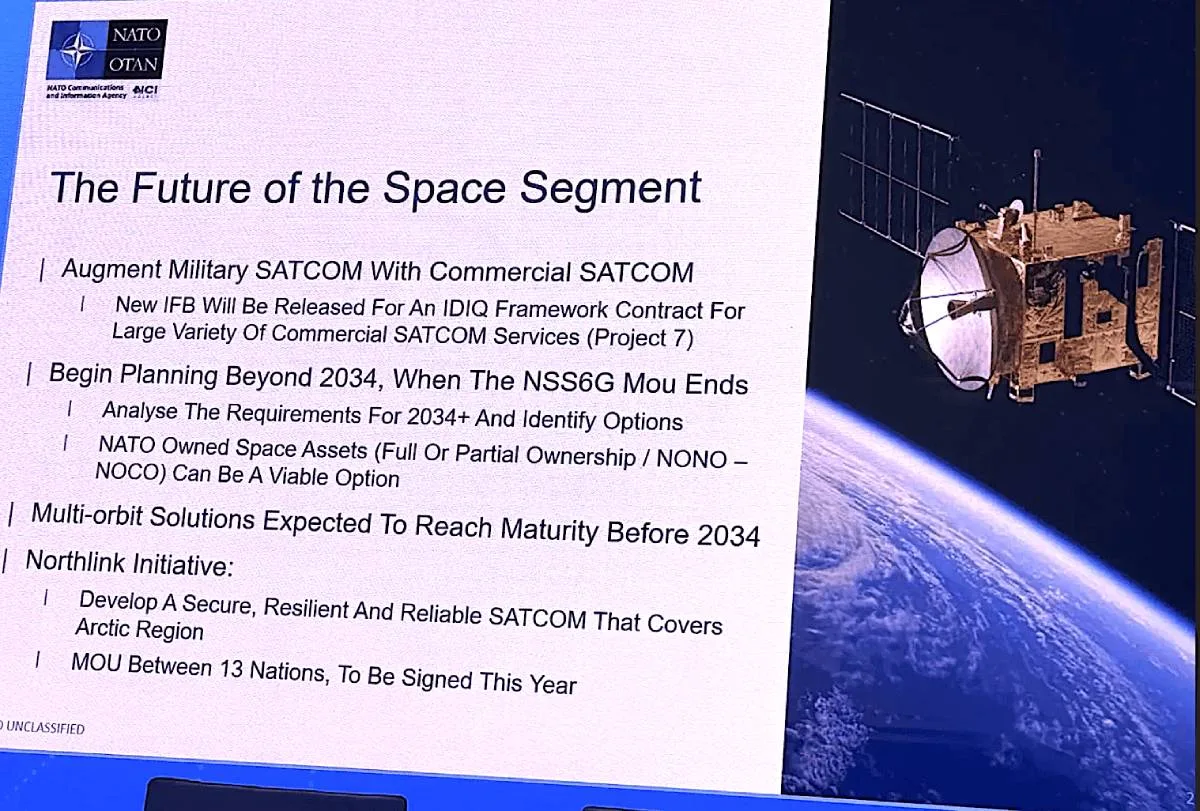
“No longer is NATO considering what we did five years ago,” Blythe said. “We need to take Ukraine as an example, with lessons for how the future battlespace will be working, including in the satcom space. We need to think more than just GEO, to look at LEO, MEO, PLeo, HEO, all the different forms, multi-orbit — this is where the commercial industry comes in to help us.
“What happens in Ukraine is what we need to build for the future,” Blythe said.
Key to this is a revamped NATO procurement policy that Blythe said is designed to move an admittedly cumbersome 32-nation bureaucracy much faster.
“This is a paradigm shift for NATO as a whole,” Blythe said. “We have a greater AOR [area of responsibility] than five years ago — 15,000 kilometers from the center of Brussels, and pole to pole, and the Arctic.”
NATO’s Project 7 is a proposed procurement that would complement today’s milisatcom capacity with commercial, for both the space and ground segment. A request for bids will be out “very soon,” Blythe said, and it will be followed by bids for UHF-, military-Ka and X-band capacity.
“We’re also looking for companies to come forward with multi-band, multi-orbit solutions that cover both our current constellations but also end-to-end service offerings,” he said. He implied, but did not directly specify, that NATO could be one of multiple tenants on a global LEO constellation, with guaranteed capacity over certain regions.
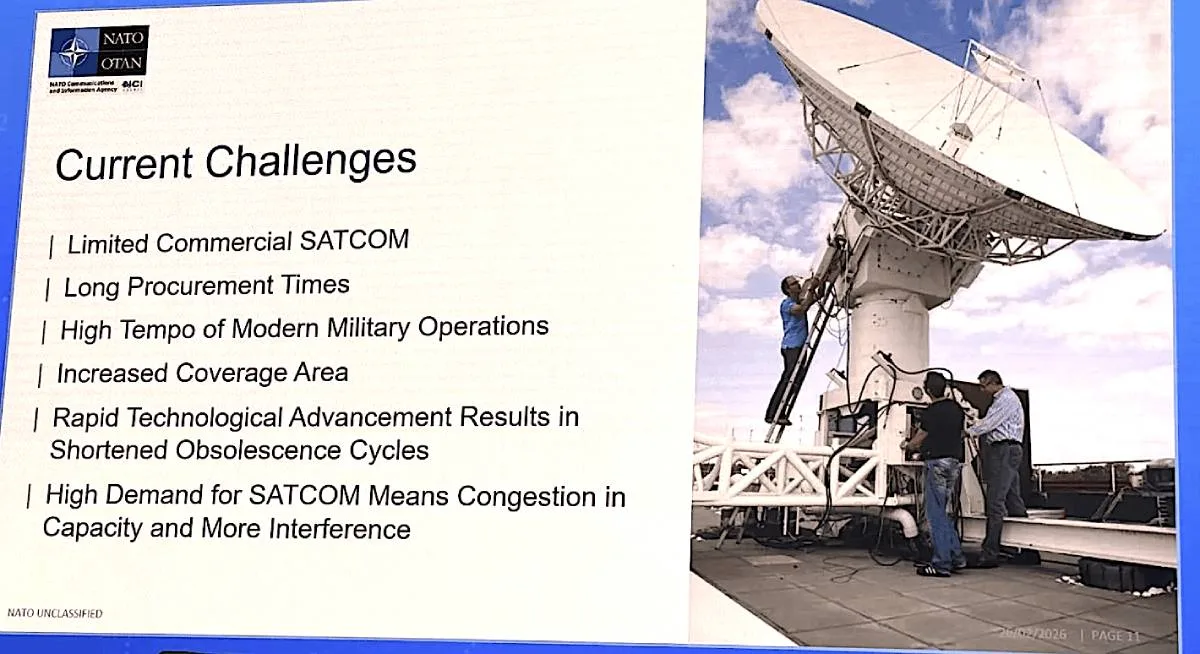
Blythe said available NATO satellite capacity is quickly booked, raising the question of whether the organization should purchase its own capacity, which it did until the 1990s, when it opted for the 15-year-lease alternative.
“We are looking at whether we are going to go back and own our own transponders within company-owned birds,” he said. “We cannot rely solely on a nations goodwill to provide us bandwidth if there is an Article 5 mission [wherein all NATO members agree to come to the aid of any of them under attack].
“We need to expect that sometimes, that capacity will not be provided to NATO. So we would need to provide that for ourselves, not only isn Europe but in the entire NATO AOR, including North America.”
Such a policy change, if accepted, likely would take effect at the end of the 15-year capacity lease from the six participating nations, in 2034.
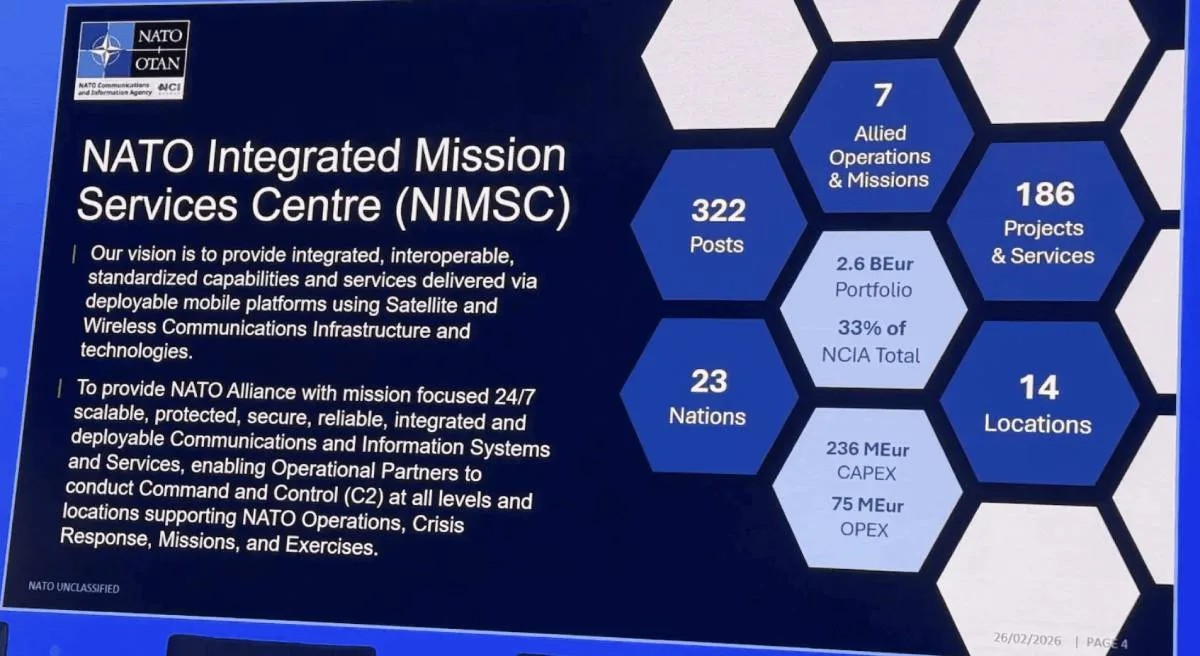
The NIMSC has a budget of 2.6 billion euros ($3 billion), which is one-third of the total NCIA budget, with 236 million euros in capex and 75 million in opex to manage 186 projects for 23 NATO members.
NATO has over the past three years agreed to a wide range of initiatives, starting with studies and analyses, to bolster its space capability.
In 2024 it announced Northlink, with 13 NATO nations assessing development of “a secure, resilient and reliable multinational Arctic satellite communications capability.” An MoU among these nations is expected this year, Blythe said.
Space Norway and the US Space Force have already deployed capacity on two Arctic Satellite Broadband Mission satellites, launched into highly elliptical orbit in 2024, which includes US military payloads on the Space Norway satellites.
Canada’s Department of National Defence recently has revived consideration of the Enhanced Satellite Communications Project – Polar (ESCP-P), signing a strategic partnership with Telesat, whose future Lightspeed constellation will cover the poles; and MDA Space, Lightspeed’s prime contractor.
“It’s all about collaboration and cooperation,” Blythe said. “NATO is moving at lightning speed compared to five years ago. We have bureaucracy and process that need to be broken down to deliver faster.”
Originally published by Space Intel Report. Read the original article here.