



The 2027 Inflection Point: Nine Executives on What Comes Next

The space industry is hitting a new inflection point. Launch capacity is tightening, nations are pushing for sovereign access to orbit and commercial demand is outpacing the infrastructure built to support it. The shift from experimentation to industrial‑scale production is now the central pressure running through government programs and commercial roadmaps.
Stella Guillen of Isar Aerospace opens this report with a reflection on that reality: Launch is becoming the limiting factor, and the next decade will be defined by who can build, deliver, and deploy at scale. It’s a framing that resonates across the rest of the sector.

Can’t Buy Your Way to Orbit, You Have to Build It.
A decade ago, space was a budget line for governments and a dream for billionaires. Last year, it was a $626-billion economy. By 2034, it crosses $1 trillion. We are watching the same thing happen that happened to the internet: a sector so fundamental it stops being a sector and becomes essential infrastructure.
National security is driving that transition. Government constellation programs, sovereign launch requirements, and defense-grade sensing and communications infrastructure are now the primary growth engine of commercial space. Every major spacefaring nation is asking the same question: can we get our assets into orbit without depending on someone else’s rocket and someone else’s launch pad? The answer, for most of them, is not yet, but the political will to change that is there, and the spaceport construction pipelines across Europe, Asia and the Americas reflect it. At Isar Aerospace, defense customers now account for nearly 60% of our inquiries over the past year. Isar Aerospace also operates continental Europe’s first privately funded orbital launch site in Norway, just signed one with Canada, and Germany also announced it wants to have its own launch pad. So more will follow.
The launch bottleneck is getting worse
Dominant launch providers are increasingly reserving their capacity for their own payloads and their own constellation ambitions. The pool of available rides for everyone else, defense agencies, allied governments and commercial operators, is shrinking, and it will keep shrinking.
When you see satellites clustered in the same shell instead of spreading across the inclinations their operators intended, you are looking at a launch bottleneck made visible. The constellation promises global coverage. The orbital map tells a different story. Those satellites are waiting for rides that have not come, and the coverage gaps they were built to close remain open.
2027 in one sentence: More innovation and launch at industrial scale
The use cases for space are multiplying faster than the access to it. Data centers in orbit will move from concept to procurement. In-space manufacturing is crossing from experiment to business plan. The compute and connectivity demand these applications generate will require launch cadences that do not yet exist at anything close to the required scale.
The companies that will define the next decade are not the ones with the most impressive engineering on paper. They are the ones that can manufacture reliably, deliver repeatedly, and build at the cadence that government programs and a new generation of space businesses require. The question dominating 2027 will not be whether demand exists. It will be who can actually deploy.
The Survey
To understand how space industry leaders are reading this moment, Constellations surveyed executives across the sector, from launch and manufacturing to satellite operations to in-orbit services. Each responded to five questions: what they misjudged this year, the single word that defines 2027, the industry question that will dominate the year ahead and the apps and ideas that shaped their thinking. Their answers follow.
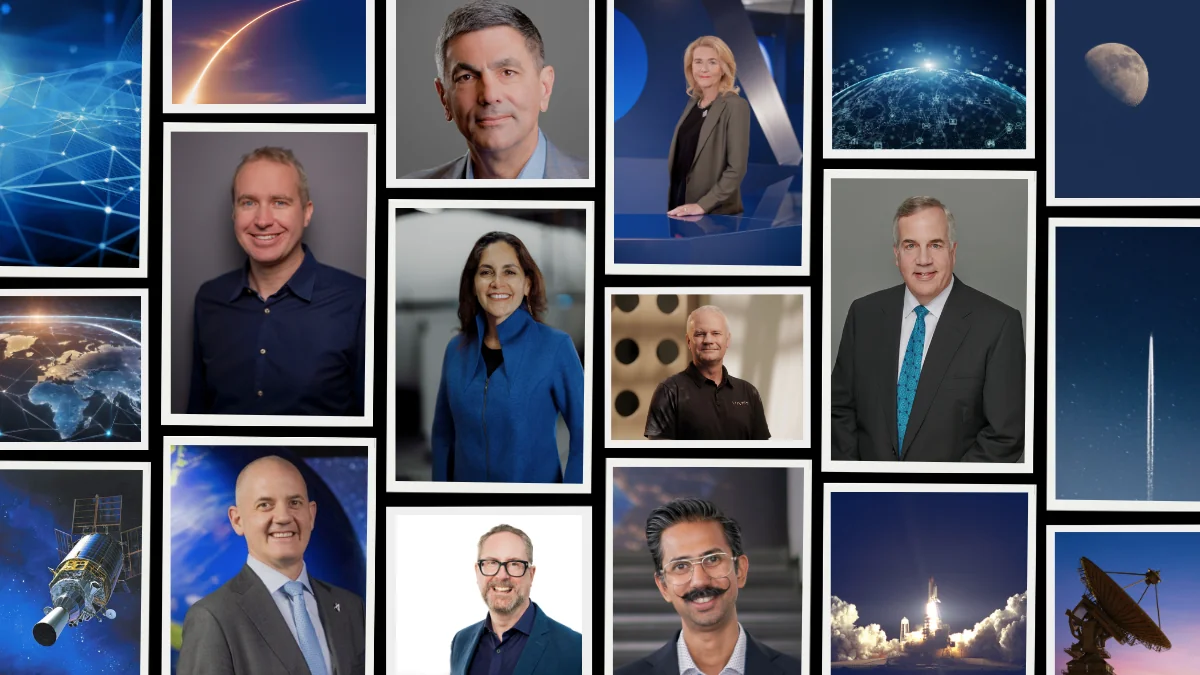
Featured Executive Survey Contributors

Q. One industry prediction you got wrong, and why:
A. I never predicted that so much investment would flow into this industry, particularly into businesses that won’t pay off for years. In today’s funding environment, the original Iridium would have been a huge success. Back then, the internet was still in its infancy and there were no Reddit communities, Substacks, or social media influencers to sustain investor enthusiasm.
Q. 2027 space industry prediction in 1 word:
A. Opportunity.
Q. What question will dominate 2027:
A. Will the launch industry finally start to open up and start filling the growing backlog of demand?
Q. App you couldn’t live without in 2026:
A. YouTube.
Q. Booklist – favorite book you read in the past year and why:
A. “If Anyone Builds It, Everyone Dies.” I’m fascinated by the potential, both good and bad, of the most consequential technology ever coming at us at light speed over the last year or two. It’s scary and exciting.

Q. One industry prediction you got wrong, and why:
A. For a long time I thought the Moon is just for exploration and there cannot be made a real commercial business case. I was wrong here; there is now so much commercial activity and potential for applications on the moon and around the Moon.
Q. 2027 space industry prediction in 1 word:
A. Expansion.
Q. What question will dominate 2027:
A. Datacenters, the next big thing or too crazy?
Q. App you couldn’t live without in 2026:
A. Spotify, you need have your space jam always with you.
Q. Booklist – favorite book you read in the past year and why:
A. “When the Heavens Went on Sale” from Ashlee Vance -> Lessons Learned from Planet, Rocket Lab and Astra: many similarities to Dcubed of things we lived through (and things that will probably come in the future).

Q. One industry prediction you got wrong, and why:
A. The prediction we got most wrong was the speed at which orbital infrastructure would scale. We were right that servicing, refueling, manufacturing and logistics would become strategically important but underestimated how long it would take to move from successful demonstrations and bespoke contracts to routinely used infrastructure. In SpaceTech, the technology can become viable well before the market, regulation and customer workflows are ready to scale it.
Q. 2027 space industry prediction in 1 word:
A. Convergence.
Q. What question will dominate 2027:
A. Who becomes the AWS of orbit? The dominant companies in space won’t be those selling hardware. It will be those delivering actionable intelligence. ICEYE is currently the strongest candidate to become that company. ICEYE wins because it solves the most important defense problem: seeing everything, all the time. It’s been battle-tested in real conflicts, including in support for Ukraine. European nations can no longer assume they will always have unrestricted access to US systems. ICEYE has become a leading European sovereign intelligence champion at exactly the moment governments are increasing defense spending and seeking strategic autonomy. It is becoming a defense platform, not a satellite company.
Q. App you couldn’t live without in 2026:
A. Readly is often described as the “Netflix for magazines” because it gives unlimited access to thousands of magazines and newspapers through a single subscription. I like this app as it allows me to stay informed across a wide range of topics, from technology and geopolitics to business, defense and science, in a highly efficient way. I can quickly scan multiple publications each day and discover insights outside my usual areas of focus.
Q. Booklist – favorite book you read in the past year and why:
A. The Future of Geography: How the Competition in Space Will Change Our World, by Tim Marshall, because it explains that the future of space isn’t really about rockets, it’s about power. The book brilliantly connects geography, geopolitics and technology, showing why space will become a critical layer of global economic and national security infrastructure. That aligns closely with Seraphim’s investment thesis that SpaceTech is moving from a specialist sector to an essential part of the global economy.

Q. One industry prediction you got wrong, and why
A. It is not necessarily a wrong prediction, but I am pleasantly surprised at how many international companies are opening up offices in Japan over the last year. As someone who has lived in Japan and been a part of the space sector here for 14 years, it is heartening to see sustained growth.
Q. 2027 space industry prediction in 1 word
A. Consolidation.
Q. What question will dominate 2027
A. Will a launch vehicle company (or better yet, companies) successfully prove capability that will lead to more options at lower costs for customers? Without cheaper and more reliable access to orbit, the commercial space sector will never achieve the incredible potential growth we are all talking about.
Q. App you couldn’t live without in 2026
A. Apple Podcast. This is how I stay up to date on the activities and plans of partners and competimates around the global space sector.
Q. Booklist – favorite book you read in the past year and why:
A. Exhalation, by Ted Chiang. It is an incredible short story selection of thought-provoking sci-fi that is entertaining and philosophical.
Q. One industry prediction you got wrong, and why
A. That once someone cracked LEO at scale, the door would close behind them. The opposite happened. Proving it could work mattered more than owning it, and now every niche has someone building for it. LEO is trending to be a market, not an exclusive club.
Q. 2027 space industry prediction in 1 word
A. Power. Not who has the spectrum – who has the kilowatts.
Q. What question will dominate 2027
A. Can the industry provision orbit fast enough for what’s coming? Compute, processing, power-hungry missions – the demand signal is the strongest I’ve seen in my career. The race in 2027 isn’t for demand; it’s for kilowatts and launch slots.
Q. App you couldn’t live without in 2026
A. Claude. It cross-references twenty years of industry context with whatever happened this morning, faster than I can finish my coffee. The insight still has to be human but the legwork doesn’t.
Q. Booklist — favorite book you read in the past year and why
A. Thunderstruck, by Erik Larson. Marconi built wireless communications while the physics establishment insisted signals couldn’t cross the Atlantic. He wasn’t the best scientist in the room, he was the one willing to build, test and iterate in public. Every era of our industry has its ’impossible’ technology and its Marconis.

Q. One industry prediction you got wrong, and why
A. I never imagined the first trillion-dollar IPO would come from the space industry.
Q. 2027 space industry prediction in 1 word
A. Compute.
Q. What question will dominate 2027
A. Supply chain control. The definition of sovereignty is evolving fast. It started as control of data, moved to control of satellite infrastructure, and the next step is control of the entire supply chain, not just the satellites. In 2027, the question won’t be who owns the satellite, but who owns everything it took to build it.
Q. App you couldn’t live without in 2026
A. Claude. I’m now on a mission to create a digital version of me 🙂
Q. Booklist — favorite book you read in the past year and why:
A. The Power of Habit, by Charles Duhigg. I’ve read it many times and still return to the audiobook. Companies, like people, run on habits; in organizational context I call it culture. Scaling a company is really the work of designing those habits right. Every re-listen catches me to break or create something that’s been running on autopilot.

Q. One industry prediction you got wrong, and why:
A. How quickly defense and security would become a major driver of investment in the space sector. Geopolitical developments have accelerated that shift faster than expected.
Q. 2027 space industry prediction in 1 word:
A. Sovereignty.
Q. What question will dominate 2027?
A. How we can scale space infrastructure and services fast enough to meet growing commercial, defense, and societal demands.
Q. App you couldn’t live without in 2026:
A. Microsoft Teams. It’s where collaboration, decisions and connections happen every day.
Q. Booklist – favorite book you read in the past year and why:
A. Project Hail Mary. It’s a book about space and science fiction, but the story reaches further beyond, and touches science, human curiosity, courage, future perspectives and more.

Q. One industry prediction you got wrong, and why:
A. We’d have a lot more and flexible GEO capacity by 2027.
Q. 2027 space industry prediction in 1 word:
A. Disruptive.
Q. What question will dominate 2027:
A. Will all the sovereign space initiatives be capitalized appropriately?
Q. App you couldn’t live without in 2026:
A. ChatGPT.
Q. Booklist – favorite book you read in the past year and why:
A. Origins of Totalitarianism, by Hannah Arendt. Some things frighteningly repeat.
The Consensus
While the responses were eclectic, one theme cuts across the executives’ answers: the distance between an idea and a working program has collapsed. Concepts that once lived in long‑range planning are already in development, and the industry is treating them accordingly. That shift is forcing a more practical read on what the next few years require – real capability, delivered on schedule, with fewer excuses baked into the timeline. In a market moving this quickly, execution is the only metric that matters.
“The next three to four years will require real capability to be delivered, both from a nation-state and capital deployment perspective,” Carrai said. “Anything less will be a failure of the industry and lead to a handful of players dominating the future.”