



The Growing Gap Between Orbital Data Collection and Data Confidence

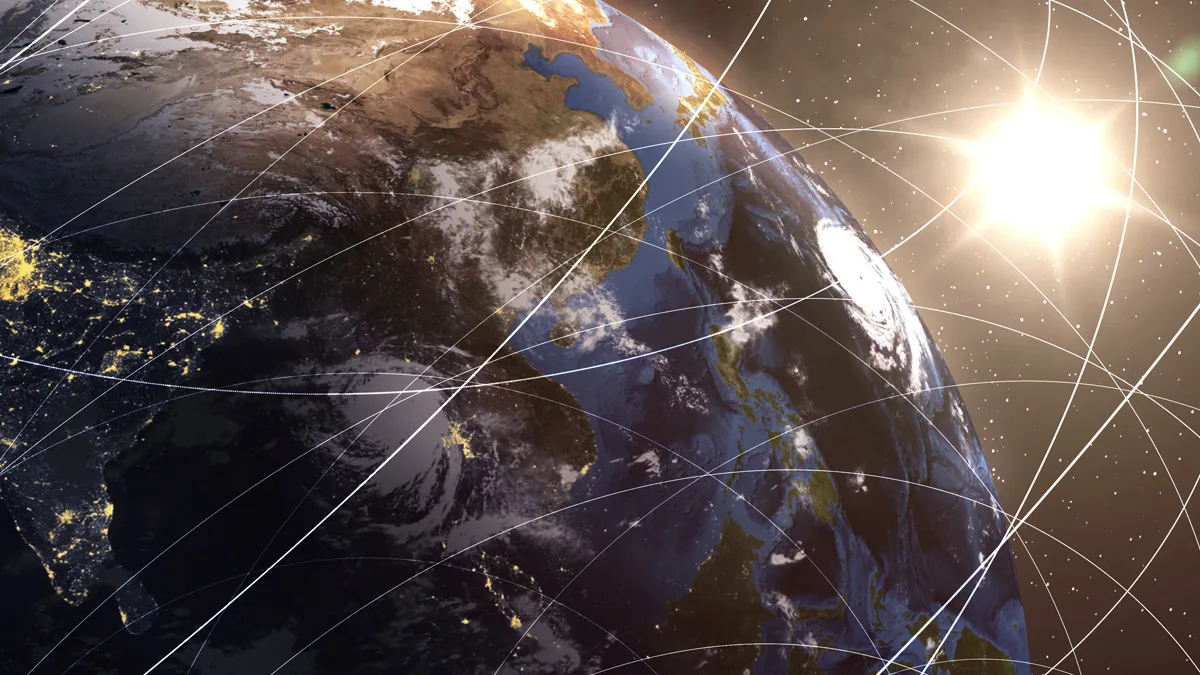
The space industry is producing more orbital data than ever before. Governments, commercial tracking firms and satellite operators are all feeding observations into an increasingly dense web of space situational awareness systems.
But the problem is no longer simply gathering data – it is determining which data can actually be trusted.
As orbital activity accelerates, the long-standing structural weaknesses in the systems designed to coordinate spacecraft safety are becoming increasingly apparent. While spacecraft operators are sharing more information than they did a decade ago, the underlying infrastructure relies on outdated algorithms and remains fragmented across incompatible standards, inconsistent sensor quality and incomplete catalogs of objects in orbit, said Dan Oltrogge, chief scientist and director of the Center for Space Standards and Innovation at COMSPOC.
“We are tracking only a tiny fraction of the millions of objects in space,” Oltrogge said. Many smaller objects remain effectively invisible to current tracking systems even though they can still do serious, if not lethal, damage to a satellite, he said.
The challenge is no longer theoretical. Typical spacecraft operators today, relying upon free-to-operator public SSA data and lax collision probability action thresholds, are mitigating less than 10% of collision risk, according to Oltrogge, citing findings from a recently published study presented at the International Academy of Astronautics SSA Conference in Madrid, Spain. In some scenarios, the effective number was even lower, he said.
Typical spacecraft operators today, relying upon free-to-operator public SSA data and lax collision probability action thresholds, are mitigating less than 10% of collision risk. — Dan Oltrogge.
“That indicates that even though we have processes for avoiding collisions, they are not effective,” Oltrogge said.
The models used in the study, having been validated in the operational context, projected collision rates across debris-on-debris events, active satellite encounters and large constellation environments using volumetric encounter analysis and synthetic covariance modeling. One of the more striking findings involved what Oltrogge described as “fratricide,” inside large constellations – scenarios in which operators fail to prevent collisions between their own spacecraft.
Oltrogge explained that while most large constellation satellite operators will prioritize preventing this from happening, there are conditions beyond the operator’s control where their constellations could become “unmanaged,” including a cyber-attack, a Carrington-like event, a nuclear detonation in space or attacks already threatened by other countries. The risk is very real and could result in serious collisions, breakup and secondary follow-on collisions. “This is what can happen if you, as an operator, don’t or are unable to respond when your satellite is at risk,” Oltrogge said.
A Space Economy Built Faster Than Its Standards
For decades, orbital coordination involved a relatively small group of experienced state actors. That environment no longer exists.
“There are many, many operators and countries involved in space,” Oltrogge said, including new space actors that are still learning operational norms and technical procedures.
The result is a rapidly expanding ecosystem where spacecraft operators often lack shared terminology, compatible data formats or common operational assumptions. There’s a growing need for international consensus around everything from reference frames and timing systems to orbit element definitions, maneuver descriptions and covariance formatting, Oltrogge said.
It isn’t that standards don’t exist. Rather, in some cases, the risk is that many of today’s spacecraft were built before some of the latest interoperability frameworks and data exchange standards were developed.
“Spacecraft might have between a five- and a 15-year lifetime,” he said. “The satellites that are up today, the oldest ones, were built 15 years ago – before these standards even existed.”
That lag has left portions of the industry dependent on flight dynamics systems incapable of supporting newer data exchange forms, said Oltrogge. Operators are now attempting to modernize coordination practices while relying on infrastructure designed for an earlier orbital era, he said.
“It’s going to take time for operators to embrace and adopt and incorporate these various data exchange standards,” Oltrogge said.
Operators are now attempting to modernize coordination practices while relying on infrastructure designed for an earlier orbital era, and trying to centralize all orbital information into a single system could prove challenging, Lieutenant Colonel Devon Messecar said during a panel at April’s Space Symposium.
“Can we make one data lake to rule them all? I feel like that’s a little bit of a fool’s errand,” Messecar said.
The Industry’s “Minimum Consensus” Problem
The difficulty is not only technical. It is also cultural.
Parts of the space industry have become overly focused on achieving the smallest possible consensus around data sharing rather than building systems designed for long-term operational transparency and effective collision risk mitigation approaches, said Oltrogge.
“There is an unhealthy tendency amongst the space community … that they’ll focus on what is the minimum consensus level of data sharing that everyone can agree to,” he said.
That approach may simplify diplomacy, but it can also limit the effectiveness of collision avoidance systems, Oltrogge warned. Sharing contact information alone, for example, is insufficient for meaningful coordination if operators are unwilling to exchange ephemeris data, uncertainty estimates, spacecraft dimensions or planned maneuvers, he said.
“We already know, based on literally decades of experience mitigating collision risk, that we need to share more than that,” he said.
The shift has already started in some areas. When Intelsat first offered to share ephemeris data around 1999, the idea was viewed as unusually proactive transparency within the industry, Oltrogge noted.
“All the other operators were like, ‘Whoa, that’s kind of crazy,’” he said.
Today, ephemeris sharing is increasingly treated as a normal part of responsible operations. Some operators are also beginning to share planned maneuvers in advance, a practice that would once have been considered commercially or strategically unwise, Oltrogge said.
“Times are changing,” Oltrogge said. “The willingness to share information that’s critical to spaceflight safety is really exciting.”
Emerging national standards efforts such as ISO 9490 (Space Traffic Coordination) and the UN SSA Expert Group signal that governments and operators increasingly recognize the need for broader interoperability and transparency, said Oltrogge. The UN SSA Expert Group was rapidly approved by UN members because of the widespread agreement that SSA and spaceflight safety are important. A survey of this new UN SSA Expert Group indicated a willingness from operators to share points of contact information, as well as positional knowledge of their spacecraft, error information, launch parameters and basic vehicle characteristics for the purpose of flight safety, he said.
But the industry still needs to move beyond designing systems around the bare minimum, he added. “We need standards that allow those who want to share more to share more,” Oltrogge said. “We should identify ways to share the data that kind of future-proof this.”
Incentivizing Coordination Among Operators
However, some operators are still resistant to sharing data with third parties, said Andrew D’Uva, president at Providence Access Company and senior policy advisor for the Space Data Association. This delicate balance between transparency and operation protection is shaping newer coordination systems, like the Space Safety Portal – a library of flight dynamics information from various member companies managed by GMV, said D’Uva.
“Our mission is very focused: spaceflight safety and the long-term preservation of the space environment,” D’Uva said.
The Space Safety Portal allows operators to contribute planned maneuvers and conjunction information while restricting broader access to proprietary operational data, D’Uva said. Operators receive “only the minimum extent necessary” of information about another object to manage a potential collision risk.
Data Fusion’s Central Role in Space Safety
As the volume of orbital observations grows, another problem emerges: No single sensor can “do it all.” Radar systems, optical telescopes, transponder ranging, passive RF and other tracking networks operate with varying accuracies, observation cadences and orbital regimes, noted Oltrogge. Some are optimized for low Earth orbit, while others focus on geosynchronous orbit or cislunar space. Many systems cannot easily process observations outside their own domain, Oltrogge said.
COMSPOC’s approach centers on large-scale data fusion, according to Oltrogge.
“You gather all the data, fuse that data together across all sensor types to obtain the best SSA information possible using that data.”
In practice, that means combining observations from multiple sensor types and organizations into a single orbit determination process, then continuously evaluating and favorably weighting those data sources which improve the solution the most, while de-weighting those sources which degrade it, said Oltrogge.
“Some of them are going to match really well to the final solution,” Oltrogge said. “Some of them are going to prove to be not that useful.”
The process allows analysts to de-weight unreliable observations and reduce dependence on lower-quality inputs, with that feedback loop critical to operational spaceflight safety, Oltrogge said.
The value of fusion extends beyond accuracy alone. For one, it creates resilience against corrupted or misleading data. Additionally, geographic and sensor diversity fundamentally improve orbital certainty, said Oltrogge.
“If you have only one sensor type, you are banking all your eggs in that basket,” he said. “But, for example, if you combine radar and optical, you get a very strong solution.”
By contrast, combining observations across disparate systems creates a built-in verification mechanism, said Oltrogge. A spoofed or degraded dataset becomes easier to identify when cross-checked against multiple independent sources, he said.
That architecture may become increasingly important as automated systems and machine learning tools assume larger roles in orbital operations, he said.
These integration challenges aren’t limited to commercial operators. Similar concerns are surfacing across broader Space Force modernization efforts, where officials argue that orbital coordination issues now hinge as much on infrastructure and data architecture as on sensors themselves. “You can’t really have one without the other when it comes to data transport and data federation,” Messecar said during the April panel.
The Limits of Automation
Automation may accelerate conjunction analysis, but it can also amplify systemic errors when underlying models fail, said Oltrogge, pointing to space weather as a current vulnerability.
Orbit determination systems often rely on atmospheric drag models generated from external space weather indices. During severe geomagnetic events, these models can quickly become inaccurate, Oltrogge said.
Orbit determination systems often rely on atmospheric drag models generated from external space weather indices. During severe geomagnetic events, these models can quickly become inaccurate. — Dan Oltrogge
“The proxies that feed those atmosphere models may inaccurately reflect what the atmosphere is doing at times,” he said.
When that happens, orbit determination systems begin fitting trajectories against fundamentally flawed assumptions.
“You’re going to get a bad orbit solution in those cases,” Oltrogge said.
The danger is not isolated inaccuracies but the possibility that multiple operators relying on similar automated pipelines inherit the same modeling error simultaneously, Oltrogge said.
To counter that risk, operators across both the government and private sector are increasingly emphasizing operational feedback loops and live-data training environments rather than purely automated decision pipelines, Space Force Lieutenant Colonel Amber Johnson said during the April panel.
The industry also needs faster atmospheric drag updates, improved physics-based models and better validation mechanisms capable of identifying when orbital solutions begin failing at scale, he said.
“If you see that process failing for a whole bunch of satellites in low Earth orbit, you know something is up,” he said.
Building an Authoritative Orbital Catalog
As governments and commercial firms compete to build large-scale SSA libraries, the question is increasingly becoming which systems will be treated as authoritative.
The answer, said Oltrogge, depends less on ownership than on interoperability and breadth.
Libraries designed around a single orbital regime may struggle to scale across the broader space environment, Oltrogge said. Systems that can process observations across LEO, GEO and cislunar space are likely to become more operationally valuable over time, he said.
Systems that can process observations across LEO, GEO and cislunar space are likely to become more operationally valuable over time. – Dan Oltrogge
Equally important is whether operators themselves participate directly in the ecosystem, said Oltrogge.
“It’s not just the SSA companies that need to be involved – the satellite companies need to be front and center,” he said.
Without direct collaboration between tracking providers and spacecraft operators, even sophisticated fusion systems will continue operating with incomplete information, Oltrogge said.
A Call to Action for the Public Sector
Governments will also need to play a larger role in supporting commercial SSA infrastructure and authoritative catalogs designed specifically for spaceflight safety, Oltrogge added.
“I don’t think that U.S. government investment in commercial SSA products and services and data fusion capabilities has really met the need,” he said. Meanwhile, other countries and regions are moving more aggressively toward integrating commercial SSA capabilities into operational infrastructure, Oltrogge said.
Ultimately, the challenge is less of a technological race and more an issue of collective coordination, said Oltrogge. The industry already possesses many of the tools required to improve orbital safety. What remains uncertain is whether operators, governments and commercial providers are willing to integrate them deeply enough to matter before congestion outpaces cooperation, Oltrogge said.
“At all levels – UN, ISO, the global community – we know we have to share this responsibility,” he said. “We need to build this deep collaboration infrastructure as much as we can.”