



Virtual Ground Systems: Unlocking ROI for Modern Satellite Operations

As satellite constellations grow in scale and complexity, operators are rethinking how ground systems support their missions. Traditional hardware-centric ground architectures are increasingly giving way to virtualized, software-defined alternatives, promising faster deployment, lower costs and operational flexibility.
From Hardware to Software: The Shift in Ground Architecture
Virtualized ground systems mirror trends long seen in terrestrial communications, where software-defined networking has reshaped operations and deployment models, Cesar Carmona, principal at Novaspace, said during the March 18 webinar, “The Business Case for Virtual Ground: Quantifying the ROI Advantage,” based on the recent Novaspace-authored white paper of the same name.
By digitizing RF signals, modulating and demodulating them through software-based modems and transporting them across IP networks, ground functions that once required physical proximity to antennas can now operate remotely, Carmona said.
This software-driven approach enables multi-orbit interoperability, seamless integration with cloud infrastructure and scalable computing and storage capabilities that are difficult to achieve with traditional ground stations, he said.
“Virtual ground is an enabler for scale,” said Carmona. “Operations can be customized to meet exactly the market needs, and resources can be spun up and down with just one click or even automatically.”
Market Drivers and Strategic Implications
Several factors are accelerating the adoption of virtualized ground infrastructures, Carmona said.
Seamless integration with terrestrial networks, particularly through 5G NTN capabilities, is projected to create a $30 billion market by 2030, noted Carmona.
“Virtualized ground segment solutions are a vehicle for the convergence between terrestrial and non-terrestrial networks,” Carmona said, noting that software-defined ground systems can evolve alongside new versions of the end-to-end 5G standard and upcoming 6G standards.
Flexible satellite operations—including software-defined geostationary satellites and multi-orbit deployments—represent additional markets of $4.6 billion by 2033 and $3 billion by 2034, respectively, he said.
“Virtualized ground systems are best positioned to provide service agility for multi-orbit operations in terms of optimization and resource usage,” Carmona said. Scalability, automation and “pay-as-you-go” flexibility are intrinsic to virtualized deployments, he said. Operations can scale up or down with minimal additional hardware, enabling faster go-to-market cycles and more efficient use of capital, he said.
Quantifying the Business Case
Beyond unlocking new revenue opportunities, virtualized ground architectures present significant cost savings for operators, said Carmona.
For example, ground system virtualization allows Earth observation ground-station-as-a-service operators to scale quickly and adapt their networks efficiently, enabling them to increase their number of visible satellite passes by up to two orders of magnitude—directly boosting revenue and profitability, Carmona said.
Financial modeling by Novaspace showed that virtualized ground systems delivered significant double-digit reductions in both CapEx and OpEx, he said, referencing data from the white paper.
To quantify this impact, two EO deployment scenarios were analyzed:
- An operator building 10 sites in Year 1 (5 antennas each); and
- The same operator adding one new site in Years 3 and 5.
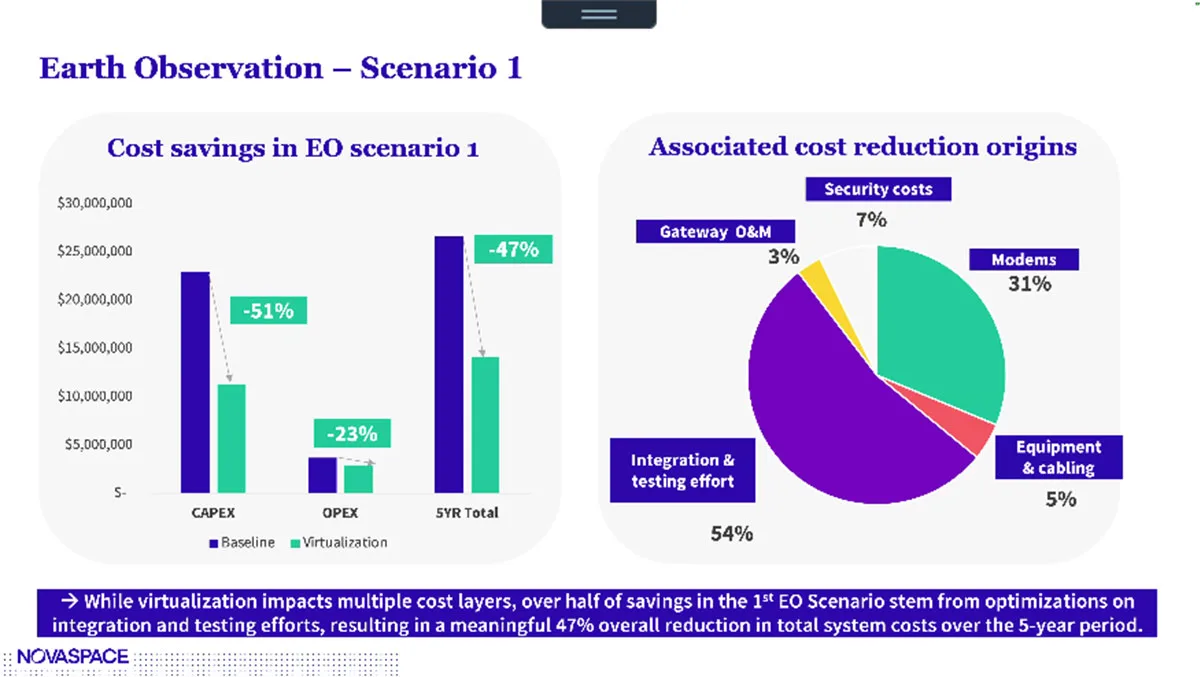
The first operator saved 47% in costs over the five-year period, while the second operator reduced costs by 52% over the same period, according to the study.
One variable stood out in both scenarios: “The largest driver comes from the savings on integration and testing effort,” Carmona said.
With the scalable setup in Scenario two, the EO operator gains an additional five percent savings on modem costs because software modem licenses can be reassigned between ground sites as needed, Carmona noted.
“This is a flexibility that can obviously not be implemented by legacy hardware solutions,” he said.
EO customers aren’t directly asking for virtualized ground systems—their main concerns are “cost and reliability”—but those priorities naturally push providers toward virtualization because lowering OpEx is essential for operating a global network, Brad Bode, CTO and co-founder of ground-station-as-a-service company Atlas Space Operations, said during the webinar.
“OpEx is one of the biggest costs to maintaining a global network,” Bode said. “I don’t think that’s going to change by virtual but if you can shave off 30% of your OpEx, it’s a dramatic cost difference.”
“Imagine the old days where you needed to make a modification to a ground site and you had to send an engineer from the U.S. to Guam or some remote location in Alaska or Ghana. The flight of the ticket alone would have been thousands of dollars, and so then you add up all the hotel cost,” Bode continued. “That’s all OpEx and having smart hands there is expensive.”
Novaspace found similar results with a satcom scenario, said Carmona. For a GEO operator deploying a single gateway at the start of a mission, replacing a traditional hardware stack with a virtualized ground segment reduces capex by 43% and opex by 30%, translating into an overall 39% cost savings over a five-year period, he said.
When those savings are rolled up over time, they equate to a roughly $3.2 million in cumulative savings and drive a 67% ROI in the first year and 781% ROI by year five, according to Carmona.
“So that means … the virtual ground segment brings approximately 75% faster ROI compared to the hardware case,” he said.
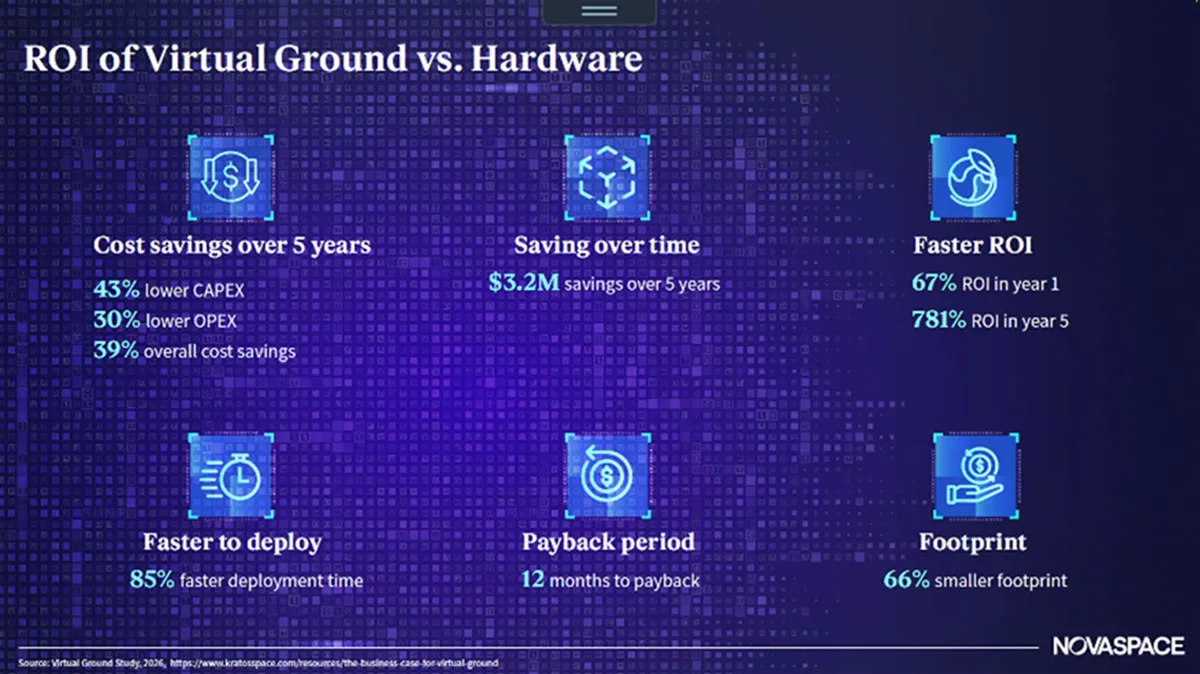
In addition to cost savings, operators can also shrink deployment timelines from weeks to just a few days through ground system virtualization, said Carmona. Compared with hardware-based systems, the payback period drops to about 12 months, roughly a 50% improvement, he said. Virtualization also cuts physical footprint and utility needs by approximately 66%, Carmona said.
“As a rule of thumb, you can consider that a virtualized solution would require one [equipment] rack, as opposed to three racks that would be required on a legacy hardware solution,” he said.
Security, Flexibility and Site Diversity
While virtualized ground architecture is gaining traction in the satellite industry, the concept isn’t new, Stuart Daughtridge, VP of advanced technology for Kratos, said during the webinar.
The broader IT, wireless and telecom industries shifted to virtualized infrastructure years ago, driven by the need for real-time updates, easier network modifications and stronger cybersecurity, Daughtridge said.
The satellite sector lagged mainly because it didn’t face the same scale pressures, but that has now changed with the emergence of modern micro-GEO satellites that offer dramatically higher capacity and new LEO and MEO constellations that rely on software-defined architectures, Daughtride said.
With this level of scale, “hardware deployments just no longer make sense,” he said.
As constellations expand, it’s also increasingly critical for operators to have flexible business models to remain competitive, said Daughtridge.
“There is so much change happening in the satcom world right now. You have Starlink, of course, but not only Starlink—Amazon is coming online, China is building large constellations, and new constellations are going into MEO,” Daughtridge said. “The competitive landscape in satcom today is completely different from what it was even five to ten years ago.”
Adaptability: The Key to Keeping Pace in Orbit
Building a satellite with a 10- to 15-year mission lifetime but deploying a ground system that confines them to a single, inflexible business model could pose a significant disadvantage for operators in an increasingly saturated market, said Daughtridge.
“That’s why the flexibility of a software-defined ground segment is so important. It allows you to adjust your business model much more easily in response to market changes,” he said. Being able to pivot your business model simply by deploying different software applications—rather than replacing an entire hardware ground system—is a huge advantage.”
For example, KT Sat, Korea’s flagship operator, is planning to launch new satellites and missions to expand coverage and deliver enhanced connectivity to its customers, Kevin Choi, CTO at KT Sat, said during the webinar.
KT Sat is targeting the Ka-band for maximum capacity, but that means coverage areas can be susceptible to climate and weather conditions, necessitating the flexibility virtualized ground architecture provides, Choi said.
With a centralized virtual ground station where antennas can be assigned remotely, KT Sat can monitor real-time traffic flowing into the central station and easily switch gateway functions from one antenna to another, allowing the operator to maintain better link quality over the satellite link, Choi said.
“This will result in better performance, user experience and quality of the service,” he said.
Feature-Forward Architectures
The adaptability enabled by virtualized ground systems also allows operators to trickle down savings to their customers, said Bode. For example, when customers request new modulation or demodulation features, Atlas Space checks whether they are on the vendor’s roadmap and works jointly to add them when needed.
In most cases, “it’s not difficult for us to redeploy when they do add it,” a level of flexibility that reduces costs for both operators and ultimately, for customers, while also improving performance, said Bode.
By taking the same path the IT industry has already taken, satellite ground architectures can also draw on seasoned IT expertise and the mature ecosystem of automation tools for software-driven operations, said Daughtridge.
“There’s a lot of different value propositions that come with moving the software from hardware,” Daughtridge said.
But the full extent of opportunities enabled by ground-system virtualization has yet to be realized, as 3GPP Releases 19 and 20 greenlight new 5G NTN features and eventually 6G, noted Choi. A hardware-based ground system locks an operator into the capabilities available at installation, and upgrading to a new release can require replacing gateway hardware already in service. “That’s probably one of the biggest pain points while we are already operating and serving customers,” he said.
“One of the biggest advantages of having a virtual ground station and virtual modem, especially in the NTN world, is the flexibility enabled by software upgrade,” Choi said. “We can adopt the newer release in seconds.”