



Where Europe Stands on the Path to True Space Power

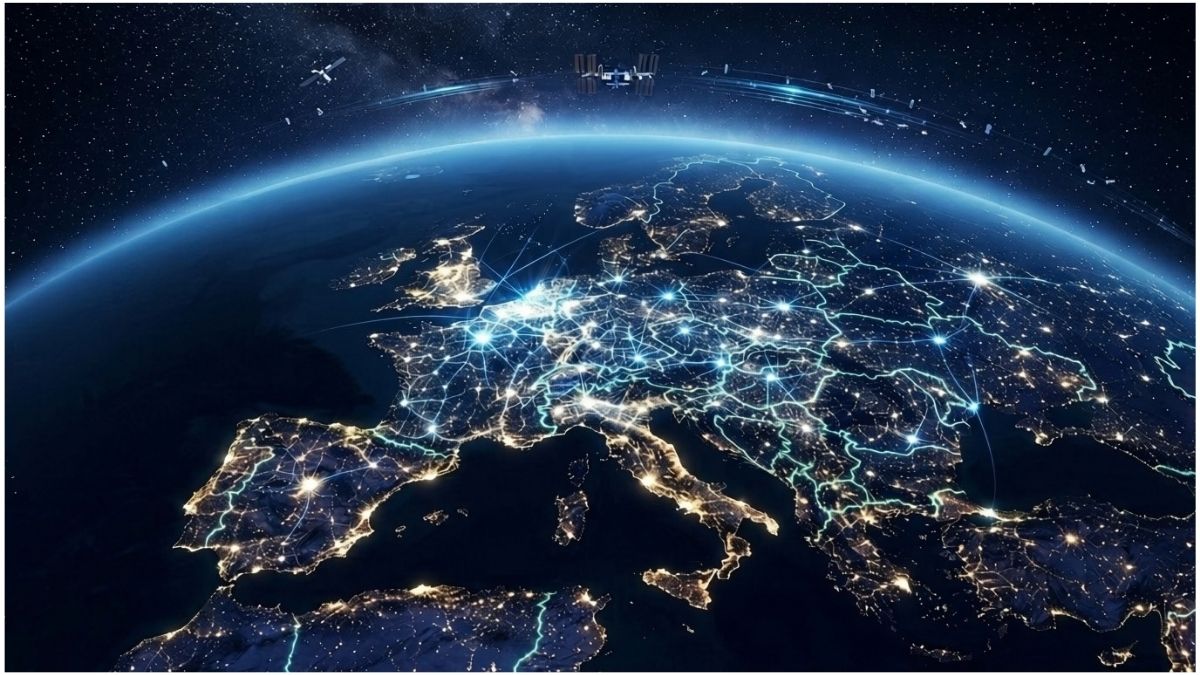
Europe is strengthening its access to space and expanding its infrastructure, but whether those steps will ever add up to something more substantial remains an open question. As geopolitical pressures rise and major powers reshape the orbital landscape, Europe’s future role is being defined in real time.
Growing Pressure on Europe’s Space Infrastructure
Heightened geopolitical tensions are pushing countries to broaden and diversify their space infrastructure choices across commercial, military and scientific domains. Space is now seen as a vulnerable but critical part of national resilience, prompting governments to reassess sovereignty requirements and adopt more distributed approaches, Brendan Mulvaney, director for the China Aerospace Studies Institute (CASI), told Constellations.
“Space is no longer a safe and reliable background to everyday life, it is now more intertwined but also far more vulnerable, critical component.”
— Brendan Mulvaney, China Aerospace Studies Institute (CASI)
This shift aligns with frameworks like the UK’s Own‑Collaborate‑Access model, as nations pursue multi‑vendor, redundant systems that avoid dependence on a single national or allied backbone, he said.
Rising geopolitical and technical pressures are also creating a tension between deeper multinational integration and more siloed sovereign capabilities, Mulvaney said. Programs like HALO and IRIS2 aim to preserve national control while still benefiting from shared resilience.
“The degree to which they are successful will determine the ultimate utility,” Mulvaney said.
China’s Model Is Influencing Global Dynamics
China’s growing space programs are central to current discussions about technological sovereignty, because countries must decide whether to build and control essential infrastructure themselves or rely on outside powers, CASI’s Mulvaney said.
China is offering a tightly integrated, single‑provider model for navigation, communications, imagery and related networks, which some non‑NATO countries may find appealing, Mulvaney said.
However, concerns are already emerging in the Global South about dependence on Chinese systems and routing national data through them. “China is attempting to bundle all of the aspects of the space infrastructure into one package (similar to the Apple ecosystem, vice the more open PC system),” Mulvaney said. For now, nations can still choose different suppliers for each layer – navigation, communications, imagery and launch – which limits China’s leverage. But if that flexibility narrows, China’s influence could expand significantly, he said.
Europe in particular is feeling the pressure. The European Space Agency on Sep. 2 announced it was considering increasing the launch cadence of Ariane 6 and Vega-C to ensure more control over future satellite deployments. German startup Isar Aerospace on Sept. 5 achieved the first-ever orbital launch from European soil, launching its spectrum rocket from Andøya Spaceport in Norway.
This comes against backdrop of SpaceX indefinitely suspending its Falcon 9 rideshare missions. Meanwhile, the U.S. firm on Sept. 28 delivered a batch of its own Starlink satellites to orbit via Starship for the first time.
But Europe remains steadfast on increasing its independent access to space – with IRIS2 deployments atop the priority list, Catherine Kavvada, director for secure and connected space and directorate general for defence industry and space at the European Commission, said during a Sept. 15 panel during the recent Space Defense and Security Summit (SDSS).
“Objective number one: accelerate the delivery of IRIS2. And when we say accelerate, the objective is to start the deployment as from 2029. And when we say 2029, it means that it should be 2029.
— Catherine Kavvada, European Commission
“The only thing that we can accept is to sit on the left, but never on the right,” Kavvada said.
This commitment is shared not only by the European Commission and the European Space Agency, but also by the industry partners involved, she said.
Alliance Dynamics Are Shaping Europe’s Room to Maneuver
A shared commitment is important, because Europe’s space posture continues to be shaped by its longstanding collaborative culture, Victoria Samson, chief director, space security and stability at Secure World Foundation, told Constellations.
“Europe is kind of used to doing everything together.”
— Victoria Samson, Secure World Foundation
Coalition work remains a core strength, but European nations still must balance collective initiatives with sovereign objectives, she said. This tension has sharpened as U.S. signals about its long‑term commitment to NATO have raised concerns among allies, prompting Europe to consider greater autonomy in critical space and ground infrastructure.
Cooperation remains a must, and that’s very part of the DNA of what the European Union is doing, Guillaume de la Brosse, head of unit – defense industrial policy for the European Commission, said on a Sept. 16 panel during SDSS, echoing Swanson.
The European Commission stays closely connected with partners around the world on space-related matters and holds intensive discussions with NATO on space security as well, de la Brosse said. At the same time, this cooperation is increasingly under pressure, and Europe needs to strengthen its own freedom of action. That begins with investing in space capabilities, he said.
“That’s why the European Commission is, on one side, pushing very much for international cooperation to remain the modus operandi when it comes to space, and on the other side, pushing very much as well and incentivizing member states to invest in a coordinated manner in space capabilities.”
— Guillaume de la Brosse, European Commission
The U.S.-led multi-national coalition Olympic Defender shows cooperative space security can work, but similar success depends on nations adopting shared standards and expanding access and information‑sharing, Mulvaney said. As more actors develop space capabilities, they’re expanding at different rates, and spreading them across multiple systems and decision‑makers introduces additional points where choices can be delayed or blocked, he said. This kind of distributed setup is harder for adversaries to disable with a single counterspace attack than the older, centralized hub‑and‑spoke model, but it also reduces some of the speed and simplicity that comes with operating within a unified command structure, he said.
Rules, Risks and Institutional Gaps Slowing Europe’s Momentum
Commercial and operational constraints reinforce interoperability struggles. Imagery providers such as Planet and Vantor face limits on what they can sell internationally, and commercial firms are increasingly subject to strict cybersecurity and export rules, SWF’s Samson said. In contrast, direct national control allows faster and more assured responses to counterspace threats, without reliance on intermediaries, she said.
But building a fully domestic or regional space program is an ambitious undertaking, illustrated by Germany’s ongoing effort to build a program centered on European-made technologies, Samson noted.
“Germany has…considered space more or less as a scientific hobby, until it finally realized that space is a is a strategic necessity. As such, Germany joined the club of nations or countries who choose and perceive space as a strategic necessity – not only for the future but for today,” Major General Michael Traut, commander of German Space Command, said on a Sept. 15 panel during SDSS.
Germany’s strategy is to take a leading role, but not to act alone. The plan is to build national capabilities that make Germany a strong and reliable partner, Maj. Gen. Traut said – noting the importance of coalitions like Olympic Defender and NATO.
“Everybody knows, in a good partnership, you have to have something to offer, you can’t take only. You have to give something.”
— Major General Michael Traut, German Space Command
The proposed European Space Component Command – an initiative focused on military space coordination among allied European nations – would be hosted by Germany’s Space Command, with the aim of involving as many partners as possible. “European” doesn’t mean participation isn’t limited to European or EU countries, but open to any willing partner, which reflects official German policy, he said.
Institutionally, Europe and NATO are still working to align their space ambitions, Samson said. NATO is attempting to develop a formal space program, while the EU Space Act has faced delays, she said. Future U.S. administrations will bring their own complications, underscoring the need for continuity and clear standards across the alliance, she said.
Meanwhile, other major powers like China continue to make strides in space, adding urgency to discussions about how Europe and its partners structure and protect their space architecture, Samson said.
Looking ahead, the broader space sector also requires clearer norms and regulatory frameworks, Mulvaney said. Key questions include whether orbital access remains first‑come‑first‑served, whether future slots should be reserved for emerging spacefaring nations and who holds the authority to decide, he said.
With commercial space likely to outpace military space, the implications of that shift need to be considered now, he said.
Europe’s Long-Term Potential Still Unwritten
Even if Europe manages more autonomy from its allies, moving beyond sovereignty to becoming a space power in its own right is a different question entirely, Dr. Raúl González Muñoz, peace and security strand lead at the Leverhulme Centre for Humanity and Space and lecturer in space policy and economy at the University of Leicester, told Constellations.
“In the context of Europe, it’s too early to talk about such concepts as space superiority at the moment,” he said.
There are currently discussions within the European Union on not the approval of the current €1.1 trillion ($1.25 trillion), but one around €2 trillion ($2.3 trillion), although discussions are ongoing and then it remains to be seen how the budget will be distributed – which will be part for the union and what will be allocated separately in state budgets – and what will be applied to space programs, González Muñoz said.
“What we will probably see is an increase in budget in several defense related activities in regards to space, not only national level, but hopefully we’ll see something on the European level as well,” he said.
At the moment, Europe is consolidating its space efforts. There’s a lot of talk about autonomous access to space as part of Europe’s political philosophy of “Strategic Autonomy,” said González Muñoz, who is also associate fellow on the geopolitics of outer space at the Academy of International Affairs NRW and European delegate of the Spanish Association for Aeronautical and Space Law AEDAE.
Europe is focused on getting systems up and running to avoid becoming too overdependent on international partners and to increase Europe’s freedom of action in space on the global stage, he said.
“How that ends up looking is still up for debate and to be seen but we are seeing already some allocations of budget for rocket systems and new satellite infrastructure,” he said.
One of the ongoing challenges is figuring out how to navigate this new era in which Europe relies on allied capabilities while still protecting key areas of strategic sovereignty and autonomy in certain technologies and space access, Juan Pablo Ramos, head of defence and security programmes at Redwire Europe, said on a Sept. 16 panel during SDSS.
“Europe has a challenge in finding that right balance that enables it to continue to collaborate in a very strategic way without incurring into inefficiencies that derive from technology duplication.”
— Juan Pablo Ramos, Redwire Europe
At the same time, there is a need to learn from fast‑moving sectors like the drone industry, where innovation cycles are accelerating. Pursuing overly sophisticated systems often means that, by the time they are deployed, they’re already outdated due to rapid changes in the landscape, Ramos said.
But it’s still far too early to apply the concept of space superiority in the context of European space, González Muñoz said.
“Now in terms of space dominance – that’s a big word. A lot will need to change in terms of political will and even political structures to allow for something like this to emerge at a Pan-European level in the future,”
— Dr. Raúl González Muñoz, University of Leicester
“I think Europeans would be more than happy if we could just protect our own space assets,” González Muñoz said.
And what space dominance would mean for Europe is not clearly defined, he added.
Europe does have some systems at the national and intranational level in Europe that could be used for certain communications, but there’s not currently a low Earth orbit megaconstellation comparable to Starlink.
IRIS2 has potential to provide resilient connectivity – the EU’s planned constellation is expected to comprise of more than 300 satellites mixed in LEO and MEO.
“But that’s not around 10,000 satellites in LEO, such as Starlink, or Chinese soon-to-be competitors such as the Thousand Sails constellation,” he said.
Political Alignment Determining How Far Europe Can Go
A lot of Europe’s space posture will depend on what happens in the geopolitical arena, González Muñoz noted.
“But we’re talking about the second biggest economic block in the world between the United States and China, so if you take it by amount of economic potential, Europe should really be able to be on par with those countries, if it manages to get its political will focused” he said.
But the geopolitical climate combined with the de-centralized decision-making of the 27 European Union member states plus the additional countries associated with the EU complicates the picture.
Could this change in 10 years? Possibly, but many factors come into play, González Muñoz said.
“It’s very difficult to say. It depends a lot on external variables as well: How new conflicts arise, how the Ukraine conflict goes, how the Europeans react, etc.,” he said.
For now, European space capability by 2030 is expected to advance only gradually because many key political and external variables remain unsettled, González Muñoz said.
Progress will likely follow Europe’s historical pattern of adapting through successive challenges, expressed in the statement from one of the considered fathers of the European Union, Jean Monnet: “Europe will be forged in crises, and will be the sum of the solutions adopted for those crises,” González Muñoz recalled.
Sovereign systems will continue developing – Galileo, IRIS2, national constellations, Copernicus and growing private‑sector initiatives – but the eventual level of independence or parity with U.S. and Chinese space capabilities remains uncertain, he said.