Transcript:
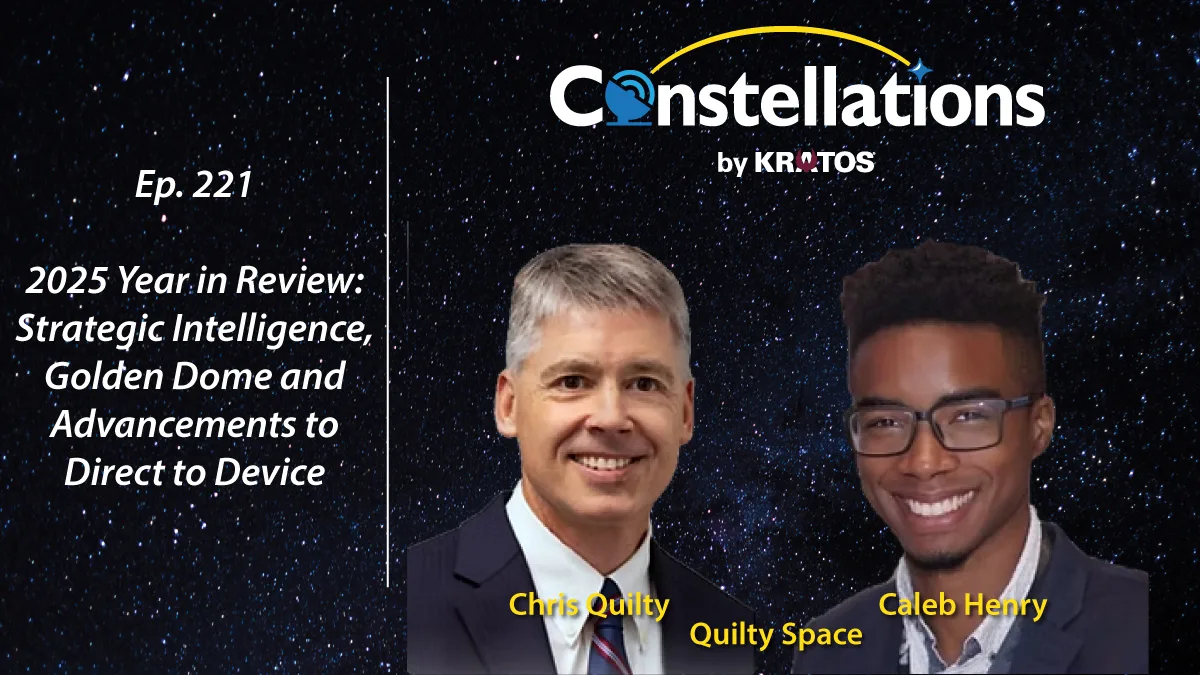
John Gilroy: Welcome to Constellations, the podcast from Kratos. My name is John Gilroy, and I’ll be your moderator. The satellite industry is moving at an unprecedented pace, marked by incredible innovation, shifting market dynamics, and fascinating technological breakthroughs. As we near the close of 2025, it is a pivotal moment to reflect on this past year and the advances and changes that have impacted the industry. From the introduction of Golden Dome, expansion of Starlink’s dominance, growth in device to device, to sovereignty becoming a driving force for nation states, 2025 has been a whirlwind. How will these changes shape 2026 and beyond? To help us break down the most significant happenings and provide expert insight into what it all means for our industry, we are joined by Chris Quilty, co-CEO and president, and Caleb Henry, director of research for Quilty Space, a global leader in space sector business intelligence. Caleb, you’re first up to bat here. You ready?
Caleb Henry: Ready.
John Gilroy: Okay. Caleb, from your perspective, what does Golden Dome signal about how other nations are thinking about space enabled defense and collective protection in 2025?
Caleb Henry: Certainly. I think Golden Dome has reoriented the entire US space sector and defense sector. There’s $25 billion that’s proposed starting out, and then the shield program is a $151 billion program over 10 years. Those are huge sums of money to bring about. Or really, bolster a space capability that we, to some degree, have had. We have our missile warning satellites, but those are becoming more expansive. We’re shifting to a proliferated architecture. And the space layer is part of an overall system that will include interceptors and space and ground-based sensors and effectors. The way I think that this is affecting the rest of the world is that when the US kicks off a very big program, the rest of the world typically takes notice. And so, we’re already starting to see some other domes being talked about. The US Golden Dome was inspired by Israel’s Iron Dome. Leonardo just announced Michelangelo’s Dome in Italy, which they are pitching to Europe. There’s Odin’s Eye, which doesn’t have the dome name, but is the missile shield program that the European Union is also pursuing. And we’re seeing smaller programs out of countries like Turkey, I think it’s Steel Dome there, and some ideas elsewhere. I expect to see similar missile shield concepts proliferate around the world. And the interesting part will be to what extent that impacts their space sector in each of these local environments. These domes are systems of systems where you have to integrate data from land, air, sea, and space. And so, it involves really every part of the defense ecosystem. And this is one of those things that I think is also making space companies become more defense oriented, which is a big trend that we’ve seen across 2025.
John Gilroy: Caleb, you used the word shield, and I imagine that a shield is to protect from a missile. Let’s talk about hypersonic missiles. Hypersonic missiles have changed the threat landscape. Caleb, what are the biggest space-based capability gaps that hypersonics have exposed?
Caleb Henry: Certainly. Well, let’s first define hypersonics, just in case there’s those in the audience that haven’t heard this term before. A hypersonic missile is one that can move at five or more times the speed of sound. It’s also typically much more maneuverable than legacy missiles. What this changes from a space-based perspective… I’ll actually talk about ground-based radars first, almost like a space situational awareness type of angle here. If you think of the old depictions of intercontinental ballistic missiles, you have this big U-shape where it would go up, it would come back down, and you could see where it would make sense to intercept. It would go all the way up into space, this makes it detectable by space-based radars. Same ones that’ll see satellites will also see this missile. And then you can use that time to plan and intercept. Hypersonics, not only does their faster speed make it so that you have less time to respond, but they typically fly closer to the edge of space. They might be in near space, they might be just over the Kármán line, somewhere around there, and that actually reduces the amount of time that ground-based sensors can see them. This makes space- based sensors more important because they need to provide that critical window where once a missile takes off, it can be spotted, tracked, and targeted by some sort of interceptor. Dimmer signals, those are thermal coatings and things that make them less susceptible to detection. It’s also an emerging problem, and it’s not one that I’ve seen or read as much about as these other two.
John Gilroy: Chris, here we are in December, and people look back the last 12 months and see all kinds of growth and try to make observations about it. What do you see as the most consequential part of Starlink’s growth this year?
Chris Quilty: Well, it’s the consumer. The consumer has been the growth driver for that business. We have them hitting about eight million consumer subs at the end of this year. And to put that in context, both Viasat and Hughes, which had a satellite-based consumer business, they maxed out at about 2.4 million subs after 15 years. Obviously, Starlink is operating on a global basis, so it’s not quite apples to oranges, but that has really been the growth driver for the company. And I guess the big thing that will drive the business in 2026, or at least we hope, is the entry of Starship into operations. And more importantly, the introduction of the V3 satellite. This is the latest generation of their satellites that is so large that they can only launch it on Starship. Literally, that is the gating factor for bringing it online. And those satellites are supposed to go from the current version of around 100 gigabits per second to 1,000 gigabits per second, a 10X, one terabit per second in capacity. The question is, when can they start launching those satellites? When will Starship come online? We’re forecasting maybe about seven operational launches this year, which sounds like a couple weeks in normal Starlink launch cadence of what they’re doing with the Falcon 9, but the point is they’re doing a big… Unfortunately, they keep using the same terminology, but a V3 upgrade on the Starship rocket itself. And what we’ve seen in the past is traditionally when they go through those large upgrades, there’s things they got to work through. We’re expecting it’ll be a good way into the mid-part of next year before they’ll actually be able to start operating that. And that will be the key driver going into the end of 2026, and more importantly, out into ’27 and ’28, where they’re going to find a more intense competitive environment with Amazon Leo. Which, if you didn’t notice, just launched the performance metrics on their enterprise terminal, and they were touting gigabit per second speeds. Whereas, traditionally, we’re talking 250 megabits per second or so for Starlink. We’re going to see a continual series of check and checkmate, I think over the coming years by these players, but the battle has begun.
John Gilroy: Chris, earlier Caleb used 150 billion. I wrote that 150 billion phrase. That was quite a phrase. You said about eight million. I think we see what’s going on here is, I think what we see is the return of the space IPO with all this money floating around. My question is, are today’s space IPO candidates fundamentally stronger than those we saw back in the SPAC days? What lessons did the industry learn from that earlier boom and bust cycle, Chris?
Chris Quilty: Historically, they don’t learn any lessons, they’re just recast in a different light.
John Gilroy: They’re human beings, huh?
Chris Quilty: Yeah, yeah. I’ve been doing the space finance thing for 30 years now, and I’ll put into context. We actually, when I was at Raymond James, we did the very first ever space SPAC deal. It was Iridium back in 2009, way back before the big boom and bust cycle we saw in 2020 to 2022. And what I’ll say is, when I looked at the list, Caleb and I were just going through some of the numbers recently. If I look at the list of 13 companies that SPACed. And you asked me a year prior, give me a list of 10 companies. I would’ve had a hard time coming up with 10, right? There were a lot of companies that were very early. Look, it was a fortuitous opportunity for the industry. If you look at a company like Planet, that’s now very successful on the road to free cashflow. If they were not able to raise 800 million back in that window, would they still be here? Or would the valuation be the same with all the dilution that would’ve taken place? Yes, I would say if you look at the four IPOs that we’re likely to see this year, three are done. We had Firefly, Intuitive Machines, and Karman, and we just got an announcement on York. They’re all doing what we would call a regular way IPO, right? A traditional IPO with underwriters, roadshow process. And I’ll note, I was just looking this morning, of like three of the six IPOs scheduled this week are still SPACs. They’re blank check companies. They’re not dead, they’re still around. But even then, the SPACs, they underwent the regulatory beating so that they’re less fly by night than they were. At the heat of the SPAC craze, the things that companies were able to claim in a public offering was, in retrospect, kind of shocking. But it was a loophole essentially that the SEC has shut down.
John Gilroy: Well, Chris, from a podcaster’s perspective, I’m glad I don’t have to pronounce space SPAC. It’s a challenging thing. But moving on from there. Back to 2025, looking back, big year for launch, huh? Several new rockets are debuting. Chris, which new entrance or vehicles do you think will have the largest long-term impact, and why?
Chris Quilty: It’s got to be Blue Origin and the New Glenn. From the perspective, first of all, number one, the heavy lift market is in crisis. By our forecast, there are no available heavy lift launches between now and mid ’28 that haven’t been spoken for. Unless you’re buying a Falcon 9 on the open market. All three of the new forklift upgrades at ULA with the Vulcan, Arianespace with Ariane 6. And New Glenn is obviously an entirely new vehicle. Point is, two of those three vehicles are still expendable. Why are we designing expendable vehicles in the 21st century? New Glenn is a reusable vehicle. And I’d say the reason it’s the one to watch in 2026 is they nailed it on their second landing. And you can think about the long, long blooper reel that SpaceX published of all their failures before they finally got it right. That’s impressive and gives us some hope. And that’s needed because Blue Origin is, drum roll again, they’re late and they’re behind forecast. And there are several companies, including AST Space Mobile, that desperately need that large faring. That’s on the heavy lift side. I do think if we go down to the medium and small lift, Neutron’s debut is clearly important, seeing Firefly getting onto a good regular launch cadence. And surprise, surprise, Relativity. We left them for dead, but they’ve resurfaced with a launch contract in hand, and we’re hoping to find out more as the year progresses.
John Gilroy: Caleb, no questions about space SPAC, we’re going to do a different one. We’re going to do space sovereignty. Across Europe, Asia, and Middle East, governments are talking more about space sovereignty. What does sovereignty actually mean, not in the cloud computing context, but in the satellite context?
Caleb Henry: Yeah, it’s an interesting question. And I think even my understanding of the term sovereignty has changed this year, just based on the number of deals that we’re seeing. I think if you had asked me what sovereignty meant two years ago or three years ago, I would’ve said, well, it’s a nation with a company inside said nation that has built something for said nation. But now we’re seeing actually a lot of American firms that are successfully pitching sovereign infrastructure to other countries. We’ve seen Planet sign deals in Japan and in Germany. Black Sky has announced several of these, another remote sensing company. AST Space Mobile is pitching and setting up sovereign telecommunications infrastructure also across Europe. And this idea being that they can make it, but they can hand over the keys to a government or local provider and basically say, “Hey, we made this for you. It’s yours.” This has become much more prominent. And as nations decide that they want to have control over key space technologies, whether that’s in telecommunications or remote sensing, or something defense related, having that kind of autonomy and if authority over these systems has made countries a lot more comfortable, including working with foreign partners in ways that might have previously been perceived as a vulnerability.
John Gilroy: Chris, when I did the introduction to this interview, I mentioned D2D. Let’s just focus in on that a little bit. Direct to device continues to grow and advance in the market. In 2025, from your perspective, what was the biggest surprise in D2D? Technology progress, regulatory movement, or maybe even partnerships with mobile network operators?
Chris Quilty: Hands down, SpaceX, EchoStar. The fact that Starlink stepped in and is paying $17 billion for the spectrum, I guess in one way should put to rest the number one pushback I’ve always heard from a lot of investors around this area. There’s companies like AST and SES and Viasat and others that have exposure here. And the biggest pushback was like, well, I don’t think anybody will pay for this service. And I think if SpaceX is willing to pay $17 billion for the spectrum, they clearly believe that it’s worth something of a service. It’s still yet to be defined, right? But that has reshaped the landscape of players in the market. And you even saw bow waves hitting companies like Iridium, which now sees a much greater threat to their IoT business. You saw MDA, their stock creator, because the risk of whether Apple’s going forward with their GlobalStar initiative. And it really falls back to what has been a trend in the direct to device industry when… Give credit to AST when they went public in a SPAC in 2021, the entire D2D business model was built around this idea of using the MNOs spectrum. And what we’ve seen is it’s come full circle now where that traditional MSS spectrum, starting with ASD surprise sub-licensing of the Legato L-band, that kicked things off. And then you saw Viasat and Space42 jump in with their Equitas joint venture. That’ll be the other interesting trend is suddenly spectrum has become really important again in this industry, rather than just selling it off for C-band proceeds. So we got more of that coming too.
John Gilroy: When you go to Space Conference, they talk about artificial intelligence everywhere, maybe even the coffee line. So we got to bring it up here. Chris, been a lot of discussion about AI and its transformative capabilities. Chris, what do you think is the most underestimated way AI will reshape the space industry?
Chris Quilty: I don’t know about underestimated, but what I would say is where I’m seeing it most visibly having an impact on the industry is in the earth observation sector. For years, the industry always talked about using machine learning. And I kind of joke, there was a period, I think it was 2014 when all of the satellite companies doing satellite M2M, machine to machine, the Iridiums and ORBCOMMS and GlobalStars. In the same year, they all did a control H and changed it from M2M to IoT. And to some degree, I thought just changing the terminology from machine learning to AI was that same glossy marketing, but it isn’t. The companies that I talked to and the end users and the use cases, AI is having a real impact on the ability to do that sort of image analysis. I still have a coin sitting over here from an NRO event and it’s a piece of film. And there was literally some guy looking under a microscope at film at some point. And you think about where it’s going to go now with mass scale AI being able to do things that you couldn’t do with traditional machine learning. Yes, I also think the most obvious place where this technology has a major role is in the space domain awareness area. Very complicated when you look at orbits and debris and maneuvering spacecraft, that just seems to be an obvious fit. And then, finally, God help us for our Golden Dome layer of orchestrating everything going on there, we can hand the keys over to… What was the Terminator network?
John Gilroy: Skynet.
Chris Quilty: Skynet. Oh, my goodness. How could I forget that?
John Gilroy: Yeah. Yeah.
Chris Quilty: Has anybody ever named their company Skynet? Would you be that bold?
John Gilroy: There’s got to be [inaudible 00:20:00]-
Caleb Henry: Their military satellites are Skynet.
Chris Quilty: Yeah, that’s a [inaudible 00:20:04].
Caleb Henry: I didn’t watch the movie.
John Gilroy: Chris and Caleb, the last question’s going to be a jump ball. I’m going to toss this up and one of you can handle it and maybe another different perspective on it. We looked at 2025, lots of stuff going on. We know that. We touched on the future a little bit. But if you two gentlemen had to pick one 2025 development that’ll matter the most five years from now, what would that be and why? Who wants to jump in first?
Chris Quilty: I’ll go first.
John Gilroy: Okay.
Chris Quilty: And I had never used the term “that was not on my bingo map” until 2025. And I’ve used it all the time this year. And Golden Dome was not on my map. In fact, shortly after it was announced, I was at an industry event and I sat down to a guy who was a staffer, a missile defense staffer for 15 or 20 years. And I was like, “Dude, where did this come from? Were you working on this all the time waiting to unleash it or not?” He’s like, “No.” So, we’ll find out and have lots of time to discuss the merits and cost and performance attributes of it. The reason I think Golden Dome will be important beyond its stated purpose is I think it has the potential to be the sort of tent pole project that pulls along the development of assist lunar economy that has… The pieces are there, right? Launch costs are coming down, access is getting there, but you haven’t necessarily seen the build out of large in space manufacturing and space domain awareness and cis-lunar things. If you have a project of Golden Dome scale happening, you’re going to see the need for orbital tugs and maneuver, orbital refueling. You need navigational awareness, you need a communication network. And once those railroads are laid, you’ve got the foundation for what can be that millions of people living in working in space that Jeff Bezos keeps talking about.
John Gilroy: Yeah. Caleb, look into the crystal ball for us.
Caleb Henry: Yeah, I paused because I’ve been debating between three, so I guess I’m not doing a good job of answering the question. Golden Dome, definitely high on the list. I think it’s hard to come across the space company to do. It doesn’t have some angle where they anticipate participating or will at least pitch their participation in Golden Dome. Very transformative for the industry. The other two, we talked about direct to device. I think release 17 as far as standards is concerned. Standards is a hairy topic, but this idea of stitching together the language of satellites with the language of terrestrial and cellular industries so they can talk to each other seamlessly using the same chipsets has the chance to really open up the market for what has already been the most stable corner of the space industry. When people think space, they might think astronauts and rockets and going to the moon, but the part that makes the most money and is steady, consistent breadwinner for the industry is telecom. This is a chance to multiply the size of the telecom portion of the industry. And in that same vein, the wild card, which I don’t know if it would be the most disruptive in five years, but it easily could be, is this push towards space-based data centers. I think this is a concept that went from completely outlandish to one that has now been endorsed by several of the world’s leading influencers. We’ve got Musk backing this idea. Bezos is backing this idea. Nvidia has chips in orbit, and more will come. I think if these players start to really put their heft behind orbital data centers, we could see another transformation of the telecom sector, which will then spill into every other part of the space ecosystem.
John Gilroy: Well, Chris and Caleb, I think you’ve given our listeners a great perspective on innovation. I would like to thank our guests, Chris Quilty, co-CEO and president. And Caleb Henry, director of research for Quilty Space.
Caleb Henry: Thank you.
Chris Quilty: Thanks, John.