Transcript:
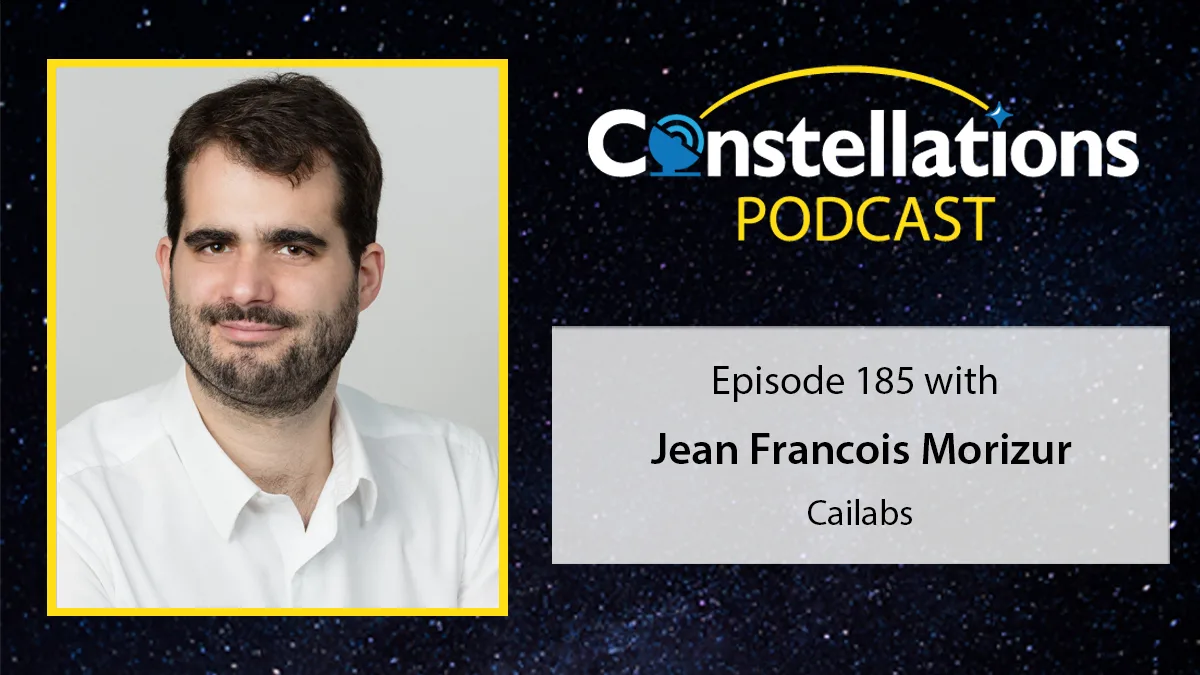
John Gilroy: Welcome to Constellations, the podcast from Kratos. My name is John Gilroy, and I will be your moderator. Today we’re shifting our focus from radio frequency to laser technology. Our guest is Jean Francois Morizur, founder and CEO of Cailabs, a French deep tech company that designs, manufactures, and sells innovative photonics products for the space industry. We’ll discuss the market for laser communications, why the industry has become so interested in laser, and how the language of satellites is changing. We’re going to be real informal. I’m going to call you JF here. So how are you, JF? Pretty good.
Jean Francois: Very good. Thank you.
John Gilroy: Good. We’re going to go from JF to RF, radio frequency. So radio frequency has always been the language of satellites for moving data from space to earth and back. So JF, what are some of the challenges in communicating with RF?
Jean Francois: Communicating with RF is the workhorse. It’s the thing that we all use. We’ve been using since, well, before the Second World War. It’s what we use today to communicate between satellite and the ground all the time. We could say, why change? It’s great. It’s there. There are some limitations. The first one is spectrum. We all know about spectrum mainly because of your mobile phones. There’s a 2G, 3G, 5G and stuff like that. They all work on different spectrum bands, and there’s always this fight between operators to buy pieces of spectrum. There’s a lot of money involved, and there’s a bunch of spectrum that’s allocated for satellite communication. And the thing is that spectrum is not going to go bigger because there’s a lot of pressure on spectrum bands. So there’s a limitation on the spectrum. It wouldn’t be a problem if we weren’t in the situation where we are launching so many more satellites today that there’s a lot of satellites, they want to talk. And when they’re talking at the same time in RF, with radio, they can talk on top of each other. And if you talk on top of each other, then there’s interference in radio. So you cannot do that. So what happens then is there are protocols and satellite A talks first and then B and then C. There’s an agreement, but it slows down everything. It’s the same way your mobile phone when you’re Downtown Manhattan, for example, if it’s too crowded, you might have less capacity. Your 5G will feel slow. This is the same idea, or you need to add more and more antennas. That’s your problem with RF. The RF is about congestion. It’s about spectrum. And when we talk about congestion, we are talking about within a spectrum band sending more and more data. There’s a limit with RF, which is called Shannon Limit, and it becomes exponentially more difficult to send more data within the same band. And today we’ve got even more data hungry satellites because you take better pictures and you communicate with you on streaming on the other side of the world. So that’s your challenges. On top of that, there’s a defense aspect. RF can be jammed. RF sends a signature and it’s quite easy to detect, easy to intercept. And sometimes it makes you the target for missile and that can be a very, very bad problem.
John Gilroy: Jean, I was in a classroom last semester, one of my students was named Shannon Lynch. She has a degree in electrical engineering and she knew all about that Shannon. She knew that one, so that was kind of a coincidence there. Let’s unpack this RF thing a little bit more. Maybe you can share with us some of the main technology differences between RF and laser technology, challenges and obstacles, maybe a brief overview.
Jean Francois: Of course. So the lasers, they work in the optical spectrum or in wavelength. We say wavelength, but that’s basically colors next to the optical spectrum. So what it means is you’ve got this kind of… We all intuitively know how laser behave because maybe we played with one with our cats or whatever it is. So you know it’s a very narrow beam of light. It’s very concentrated. It’s like a tunnel for your light. This is the great analogy to look at lasers. It means it’s more complicated to point accurately. Imagine the satellite to the ground. We are talking a few tens of meters on the ground. That’s the size of your spot from the satellite to the ground. So you’re pointing a curve, you need to be much higher than what you’ve got in RF. RF, we are talking tens of kilometers. That’s the difference. So probably in the US audience it’s probably meters and miles, tens of meters, tens of miles. So basically what it means there is pointing accuracy is going to be much bigger challenge with lasers than it is with radio. On the other hand, once you are within that tunnel, once you are within that link, you can carry far more data. And that’s what you see today when you go to the optical fiber in your networks in home. You can see that fiber is always carrying far more data than what you could do with copper, which has very similar behavior as your RF stuff. So basically there is this movement to this tunnel of light that carries far more data that is much more difficult to point. But at the same time, they don’t interfere with each other. If you’ve got two laser beam, two laser pointers, there’s not going to be influence from one laser to another. And this is very important in our world because it means that you are looking at point to point links that will not crosstalk, that will not contaminate each other. So those are the benefits of lasers. The challenge is going to be weather, so your clouds, coverage, and also the turbulence that comes with going through the atmosphere. These are the two big thing that you need to solve, and also the pointing accuracy that I mentioned earlier, being able to point very accurately from one satellite to another or from satellite to the ground.
John Gilroy: Well, satellite to the ground, well, there’s a good transition for you. I was at your website this morning. Guy’s been around since 2013. On your website you say what you’re doing is you’re shaping the future of light. Wow! That’s pretty impressive, I’ll tell you the truth. So let’s talk about light and these ground stations here. So how are optical ground stations different than traditional, I guess, RF ground systems?
Jean Francois: Optical ground stations are designed to deal with laser light. As a result, you have to carry… You’re talking about the telescope, optical telescope, rather than RF antenna, which is these big dishes you can see sometimes on the roof of cars or on the roof of buildings. These white reflectors that concentrate the RF signal. Imagine a telescope that needs to track a satellite, so link and point to satellite very accurately and also some lasers to enable the connection to be made because you’ve got a first course tracking and then you’ve got a fine tracking where you’re using active lasers from the other side to know exactly where to point. A ground station is really kind of like an optical head. But then the rest, the data processing and the modem and all that stuff is very similar to RF. So basically it’s like changing the top of something, but then the rest, all the infrastructure remains very similar. We are just a ground company. There are other people that do space to space or terminals in space. We do communication with satellite, but we only do the ground segments. That’s our play. This is what we decided to do because we know that we are good at dealing with the shape of the light. This was the core of what Cailabs was doing since 2013. We actually realized that our ability to play with the shape of the light was critical for sat to ground communication only in 2017, so not at the start of the company. Because the satellite when it goes from… Sorry, the light when it goes from the satellite to the ground, it is deformed by turbulence in the atmosphere. And this is really a question of beam shape. They call it echo. You can find that on Google, speckle pattern lasers. You can find this kind of shape. And this is what kills the beam or the ability of the beam of light to carry information. From satellite to satellite is already a solved problem. And from satellite to ground, you need to deal with the shape of the light and a complex shape of the light. And this is what we do.
John Gilroy: I deal with a lot of software companies and there’s a phrase that they band you about. It’s called “lift and shift,” when you transfer technology sometimes to the cloud. And that’s always a fun thing to say. So I’m trying to apply this maybe to ground stations. So what is the general process to add laser into a traditional ground system? Is it lift and shift, or is it redesign? Is it modification? Or what’s the process?
Jean Francois: So first off, you will decide to put ground stations in locations that are different from RF. Now, that’s very interesting. This is something we found during a study. You don’t want to put optical ground station in places where there’s too much cloud, which is good. I mean, it’s obvious, but it’s better to say it. So what happens is you want to put there in drier climate where there’s less cloud and there’s a lot of those places. And you also want to put it close to fiber optics, because you have so much more data now that you need to carry that into your network efficiently. So in the end, the locations you’re going to look for are different from the ones that used to be very good for RF. Usually in RF you had polar ground stations very close to poles because then they could connect to some type of satellites and type of orbits, but there would be a very high cloud coverage. And also in sometimes remote areas because you want very low radio noise. And in optical, you don’t care. You want the fiber. You want the connectivity. So basically the location are going to change. Although a lot of our clients when they come they say they’re going to put their optical ground station next to the existing RF. So there’s a paradox, and so we end up going in awful situations. But I see this evolution where you put ground station in places where there’s just no cloud and fiber and beyond that then the networking management is very similar, although you need to take into account cloud coverage a bit more than for RF. And so there’s a bit more active management of where you connect, where you don’t connect, where you try to do things and stuff. It’s not more complicated. It is just taking into account specificities of this new medium, and it requires additional software, but it’s okay.
John Gilroy: So JF, people all over the world listen to podcasts or listening, they understand you have an accent probably based in Europe, you know that. So you know the folks over at Novaspace. At Novaspace, they have a ground segment market prospects report, and it predicts that the number of satellites launched with laser communication terminals on board will double year over year for the next couple of years, going from 500 to 1,500. Most popular kid in town, huh? Why are they so interested in this intersatellite laser links?
Jean Francois: Actually on that one, I think there was an announcement a few weeks ago about Telesat Lightspeed going with a major announcement for more than 700 laser terminals to be launched in installments. So I think it confirms this kind of study, which is 100% true. Today what we are seeing from the ground, and keep in mind we don’t sell those terminals from satellite to satellite, although we connect to those, it doesn’t make sense anymore to make a constellation without this kind of optical intersatellite links. Because they’re so powerful in carrying data from one satellite to the other that it doesn’t make sense not to do it. I think there was Declan from Rivada, the CEO from Rivada, he said that at a panel in satellite and basically said, “Yeah, well, when you design a constellation today, it is stupid not to include optical intersatellite link.” I’m paraphrasing here, but it was something along that thing. Basically it’s because in this situation you’re able to provide a much better service by being able to shift data from one satellite to the other. In most of the architecture today, you have lasers from satellite to satellite, and then you have radio from the satellite to the ground. This is what people do. Starlink, that’s what they do. Kuiper’s early architecture is very similar to that. All those plans involves laser satellite to satellite and then radio satellite to ground. Our goal is to make sure that with advancement demonstrations and the early adopters, we are able to ship that to say, okay, you’ve got laser all the way to the ground.
John Gilroy: Well, you’re in France. I’m in Washington, DC. And in this town, security is everywhere. People talk about computer security, security this, security that. So let’s talk about security with these laser links. So how secure is it anyway?
Jean Francois: It is very difficult to intercept, very difficult to detect. This is why they’re qualified as LPD/LPI, low probability of detection, low probability of intercept. It is extremely difficult to intercept a laser beam because you need to be within the tunnel. You need to be within the laser beam itself. If you are good at pointing or if you don’t transmit unless you’re really pointed to the right location, you can be very sure that it is not being intercepted. Same thing for detection. Because there’s no silo lobes, there’s no leakage on the side, nobody knows that you are here when you’re emitting. This is very, very strong in conflict areas where sending RF signal is basically painting yourself with a big target and say, “Yeah, just hit me.” Security is very big there. This is why you’ve got the SDA, for example, pushing very hard on laser communication. So space development agency in the US, they are at the forefront of pushing lasers everywhere in their communication channels and they’re at the forefront of this test and validation of interoperability between different suppliers to make intersatellite links and then going to the ground.
John Gilroy: I’m going to impress you with some big fancy names. I’m sure you’re going to be impressed. Starlink, NASA, Space Development Agency, all these organizations are really driving the adoption of laser. So they’re really pushing it, aren’t they?
Jean Francois: Yes, they are, and it’s quite impressive to be honest. What the SDA has done in the last few years was accelerating the development. They put pressure on everybody to deliver things fast and it’s really great. On our side, I’m also part of the France Deeptech Association and we’re trying to take example and trying to write a report on how SDA was built and what are the lessons we can learn and try to apply in France where a country where bureaucracy is really light, it’s well known for that.
John Gilroy: I talked about this Novaspace report earlier. You’re familiar with it. In the report, it also states that the demand for intersatellite links will be much higher compared to downlink to earth applications. I think it’s called DTE. Can you shed some light, seeing how you’re an expert in light, can you shed some light on the outlook on laser and DTE from your perspective?
Jean Francois: Yeah, of course. So one of the element is usually we mention we use DTE, direct to earth, as a way to talk about earth observation. I’m taking a picture, whatever it is, and then I want to download it back to earth as fast as possible. And so laser DTE is more like, okay, I’ve got just a laser terminal that points to the ground straight away. I think on this one, we might not be in 100% agreement with what Novaspace is pushing out at the moment because we see demand on the DTE side also, especially with a new concept where you actually use the same optics for telescope or the data acquisition part, and the laser comm part. Meaning that the system, the terminal becomes almost free in terms of added weight in the satellite. We see that this drives the adoption of optical faster than what we expected. So I think we will see faster DTE than probably what Novaspace was pushing. Clearly the big dogs in there are SATCOM people, so SDA and Starlink and all that. These are the big dogs definitely in terms of volume, in terms of impact. But yeah, DTE is probably not as slow as what Novaspace says, but still is going to be a side of the market.
John Gilroy: I mentioned software developers before. If you sit down and chat with software developers, they always talk about use case. What’s the use case for that? What’s the use case for this? So what about you there? A guy from France, I’m going to ask you about a use case. So what are some examples of the best use cases for laser and satellite networks? Can you share some examples that maybe you’ve worked on lately?
Jean Francois: Yeah, of course. So if you take a very macro step, what laser can do is bring you capacity that is just tremendous. What it means by that is you’re able to bring connectivity on the scale of what’s needed for a city, so as a backup. For example, if your fiber is down, you’re able to bring that through the sky, which is just impressive. You can do that also with military bases around the world and not rely as much on existing fiber infrastructure. And you can connect mobile places, mobile operation centers also with lasers, giving this kind of capacity, crazy capacity in complex environment. This is what PWSA from the SDA has pushed forward, Proliferated Warfighter Space Architecture. There is this idea of being able to deploy lasers both in military bases, but also forward in advanced operational basis because of the benefit for discrete communication. This is one side of the use cases. We’ve seen very interesting use cases also on maritime environment, both ship to ship and ship to satellite, because being in radio silence for maritime operation is very important also as a defensive protection mechanism. Because it’s difficult to hit a ship that is radio silent, but it’s easier to hit one where that is not radio silent. So that’s another very big use case for that. And there’s also the main, and I think the most biggest use case there is, which is the cost per bit for optical is much lower than the cost per bit for RF. So anytime anybody wants to move data, which is basically the function of any SATCOM operators, Starlike, Kuiper, including everybody, basically the main driver today is that we need to solve all the little kinks of optical links that are still there, that are the reason why people don’t move from our F2 optical. If we solve that, then it’s going to be cheaper, just plain cheaper. If I can tell you your Starlink connection get a 2X gaining speed at the same price or you get it twice cheaper, that’s good for you or it’s good for the margins of Starlink. So basically this is what you get. You get cheaper solutions, so cost per bit is one huge, huge advantage of laser, and then the rest is security.
John Gilroy: JF, this is the Constellations Podcast. And I think if you look around, there’s a lot of different constellations floating around there now. It brings up the topic of multi-orbit links. Multi-orbit links are a hot topic today and everyone wants to know how multi-orbit can really make their service delivery and operations better. So what is laser’s role in this multi-orbit network?
Jean Francois: Today, a lot of the connectivity between orbits is done with lasers because it’s a way to be efficient on that front. I think the first one I would say was probably EDRS, European Data Relay System. It’s a very long time ago and it’s still active. And it’s sending optical data from a LEO satellite to a GEO satellite as a relay. And then that’s a really very strong multi-orbit situation. They use RF down from the GEO to the ground, which was not really that efficient because the challenge was going through the atmosphere at that point in time. What’s really interesting there is I think laser is an integral part of any multi- orbit architecture. This is what we’re seeing today with much of our clients. They’re talking to us about connecting MEO satellite or GEO satellite or LEO satellite and we have to be able to provide solutions that are compatible with all of that. And then to be honest, there’s so many different architecture that you lose count, how many MEO, how many LEO, how many GEO and where, what altitude and stuff like that. And it’s really fun game to watch. I’ve got no clue who’s going to win on this. I wouldn’t care to bet, but I think it’s really a fun time to be in this industry.
John Gilroy: Well, JF, we have crystal balls here in the United States and I avoid them as much as I can. Don’t you know if you have crystal balls in France or not? Gaze into that crystal ball on your desk there. I think I see one. So JF, look at RF. So do you see the future where RF is completely replaced by laser as the main communication for satellite networks? Think that’s going to happen?
Jean Francois: I don’t believe so. I believe that laser comm will be a compliment, very strong compliment to RF, but it is not going to replace it. And this is coming from a guy who wants to push a laser comm as much as possible. But I think that RF works. RF works really well. If you want extreme cost advantage, you’re going to go laser at some point. If you want extreme security or if you want good security, you want to go laser at some point. I think these are the big drivers. For the main use cases today where RF works, you want to stay there. And the role of companies like ours and a lot of companies around the world is going to be to unlock use cases after use cases that makes sense for a laser comm. To be honest, I think for user connectivity, when we talk about direct to mobile, when we talk all of those stuff, it has to be RF for a very long future. But even if you look at direct to mobile or direct to cars or stuff like that, at some point it becomes a question of the gateways. You’ve got so much data on the satellite, how do you getting back to the ground? And I believe on these kind of use cases, then there’s a complement RF to the users and laser comm back to the ground.
John Gilroy: Well, JF, what I think you’ve given our listeners is a real laser focus on laser marketing, laser technology, and laser terminology. I’d like to thank our guest, Jean Francois Morizur, founder and CEO of Cailabs. Thanks, JF.
Jean Francois: Thank you very much, John. Thank you.