Transcript:
John Gilroy: The views expressed in this podcast or on www.constellationspodcast.com, do not officially represent the views of the U.S. Military or the United States government. The appearance of U.S. Department of Defense, DoD visual information, does not imply or constitute DoD endorsement.
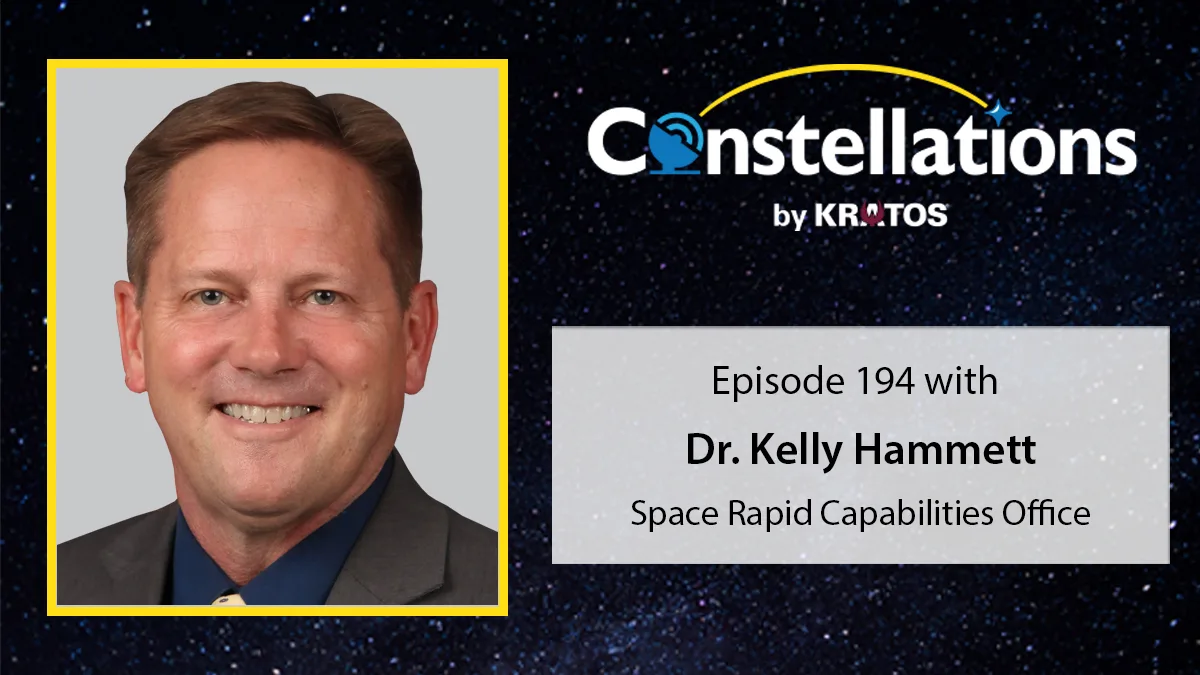
John Gilroy: Welcome to Constellations, the podcast from Kratos. My name is John Gilroy and I’ll be your moderator today. We’ll be talking with Dr. Kelly Hammett, the Director and Program Executive Officer for the Space Rapid Capabilities Office, or RCO in the Space Force. Space RCO delivers timely, combat credible space and ground capabilities to protect space assets and defend joint forces from space-enabled threats. The office works closely with the USSF Field Command, Space System Command, Space Operations Command, Space Training and Readiness Command to rapidly develop and field space capabilities that align with combatant command requirements and service priorities. The organization is headquartered in Albuquerque, New Mexico, with additional offices and staff in the Washington, DC, Los Angeles and Colorado Springs areas. Dr. Hammett, are you ready to go?
Dr. Hammett: I am ready, John.
John Gilroy: So, let’s start at the beginning. So what are your top priorities in your job?
Dr. Hammett: So I’ve been here just about two and a half years now, and I really have three top priorities. One is to execute our portfolio of programs with programmatic discipline and technical rigor. Number two is to establish a footing for strategic communications and public messaging. And the third is to work with our transfer and transition part on the back end of our acquisitions so that they are tested, certified, and fielded rapidly as well. It doesn’t do us any good to go fast in acquisition if the back end of the process takes multiple years.
John Gilroy: Yeah, it’s interesting, you talk about footing and we’re talking about space. We got your feet in the ground and maybe you head up in the air and talking about some more sophisticated topics. So Dr. Hammett, how are you working to speed up the acquisition process?
Dr. Hammett: There’s really a couple of main things that help us go fast. One is the typical program of record within the Department of Defense has to go through what’s called the JCIDS requirements process, and that is whole year effort to establish capabilities, requirements, coordinate those across the joint force, get them through the Pentagon, get funding established, and we don’t have to do that. We have a board of directors that assigns us programs. The Secretary of the Air Force is the one voting member of that board. So if the secretary tells us to do something, he typically asks advice of the other board members. But if they tell us to do something, we can go quickly to get a program started. The other way we do that is quite often we will get funding added into our line in the year of execution through program decision memoranda’s, congressional ads, other types of things. If you listen to the Secretary of the Air Force, Frank Kendall, he’s been saying for two years, they wanted to get this thing called Quick Start, because if you don’t have authority to spend money prior to getting all those approvals in place, you’re two years behind where you want it to be. And so we have that in Space RCO, and he has now gotten the Congress’s permission to have that for the Department of the Air Force.
John Gilroy: So Dr. Hammett, what is your organization doing to deliver space and ground systems to counter space threats?
Dr. Hammett: We have a portfolio of acquisition programs that we execute here from Albuquerque, and that is both flight programs, ground-based programs such as remote modular terminals that you’ll hear in the news currently. It’s a system that we are working hard to field and things like SCAR, the Satellite Communication Augmentation Resource, which is a phased array antenna, to help us augment the current satellite control network, which has very limited capability and capacity. And then we have flight programs. Then one of the most recent programs we have is a ground software program, ground control program, called Rapid Resilient Command and Control, R2C2, is what that stands for. And that program was given to us by our service acquisition executive Mr. Frank Calvelli, because the Space Force typically doesn’t do ground very well. The program that we essentially replaced was called Enterprise Ground Services. It was over scoped, it was not getting products delivered, and Mr. Calvelli gave us a joint or a combined program office with Space Systems Command under my PEO authority. So we have the program director, SSC has the deputy program director, and that’s a sampling of the things I can talk about. Other things are at higher classification levels and can’t really get into those details here.
John Gilroy: I’ve done a lot of podcasts. I like to pull in quotes from famous philosophers just to spice things up a little. So I decided today I’m a quote from a guy named Dr. Kelly Hammett, and this guy, and he once said that, “Velocity is speed with direction.” So, how do you ensure space operations are fully integrated with air and ground while maintaining speed and coordination across teams and partnerships? Kind of pushed and pulled in a lot of directions here, aren’t you?
Dr. Hammett: Yeah, it’s not easy. I guess I’ll say I have a really, really good team, and I should have said this earlier as well. One of the ways we go fast and go in the right direction is have a lot of delegated authorities pushed down to the lowest levels that we have. So, my senior material leaders often approve ACAT-II or ACAT-III equivalent programs, and we divide our portfolio into two acquisition deltas run by each of those SMLs. The quote really came from my predecessor, who when I got here, the quote was, “Speed is king.” And I say, speed kills. Velocity orspeed with the wrong direction takes you off cliffs, takes you into cars and brick walls. So you have to be headed in the right direction, where the quote came from. But it is a complex endeavor with a dynamic space force in its fifth year trying to assimilate multiple organizations that came online at different times. So, it is a full contact sport for us. I spend a lot of time on the road, I spend a lot of time in conferences, workshops, trying to understand what’s going on in the rest of the Space Force. That gets back to big rock number two, we have to send our message, but we also have to understand the message that’s coming from the rest of the Space Force and align to that, because we are part of the Space Force. So sometimes you’ll see things in the news, quotes about us being semi-independent. We’re not independent, we just have a short command chain to the service acquisition executive and the Secretary of the Air Force. So, that’s what they mean when they say that we are quasi-independent. It means we’re not one of those field commands that you listed in your introduction. There’s also a lot of confusion about that. We sometimes get labeled under Space Systems Command is the big acquisition organization for the Space Force, much larger than us, much bigger budget. But then we also have some agency. So, it can be confusing even inside the Space Force. Why do we have these three acquisition organizations? They started at different times with different purposes, and we’re actually working through that right now. We have a niche. SDA has an niche, SSC has a very large portfolio of programs, and we separate ourselves, but we work very closely. We do things like the Program Integration Council, Acquisition Leadership Sync, so that we can communicate across those organizations at senior levels to make sure we’re all headed in the same direction. We’re not duplicating, and we’re not canceling each other out by going in the wrong direction.
John Gilroy: Well, Dr. Hammett, let’s take this word you use, communicating, and play with the different levels and different aspects of it. So when it comes to communication, how do you communicate demand signals to industry to break your folks in the business here? Especially as you’re trying to move away from so much classification but do not want to be completely open, so how do you balance that? Another form of communications you got to balance.
Dr. Hammett: Yeah, it is also challenging. I should have said in the background here is my director of strategic communication and his able assistant, so that was part of Big Rock Number Two, we established an office and hired people to specifically help us communicate both externally to industry and internally to the Space Force, as I kind of alluded to earlier. But we use multiple venues for the classified activities. We actually have annual meetings with our government stakeholders and our industry partners, who are cleared to our portfolio of programs. I almost never refuse an invitation to do one of these, to be on a podcast, go speak at a conference. So I said, I’m out on the road, always trying to meet with industry, communicate with industry. We have a website that is open for contact. I don’t want to call it our front door, because that term gets used a little bit too much, but it’s a place where people can contact us. We have dedicated staff members who will reach out to connect, and I guess I don’t have to brag on a little bit. The feedback we get is useful in that companies can come talk to us. We will not always do business with them. Sometimes the answer is no, but at least they will get an answer. They don’t go into the void. We also routinely of a technical maturity, we will routinely refer those companies to our partners at the Air Force Research Lab or other laboratories that it’s their job to mature technologies. For Kratos and Blue Halo and some of our other partners we’re working with right now, we have tech development efforts in the pipeline, in the labs that are going to feed our programs, and those are the main reason, the main venues and means that we use to communicate. We also, if we find a company that we’re think we’re interested in their product or service, we will send a site rep, a technical team, our head of contracting or somebody like that out to visit them to, again, walk the floor, meet their people, see their attitude. Just recently we onboarded a few new companies. We onboarded 20 new small businesses through the R2C2 program that I talked about earlier. We onboarded Anduril into our portfolio and that all happened because we went on a site visit, we took a team. We were incredibly impressed with, I’ll say the culture, the effort, the interest that Anduril brought to us. And so we were very interested in working with non-traditional partners like that, who are hungry and are agile and are ready to support our mission set.
John Gilroy: Hungry and agile, well, I like those two words. Let’s talk about these hungry and agile companies, these commercial companies. So, how will commercial companies manage and defend their investments?
Dr. Hammett: So that’s a great question. I’m certainly not an expert in that area, but I’ve been doing this for a while and I’ll tell you, we do a couple of different things here in the office to help them. One is, as I said, these portfolio days, we give them longer term demand signals where we think there are gaps in the architecture and where we need to head. So they will often place bets on IRAD and other independent investments on company funds to be ready and positioned when the acquisition is coming available. We send our technical director and other members of staff to IRAD reviews to actually give direct feedback to companies when they’re trying to make these decisions. And then the other thing I do is routinely, it’s monthly to bi-weekly, is I meet with senior executives of the defense industrial base, both large and small, but mainly the ones that we have existing work going with and they want to get more of the portfolio. It’s repetitive within our portfolio of these offers tobe positioned and we try to inform them the best we can so that they can do that.
John Gilroy: Wow, that seems pretty impressive making all that contact with commercial companies. Let’s change gears a little bit here. What do you think about General Guetlein’s methodology? He says, “Something like exploit what we have, buy what we can and build only what we must.”
Dr. Hammett: I think it’s a very catchy phrase that he coined. A lot of people have latched onto it, used it in public settings and I support it in terms of a philosophy. We do not want to reinvent things that have already been done elsewhere. So, we want to find those offerings, products and services that maybe were developed for the intelligence community and repurpose them for the space force. That being said, I still see a fairly large segment of the community not really acting on that philosophy. I see commercial data products and services that the Space Force could be ingesting and using right now, and they’re very slow to adopt it. They don’t trust commercial data, even though you’ll hear them out in the press talking about it. The Space Force established a commercial office to do just that. The people who have been most successful were the U.S. Space Command Joint Commercial Office, and they have been procuring products and services from commercial for quite a while and delivering them right to warfighter. So, I think we need to do it. We need more of it and we need everybody to come on board.
John Gilroy: When I listened to General’s methodology there, and I’m in the Washington, DC, area and we see a lot of federal policies that may or may not be implemented. So from your perspective, what are the areas out there that most need to be improved to realize this methodology?
Dr. Hammett: So I think there are a few. One is the acquisition organizations need to be smarter buyers, more aware of products and services that are commercially available right now that may have been developed for a different organization, but they’re the 80% solution for what the Space Force is looking for. And that is the philosophy we are taking. We are trying to repurpose things that either commercial has done or things that have been done for the intelligence community or missile defense agency or others. And so you have to get out there and engage with industry as we’ve been discussing this whole time to really focus strategies so that their appropriate capture proposals from companies like this. What you see all too often is just an RFP goes out on SAM.gov or Beta.gov or whatever it is now, and just the acquisition organizations just award to whoever responds. And so sometimes there’s an element of chance versus doing your homework to craft an acquisition strategy that’s inclusive enough to get some of those other offers. I hear that a lot from industry VPs and others like, “Well, we didn’t know about this opportunity or that. We missed this.” Somehow, they have teams that spend a lot of time scouring the internet looking for business opportunities. That’s not the best way to do this. We need to focus our interactions and our acquisitions with companies that, again, can really meet the need and are willing to come along and do that. I had another thought. Well, you talked about classification. That’s another hindrance to this process, because again, sometimes we will limit pools to people who are cleared and not necessarily get the best product or service, because we’ve put that limitation on ourselves. So we are going through an exercise right now called SAP Enterprise Reform Special Access Program, enterprise reform, where we’re trying to downgrade classification of a number of different activities. I will say also another area that the Space Force is trying to improve significantly is with international business partners and allies, we’re seeing a lot of motion to get joint ventures between UK Ministry of Defense and Space Force, other types of things like that. So expanding to the global marketplace, you can find a lot more of what exists currently and not have the U.S. industrial base reinvent something that already exists in another country. We found a couple of those specifically in things we’ve been looking at with companies like MDA Space in Canada. So, we’re trying to bring them into our portfolio as an example.
John Gilroy: Dr. Hammett, I’m taking notes here and just in this brief conversation, we talked about SCAR and SAP and all kinds of terms and using differently and applied in different ways. Let’s dig deeper into here. So can you describe what you consider to be dynamic space operations?
Dr. Hammett: Yeah. I normally say I’m not very quote worthy, but I’ve started to say this very bluntly. What it means is to get away from what we have right now in the Space Force, which is a lot of fat, juicy, still deaf, dumb, blind targets in multiple orbital regimes. And so that’s the whole mindset we’ve got to change. That’s the way satellites were built for decades, very exquisite, very expensive. No maneuver capability, no ability to defend yourself to duck run, punch back. All that will change under dynamic space operations because it’s now a war- fighting domain. And that’s been a shift that we’ve talked about publicly. Very interesting to hear about things like Sputnik S discussed in the public. If you go listen to posture testimony from the secretary or Mr. Calvelli or any of the chiefs, they will talk about space weapons that China has fielded and put in orbit in multiple regimes. And anything that you can think of, literally, China has put it on orbit. They’ve got lasers, they’ve got high-powered microwaves, they’ve got rail guns, they’ve got all these things, co-orbital ASATS. They have demonstrated ground to low Earth orbit, an geosynchronous orbit, kinetic interceptors, so that’s what you’re facing in a threat environment. So if that’s the case, you don’t want to be deaf, dumb, blind and still, that’s a good way to die quickly, and so that’s what we’re trying to change. And it’s not, it includes maneuver, but it’s not just maneuver. It’s all those other things as well. The challenge will be, if we have to do that in the timing and tempo of a conflict in space, how do you synchronize and coordinate the activities of all those space assets? That’s where something like R2C2 comes in. That’s where SCAR comes in and that’s where companies like, I’m going to throw you guys a plug, Kratos, comes in because you have capabilities to offer in those areas. So again, you talked about earlier, how do we prepare you for a demand signal? We communicate this message, we tell you that culturally, organizationally, and product-wise, this is where we’re going. So, you can help us start moving in that direction.
John Gilroy: I did preparations for this interview. I saw your quite extensive academic background, and I’ve got reason to maybe have a conversation with you, but then you start talking about punching and ducking. I don’t know what happened to this interview. We went from highly sophisticated satellite concepts to punching and ducking, I don’t know, we get in trouble with this one. I got one final question for you. It’s got nothing to do with punching and ducking. I hope so. What’s the best way to communicate with Space RCO if you have new compelling commercial technology?
Dr. Hammett: As I said earlier, we have a dedicated strategic communications team. We have a website, we have booths at conferences around the country. And the website is [email protected]. So that’s the best way. As I said, we have dedicated staff that will respond if you contact us through that website. But we are also, like I said, quite visible out in the community at conferences, workshops, other places. And we want to do more than just get an email on a website. We want to learn about companies and their products and services and offerings and the maturity of those and their applicability to our mission needs.
John Gilroy: Wow, that’s great advice. I’d like to thank our guest, Dr. Hammett from the U.S. Space Force. Thank you, Dr. Hammett.
Dr. Hammett: Thank you, John.