Transcript:
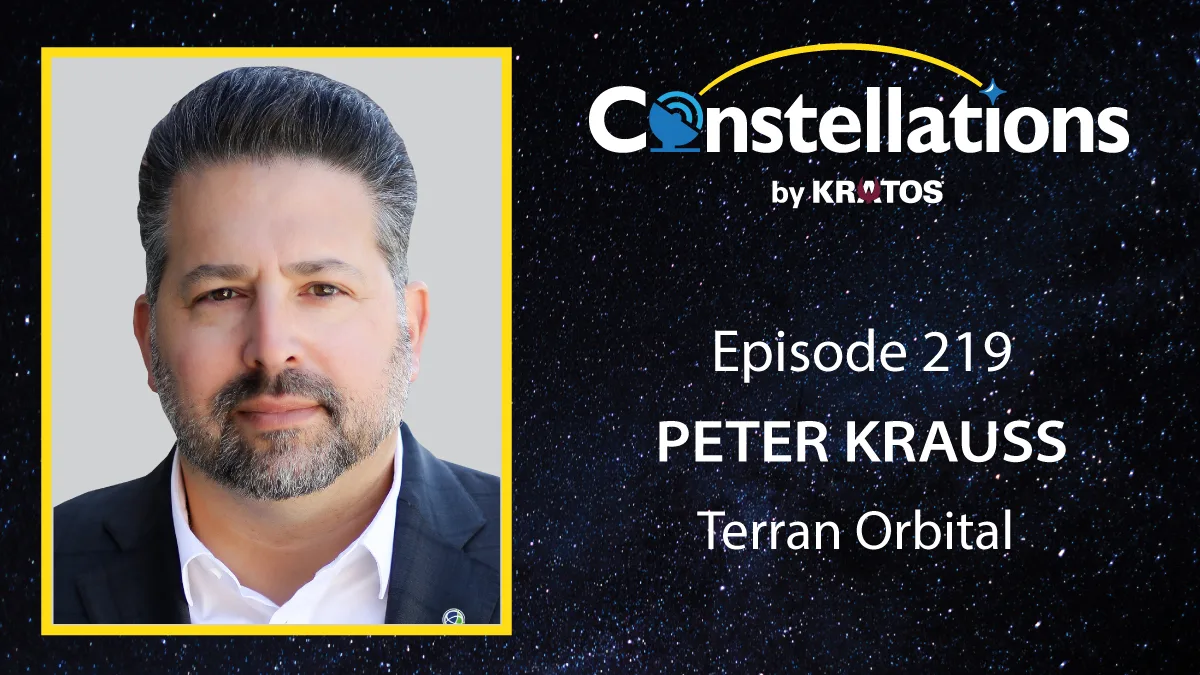
John Gilroy: Welcome to Constellations, the podcast from Kratos. My name is John Gilroy and I’ll be your moderator. In today’s episode, we are talking about speed, scale and the industrialization of space. With satellites being built, launched and operated faster than ever, the supply chain and manufacturing base must keep pace to meet urgent needs. Joining us is Peter Krauss, president and CEO of Terran Orbital to explore how the space industry is addressing the key challenges from designing resilient spacecraft for increasingly congested LEO orbits to navigating the opportunities and complexities of the emerging CIS lunar frontier. Peter, are you ready to handle these questions?
Peter Krauss: I am ready, John. Good to be with you today. Thank you.
John Gilroy: Wow, what a topic. This is an exciting area here. Peter, when we look at the global competition in space, speed seems to be the name of the game. From your perspective, why has industrialization of satellite manufacturing become so central to the future of space power?
Peter Krauss: Yeah, great question and you’re spot on. It is about speed right now, and that’s the major transformation that’s happening in our industry really over the last three to five years in particular. And the reason being is in some cases we’re genuinely playing a game of catch up. I know we’re going to talk more about this through the discussion today, but space has become hotly contested and it’s a more contested domain than it’s ever been in our history. So we’re either playing catch up or we’re trying to stay ahead in certain domains, and speed is of the essence industries recognizing that, governments recognizing that. In the immortal words of Ricky Bobby, you’re either first or you’re last. Right now we’re actually behind in certain domains and in certain capabilities. And again, when you’re dealing in a contested space where space has become effectively a war zone, speed is critical.
John Gilroy: Some people say speed is innovation. That’s a whole… Maybe Ricky Bobby said that as well, but I’ve heard that from another-
Peter Krauss: He probably did.
John Gilroy: … race car driver. Building, launching and delivering capability on orbit is critical. How do you balance speed with quality and mission assurance so that satellites are not just built fast, but built to last in orbit?
Peter Krauss: Yeah. Well, you never sacrifice quality for speed. There are companies that have done that and they’ve done so at their peril. We never sacrifice quality. There’s a notion that’s been flying around industry for the last few years where the industry has shifted to 80% of capability at 60% of the cost. We don’t really subscribe to that theory, definitely to the lower cost part. But we believe it’s not about less capability, it’s about different capability, and it’s also about different mission expectations. The days of building big, beautiful, exquisite, very large, very expensive, very time-consuming satellites is not over, it’s an and or. But that space of these big beautiful satellites, as I love to call them, is not what is happening right now in the space domain. It’s faster iteration of technology, faster iteration of capability. So again, I don’t subscribe to this notion where you have to have less just because you’re paying less. It’s about different, and it’s also about different mission lifecycle expectations. The satellites I was referencing before, they have a mission lifecycle of 5, 10 or even more years. Today we’re looking at mission cycles that are in the three to five year range. So again, different expectation because as technology is evolving as quickly as it is, you want to replenish that capability with new assets more frequently. So it’s a whole different notion of how we’re going to populate space.
John Gilroy: Peter, even with advanced manufacturing processes, the supply chain has to keep pace. So where do you see the biggest bottlenecks in today’s industrial base and how does the industry get ahead of them to meet customer demand for faster builds?
Peter Krauss: Yeah, that’s a great question. So often as a CEO, you get asked what keeps you up at night, this is one of those questions that keeps me up at night. When I think about the broader supply chain and its ability to keep pace with the demand, the never before seen demand that’s in the industry today and will be over the next few years. This is where candidly, Terran Orbital has a bit of an advantage. We’re highly vertically integrated. We manufacture about 80% of our own things, components and modules in-house. So although we heavily rely on raw material suppliers, we don’t rely as much on some of the broader, what people would consider the more traditional subcontractors. We’re not just an integrator, we’re an actual manufacturer of all the things that we use, the parts and the pieces internally. We even have our own machine shop, et cetera, where we mill our own parts. But this is a real challenge for industry, and I think over the last couple of years it’s been a real wake-up call for industry, how are we going to scale? When we look at what’s on everyone’s mind today, Golden Dome for America, it’s the hot topic in industry right now, and we’re talking about thousands of satellites over a very compressed schedule. It’s not just about our assembly and integration and launch and test capabilities, it’s about the supply chain. How is the supply chain going to keep pace? We’re working very closely with those supply chain partners. We’re pushing them and have been for the last couple of years, to scale, to grow, to invest in their own infrastructure. We’re sharing more than we’ve ever shared. I believe industry’s doing a better job of this, of sort of telegraphing the out-year sort of demands. You know what I mean? So what’s coming two, three years, five years to help the supply chain prepare and ideally scale and grow to meet this demand? Because again, these are never before seeing demands on our industry.
John Gilroy: I did some research in the company, saw your building in Florida, and you folks have been around a while. So how does that experience help scale to meet the demands?
Peter Krauss: Yeah, so glad you asked that. So we very proudly have more flight heritage and more proven on orbit performance and more orbits than any other non-traditional space company. So obviously we’re very proud of that. We joke from time to time that we’re an 11-year-old startup. After 11 years you’re really not much of a startup, let’s be honest. But the reason we still carry that moniker a bit is we want to move fast, be nimble, be lean, be a bit more entrepreneurial in our approach, and that’s where the startup moniker really fits. But over the years, now being 11 or so years, we’ve developed a set of rigor and discipline that is not typically associated with most startups. And if I may say space is exciting, dare I say, it’s even a sexy environment that is attracting a lot of company and a lot of investment. So there’s a lot of new startups that are popping up all over the place. I’m sitting here in Southern California and I could throw a rock and hit another space or aerospace company pretty close to our proximity. But when you look at how hard space is, and we forget that sometimes, space is really hard, experience matters, heritage matters, flight components that have flown years and years and years with proven flight, heritage matter. So again, when we’re looking to move at the speed at which we are as industry, when the government is setting new requirements that have never been seen before and need to be executed at a speed that has never been seen before, that experience and that flight heritage really, really matters. And I think industry was leaning a little too heavily into new is cool, and they wanted to really diversify the supply chain and bring on and bring up to speed a bunch of new suppliers. Which in a lot of ways, John, was good for the ecosystem, if you follow what I mean. But now we got to take a little bit of a step back and go, who can really perform here? Who can really execute to these mission-critical scope of works that we’re seeing from government and from even commercial that have never been seen before? So you have to be able to iterate fast, yes. But the experience really, really matters here.
John Gilroy: Well, when people look at current conditions, and you kind of summarize them there quickly there, we often hear the space race is no longer about who can launch, but who can sustain capability. So how do you ensure keeping pace with the rapidly evolving needs of defense, government and even the commercial operators?
Peter Krauss: Yeah. So I make this point clear all the time. We don’t get to define scope or mission set or what government or various agencies might need. What we focus in is making sure that they are aware of the art of the possible, and we’re always innovating as a company. Our industry is always innovating at something. I think as a whole our industry should be very proud of. But again, we don’t set the mission set or the scope. We respond and react and we deliver on-orbit assets based on the requirements that are put in front of us. But that art of the possible is really critically important, and at least at Terran Orbital, we’re committed to be a leading edge technology company. When you look at our mission and our vision statement, we don’t talk about satellites, we don’t even talk about on-orbit assets. We talk about being a leading edge technology company that’s always going to be innovating and delivering those innovations to our customers, whether it be government, commercial, civil, whomever it might be. But again, speed. It’s still about the speed and the ability to do that. And how quickly can you iterate? How responsive is your engineering core? I mean, we have over 200 engineers on staff just here at Terran Orbital, and we operate in a very fast-paced, iterative environment. We’re always thinking what next? What next? What next? What next? And that’s again, where we deliver that art of the possible to our customers.
John Gilroy: Peter, with thousands of satellites already deployed in LEO and many, many more planned, I guess getting crowded up there. So how do you think about designing and producing systems that can operate effectively and safely in such a congested environment?
Peter Krauss: Yeah, I love this. So I often say, I say it internally and externally, it is a miracle of science that there aren’t a satellite’s falling out of the sky, and that these things aren’t bumping into each other and colliding into each other. And I don’t say that to be alarmist. It’s actually quite the opposite. It’s a real testament to the science and engineering that goes into what we do and what our industry does. LEO is highly congested and is only going to get further congested over the next two to three years with the planned constellations, both government and commercial. This is why industry and various different agencies are looking beyond LEO to GEO and to Cislunar in particular. GEO is hard because for those of you that know, you have to get through MEO, which is the radiation belt, which is really hard on electrical equipment and space satellites. So you don’t operate a whole lot in MEO, but you have to get through it to get to GEO. We’ve played very heavily over the last several years in Cislunar orbit. Something I’m always excited to talk about. This is a vastly untapped broad area of space, which is the orbit between earth and Moon that is now also becoming hotly contested between us and certain governments, and again, is an untapped area that I believe is going to be tapped far more in the future. With all of that in mind and with the knowledge that we’re going to have to get out beyond LEO, we’re developing our satellites, our buses, our components and modules to be far more RAD tolerant, giving them greater RAD hardness so that we can get beyond NEO into GEO and survive in that very active now Cislunar space.
John Gilroy: Well, I’m pretty glad you brought up that topic there. Beyond LEO, which of course is Cislunar, beyond LEO there is a growing discussion about this Cislunar domain. So Peter, what opportunities and challenges are there and how might industrial-scale manufacturing enable capabilities in the far beyond out there, Cislunar?
Peter Krauss: Yeah, I love talking about Cislunar. We’ve been with a partnership with another company. Some of it’s classified, I can’t get into it here. But we have on-orbit assets in Cislunar today, and we’re working on a couple of go-forward programs that will put more assets in that orbit. The need and the demand is very similar to what we’re doing in LEO, but the need, again, the tolerances of, the RAD hardness of, the ability to survive in a harsher environment, we’ve had to iterate and develop our space vehicles and our buses to be able to tolerate that environment. I don’t think Cislunar is currently… It’s changing and it’s changing pretty rapidly over the last six or 12 months actually. I don’t think Cislunar is still getting enough love or enough attention. I can tell you it’s gotten the attention of the Chinese. The Chinese are in Cislunar orbit. The Chinese have assets on the other side of the moon already where we do not. So they’ve got eyes on the sky, so to speak, in areas that we do not. I’m sure as any government person or military person will tell you, blind spots are not good for business and we want to cover for those blind spots. So I believe Cislunar is going to continue to get more and more attention. It certainly needs to. We’re certainly pushing that initiative because again, it is a highly contested space. And I’ll be frank, we’re late to the party.
John Gilroy: Peter, your company’s been around for over a decade now, so I guess I have the right to ask you the next decade look in the future, maybe 5 or 10 years. So what does the industrialized space factory of the future look like? What role will US companies play in ensuring that the United States and its allies remain competitive in space?
Peter Krauss: So ironically, what we’re building, and I think what industry as a whole needs to build is going to look awfully like a very high capacity, very industrialized leading edge automotive facility. That’s really where we’re going with this. We have to have an assembly line-like manufacturing process where we’re not building one or two satellites a year or even 10 or 20, but hundreds. It’s not about building one big, beautiful, exquisite thing. It’s about cut and paste, rinse and repeat, do so at scale at a rapid pace, whereas as you said earlier, without sacrificing quality or on orbit performance. So we’re really in the process, John, of building a better bounce trap. We’re trying to build an industrialized manufacturing environment, very similar to automotive, where at a very high rate, with high technical skill, you can execute over and over and over again at a rate of hundreds or more vehicles a year. Look, we’re now part of Lockheed Martin. We’re an independent subsidiary of Lockheed Martin. I’d be remiss if I don’t mention that. And as a broad enterprise, not only as Terran Orbital, we’re really starting to perfect this art of what Lockheed refers to as a speed center, which is taking all that knowledge, all that capability, all that power and leveraging it into iterating faster. And that’s what’s absolutely required. So over the next, not only 10, 3 to 5 years, there’s going to be an exponential expansion of capability, of capacity. And again, this highly technical industrialized manufacturing line, very similar to high-scale automotive manufacturing. That’s where we’re going.
John Gilroy: If you look at automotive manufacturing, they’re not isolated. And I think no company builds spacecraft in isolation. So how do partnerships across the space ecosystem from suppliers to launch providers, how do they enable a capability to accelerate production and deliver this amazing new technology?
Peter Krauss: Yeah. So as I mentioned earlier, we work very closely with our strategic partners. We’re a bit different than industry norm, where we’re as vertically integrated as we are, but we still have very key strategic suppliers and key and important areas of our space, vehicle design and manufacturing. And we’ve been trying to be ahead of the curve with them, encouraging them to invest harder, more, faster. Again, as I mentioned earlier, being a bit more forward-thinking and sharing our capacity requirements, our forecast to say this is what we think is happening in the next 6, 12, 18, 24, 36 months. And that’s an important point too, John, is what we call period of performance over most of these build contracts is 18 to 24 months, not 3 years, not 5 years, not 10 years. We’re being asked to design, build, test, launch within 18 to 24 months. So you need a supply chain that can support that and can iterate at the same speed that we are. And we have extremely strong partnerships that we’re proud of. Industry as a whole needs to continue to develop that and press on that. We at Terran treat those partners as just that, partners. We’re in this together. We succeed together. We fail together. And as everyone knows, you’re only as strong as your weakest link and your weakest partner and why we work so hard to develop it. My call to industry though is do more. We need to absolutely invest more in the infrastructure, invest more in the capability, invest more in the capacity so we can keep pace with this demand. No one company, no one vendor is going to win all of this business, whether it be for Golden Dome for America or any other large constellation. It’s going to take a village. But that village is very reliant on that supply chain and they’ve got to do more.
John Gilroy: Peter, earlier in this interview, you mentioned a contested environment. Space is no longer a benign environment. How do you design and manufacture satellites that are not just rapidly produced, but resilient enough to operate through interference, threats and contested conditions?
Peter Krauss: Yeah, it’s scary to many and it’s thought-provoking to many, but space is now a war domain. It is a highly contested space. Industry figured out, and government figured out that having one big satellite up in space that could be potentially affected by EMI or EMC interference, or that could be knocked out of the sky by way of some ordinance, and then how long would it take you to replace that capability? So the whole industry has shifted to faster proliferation of assets in space. I’m going to fall short. These are not disposable satellites. I made that comment once before and it offended some people. These are not disposable satellites, but they are more easily replenished satellites. They’re at a lower cost point. So the value to government in particular, we could put up 20 satellites in some instances versus 1, 10 versus 1 depending on the capabilities of the asset, and we can build them faster and we could replenish and replace them faster. I often reference this, HP’s printer model is not about selling printers, it’s about the replenishment model of being able to supply you with ink so your printer always works. This is somewhat similar where that we’re going to put up 20 of something, 40 of something, 100 of something. If one or two of them have a failure, if one or two of them are interfered with, if one or two of them are knocked out of the sky somehow there’s a whole army of them to take its place. And that’s the profound difference that’s happened in industry over the last few years with these constellations is it’s not about one bird, it’s about many birds with tons of redundancies. And we’re building in those capabilities where they all cross-communicate, a lot of things I can’t always talk about right in open forum, but you don’t break the daisy changes because one satellite goes away or two or five. You have levels of redundancy that have never been seen before, and you got to be able to, again, iterate and go fast. So if we do have to replace an asset, we can do so very quickly.
John Gilroy: Levels of redundancy, that’s going to echo in the halls of the Pentagon, I tell you what, those guys talk about all the time.
Peter Krauss: Yes, absolutely.
John Gilroy: You mentioned this space, space earlier, and it’s an old term, been around a while, but if you had one message about what’s needed to keep up with the space race, so what would it be?
Peter Krauss: Two words. Go fast.
John Gilroy: And not make a mistake, go fast and break things or just go fast?
Peter Krauss: No, no. The old go fast, break a lot of eggs to make omelets. No, I’m not suggesting that. But speed is critical. If you’re talking about a two-year procurement cycle and then you’ve got to build things within two years, that’s still four years. I think government in particular is taking a look at their strategy around procurement. How do we do that faster? How do we get the scope of work that we need? How do we get the capabilities that we need? How do we work closer and earlier in the process? I think that’s really the key, John, earlier in the process between government and agencies and industry in a true partnership to develop capabilities, understand the art of the possible, have that inform the RFP that eventually comes out for the procurement process so we could move quicker. Respectfully I say this to my government colleagues, we have more bureaucracy, a bit more red tape than let’s say for argument’s sake, the Chinese. They see it, they decide to do it, they execute it, because they’re the decision maker and the executor all in one process. Our process is a bit more cumbersome, and I think government’s working it hard to streamline that and improve that. But that’s my message is for the benefit of industry so we can iterate and move faster and build and deliver on orbit assets faster. The front end of the process also has to get faster. So that’s what I mean by go fast.
John Gilroy: Peter, I think you’ve given our listeners a better idea of the industrialization space. I’d like to thank our guest, Peter Krauss, president and CEO of Terran Orbital. Thanks, Peter.
Peter Krauss: John, it was a pleasure. Thank you so much.