Transcript:
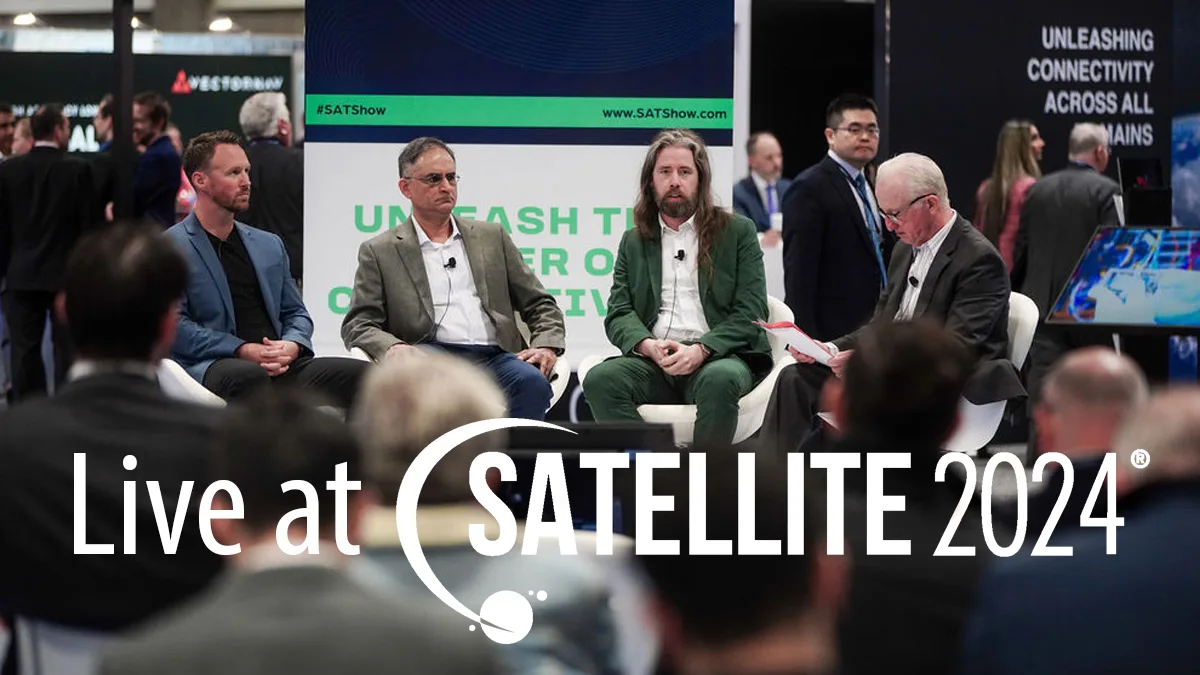
John Gilroy: My name is John Gilroy and I will be your moderator today. I’d like to welcome everyone here to the recording of the Constellations Podcast. We’re happy to be recording at Satellite show. I’m sure that everyone in this room has heard of the leading edge. I’m sure you’ve heard of the Bleeding Edge. And I have a four- year-old grandson, I’ve told him, “Don’t go near the edge.” So the edge has got something to do with something. We’re at satellite here, so what’s edge got to do with satellite? Well, actually, if you walk around the floor here, you’ll find edge popping up here and there and a lot of different conversations. So I’m going to focus on the edge today with this podcast. When you think of terrestrial networks, the edge is the access point closest to the end user. It runs on general compute and is responsive to changes in network demands. With satellite networks up in the sky, the edge is the terminal. And terminals are largely proprietary, hardware-based and fixed for one mission, and that mission is operating much differently than the terrestrial edge. Today, we have a panel of experts, and we’re going to discuss how digital transformation and virtualization is changing the edge of these satellite networks, specifically at the terminal and opening the door to multi-orbit, multi- everything solutions for satellite consumers. Our three panel members are Vinay Purohit, Founder and CTO at CloudJuncxion, Dallas Kasaboski, Analyst for Northern Sky Research, an Analysys Mason Company, and Kevin Tobias, Director of Product Management at Kratos. They will talk about multi-orbit, multi- everything, access at the satellite network edge. And tough questions. I got to start with Dallas. He flew here all the way from France, so we got a tough question for him. As the satellite industry moves along the journey of digital transformation working towards standardized operations and embracing virtualization, the future of satellite networks is looking to be dramatically different than they are today. So Dallas, can you tell us about the hottest industry drivers causing this movement to digital architectures and how that’s changing the ground?
Dallas Kasaboski: Thanks, John. Happy to be here. On the highest level, the two major drivers are standardization and flexibility. They may not sound as exciting, but they’re influencing everything. Hardware side, we’re seeing standardization, which is enabling scale, growth, and interoperability. But of course, we’re mostly talking today about the virtualization, digitization, standardizing those processes. If anybody in the room or anybody listening, talking about D2D, direct-to-device, we’re seeing the standardization of the 3GPP protocol and on flexibility, as you said, multi-orbit, multi-everything being able to do more in a more flexible manner.
John Gilroy: Earlier this morning there was a gentleman up here talking about direct-to- device, so that really is a popular topic as well, but I want to look at the terminal market. Let’s look at the terminal market, specifically for commercial satcom. Dallas, what’s the state of that part of the market and how is it changing?
Dallas Kasaboski: It’s been changing a lot in the last few years. Even here at Satellite, you walk the show floor, it’s always had a lot of equipment on it. I would say more than about five years ago, the terminal market was limited. There were a lot of interested players, a lot of development, but scale was low. Digitization, electronically- steered antennas were few and far between. Now, greater pressure, more players, more investment, and we’re seeing a lot of real, viable products on the floor.
John Gilroy: Kevin Tobias, when you go to a restaurant, the restaurant has to get provisioned with food in order to keep up with the demand for the food. Satellites need to be provisioned, as well. And Kevin has got a pretty good experience with provisioning different types of satellites. The restaurant question for you, the provisioning question is how is a traditional terminal provisioned and how does it scale and operate?
Kevin Tobias: Sure. Let’s first describe what a terminal is. It is an antenna system that allows us to connect to the satellite. There’s a series of system components like block upconverter, low-noise block, that bring it down to an intermediate frequency where we have a modem. So when we think about these components that bring together the connecting to the satellite, converting that to an IP connection, you have to think about the full life cycle, installation, operations, and maintenance. And the first thing we do in provisioning the terminal is to bring those components together based upon the use case. If I’m comms on the move or I’m fixed, I’ll pick maybe an ESA, for the comms on the move, or a parabolic. And then depending on that definition of the terminal for the use case, will determine my provisioning flow and how I actually go and commission that terminal onto the network. In the case of say, a parabolic, I’m going to have to actually go and line that up with the satellite to bring it onto the network, make sure that I have optimal RF performance before I can start delivering the service. Provisioning is all about bringing those components together, bringing that terminal onto the network to be able to provide the service to the end customer.
John Gilroy: Vinay, I started off talking about the edge and the leading edge. In modern networks, the edge is the place closest to the end user where edge computing can occur. The terminal is a satellite communications network edge, but computing doesn’t take place there. The data is relayed back to the gateway. Vinay, can you share with us your knowledge of how terrestrial communications work at the edge and how it differs from the satellite?
Vinay Purohit: Let’s look at some examples of terrestrial links. Historically, it’s been, if you are fortunate enough to have wired connectivity, you might have fiber, DSL, cable, or if you’re in a good coverage area, you might have LTE or a cellular connection. Main difference between terrestrial versus satellite, historically, has been the latency characteristics. Satellite’s always been GEO-based, and now you’re starting to see LEO used more and more. So latency has been the attribute that’s been different. And also, amount of bandwidth. Satellite connections usually, historically, have been narrowband to maybe tens of megabits, in some cases, hundreds of megabits, but those are rare. But definition of edge is highly dynamic. If you’re in a first responder network, edge is where the first responders are. And that may change if you are the oil and gas industry, that may be out in the ocean. And the only activity you may have over there is satellites, may not have any cellular, might have a point-to-point microwave link.
John Gilroy: A better idea of how it works on the Earth here on the ground. Dallas, so what about the satellites? Can the satellite itself be the network edge and run computing on board? That seems crazy.
Dallas Kasaboski: Yeah, I think there are two main use cases to differentiate between. You have network management, and you have onboard computing and processing. Depending on which of those you choose, the definition and even the location of the edge might be a bit different. In general, we’re seeing a rise of interest in both. As you mentioned before, network management can often be done at the gateway on the ground. There’s some that’s being looked at coordinating and we’re seeing a lot of optical equipment on the floor and high-speed data rate transfer, being able to manage networks in orbit or make changes to capacity if you have a constellation such as that. And in terms of onboard processing, we’re seeing growth of that, as well. Outside of satcom for a moment, we’re seeing it in things like image processing and image analysis on board. And within satcom, it’s rising with the tide of software-defined satellites, but it’s always an arms race or a bit of a co-opetition, as they say, between the hardware and the software being more flexible on board.
John Gilroy: Vinay, you’ve got a good knowledge of the terrestrial network itself. My question is how can the traditional satellite terminal change to be more responsive to new space technologies to perform more like the terrestrial edges?
Vinay Purohit: You look at some of the newer terminals coming out, some of them can do multiple beams simultaneously. I’ll take a more network-centric view of this, as opposed to a transmission view. If you have multiple beams, some of the terminals might allow you to use just one at a time, only use LEO or maybe you can use GEO, but you can’t use both. So that has to change over time. I think customers are increasingly looking for having both available simultaneously. Now, even if you provide that capability, utilizing both of them simultaneously, for example, has historically been a challenge. And there are networking aspects to it. Like if you switch from LEO to GEO, will that break your… will the cryptos lose sync, for example? Or if you don’t have cryptos, if you have direct TCP sessions, will those drop? Having smart built into the terminal, that’ll make the use of LEO and GEO for example, or MEO… more transparent. If you’re switching, whether you’re using all of them simultaneously, that all looks completely transparent, just works, the orbital space. Having those smarts built in is where I think the terminal space is there, as well. Besides the multi-being capability.
John Gilroy: Kevin, at seven o’clock this morning, believe it or not, I was at a breakfast and they talked about software-based terminals. My question to you, whether or not you attended the breakfast, is what are the advantage of these software- based satellites? To the satellite operators and customers all around us here, what are the main advantages?
Kevin Tobias: We’ve seen digital transformation applied in the terrestrial networks in the forms of network function virtualization. That’s just taking physical network functions and appliance and virtualizing it, running it on general-purpose compute. And the term that we typically use is to say we’ve disaggregated the network function from the proprietary hardware. And it’s really important in this conversation, where we start to talk about multi-orbit access. And some of the points that Vinay just brought up is the ability to be able to add additional access networks to a particular edge. If it’s proprietary, that looks like we’re stacking up hardware for each one of those access networks to bring just connectivity to the edge. But once we’ve disaggregated and we’re running the network functions at the edge, we can orchestrate those and run them on a single platform. It also serves as a basis for thinking about the entire edge, or the entire service, that the operator is trying to provide. If that service includes security, it may be a firewall, it may be encryption. If it’s resilience, it might be multiple access networks. So being able to add all of those onto a single platform and orchestrate them, it being software-defined and virtualized is basically the basis for making that happen. It’s table stakes.
John Gilroy: Does the word elastic apply here? Is that a good word to use?
Kevin Tobias: Absolutely. As your demand on the ground grows or your mission needs change, being able to change the size of your modem, per se, to add more capacity, or spin up another modem to be able to bond those two together to meet the mission needs, is critical.
John Gilroy: Dallas, if you went to Google Trends and typed in “digital transformation,” you’d see a hockey stick. Everyone’s talking about digital… car manufacturers are talking about digital transformation. My digital transformation question for you involves satellites. The digital transformation of satellite networks has opened the door to orchestrated and automated operations across multiple platforms. What are some of the use cases you are seeing for these expanded capabilities, and can you give us some more examples?
Dallas Kasaboski: On the highest front, it’s all about having seamless connectivity, being able to change and have flexible capacity and being able to shift your network based on supply, demand, or issues of hardware or outages, other things like this. Some real specific examples we’ve seen in the satellite industry is a cooperation between things like companies like SES. So SES mPower partnered with Starlink for Maritime, so there’s a multi-orbit aspect that’s going on there. Intelsat, OneWeb as well, as well as OneWeb and Eutelsat. So it’s all about this orchestration that Kevin mentioned, being able to disaggregate the hardware from the software and the software allows you to scale and to be more flexible, like I discussed earlier.
John Gilroy: Vinay, we’ve heard the words elastic, we’ve heard the word orchestration, and we’ve heard the word multi-orbit. Multi, multi everywhere. From your perspective, what do you believe the advantages are of new digitally- transformed satellite terminal models for this multi-orbit, multi-axis operations?
Vinay Purohit: I think the biggest trend you can see in the future is really the flexibility, and Kevin alluded to that. What I think our customers are looking for at the end of the day is completeness of a solution. You can’t just hand them a terminal and expect them to build out a complete network connecting multiple sites. Networking aspects are pretty significant, as well. Having a highly configurable platform, where you can spin up not only modems, but additionally, maybe something that allows you to run some smart SDN software that ties it all together and solve some hard networking problems for you, such as… You look at LEO, GEO, you’re trying to use them simultaneously, can you keep that transparent to the customer? Might see a latency difference once in a while, but other than that, from an end user perspective, looks seamless and you allow them to connect legacy terminals into that system. They’ve invested all that money, they’d like to continue to use it. Do you provide them access to LTE or any transport known to mankind? And they utilize all that simultaneously, effectively create more resilience and simplicity. Simplicity is key. You have sites with multiple transports. The networking aspects, again, get pretty challenging. So rather than having the customers figure out how to do all that, I think the terminals need to have the hooks built in to simplify all that.
John Gilroy: Kevin, the last time we spoke, we talked about elastic. And before we started this interview, we talked about traditional networks, new networks, and the word that’s used popularly with software people is hybrid. Hybrid cloud. Public cloud and a hybrid cloud. Let’s look at this word, hybrid, and see how to place the satellites here. We covered traditional terminals, and I think they’re trying to change to be more like the terrestrial edge and include running on general compute rather than purpose-built hardware. What does that mean for value- added applications like SD-WAN, and other network applications? Is this where the hybrid comes in?
Kevin Tobias: Yeah, I think it goes back to what Vinay just said is, it’s about delivering a whole solution to the customer and simplifying the user experience, the operational complexity of delivering that service. At the end of the day, the customer just expects, “I want a resilient connection with this latency, with this jitter, with this throughput.” And what SD-WAN allows you to do, once you are running in this software-defined model at the edge, is, I may even have an existing edge that has multiple terrestrial connections. We talked about a couple of the use cases there. It could be LTE 5G, it could be WiFi, it could be microwave. By adding satellite to the edge as well, it gives this ubiquitous, highly resilient model where we no longer have limits on where can these edges be deployed. SD-WAN, as I see it, is part of the simplification process for adding that behind all of those access networks and allowing the service provider and operator to say, “Here are the applications that I want to prioritize. Here is the quality of service that I want to give to the customer.” And allow the SD-WAN, as another virtual network function as a part of that orchestratable chain, take care of that work for them and make sure that they can maintain that for the purposes of their SLAs.
John Gilroy: Kevin, I think we have to take the satellite operators and get them off the hook here a little bit. Ten years ago, I started doing interviews about SD-WAN. And finally just in the last four or five years, maybe the technology caught up or the cloud caught up so they could use it. And so if you’re a satellite operator, don’t beat yourself up because you don’t use SD-WAN already. Finally, we have an opportunity where there’s a perfect storm. The hardware, the communications, finally, you can actually deploy it effectively. Isn’t that right?
Kevin Tobias: Absolutely, yeah. I think it’s the convergence of non-terrestrial and terrestrial networks. It’s the movement of software-defined networks that’s bringing all this together.
John Gilroy: Here we are in Washington, D.C. You drive over the river, there’s that little building there called the Pentagon. And I’m sure if you did a word cloud of what they talk about at the Pentagon, security has got to be top on the list. I got to go to Dallas on a security question here. What is the industry view of security of digitally-transformed satellite networks versus old school, OG, as they say. So what about security here?
Dallas Kasaboski: Simplest way to put it is a slowly rising tide. The threat or the opportunity or the concern over cybersecurity is real, but the actions being taken, the investment, the integration of it, outside of some use cases, is only slowly rising. Obviously, if we’re talking about very secure commercial networks, we’re talking about government, military applications, it’s basically first and foremost. But a lot of the industry is still trying to decide exactly which way to approach this. So I think for anybody who’s involved in offering or provisioning cyber secure options, you just need to make sure that you can integrate it into the system to continue, and place the value on the continued access to the network.
John Gilroy: Vinay, I was at the breakfast seven o’clock this morning, as I mentioned, and I sit next to a guy. And he talked about the money. He said, “Show me the money. Well, what’s the ROI on this?” So what about the money? And the business questions are going to go to you, because you’re right in the heart of business, New York City area. When satellite network functions are deployed as software, we switch to software, let’s say. How will that affect the business model, the money model, the business model for value-added app providers and their deployments for satellite?
Vinay Purohit: What you’re starting to see is notion of managed networks, using satellites, starting to become possible. I think satellite operators have been pursuing that vision for a while. They never quite figured out how to monetize it. They were mostly selling bandwidth. But now that certain capabilities are becoming available, the notion of providing managed service now looks feasible, looks like there’s some money to be made there. Because you’re truly adding value beyond just providing bandwidth. Now, if you’re able to provide multiple pathways, whether it’s just multi-orbit, or bring in other transports and be able to manage all of that, I think that creates a whole new value proposition. And plus, being able to manage it remotely and adjust capacity as needed. Customer doesn’t have to worry about the specifics of the terminals. That’s all taken care of for you. Networking aspects are taken care of for you. So all that is enabling a new business model for the satellite providers.
John Gilroy: Well, Kevin in little league, everyone gets a chance to hit the ball and each one of you’re going to a chance to hit this ball. I’m off this question up and get each one an opportunity. The question is a framework here about digital transformation. So here’s the question. Digital transformation and virtualized network functions are undeniably creeping into all aspects of satellite networks. I’m sure each one of you have different perspectives on this question, but for each of you, looking ahead 10 years, if you can even imagine that, 10 years down the road… Dallas, how would you describe the satellite networks 10 years from now if you even can? So 10 years from now, what do they look like?
Dallas Kasaboski: Integral to the terrestrial network. Where right now there there’s always been a separation between satellite and the terrestrial network, partially because satellites literally are disconnected, but also they have advantages that terrestrial doesn’t. But in order for both to play together, to scale, and to offer the most diverse solutions, they need to be integrated. And on the end user level, it shouldn’t matter. You shouldn’t even know. It should be, “Well, I’m just connected.” It doesn’t matter if you’re connected to terrestrial, cellular or satellite.
John Gilroy: Vinay, integral? Does that make sense for you for the next 10 years?
Vinay Purohit: Yeah, so I think blending of the transports, making it transport-agnostic, simplicity, completeness. I think all those aspects would be very important going forward. And resilience, at the end of the day, is what customers look for. Resilience without taking on too much complexity. That’s where I think the terminal market is headed.
John Gilroy: Integral, resilient. Kevin, is your word hybrid? Is it fusion? What’s your word for 10 years from now?
Kevin Tobias: I would say intelligent. As we see the digital transformation take its course, we become orchestratable and automated. One of the best ways, as we look even beyond 5G, we look towards 6G, you’ll see that applying cognitive networking to the network will be a crucial part of that. So applying AI and ML at the edge, at the core of the network, essentially to start to take the human out of the loop and simplify, like Vinay said, that operation is going to be the next step, as we move beyond this digital transformation.
John Gilroy: Three key words here. It’s interesting. Artificial intelligence, machine language. Really? It took this far to come up. It took 10 minutes for that to come up. No, no, really? So Dallas…
Vinay Purohit: No generative AI.
John Gilroy: Do you really think it’s going to change that much? Or how is it even being applied today? There’s a lot of mistakes being made. I’ve seen some terrible text written by artificial intelligence. So I think we’re in the 18-month-old stage of artificial intelligence, falling down a lot and breaking things. But AI, where’s it headed?
Dallas Kasaboski: Yeah, it is a good metaphor. We’re in the toddler stage, I think. There’s been some interesting use cases where they can pick up and run, but there’s a lot of places where we need to take it slow, develop it slowly, iterate. And that’s what we’re seeing. We’re seeing it in all aspects of the satellite sector. Orchestration, manufacturing, processes. But, like anything, we need to iterate and iterate and iterate in order to increase its capability, but then eventually, ease our networks and make it simpler.
John Gilroy: Vinay, any role for artificial intelligence? I’m an old guy. I think it’s difficult to have regular intelligence. How do you play with artificial? I see a lot of problems. How about you?
Vinay Purohit: Definitely quite a few use cases for AI, and you don’t want to overuse it. There are some problems you can solve quite effectively without bringing AI into the mix. But certainly, when it comes to any kind of management of the network, you might be able to get a better view of the overall picture of the network using AI and make adjustments, which a human might take much longer to react to. The automation of some of those adjustments, there’s definitely a role there. Allowing folks who are not experts in a particular domain to be able to troubleshoot certain things about whether it’s a terminal or the networking aspects, generative AI can help a lot there, I think.
John Gilroy: Now, Kevin, I think that there’s a company in Arlington that does digital twins. And so if there’s a problem with satellite, they can create a digital twin here and, through artificial intelligence, troubleshoot it. There’s always that for… So what do you think?
Kevin Tobias: Generally speaking, we’ll start to see how can it help us in monitoring the resources. We just talked about now we’re running on general purpose compute, which means we can do many things. One of the things we’ll notice is that those AI and ML workloads will begin to monitor our systems and be able to alert us about predictive maintenance that needs to take place or how we could better utilize the infrastructure that’s available to us. Ultimately, what that’s going to lead to is better op-ex for the telco and satellite operators.
John Gilroy: Dallas, we’re going to go back across the river to the Pentagon. Now, there’s certain applications that certain agencies have in time that are never going to go to the cloud. They’re going to be stuck in proprietary. And believe it or not, there’s a guy in town named David Linthicum. He’s written recent book. He talks about repatriation. It’s like people have gone to the cloud and come back. Isn’t that a delicate topic here? Dallas, can you handle that delicate topic? Repatriation? Really? Could people actually not optimize by moving to more digital transformation-type activities?
Dallas Kasaboski: There’s always an edge case, there’s always a use case. There’s a lot of places where it might make sense, even if we move past the delicacy. I think there’s places where it might make sense to not complexify your network, or to connect it to a broader stream of network. But in any case, we’re all excited about technology, but it’s all about delivering a solution. If it makes sense to stay off the grid in that aspect, great. But there are a lot of advantages to all of this collaboration and integration, as long as you examine that technology carefully.
John Gilroy: Vinay, repatriation, new word for you, or have you heard about that? Or what do you think?
Vinay Purohit: You’ll have to define that for me.
John Gilroy: Oh, okay. Just moving it back from the cloud. Go to the cloud, moving back, because maybe it’s too expensive, maybe it doesn’t meet your needs. Maybe there’s security concerns. You’ve heard about this, Kevin, haven’t you?
Kevin Tobias: It depends on the particular use case, right? Sometimes we can even run the edge cloud near where the sensors are in collecting the data. And to Dallas’s point, I think it depends on the use case. There’s use cases where all we need to do is send a message. All we need is, basically, a direct-to-device type connection. You don’t need an entire digitally-transformed platform with multiple network functions to complete the solution and provide the service to the customer.
John Gilroy: Well, I started off talking about the Bleeding Edge and the leading edge, and I think everyone has given us a better idea of what the edge is all about, especially how it applies to satellite technology. Let’s thank all the guests here. Thank you very much for your time.