Transcript:
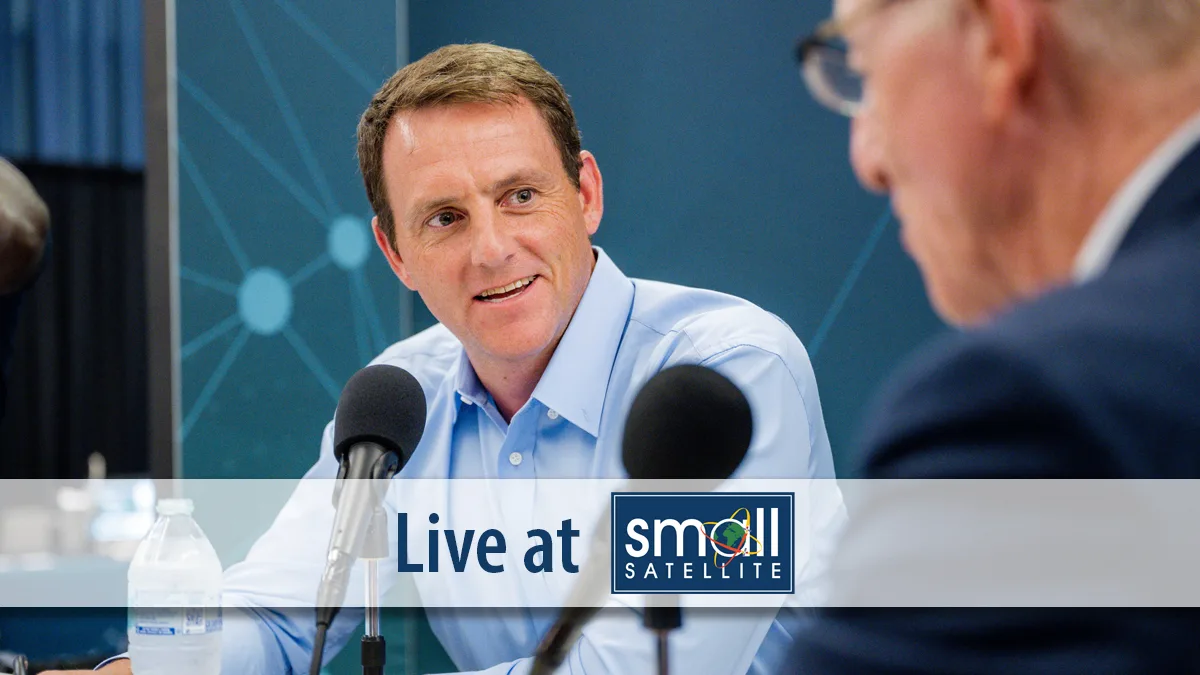
John Gilroy: Welcome to Constellations, the podcast from Kratos. My name is John Gilroy and I will be your moderator. We are recording this from the Smallsat conference in lovely downtown Logan, Utah. The need for operational flexibility for satellites in orbit has only grown. Tens of thousands of satellites means tens of thousands of opportunities for disaster. Our guest is Kevin Lausten, President of Morpheus Space. He is joining us today to talk about the technology behind satellite mobility, how it is evolving with satellite designs and how applications are growing beyond collision avoidance. Kevin, what is the main purpose of satellite mobility in space and how has it traditionally been implemented?
Kevin Lausten: Thanks, John. It’s a pleasure to be here. I appreciate the invite from Kratos to be on the podcast today. Space is becoming increasingly congested, contested, and competitive. With the increase in volume in spacecraft, there’s a dramatic expansion in the need for space mobility. The low Earth orbit environment has a dramatic increase in spacecraft, and as a result, you need to be able to maneuver to avoid other spacecraft that are in that environment with you. 20 years ago, it was as if you’re driving on an open highway and you could just put the car in cruise control and you didn’t have to worry about a steering wheel. You would just stay on the course, stay on the path, and you’d be fine. Now it’s a congested highway and you need to have blinkers, you need to have a steering wheel, you need to have brakes, you need to have gas because it’s increasingly congested. That’s one driving factor behind the need for space mobility. Space is increasingly contested. We’re seeing adversaries demonstrate capabilities to approach our spacecraft in the western allied nations, and we need to be able to navigate away from those environments and also demonstrate comparable capabilities in that increasingly contested space. And then finally, space is an increasingly a business space, a business opportunity for companies that have payloads in orbit. As it becomes more competitive, companies need to maximize the value of their payload and space mobility is a great way to do that. It’s a really important factor. As missions change, as business dynamics change, the location in the orientation of spacecraft need to change to be able to maximize the returns that companies create from their payload. And space mobility is the way in which you do that. In summary, space is congested, contested, and competitive. And space mobility is the way in which you address those challenges.
John Gilroy: You talked about contested navigation. Two days ago, I was on the 405 in Los Angeles. It’s like, “It used to be a dirt road, now it’s the 405. It’s all of a sudden all kinds of things to worry about.” On the 405, I worry, worry about people getting flat tires and people turning into my lane more or less simple things compared to a 3D environment in space. What are some of the causes for satellites to move out of orbit?
Kevin Lausten: A big reason for satellites to move out of their standing orbital plane is collision avoidance. As I mentioned previously, space is increasingly congested, and a conjunction between two spacecraft would be highly problematic for everyone who’s operating in low Earth orbit that has the potential to create a substantially challenging scenario for everyone who’s in that orbital plane. We need to be able to maneuver around situations where there might be a conjunction. Having propulsion on a spacecraft is becoming increasingly important, and moving out of the orbital plane of an incoming spacecraft is really the only way to avoid a conjunction. I’d say another important element to space mobility and why you would want to be able to perform a maneuver if you own a spacecraft, is to actively de-orbit, traditionally a way in which spacecraft that have reached the end of their mission life. Commonly, in the past, what has been done is basically operators allow gravity to take its natural course and pull a spacecraft down to Earth, and that spacecraft burns up on reentry. When you do that, you’re basically leaving a piece of debris up there and hoping physics does its job over time and there’s no conjunction. Increasingly that’s becoming important to have active de-orbit. And satellite operators really need to be thinking about how to have sufficient propulsion and fuel onboard to be able to actively de-orbit and take a spacecraft that’s met its end of mission, back down towards the surface of the Earth and burn up on reentry in a controlled way.
John Gilroy: I’ve done some research on it. I think the word is drag. Let’s talk more about LEOs. You mentioned it as LEOs take off and the satellite designs have begun to vary in smaller models. This is the Smallsat conference, after all, how has that affected propulsion technology for handling mobility?
Kevin Lausten: We hear again and again at shows like this, the demand for propulsion continues to increase. As operators and integrators take these big business models and these business plans to scale out constellations, it’s very exciting. It opens up new use cases, opens up new applications and new opportunities for everybody here on Earth. But to support those business plans, there needs to be capacity for all of the components that would feed into a spacecraft. And propulsion is one of the most challenging components that feed into spacecraft. As we think about the proliferation of constellations in low Earth orbit, there needs to be reliable supply of propulsion to meet the needs of those large constellations. Scalable production is really something that we at Morpheus Space think a lot about and have made substantial investments to be able to meet that demand with sufficient supply of propulsion technology so that the big visions, the business plans that are out there to scale out substantial constellations can be realized.
John Gilroy: Back to the 405 analogy, don’t run a gas up there. That’s a simple solution. I mentioned earlier this number 40,000 and everyone has a different number. When you look at these 40,000 projected smallsats, what do you think the biggest challenge is in supporting them in the next 10 years?
Kevin Lausten: Back to my earlier point, scalability is really important and reliability. First of all, you need to be able to manufacture it, scale, produce the necessary satellite buses, the components including propulsion, and deliver those on a consistent basis to realize that vision of tens of thousands of spacecraft in lower Earth orbit. Taking what used to be a boutique industry and translating that into a high, throughput manufacturing industry is a big transition that I believe the whole space economy is going through right now. We’re seeing companies like SpaceX demonstrate the ability to take an idea and then scale it out to thousands of spacecraft in a matter of years. And I personally believe that’s inspirational, and I believe that we as an industry need to take those signals and apply many of the high throughput manufacturing techniques that have been established in industries like the automotive industry and apply it to space. I think that’s one really important aspect of being successful as we scale out constellations. I think the second really important aspect is reliability. There’s really no margin for error, and errors can cause tremendous problems if there are constellations that don’t go according to plan and there are anomalies on orbit, it’s very difficult to service a spacecraft once it’s up there. Back to your 405 analogy, if you break down on the side of the road, you’re on Earth, you send a tow truck, that’s much more difficult. I’m excited about some of the new companies and the new technologies that are coming online to do in-space servicing. Those are still early days. The way to combat the early days of in- space servicing is to build reliable technology. I’d say the big challenges are scalability of production and reliability of the technology that we’re launching to orbit.
John Gilroy: Back to the 405, you got gas cars, you got diesel vehicles, you got an occasional electric vehicle, and most people understand that. But let’s talk about propulsion for these satellites. How does a propulsion system work for smallsats?
Kevin Lausten: There’s a lot of different technology out there, and there are different tools for different jobs. Let me tell you about electric propulsion, because that’s what Morpheus Space represents, and that’s the kind of technology that we’re delivering to the market. Electric propulsion has a number of key benefits, one of which is the gas mileage. We have the ability to provide a lot of propulsion over a long duration. Many other technologies have higher thrust, and there are certain places for high thrust, high energy maneuvers, though the challenge with those types of technologies is you run the risk of running out of fuel and getting stuck on the side of the highway. We’re cruising comfortably in the middle lane with electric propulsion. We’re reliable. We have the ability to run for long durations, and we can make maneuvers with electric propulsion to move from lane A to lane B to lane C in a very methodical way. Electric propulsion is a very reliable type of propulsion system, and it allows for the users of electric propulsion to ensure that their spacecraft have long lifetimes. There are other situations where you might need to use chemical propulsion to perform high energy maneuvers, and there’s a time and a place for that. But if the intention is to maximize the value of your spacecraft, electric propulsion is something that’s very much under consideration.
John Gilroy: Here we are at a Smallsat conference, I bet if I walked around the room here and said, “Array”, most people would think of antenna array or something. Word association and I guess that’s what I fall into too. However, there’s a concept of arrays that changed the way propulsion is traditionally done, maybe this is innovation here.
Kevin Lausten: Thanks for bringing that up, John. I’m really excited to talk about our propulsion product, Go-2. Go-2 is a type of field emission, electric propulsion technology that we’re just now bringing to market. The Go-2 system is about a 1U form factor, and within that 1U, we have 40 emitters organized as an array five by eight, a total of 40 emitters. And that configuration, that architecture provides for a number of important benefits. First off, each emitter has its own fuel source, its own fuel tank. This allows each emitter to operate independently. And if you need to turn on or turn off an individual array element on its own, you can do that. If you’re operating with a single emitter, if there’s a malfunction with that single emitter, then you’re in hot water, you’re dead in the middle of the highway, that’s a problem. If there happens to be a challenge with one of those 40 emitters, then the other 39 can compensate for it. That’s one of the benefits. The second benefit that’s really exciting is the ability to perform thrust vectoring. If you initiate variable thrust across the mix of emitters within that Go-2 propulsion unit, you can turn the spacecraft. Traditionally that would be a thrust vector control system or a gimbal would be required to perform that type of operation with a maneuver, with Go-2, you can ignite different emitters at different thrust levels to orient the spacecraft in a different manner. That’s a pretty unique capability. We’re pretty excited to talk about that, and we believe that it can drive down the cost and the weight of a spacecraft and reduce the complexity, therefore driving greater value for our customers.
John Gilroy: And the word I wrote down was resilient. When do you have that many, if one or two fails, you’ve got resilience. It’s built in, isn’t it?
Kevin Lausten: That’s right. We’ve got a built-in back system of sorts. Back to my earlier point about reliability. That’s a really critical point, and we’ve got a number of points of redundancy and reliability built into the system itself.
John Gilroy: U.S. military, that’s their number one word, man, resilient, resilience is important for them. I’ve been doing some research on this whole idea of propulsion technology, and let me just summarize it and you can just walk away or something. I can give my ideas here. I guess the main purpose of propulsion technology is to move satellites into orbit and keep them there safely. We know that. Collision avoidance, we know that too. There’s talk about a more unorthodox use case like maneuvering to see what other satellites are doing. Have you had requests from the market for this type of solution?
Kevin Lausten: There’s a wide range of use cases out there for propulsion, and there are a number of different application areas that benefit from propulsion. Some of the more traditional ones are communications, Earth observation, GPS, but we don’t really play in the GPS space. Those are heavier, bigger propulsion systems. Then there’s emerging use cases and applications, and you’re talking about what the government commonly calls rendezvous and proximity operations.
Kevin Lausten: Approaching a spacecraft and taking an observation of that spacecraft, there’s lots of reasons why you might want to do that. Here at the show, we’ve talked to a number of companies that are doing that kind of work. Electric propulsion is well suited to address some of those needs. Of course, it depends on the size of the spacecraft, but that appears to be an emerging use case that is getting a lot of attention within the U.S. government and allied nation governments for observing our own spacecraft and then understanding what else is going on up in the far reaches of space.
John Gilroy: I have to run with this, Kev. This is Smallsat conference, and there’s of course professional talks, but there’s a lot of action going on in this cafeteria. There’s a lot of people sitting over in a corner with Kevin and another group meet there. I met some guys from Chile earlier. I met some guys from Spain earlier. This is a conference where you really get to exchange ideas with, and it’s all very informal, and it’s a wonderful conference for explaining new and innovation ideas with propulsion, isn’t it?
Kevin Lausten: That’s right. I feel very fortunate to be able to participate in this show because we do get to meet with these oftentimes young innovators who are bringing new ideas to the table, who are taking some of the hardware developments that are happening within the industry and using them to bring forward new business models, new technologies, new applications. I’ve heard a number of them this week that are really exciting and gives me a lot of optimism around the success of the space economy because it’s not just about Earth observation and communications or positioning. There are so many other applications that are starting to crop up, and some of them will be successful, some of them won’t.
John Gilroy: It’s like Silicon Valley, a lot of people. Now, I think Europe has got a lot of small companies talking about new innovation ways for propulsion, and this is where they come together. Those guys are from Spain. They’re talking about new ways for propulsion, it’s really an exciting place to be from all over the world, and I never realized that this whole concept of satellites and space, it’s an international concept, and everyone’s got ideas from all over the place. One concept that people do talk about this conference is space debris. What about mobility for collecting or removing space debris? Is that a problem you’re helping to solve or you’re hoping to solve?
Kevin Lausten: That’s most certainly a problem that we’re designed to solve. That’s part of the reason we exist, is to help resolve that issue. It is a real issue today, John, that there are a number of pieces of space debris up there that are monitored using a wide range of techniques, and there are ways in which propulsion can be used to avoid those pieces of space debris. We talked about collision avoidance, commonly collision avoidance maneuvers are performed to avoid space debris. That’s one way that we’re contributing today. And then there are a number of really great ideas around how to clean up space. If there’s a spare tire sitting in the middle of the 405, someone’s got to come along and get that out of there. And first thing you got to do is cruise on up to the spare tire. And then second step is pick it up. And then third step is carry it off the highway. And a couple of the steps I just pointed out there require mobility.
John Gilroy: Without causing another accident.
Kevin Lausten: Without causing another accident, without creating a bigger problem. There’s a whole architecture that needs to be implemented to allow that to occur. There’s techniques to approach space debris. There are techniques to secure space debris. There are techniques to de-orbit space debris or rendezvous that space debris with a central repository. That’s the trash collector of sorts. There are a number of different ideas around space debris collection, mitigation, and remediation. The question I have around that topic area is who pays for it? And that’s probably a different conversation for a different podcast, but I would challenge our audience here to think about what’s the business model around space debris mitigation? It has to happen. It’s in everyone’s best interest, but how does it get paid for?
John Gilroy: And retail is, if you broke it, you own it, and maybe that’s some whole different interview there. I’m taking notes here, and we talked about de-orbiting mobility and mobility with collisions and mobility with debris. Are there any other ways that propulsion technology can be applied in space aside from these three or four things we’ve mentioned?
Kevin Lausten: Geez. I mean you need propulsion to get to space. Space is big, space is growing and to explore the far reaches of space, you need propulsion. You need mobility. And again, there are so many different types of technologies out there. There’s electric propulsion, there’s chemical propulsion, there’s nuclear propulsion, and we need to continue to invest in pushing the state of the art for propulsion to allow us to explore the deep reaches of space. There are many, many benefits to the human race to be able to explore the far reaches of space. But to get there, we need reliable, scalable propulsion technologies that allow us to get to the Moon, get to Mars, get to the outer reaches of our solar system. There are many different applications of space mobility. There are things that we’re, at Morpheus Space, really well suited to do, and that’s station keeping, that’s collision avoidance, that’s de-orbiting, but that’s just scratching the surface. There are so many other forms of propulsion that are out there that are really valuable and useful for many other applications, and we need to continue to invest as a society in this technology and as an industry in this technology to ensure that we reach the full potential of the space economy.
John Gilroy: I’ve been reading about there’s this company that wants to go to the Moon and take water from the bottom and use that for propulsion for going to Mars or going to outer space for something. Some concepts and ideas that young people at this event may come up with these ideas and thoughts. Looking down the road and looking around the people at this event, there’s a lot of college kids here. Where’s the future of propulsion technology look like?
Kevin Lausten: I would say that there are many different aspects of propulsion that need to continue to evolve, develop, and advance. I really believe that we need to continue to invest in technology development, research, and development. Though the time is now to scale out production, the time is now to improve our reliability and our resiliency in those propulsion technologies. It’s time for this to go from what has in the past, at times been thought of as lab experiments to something that is as common as your motor in your electric car and your combustion engine in your gasoline engine vehicle. We need to have these as mass market, reliable technologies that the industry can depend upon. In many cases, we’ve gotten there, and in other cases, we need to continue to expand the production and the reliability of the technology.
John Gilroy: The space industry can be unpredictable. I read in a space.com article from 2022 that you were considering taking Morpheus Space public. Since this is something you are in the middle of working through, can you share with some advice on the pros and cons you’ve been thinking for our listeners?
Kevin Lausten: Sure. We’re still a young company. We’re 60 employees in two different offices, one in El Segundo, California and one in Dresden, Germany. We keep our options open to a wide range of opportunities to bring investors into the equation for our company. I’d say we’re a ways away from considering a public offering, but anything’s possible. We’re pretty satisfied with the track that we’re on, and we’re making good progress. Our focus is around bringing our technology to market, supporting our customers, and helping our customers be successful in their business plans and execution is key at this point. As far as the capital markets go and the opportunities for raising investor dollars from other paths, we’re keeping our options open. A public offering is not something that’s in the near term roadmap for Morpheus Space, but anything’s possible in the future.
John Gilroy: Kevin, this has been a great interview. I think you’ve given our listeners deeper meaning into the word mobility, haven’t you? I’d like to thank our guest, Kevin Lausten, President Morpheus Space.