Transcript:
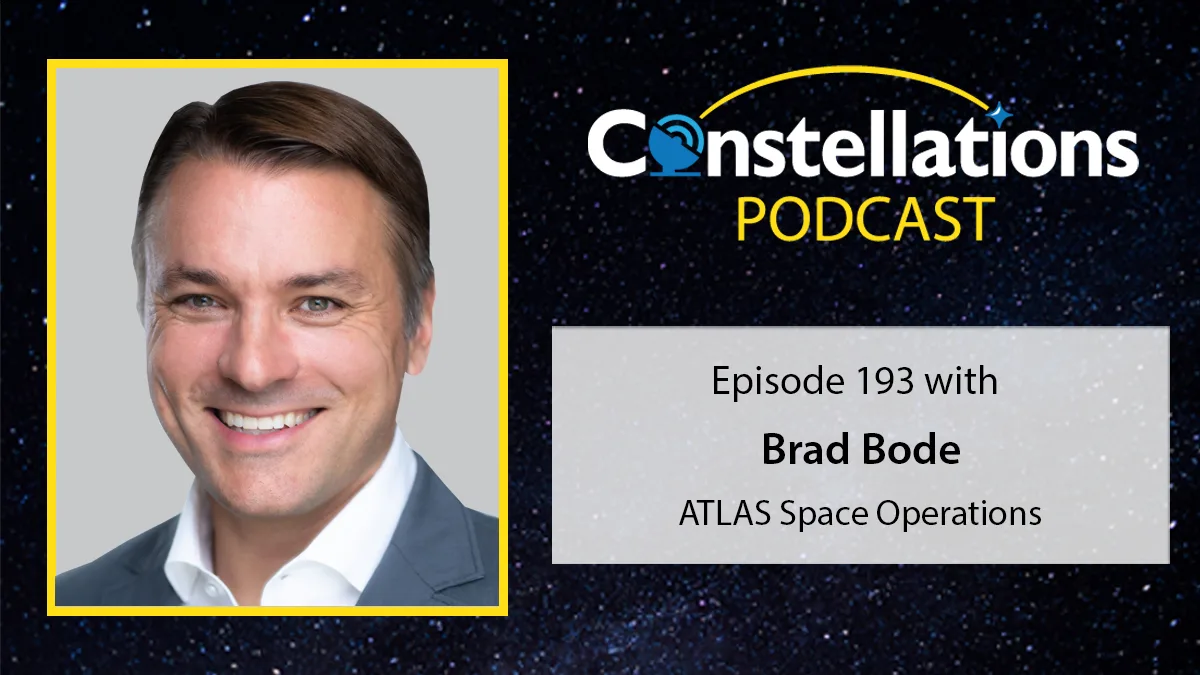
John Gilroy: Welcome to Constellations, the podcast from Kratos. My name is John Gilroy and I’ll be your moderator. Customer demand for ever higher data rates has driven the satellite industry into a digital transformation. And Brad Bode, CTO at Atlas Space Operations, has been at the forefront of this effort. Brad joins us today to take a look at how the market and technology are changing in Earth observation and ground station as a service. Brad, we’re going to jump right in here. Let’s first talk about your take on the current state of the market. A few years back, analysts were estimating that the GSaaS market as the rest of the satellite industry, would experience consolidation. What is your perspective on this now a few years later?
Brad Bode: Well, I think there is very clearly some reshaping, but there hasn’t been consolidation yet. I think there’s a lot of room for it to still happen because first off, in the commercial marketplace for GSaaS, while there is money, we have KSAT who is able to afford economies of scale. So everybody in the commercial marketplace would be competing against KSAT. Additionally, the main focus of the commercial satellite operator is cost in terms of GSaaS. They want the lowest cost per minute possible and that leaves a lot of room for different approaches to handling some of the problems that you have in ground station as a service. So there’s multiple players. To list out a few, there’s KSAT, there’s Leaf Space, there’s Atlas Space Operations, us. There’s RBC Signals and Infosteller. That’s primarily the larger group. And you’ve got SSC as well, but they’re focused on Lunar. So within those, there are different focus areas of each. And that’s what has allowed there to not be consolidation, is that each one is focused on a particular market. And then of course that 1,000, whatever you call it, the 1,000 pound gorilla of KSAT. So what we focus on at Atlas Space Operations has been the software approach to how we do these things. So GSaaS for us is ground software as a service because we emphasize a software layer that sits atop the infrastructure that provides additional capability. Beyond just here’s the infrastructure, here’s the antenna, and here’s the feed from the antenna. So we take it in another direction and do more of a full service mission. That includes analyzing each and every pass. That includes onboarding, which we’ll talk about later, and some of the tools we built to speed that up. That includes machine learning and analysis. So we differentiated ourselves in that area. And what’s happening in the marketplace is we are getting a lot of attention from the government direct and indirect customers. So what I mean by that is primarily drivers of space economy in general, are the US Government, the European Government, ESA, Japan, and a few other countries. We don’t count China because we personally cannot serve China because of our primary customer is the US government. So you’ve got that government direct and indirect and that’s the sweet spot for us in terms of who we’re looking to serve. Now that can be companies that we have great relationships with like Lockheed, or L3Harris or Lockheed or some of the larger aerospace. Millennium, York. These are great companies that their primary end customer is the US government. So on the other side of that, you’ve got other companies that are able to serve the European commercial market. Leaf Space is doing a great job there as well. So I feel like the consolidation hasn’t happened yet because there’s enough to go around to keep the companies moving forward. And particularly in the companies that don’t have a high degree of software, they’re able to offer a low cost alternative that’s just primarily infrastructure. And they do it in a smart way that serves their market. I do think, and I should lump Viasat in here as well. I forgot to mention Viasat RTE, that’s another great company that we have a great resell relationship with through our software. There’s AWS, there’s Microsoft as ground station as a service. I think that Microsoft is one of the companies that isn’t consolidating, but they’re maybe not seeing the value in the business for them, the volume that they need to justify putting up 30 antennas. I do think some consolidation will happen, but I think it will be more so in that companies will own antennas. There will be large infrastructure firms that own the antennas and the companies will then just be resellers of antennas that they don’t own. Right? That some infrastructure company that’s BlackRock owns is putting up antennas to compete with, for instance KSAT.
John Gilroy: Yeah. But that’s an interesting perspective reshaping and not necessarily consolidating. Good. At World Satellite Business Week back in September, Novaspace addressed the crazy state of the satellite industry as it scrambles to address vertically integrated SATCOM service providers like, no guess here, Starlink. So what do you think is the most important thing that satellite operators and service providers can do to stay competitive today?
Brad Bode: Absolutely number one is the product. What is the product that you as a satellite operator are publishing out and selling? Does it solve a need of one of the governments of the world? And/or multinational corporations that need some kind of data? If you don’t have a backlog of customers looking for that type of data, that’s where it will be very difficult. I saw a very interesting pitch recently, which was compelling, which was a more highly accurate GPS, commercial GPS signal. Now that’s interesting because you can see a need for a global community to need that type of secure GPS that has higher fidelity than existing GPS. That’s interesting and it’s compelling. Then there are other companies like Tomorrow.io, selling additional weather related observations to world organizations that model weather. For instance, NOAA. And they can sell directly to these big players. So the product matters first and foremost. And then in many cases, latency matters as well. So latency, how quickly can you get that data down and get it in the hands of the end user? So between those two, I think that’s really the sweet spot. Find the right product, get the right latency. In our company, we like to work with satellite operators that have a unique problem and like to partner with a ground software as a service company to find the right mix of ground stations to reduce their latency. We own our own ground stations, but we operate, I think it’s 48 others. We have access to 48 others through AWS, Viasat, and a number of other third parties. We’re a certified reseller of all of those. So what makes us able to respond to the needs of our customers is the fact that we have integrated those third-party antennas and you can access them through our one single software interface. And we’ll talk more about that later because you asked some questions about that and I’ll give some touch points on why that matters.
John Gilroy: So I got a classic chicken versus egg question for you here. It has come up in the past that satellite operators and service providers often think of the ground segment last when they’re expanding their business. So why do you think the ground should be the first thing in their mind?
Brad Bode: Well, number one, it can alter your modeling and design. So from a CFO’s perspective, it can alter the modeling of your business model that says whether or not you’ll be profitable and when you’ll be profitable. If you don’t know how much you are going to pay and you can’t predict exactly how much you should charge for your end product. So finding out how much you are going to pay is going to differ based upon the locations you need for your particular constellation or single satellite. If you’re looking at trying to have an antenna in a very difficult location because it reduces your latency to get the data to the customer, you’ll pay more. Some areas on the globe, the cost of gigabits of internet of ISP are 100X what they are on other parts of the globe. So you cannot wait or sleep on that thinking, “Oh, it’s roughly going to be $4 a minute.” It might not be the case. And it might not be the case that you can meet your latency needs with what’s there on the market. So you need to start designing those solutions in early. Running your predictions about how much you’ll need and where you’ll need your ground system. And the ground system operator can help you with that. So from a modeling cost perspective, it’s really important. From a latency perspective it’s really important. And then it can also alter your satellite spacecraft, your space radio design or which ones you choose. Any good ground station as a service provider will be able, or should be able, to provide you a list of satellite radios that are known to be compatible with certain baseband or RF chain stacks. We provide that to our customers and we’ve seen them change which spacecraft radio they’re actually integrating into their bus because they know they will have to do less work validating that RF chain. Not every spacecraft radio is made the same. It may say that they implemented some particular mod cod, HDLC in one particular way. That they’ve done it to spec. But what we’ve found is oftentimes they misinterpreted the spec. And so knowing ahead of time that that radio is compatible, does work with the RF chain, can save you a lot of money and a lot of headache down the road.
John Gilroy: Now, Brad, generally speaking in the business here, it’s understood that choosing GSaaS as the ground segment option for new satellite launches can cost less and get services up and running faster. Let’s assume that. So what are the other advantages that may not be so well known?
Brad Bode: So in our particular case, because we’re ground software as a service, I’ll describe one key point to that. As we have a centralized access to all of our antennas, it’s the same IP address and the same port, no matter which antenna you are accessing. There’s no modification to your system except looking at the antennas through our API that are available to you and then scheduling against them. The key point here is that if we want to turn on access to another antenna for you, on our system, it is quite literally the flip of a switch. We go into our user interface for admins and we tier you or place you on that antenna and you can begin scheduling in minutes. This allows a company to modify their concept of operations as they learn more. So it might be one thing to decide you need two antennas. But then as you get closer to launch, you want to modify your solution without a major impact on what you’ve already built. And so the access to these many antennas and how quickly we can onboard you onto that antenna, is I think another advantage that ground software as a service gives. Now ground station as a service, like I said, is a little bit different. There’s not a software layer on top of it. It’s not horrible, but it’s not the same as layering it with software on the top. Other advantages would be just being able to have access to something that treats the ground systems as a ground truth. And what I mean by that is we monitor every single pass we take for our customers. And we tell you from the ground perspective whether or not the pass is a success or a failure. And we’re often telling our customers that we are suspicious of a particular pass before they reach out to us. Because we have built this software tooling in and we monitor all of the hardware for issues and we know what is nominal or normal for the ground hardware. Now we’re not looking at the telemetry, we’re not looking at the data from the spacecraft. We’re telling you, “Look, don’t worry about the ground system. We’ve got it. We know what is good and we know what is bad and this pass was good.” Now if there’s a problem, you can rule out the ground system through our software right away. You don’t have to go poking in the ground system. You can start looking at your spacecraft. Was your spacecraft transmitting at full power? Were you in safe mode? We get these things all the time. So those are some of the advantages of ground software as a service, which I prefer.
John Gilroy: Good. Let’s talk about software here. In enterprise software, testing is a real big deal. There are companies that specialize in testing and setting up automatic testing. We know that’s true. So can you describe the process of testing an integration of a satellite or new service with a GSaaS ground system? And what is that experience like for satellite operators and service providers?
Brad Bode: Yeah, that’s a great question. We have a process for onboarding new customers. It’s funny, we call it copilot, but this was before all the AI copilots were coming out. We created a user interface that has different phases, that steps the customer through those different phases, and automatically places a check next to the different items they’ve completed. So for example, have they added their satellites via the API or the user interface into our system? That check mark will turn green because we don’t want to take further steps in validating their spacecraft until we’ve got the basics of making sure the API is working and that they have integrated it into their TTNC system or their mission planning system. So our first phase is really just data collection. We need some sample data files from the customer so that we can play them back when they’re doing testing. The second phase is to integrate the API or use the user interface that we have built to make sure they understand the actual day-to-day tasks they have to do. Adding satellites, submitting task requests, downloading data. If they’re doing live commanding at TTNC, they need to connect to something called the FPS, which is that thing that sits in between all the ground sites. They need to connect to it and receive dummy data. It can be a test task that they’ve submitted to us to say, “Hey, I want you to just play back this data.” We’re not concerned about actual satellite activity right now. We’re just concerned about the plumbing. Have they accomplished the plumbing? So once they’ve integrated with the API and gotten the plumbing working, now we need to build around that framework. And the next step is to do a configuration, a satellite configuration integration effort. We call that Atlas in a Box. So we take the Atlas in a Box, which is just a rack of deployable hardware, to the location where the customer is. This is a high-end service that we’re offering as white glove, right? We bring it to them. One of our team members goes with, they plug it into a flat sat or bench sat, and now that rack of equipment acts like a ground station and it’s plugged directly into the satellite. So the goal here is to do an end-to-end test through our API, through the FPS, all the way to their location, and into their satellite and back out of their satellite. And to validate that entire stream of data. Because we’re not actually steering an antenna. That’s fine, that’s a known quantity. We know we’ve already done the link budget, we know we can do that. But we need to make sure that the commands are parsed and sent to the spacecraft. We need to make sure the data coming down, that the modem and the FEP are configured properly. And we do all that in about a week to two weeks with our customers, with the hardware at their location connected to that flat sat. Now all that data is collected by copilot and you’ll see green check marks again. And one of the things we look for is: were there actual payload data frames received by the customer? And we can monitor that. We monitor it because we have a piece of software that sits between it. We’ll also look at the metrics that we gather from all the hardware that tells us how many commands were sent to the spacecraft. And then whether or not we actually received data back from the spacecraft. So these are all these subtle details that we guide the customer through with a self-managed process called copilot. And we get to the end goal of transitioning them to our production system with a configuration that is known to work.
John Gilroy: Right. Brad, I looked up you on LinkedIn earlier today and you’ve been at Atlas for a few years here. It sure seems that you have been forward-thinking for many years and have been embracing digital transformation, making investments in software as the technology gets better. So what have been some of the challenges of ground network modernization that you can share with our audience?
Brad Bode: Absolutely. Well, I think one of the challenges that we took on early was mixed modems. So that means we would control and monitor modems from different providers. That would be any modem provider. Kratos is of course one of the top providers of our modems, but there are others. And the reason we did that early on was because many customers have already tested with a particular modem and they don’t want to do that testing again. So we wanted to be able to support many different modems. Now that makes things more difficult, but we have since created a software layer that allows us to do that without a problem. Then there are mod-cods. That’s also another issue. Quite often you’ll get a new customer where our hardware doesn’t support the mod-cod, modulation, demodulation, the different schemes. That it does not support what they’re asking for. In which case we have to go back to the modem or FEP provider and ask them to update it and that can take time. So that primarily goes back to deciding, and we asked this question earlier, why should ground be part of the early conversation? It’s because these mod-cods that they choose could be widely unavailable. We’ve had that happen before. Additionally, often when you update the software at a ground site, the modems or the FEPs, you will have it break something, an interface changed. Now that’s gotten a lot better. Kratos has put a lot of effort into making their API and user interface more consistent and not breaking things as you upgrade. So we isolate the customer from these issues though. And that’s what’s nice about having a software layer between everything is these issues don’t impact our customers. They only impact us. And we’re well aware of when we’re doing a software upgrade and it has gotten easier to upgrade software at virtualization. So there’s a lot that hopefully customers don’t have to see.
John Gilroy: Well, we just mentioned challenges, so I guess we got to flip it here and talk about your successes too. So the other side of the coin. Successes. So what are some of the examples of your customer’s successes thanks to working with the software?
Brad Bode: Well, let’s take for example, we had a customer come to us a little while ago saying that they needed support on a new antenna right away. That they lost support for their lead out mission. And because they had already been integrated with our API and with our Freedom Pass server, we were able to flip a switch and I think it was a matter of hours and they were using this new antenna. So I think that’s one critical example. I think another one would be we have a big customer of ours who was having trouble with one of their satellites and they didn’t know why. This was years ago. And they came to us and said, “Hey, look, we heard that you have the data from all of the RF chain. And we would like to get that data, all the metrics you collected about what actually happened during the past. And we want five months worth of that data.” So we said, “Sure, we can give you that.” So we gave it to them. It took them a while. It took them another three to five months to figure it out. But what our data revealed was that there was a software update on their spacecraft. They correlated with a software update and they had turned off one of the RF switches. So there was lower power getting to the ground station. So if it wasn’t for the software mindset, we wouldn’t have that data. And what that resulted in was us starting to take a look at machine learning to see if we could spot those issues on the hardware at the ground site and the data coming off the hardware at the ground site. Not the spacecraft payload, but could we identify where the issue was? So we want a SBIR to do that. We’ve since executed on that. We’ve put out some patents on that particular topic. So now we’re starting to use machine learning to actually look for anomalies on the ground hardware and identify where those issues might pop in.
John Gilroy: Yeah, machine learning is great for looking at anomalies and cybersecurity and all kinds of aspects. When I introduced you in the start of this interview today, I talked about Earth observation. So GSaaS has always been known as a solution mainly for EO applications. Are there others?
Brad Bode: That’s a good question. We do have mostly EO. However, there are a number of programs that we don’t know what they do because we can’t. And we do have government customers who they’re under no obligation to tell us what their CONOPS is and why they’re building the satellites they’re building. We have a lot of space weather. Well, not space weather, but observations of Earth in regards to weather on Earth. So there’s different tooling that is used to feed into those NOAA data models for predicting weather, but that’s still Earth observation. I think there is probably other applications on our system that aren’t technically Earth observing, but I couldn’t say. It’s a good question.
John Gilroy: Brad, I got another competition question for you here. A recent article in Via Satellite talked about SpaceX’s Starshield and its effect on competition in your market, the EO market. So what are your thoughts about that? And do you think it’ll have a similar impact as Starlink has in SATCOM?
Brad Bode: I think it’s too early to say. I do think it will have an impact in the EO market. But there are so many different ways to observe the Earth and data to collect, that one platform, I can’t see ruling them all, so to speak. That additionally the government is very hesitant to put all its eggs in one basket. We can see that with launch companies. If you were a commercial company betting on who is going to succeed at spacecraft launch, you would always just go to SpaceX because they’re the lowest cost and they offer probably the best service. I mean the second runner-up would be Rocket Lab, right? And we don’t see that happening because the government doesn’t want that to happen. They want competition in this marketplace. So they award contracts to other providers. I think that it’s similar in the EO marketplace, in the sense that the government’s always going to buy data from other providers. It really depends on how Starlink or Starshield shapes up. Are they going to be a system that houses other people’s Earth observers? Meaning payloads or sensors. Or are they going to do it all themselves? I think the smart move would be to allow all of these sensor manufacturers or companies that would look for the data or need the data to run through their algorithms. That they would buy time on Starshield with their payloads. Starshield would deliver the data. And then really if you look at it, where the money is, it’s not in getting the data down to the ground. I mean, there’s money there, I’m in that business. But the actual data and the fusion of different data sets is really where the money is, in the big dollars. Because insights and real important actionable intelligence can come from fusing different data sets. It’s not just one data set. It’s not just SAR. It’s not just EO, electro-optical. It’s the fusion of all that data that is going to be valuable. So I think there will be some changes and it will have an effect. But I think the biggest effect it will be to focus the marketplace on what the marketplace actually needs data-wise. It is going to make business models more honest, I guess is another way to put it. Less pie in the sky type ideas. We’re going to go mine palladium on a remote asteroid. It’s going to force companies to take a look at how they can scale and bring some new data to market that the then algorithmic people will use.
John Gilroy: Yeah, maturation. It sounds good. At the beginning of this interview, we look back to see if the guesses about GSaaS ended up playing out the way the industry expected. So let’s get out the crystal ball here. How do you see the market and technology changing five years from now?
Brad Bode: Oh, man. I’ll always go back to one thing, which is it’s going to be a hybrid marketplace, particularly from ground software as a service. It’s not just going to be direct to Earth RF, it’s going to be direct to Earth RF, mixed with optical, direct to Earth optical. It will be then also space relay down to Earth. Ultimately, everything has to get to Earth. But the question is which method are you going to use to get it here? And in some cases, direct to Earth RF is going to be the workhorse. And then in other cases you’ll want backup with optical because optical is not going to work in every location on the Earth. You’re going to have to wait. And then having to wait will result in that data not being as valuable because there’s probably a 10X value trade on latency. It’s way more valuable the sooner you can get it in particular cases. So optical doesn’t necessarily provide that, but it does provide a lot of data fast when you can hit those locations that have the optical terminals. And then space relay of course, is a great utility. We haven’t seen yet played out yet, but it will in the next five years and more so after that. I think having a provider like us who’s emphasized software that can offer both RF to optical to space relay data management. Because that’s really what we are is a data management company. We’re providing a way to access your data that happens to be in space. So I’ve talked to a lot of the space relay companies. It’s not necessarily their job to make it easy for you to use their system. Or to backhaul their data from their touch point or different methods for accessing the data stream from space. We will do that for you and still provide that one entry point, whether it be mobile, optical, direct to RF, or space relay. And that’s what the government’s asking for. That’s where we’re getting a lot of interest on any number of government programs. And I think that’s really truthfully where it’s going to head is in that hybrid space architecture, which is a government program we are part of.
John Gilroy: That’s interesting. All right, Brad, I think you’ve given our listeners insight into the value of GSaaS. I’d like to thank our guest Brad Bode, CTO at Atlas Space Operations. Thanks, Brad.
Brad Bode: Thank you so much.