Transcript:
John Gilroy: The views expressed in this podcast or on www.constellationspodcast.com, do not officially represent the views of the U.S. Military or the United States government. The appearance of U.S. Department of Defense, DoD visual information, does not imply or constitute DoD endorsement.
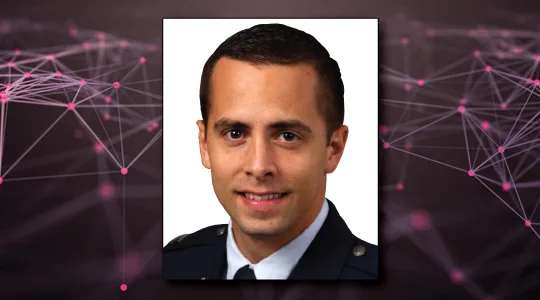
John Gilroy: Welcome to Constellations, the podcast from Kratos. My name is John Gilroy and I’ll be your moderator. Our guest today is Captain Jake Singleton, Air Force Research Laboratory. Captain Singleton has a master’s degree in astronautical engineering and has been involved with rapid technology adoption with a focus on investor engagement and increasing cooperation with international government and industry. Much like exchange students, the Air Force has a problem similar to this with our allies. In his role as an exchange officer, Captain Singleton is working with his peers in the United Kingdom. He plays an important role in promoting international cooperation and military research development and acquisition among several NATO countries. Captain Singleton, can you tell us a little bit more about yourself and how you managed to make your way to the UK?
Capt. Jake Singleton: Thanks, John. Thanks for having me here today. I’m excited to tell you a little bit about my story. It is a long story and I’ll try to keep it succinct, but I am an acquisitions officer. So, a developmental engineer by trade. Started my education in mechanical and then proceeded to get a master’s in astronautical engineering. As I came into the Air Force, very excited about figuring out how to deliver these new technologies to people that were at the tip of the spear, to our end users, our operators, and as I started to experience some of the challenges inside of program management, I learned that there was this gap. The gap really existed where we started to see emerging commercial space technologies that were coming out of the marketplace, independent of the government requirements, in a community of entrepreneurs and startups, investors, that we didn’t traditionally have a good relationship with because of our long processes. I started to see this problem of, there’s a lot of risks, not simply in technology development but simply in how we do business and we really need to change and transform that a bit. So, I had the opportunity at AFRL to start working in this area of figuring out how to position ourselves as early adopters for this new community of developers in the marketplace with accelerator programs, pitch days, and things like that. As I started to invest time and energy into these problems, we started to see some successes, and some of these successes were happening in the international arena in the marketplace here.
Capt. Jake Singleton: What I realized was the marketplace is a global marketplace, and so partnerships and successes here were going to require us to be working with partners in the industry outside of our borders. So, I had the opportunity to participate in an exchange program where I got to come out here to the UK and work for the UK under this exchange to work on some of these problems. It was really exactly that, trying to figure out how to take some of the lessons learned, the best practices that we have in the U.S., some of the unique authorities, things that the UK was doing really well, and bring these together to really just scale and multiply the results of what we were doing. So that’s really what drove me to get out here and under the exchange program that I’m participating in. I’ve been out here for the last couple of years with our UK partners and it’s really been an exciting ride with some challenges and a lot of successes.
John Gilroy: I’ve got to talk about this exchange thing. In a classroom, an exchange student is treated just like all the other students. So, I guess an exchange officer, you’re serving the Queen right now, is that right? What’s going on?
Capt. Jake Singleton: Yeah, that’s right. So, I’m active duty Space Force today, but functionally day-to- day, I work with our British partners, I’m tasked and work for our partners. I was riding the bus up to the UK MOD site that I work at with another DSTL colleague and one day he mentioned this phrase, he said, “Living the dream serving the Queen.” I just laughed. I’m like, “Oh, I’ve never heard that.” Obviously, we wouldn’t in America. But it really has been a neat experience to be working in an environment where I’m not just talking to our international partners, but I’m sitting in the office with them and we’re working on solving problems together. It’s just transformed the way that I look at the world and how we cooperate together.
John Gilroy: So, is there a parallel in the United States? Is there another exchange officer in Denver or something?
Capt. Jake Singleton: It doesn’t always work one-to-one. Sometimes it does. The exchange program, it’s not swapping personnel all the time, but it’s really giving a process and a framework to send these exchange officers into different countries. You can imagine the size of the U.S. Department of Defense. We have a lot of people, a lot more than some of our allies in their offices, so we’ll send out a lot of people. I’ve met exchange officers from the UK, Australia, and other countries that have come in to work within our labs as well, but it’s not always one-to-one. We do have exchange agreements under this program with 16 different countries, that we do send exchange personal around and that we can receive them from. Some of them have a little bit of different rules on how we do that, but it really is an exciting program that we have.
John Gilroy: Captain, one of your efforts is a focus on emerging commercial space technologies that can be matched with defense needs. So, what kind of needs or requirements are the Department of Defense looking for in the commercial sector anyway?
Capt. Jake Singleton: Yeah, that’s a great question. So, we use this term “dual use technologies” and these are technologies that have a clear commercial market as well as, you know, they can bring value to that defense mission as well. In different mission areas and technology domains, this overlap kind of varies. For space, the overlap from my perspective, is just nearly right on top of each other. There’s not any technologies that the commercial market is putting into orbit or in support of those space capabilities that can’t bring some value to defense. So, when you asked me that question on like what technology or mission areas, really it’s just about everything and there’s so much that’s just quickly emerging out of this commercial space market. But what’s interesting is that a lot of these companies, they’re developing these technologies because there’s a need in the market, there’s an opportunity to make money, right? They don’t realize that they have a big potential customer within the U.S. Air Force and the Space Force. Similarly, there are a lot of our end users or procurement officers and folks like that within the Space Force who don’t realize what technologies are coming out of the marketplace.
Capt. Jake Singleton: I can give you a good example. One of the first accelerator programs that we piloted back at the beginning of 2017, there are a handful of companies in there, one of which was developing, it was just a small couple of members of the team, they were looking at developing a constellation of space-based hyperspectral imagers for the oil and gas industry. They came up to us and they said, “The Air Force is here. Are you guys interested in space-based hyperspectral imaging?” We just shook our head like, “Yeah. We call it ISR. Curious, what are you guys building it for?” They said, “Oh, the oil and gas industry, because federal regulations say that oil and gas companies need to monitor gas lines for leaks and, today, people are just paying private pilots to fly the gas lines and looking out the window. It doesn’t really work, but they don’t have a lot of other options.” So there was this kind of realization, both from the company as well as from the Air Force customer, on, wow, there’s huge opportunities here. I’d say from that time in 2017 to now, we’ve made transformative changes within the Air Force and the Space Force to figure out how to better engage these new companies that are developing these technologies that can bring value to us. I’d say I really believe those opportunities that have been presented have been valuable for defense as well as the companies. I talk to companies all the time and it’s never been a better time to work with defense and the way that we’re working together really has helped and is healthy for both of us, for them, their investors, their customers, as well as our end users.
John Gilroy: Captain, this ISR is a real good example of emerging technologies and a lot of them are in the marketplace, as you said, just emerging out of needs. So, the question really is, how can the government find out about relevant technology sooner and apply them quicker? I guess you’re the lead on that.
Capt. Jake Singleton: Yeah. So, when we first explored this challenge of how do we do this better, what we tried not to do is create a government program to try to attract more of these companies. What we wanted to do is we wanted to step ourselves outside and have us be the one to pivot and to shift to be able to accommodate those relationships a little bit better. We found there’s a lot of companies that want and are interested in working with us, but they don’t know how. Our end user, our customer, is in a windowless building behind a barbed wire fence. Where do you start? What do you do? So, we looked at innovation hubs outside our gates where we can engage companies. We have a front door where companies can come in and talk to us and explore those opportunities. One of the big ones were these accelerator programs. You can really say they were already a best practice within industry where companies could participate in to get what we say is more investment ready. You’ve got these startups that are trying to close a business model and get to market, raise private capital, establish those customers, and the real successful companies that were emerging and disrupting these markets were coming through these VC-led accelerator and incubators. They were like a business boot camp where companies could get all the support they needed to get to market. The idea that we had was, while they’re going through this boot camp and getting investment ready, let’s partner them with some Air Force or Space Force customers to help them go through this process of beneficiary discovery where they could explore and validate quickly the potential military utility of what they’re doing. So now inside of an 8 to 10-week period, they’re pitching in front of investors and they also have a very clear value proposition for a real military customer and acquisition opportunity.
John Gilroy: I want to bring up a couple of terms. Now we have a lot of international listeners, so I’m going to spell this term out, then I’m going to speak it like it’s an English word almost. It’s A-F-W-E-R-X, AFWERX. When you started talking about it, well, it sounds like AFWERX. I guess you’re a part of that, I know you’re a part of AFRL, but is there a difference between AFRL and AFWERX? Just to make it even more confusing, there’s now a SpaceWERX too, so try to explain all those three in 10 seconds Jake, can you do that?
Capt. Jake Singleton: Give me 15 seconds. So AFWERX was this idea that we could, through partnerships, leverage all the innovation that was happening across the Air Force, both with our intrapreneurs, inside of the Air Force, as well as connecting those external innovators within the commercial marketplace to solve problems. So AFWERX was a startup of its own within the Department of Defense. It is currently today part of AFRL. So that answers your first question, what’s the difference between AFRL and AFWERX? Well, AFWERX is really an innovation shop within AFRL. They focus on a program called, Air Force Ventures, which is using the Small Business Innovation Research Program, America’s seed fund, to engage startups in a more transformative investor-like way. They also have a Spark program where they’re fielding solutions to problems from our own airmen and guardians, as well as the Prime program that’s figuring out how do we prime markets and let the commercial market drive the development in certain sectors. A good example, flying cars. So SpaceWERX is, as AFWERX kind of grew from its startup to scale-up phase, we also had the creation of the Space Force as a part of the Department of the Air Force, but its own service. So, the question was, well, should the Space Force independently have its own focus, like an AFWERX program, to gather all the innovation efforts and stakeholders to do something similar. The conclusion was yes. So SpaceWERX, similar to how the Air Force and Space Force has that relationship, similarly, the SpaceWERX is a part of AFWERX, but independently run to focus on those space innovation activities.
John Gilroy: You know, Captain, thousands of people from all over the world have listened to this podcast, go to Google and type in “Constellations Podcast” to get to our show notes page. Here, you can get transcripts for all 100-plus interviews. Also, you can sign up for free email notifications for future podcasts. I want to focus on projects here, maybe get a little more specific here. I know that the AFRL is involved in research and development with many international partners around the world and they’ve led the way in several projects that are accelerating technology for the United States and their allies. Can you maybe mention a couple of these projects and have they been successful or give us some real- world stories?
Capt. Jake Singleton: Yeah. So, we have had a rich history of successful collaboration between the U.S. and our international partners for decades. A lot of these programs have been focused on research and development within our own research and development facilities, like the Air Force Research Lab. In the UK, they have DSTL, which is the Defence Science and Technology Laboratory, and we have memorandums of agreement or understanding that are built to facilitate cooperation within R&D. We have one of these MOUs when we were talking about space called the Responsive Space Capabilities MOU. Underneath that, there are what are called project arrangements for specific projects. One of those is the Micro-Sat Military Utility Project arrangement. We have another one focused on responsive launch and range. We use those agreements to cooperatively look at responsive launch, small satellite development, hosted payloads, as well as looking at how do we pull data and exploit data sources together. So those are our programs and projects that we’ve had ongoing for some time with a lot of success. What we’re currently thinking about more is, as we’ve seen the technology development landscape around the world shift from being government-driven to private sector-led, how do we get our international partners like the UK and U.S. and others to cooperate in a similar way? So, where our focus is not simply pulling R&D out of our own labs, but how does the U.S. and the UK together look at partnering with the startup community and adopting solutions from the marketplace. That’s really what’s been exciting in just the last 12 months and what we’ve been focusing on.
John Gilroy: I have to bring up our audience again, this is a term used, MOU, in the federal government. Everyone tosses it around like a baseball or something, but it’s a memo of understanding, MOU, that’s what people use. I didn’t want to have our audience go, “What’s that?” and type it in trying to figure what it’s all about. In researching your background, it looks like you’ve been closely involved in a London-based accelerator program. It seems really similar to the ones in the United States you’ve mentioned before, and I guess the association has been successful. I guess one example is the ISR. Have any other ideas been useful for the DoD?
Capt. Jake Singleton: Yeah. So, the accelerator program you’re referring to, I believe, is the Seraphim Space Camp. So, Seraphim Capital is a London-based VC that is very prominent in investing in new startup space ventures around the world. They’ve had a lot of very successful companies come out of their portfolio in the last couple of years. So similar to how I talked about within the Air Force over the last few years, we’ve been engaging with accelerator programs to figure out how do we find those dual use opportunities. The UK, in their own independent ventures have been exploring the same things. One of those was through this partnership with Seraphim. So DSTL, again, that’s the Defence Science and Technology Lab, it’s the science and technology arm of the Ministry of Defence, and they’ve been partnering with and participating in this Seraphim Space Camp over the last couple of years. Twice a year they’ll run a cohort of anywhere between 6 and 10 companies that are again getting investment ready, maturing their business models, and DSTL is engaging to really introduce to these companies, here’s how you might work with the Ministry of Defence, here are what some of our needs are. There are some great examples of companies that have come through there that have been successful. One of them, we talked about ISR and space-based hyperspectral in the U.S. One of the companies coming through here which has successfully raised some capital recently has been looking at a constellation of about 100-kilogram class satellites doing thermal imaging from space as well. So that’s a very clear dual use opportunity that the Ministry of Defence has been able to explore and look at because of partnering with the Seraphim program.
John Gilroy: I want to maybe take a closer look at this DSTL. Inevitably, you’re learning a lot of lessons over there interacting with all these different people and you’re interacting with the space program that you talked about earlier, the Defence Science and Technology Laboratory for the UK Ministry of Defence. That’s Defence with a C, isn’t it?
Capt. Jake Singleton: It is. That’s correct. I have to spell it differently every day.
John Gilroy: Yeah, it must drive you crazy. So are there major differences, minor differences? Is it something minor like a letter in the word or similar concerns, similar goals? It seems real close, doesn’t it?
Capt. Jake Singleton: Yeah, very similar. I’ve learned that we have a lot of similar challenges as we’re doing research and development. As you consider how we fund our R&D for defense in using taxpayer public dollars, we take very similar approaches to how we run competitions, including things like competition to get good value for the money. A lot of our processes are similar. Similarly, we’ve run into very similar challenges. I thought it was funny coming out here that I hear a lot of our UK partners complaining about the same things that we do. It’s funny because they’ll point at the U.S. and say, “Oh, you guys probably don’t have these problems. You guys have probably figured this out.” I think, “No, we haven’t. We have the same frustrations and we point to you guys thinking like, oh, the UK is doing it better.” But what I have found is that there are a lot of real ways where we can complement our strengths and our weaknesses to really accelerate the results of what we’re doing. We were able to do that this last year with our international pitch day. We might talk about that later, but the strategy that we came up with in the end to deliver that program was a strategy that independently both of our countries couldn’t have run alone to reach the same results. So, I am a firm believer that aligning these complementary programs in both the countries can allow us to achieve results that we can’t individually.
John Gilroy: If you take a look at the DSTL, I think it has a new division called Exploration. It looks like this division will identify and accelerate transformative technology systems and concepts for defense and security. So, give us some more insight on this. Do we have something comparable in the United States or is it just in the UK?
Capt. Jake Singleton: I think there are a lot of comparable programs. The Explorations division, it is just like you described it. It’s looking forward, it’s looking into the future, it’s looking at what are these opportunities that maybe don’t fit that we should be thinking about that are going to have big opportunities for impact in the future. Whatever organization you look at in the U.S. are going to have similar approaches. AFRL just recently did the S&T 2030 review where they were trying to look at what are the priority technology areas that we should be looking at? So, Explorations within DSTL from the concept of looking forward with future into these new opportunities, it’s not really a new concept because other groups and divisions, they’re always trying to have a future-looking vision. For example, within DSTL’s space program, they’ve had in the past an explorations kind of focus as well in how do we look and receive these kind of new emerging ideas. I think what is important to recognize is the emphasis and the priority that DSTL is putting on this today in having a dedicated division within its ranks to focus on exploration and new opportunities.
John Gilroy: Well, Captain Singleton, I want to pivot here from space to security, and the term that’s used of course is DevSecOps. So, when you think of DevSecOps, are there any suggestions that come to mind in ways that we can improve or facilitate improvements both internally and with our coalition partners so that everyone can share these improvements quickly?
Capt. Jake Singleton: Yeah, I’ll be honest, I won’t be an expert, an authority, on the DevSecOps. I know a lot of our airmen and guardian that have been involved over the last couple years of really introducing DevSecOps into how we develop and procure software for the Air Force. It’s been very exciting and it’s one of those changes and pivots that I believe is transformative, it is disruptive, and it’s going to give us that competitive edge in the future. It really gives me hope because sometimes we struggle through using archaic old traditional processes that aren’t relevant anymore. I think the use of DevSecOps with software development is one of those that is allowing us to be relevant as we move into the future. When you ask that question of are there opportunities you consider an international and a coalition approach and I would say, yes, absolutely. You could imagine an environment where the platform and the players that are providing this DevSecOps for the U.S. could, through a tech transfer strategy, provide the same support or allow our UK partners to adopt in a similar way. I know we’ve had conversations and are thinking about those sorts of things, but I guess to answer your question in a simple way, but without being a technical expert or authority in that area, is absolutely yes, we should, and I think there are opportunities through tech transfer activities where the UK or other international partners could leverage the same resources, lessons learned, to introduce similar processes within their ranks.
John Gilroy: You know, Captain, I had the pleasure of interviewing Nick Chaillan, Air Force Chief Software Officer, and I think maybe in the interview or after the interview he said that collaboration with industry is a key to the success of advanced cloud and software efforts. So, do you think that this collaboration with partners here as well as industry is important? Really, how do you create an environment where everyone can securely share these new ideas? That’s the challenge, isn’t it?
Capt. Jake Singleton: It is a challenge. It’s an absolute must. When you think of this strategic competition around the world with emerging technology and just how our operations are changing, we have a couple advantages here against our adversaries. One is just the absolute genius of our American innovators, both within and outside of defense. The spirit of our entrepreneurism is just unparalleled, and it will always give us an advantage if we can harness and partner with those. Beyond that genius of our entrepreneurs is our alliances and partnerships. They’re absolutely necessary and important and they’re something that others don’t always have. I’ll give you an example of why this is so important for space today. You can consider this as we’re onboarding these critical new solutions and innovations from industry. That is because when we think about the talent, the solutions coming out of industry, we have to recognize that that is not a U.S. industry today and that a lot of the solutions are emerging out of this international or global marketplace. We often talk about this gap that has developed over the last several decades where all of a sudden, a lot of the funding is coming from non-government sources into this community of entrepreneurs. But there’s a new trend that really has emerged in just the last couple years, and this is where it’s really exciting and it highlights the challenge here. The 2017 timeframe, when there was a record number of new investors investing in startup space ventures with record numbers of capital, the majority of these investors were now non-U.S. investors. Then, when you look just a year later in 2018 the majority of the deals were going to non-U.S. companies. So, you have all of a sudden, the last couple of years, record amounts of capital that is now dominated by non-U.S. investors with the majority of deals going to non-U.S. companies. Now, folks will say, “Hey, well, what about SpaceX? There’s billions of dollars and this is U.S., right?” Well, while they dominate the headlines, what Seraphim Capital in a recent report highlighted is that there are nearly 200 companies from around 30 different countries currently raising capital today for new satellite constellations and that should be of interest and exciting to us.
John Gilroy: Oh, that would scare some people, I would think, wouldn’t it?
Capt. Jake Singleton: Right. I say that because if we fail to recognize that we need a solution and a way to work with allies to adopt solutions from that global marketplace, if we fail to do that, we’re missing a lot of these solutions that are emerging in the market. That wasn’t a real concern 10 years ago. It is today.
John Gilroy: It’s almost like the ostrich putting his head in the sand thinking they have all the answers and there’s a lot of stuff going on around them.
Capt. Jake Singleton: Yeah.
John Gilroy: Captain, earlier you mentioned pitch day and I didn’t want to steal your thunder. If you want to expand a little bit on that at the end of the interview here on how you handled pitch day over there?
Capt. Jake Singleton: Yeah. So that’s a perfect time to mention it. We talked about the environment today with these trends. There are technologies emerging independent of government requirements, again. They’re emerging outside of the U.S., around the world. So, we have to ask that question, do we have a way, an ability, to attract and work with these companies? International Space Pitch Day was a first pilot and demonstration that we can when we work with partners. So what we did for International Space Pitch Day is we took the lessons learned from these accelerator programs that both the U.S. and UK had been engaging with, as well as the model of these pitch day programs, and I can talk a little bit more about that in a minute, and we took all of that and we scaled it into this global environment. We took challenge areas that were shared by the U.S. and the UK in combined space operations, we ran an industry accelerator program where companies from around the world could engage with our end users and our stakeholders to learn and understand what these problems were, and if they were interested or had relevant solutions, they could submit a proposal to participate. We had over a hundred suppliers engaged through this process from over 15 countries around the world. We down selected to about 15 companies from around the world to participate in some design sprints that we ran that allowed them to really refine and understand through more iterative interactions with those end users what that value proposition was and then pitch at our international pitch day.
Capt. Jake Singleton: We had a panel of UK and U.S. military space decision makers sit on a panel together, now, given this was 2020 and in a virtual environment, we had the companies pitch their solution to them. This panel was able to make decisions after the pitches motivating contract awards that same day. So companies were able to pitch to both the U.S. and the UK customers together in response to shared challenges in space operations and were able to walk away with contracts funded on behalf of both the U.S. Department of Defense and the UK Ministry of Defence. We had 10 successful companies this year out of the 15 that pitched. These companies were from the U.S., UK, as well as India and Australia. We’re really excited about the solutions there. That was just unprecedented. We had 14 different defense organizations from across the U.S., UK, and NATO participate and we awarded on the spot contracts to emerging foreign startups from around the world.
John Gilroy: Wow. I love the success story here, really putting innovation in work boots, aren’t you? That’s great. Well, Captain Singleton, our listeners have learned a lot of lessons about international cooperation to foster innovation. I’d like to thank our guest, Captain Jake Singleton, Air Force Research Laboratory. Thank you, sir.
Capt. Jake Singleton: Thank you so much. I really appreciate the time.