Transcript:
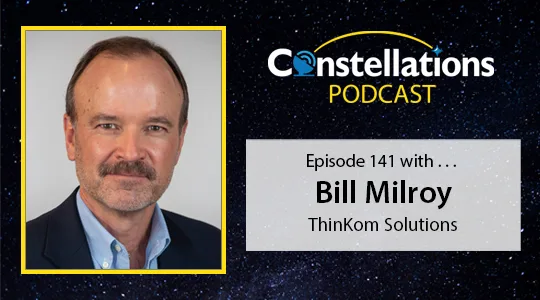
John Gilroy: Welcome to Constellations, the podcast from Kratos. My name is John Gilroy and I’ll be your moderator. Today, we take a look at the ground and specifically at antenna systems. How do they adapt to the fast-changing satellite technology and demand both on the commercial and military sides? To cover that topic, we are speaking to Bill Milroy, the chairman and CTO of ThinKom, an innovative leader in antenna systems covering connectivity in X, KU, KA, and Q band for commercial and government applications. Bill, let’s jump right in here. Satellite technology is changing at a rapid pace. As an antenna manufacturer, how do you keep up?
Bill Milroy: Sure. I am a fan and I appreciate the opportunity to participate in the Kratos podcast series. I had an opportunity to look at quite a few and I’m looking forward to adding to the very rich background that you have available. So relative to satellite technology, yes. Satellite technology is particularly today moving at a rapid pace. People probably hear about the moves that the various constellations, not just the GSO constellations, which we’ll maybe talk about a little bit later. But also, on the NGSO or the LEO constellations that have made a lot of news. We at ThinKom, being an antenna manufacturer, we of course need to follow the market realistically, but we try to do what we can to lead. We believe we’re doing a good job and the industry as a whole is doing a good job in leading, in terms of interoperability. As we have more and more constellations available, the need is for more and more terminals to be able to work towards interoperability, to work on different frequency bands, different orbits, different types of constellations. So that’s something I’m hoping we’ll have an opportunity to talk to a little bit during our conversation.
Bill Milroy: So really that breaks into in the jargon in the industry that the prefix multi is used a lot. So there’d be multi constellation, multi orbit, multi beam, multi band. So if I can, let me just say a few words about each. So multi constellation really has been around for a long time. It just means in a given type of satellite setup, like a GEO satellites that have been around for some time, you want to be able to work on not just one constellation, not just one owned satellite, but you want to be able to work on everyone’s satellites ideally. Then multi orbit applies that with GEOs, which have been around for some time and will continue to be around for some time, that you would like to be able to move on to the MEOs, the LEO constellations and that we read so much about. So that would refer to the multi orbit. Multi beam is not always required in terminals, but it’s becoming more and more preferred. And that means that your antenna terminal would need to be able to not only create one beam, but perhaps two beams, one beam being on one GEO satellite and one on a different LEO satellite or on two different LEO satellites. And hopefully we’ll get a chance to talk a little bit about what the advantages of that are.
Bill Milroy: As the fourth multi, which is multi band, as they always say, you can never be too rich, too thin, or have too much bandwidth. So as bandwidth extends into larger and larger bands, we’ve started at KU and we’ve now added KA. And at some point in the near future we’re going to add other bands like Q and V band. That’s just the way the evolutions market’s going. And here at ThinKom, I like to think we are leading in all those areas. At least we’re doing our best to anticipate where the markets are going and making sure we’re checking the boxes along all those different parameters.
John Gilroy: Let’s go back to my first question about being an antenna manufacturer. And so you must have a very good idea what’s going on in the satellite communications industry, because you have a limited number of resources, limited number of human beings, and eight hours in a day to manufacture these. And so it must be a challenge just to know which ones to focus on. Is that right? Or you just have a bus and then you apply different segments to that bus?
Bill Milroy: No, that’s spot on. For sure we try to evolve our designs and have some amount of commonality, particularly preserving the parts that we’re best known for. Here at ThinKom, we’re best known for our reliability, so we don’t want to stray too far away from the basis of that. That brings us that great industry leading reliability. And we are here at ThinKom, speaking specifically to us, we’re about 140 people, so that’s medium size, small depending on what you’re comparing to. But it means we can’t go after each and every opportunity even if we think it’s promising. So you’re absolutely spot on, John, that we need to do our best to predict which areas that we bring the most value. We like to think extreme value. I’m sure most of our competitors do the same thing, but we place our bets and hopefully we’ll win in the long run.
John Gilroy: We’ve been doing this podcast for five years. We talked about every topic under the sun, I think. And I think we talked about phased array antennas a while back. But there are new listeners. We have thousands of new listeners all over the world. For the benefit of our new listeners, can you give us a brief overview of what this phased array antenna is?
Bill Milroy: Sure. We get this question a lot. So without getting too much into the technical detailed descriptions, everyone knows sort what an antenna is. There’s all types of antennas. Most of the satellite antennas we see are either a parabolic dish that’s maybe on someone’s house or at a business on the roof or we see on a top of an airplane dearer and dearer to our hearts here at ThinKom, you’ll see a radome on top of the antenna and hopefully a thin radome, which is kind of our signature in that industry.
Bill Milroy: But in terms of phased arrays, phased arrays are generally anything that’s not a parabolic dish. So if it’s an antenna and it doesn’t look like a dish, it’s probably a phased array. Now, phased arrays can be in different flavors. So for instance, a phased array could just be a panel that has a gimbal, a couple motors that point it in different directions. That’s technically a phased array.But I think as we move forward, the definition of phased array is really narrowing down to more, what will we talk, an electronically scanned array or in the case of ThinKom, we have a mechanically, a mechanical phased array.
Bill Milroy: So let me say a few words about that. Under the subset of electronically scanned arrays, these could be active antennas, meaning they have a separate LNA and H high power amplifier behind each element. They could be a passive electronically scanned array. Or in the case of the ThinKom VICTS array, it can actually have a centralized low noise amplifier, a centralized H high power amplifier, and then mechanically move the antenna back and forth. When I say mechanically move back and forth, when you look at a ThinKom array or you look at an electronically scanned array and you see and they’re scanning actively, you don’t really see anything moving. You don’t see any moving parts. So the distinction is somewhat esoteric and internal, but the key, when we use that term now in the industry and we use the term phased array, I think everyone has in mind either ThinKom VICTS array or an electronically scanned array from various competitors.
John Gilroy: We’re recording this in the Washington DC area and the Pentagon’s just up the road. So the military community is very interested in reliability. And so I want to do a little bit deeper dive on that. I went to YouTube and typed in Bill Milroy and I found a video with you. And Bill, believe it or not, you used a four letter word and the four letter word was M, T, B, F. Mean time between failure. This is an old term from back in the hard drive days, back 15, 20 years ago. They’d build hard drives and say, well, it’s going to, certain number of hours, it would fail, but it’s average of fail and this or that. So tell us about mean time between failure and antennas.
Bill Milroy: Sure. So yeah, the F for failure, it doesn’t seem like a very positive way of looking at things, but yes, that’s a very common term. The mean time before failure in the airline industry, I think the benefit of having mean time, a high mean time before failure, that’s what you want to have. And of course as the mean time before failure becomes larger and larger, we can realistically call the antenna or the subsystem more and more reliable. But in an airline industry, in a commercial airline industry, it’s very expensive and tedious to take an airplane and put it in the hangar and replace the antenna that’s on the outside of the aircraft or to service the antenna on the aircraft. So reliability really translates into dollars. And in the military, if you’re taking antennas, like ThinKom antennas are actually enclosed in some aircraft. I mean actually no radome. They’re actually embedded in the plane.
Bill Milroy: So obviously if you’re embedding an antenna or any other device into a vehicle or an airplane, it’s key that the system be reliable. And so then also in terms of numbers, not to go too much in numbers, one of the things we’re particularly proud of at ThinKom is in the aeronautical marketplace for instance, we’ve just passed 30 million flight hours with our system. So that’s a pretty storied past that’s accrued over many years, and we’re proud to say that we lead the industry. We have about a hundred thousand hour or greater MTBF, meantime before failure. So that’s something we really concentrate on. If you don’t have a high MTBF, that’s something people pick on you and generally that could be a big competitive disadvantage if your MTBF isn’t up to snuff.
John Gilroy: Well, from the ground to the sky. I have a friend who owns a testing lab in Chantilly, Virginia here and he tests aerospace equipment. He designs his own testing equipment, these big huge boxes and everything else. And so I think when you try to test stuff, it’s okay to temperature testing or pressure testing, but when it comes to outer space, it’s tough to test it. So what about the challenges of creating antennas for deployment in space vehicles? It’s got to be a hard environment to try to even think to test it, isn’t it?
Bill Milroy: Oh, sure, absolutely. So some people have likened it to being that the launch is particularly from a shock and vibration, it’s three to four minutes of terror followed by a lifetime of relatively benign shock and vibe. But then once you make it through the shock and vibe of the launch and you’ve survived, obviously that’s key, now you have more long term effects. You have radiation effects, outgassing, multipaction, passive intermodulation. These are all terms, I wasn’t planning you to go into each and every one of them, but they’re all unique to the space environment. So as people like to say, space is hard and in fact it is. So, you can’t just take an antenna that works well on the ground or even an antenna that works well on an airplane and without any further consideration, put it on a satellite and hope it works well. So we are the other parts that go into the space part and it depends. The industry is really has, it’s segmented. So you have the CubeSats, the nanosats that are very small, smaller than a loaf of bread if you will. And oftentimes those are launched and it’s okay for them to only survive a year or two, maybe even a little bit less in orbit. On the other hand, the other extreme there are the really large payloads, the really strategic and expensive, super capable payloads that are going up into GSO and costs hundreds of millions of dollars. And those need to, typically you need to absolutely meet 15 years. So you need to be able to work at least 20 years in that really harsh environment. So this influences everything, influences the design, the assembly, for sure, the testing, the ground testing before we launch. It influences the materials that we select.
Bill Milroy: But when it comes down to it, it’s very similar to what we’re already accustomed to. Reliability is key because it’s very difficult to service these or it’s impossible today to service them. People are trying to work on ways to service satellites on orbit, a lot of creativity there. But in general, you’re not going to get a chance to do any maintenance on the antenna and it has to be very capable. It has to be very light. I guess that’s sort of a given. You need to be unusually light because it’s expensive to launch things into space and you need to be compact because all these satellites need to fit or the satellite antennas that are on the satellites need to fit into a very confined environment to be able to fit into the launch rocket itself. So these are all the additional considerations that going forward with the space base and it’s an exciting area. We’re just, have our first antenna in space qual right now and with a little bit of luck, we’ll launch our first antenna next year.
John Gilroy: Bill, I got a multi frequency question for you. So next August, I’ll be in LA. So if I drive by your manufacturing facility there, will the sign say one ring to rule, one antenna to rule them all? Can one antenna cover all the frequencies?
Bill Milroy: Well, there’s two, I guess that’s a two part answer. I think the answer is yes, but at what cost and what practicality? So I would say if you had asked me or invited me on the podcast a while back, maybe two or three years ago and asked me to you, is there a benefit to doing KA and KU band? Those are two very popular frequencies. So for the listeners, KU band is generally considered the 10 to 14 gigahertz frequency band. KA, I’m referring to roughly the 20 gigahertz receive band, the 30 gigahertz trans band. But so we refer to those as KU and KA. And a few years ago, there was global coverage available for KU, regional coverage for KU, but only regional coverage for KA. That’s when KA was just getting started. But today you have over water capability with multiple constellations at KA global. You have lots of regional capability. You have lots of over water capability in KU, a lot of also regional capability.
Bill Milroy: So today it’s harder to make the argument that you really need to do KU and KA because you have such a rich multiple constellations, multiple suppliers, multiple orbits that are going to work in either band. And if you do add KU and KA, which is something we can do and in some niche cases are doing here at ThinKom, the downside is there’s really no free lunch there. We have to add more equipment, more weight. We like to think we do a better job of that than anybody else. But when you get down to it, it is an extra overhead on the cost, the size, and the weight of the system. And I think it’s more difficult to actually make the argument that you need to do all the bands at the same time. That being said, there are some select cases where we may want to move to other frequency bands. So I want to make just a mention here since this is the frequency topic.
Bill Milroy: We think at Q and V band are going, which are, Q band would be in the 37 to 42 and the 47 to 52 gigahertz band, for those who are keeping score. But those bands I just mentioned, that’s 10 gigahertz of bandwidth. So that’s three times the bandwidth that’s available today. We see the market moving to that direction and that might be a standalone antenna that can do Q and V band. We do that already at ThinKom. Or it could be a hybrid antenna that works in KU or KA, but also does Q and V band. So I think the answer is, it’s probably not worthwhile to do one antenna that does DC delight, that does S band all the way through W band, which would be the multiple extreme. But there are cases where it’s going to start to become important to do at least two bands. And I just made some examples where I think that that’s going to have some utility going forward.
John Gilroy: In Washington DC here, a lot of the software companies are having real challenge moving to software defined networks. I would imagine there’s similar challenges in software defining antenna. Is that true?
Bill Milroy: Absolutely. So ThinKom, we use software for sure. We’re mostly would be accurately characterized as a hardware company. So software defined to us really would mean reconfigurable hardware, hardware that can work using different software on different systems. So as an example, our thin air product line, it’s like a lot of our competitor systems, they go on different aircraft. We already mentioned multi constellation. Usually each constellation has its own modem requirements. Each modem has its own software requirements. So we already have to be able on a software defined basis to move back and forth between those. And as we move to multi constellation, as I mentioned, that would be the LEOs, the MEOs, the GEO satellites to be able to work all those. Likewise, those all have different software requirements as well. And then as we add software, the cybersecurity part becomes an important part as well. Because the cybersecurity, although it could have some influence on the hardware, it’s generally a risk that’s defined in the software. So as we add more and more software features to our systems, that means that we need to also remain vigilant and have increasing vigilance, if you will, with cybersecurity.
Bill Milroy: And then I wanted to give one other example if I could on the software defined antennas. There is a movement that, sometimes the term is used as virtualization, software defined or reconfigurable. We have a ground station product here at ThinKom that we’re just getting started with. And the ground station product is, imagine you have parabolic dishes. So generally, a parabolic dish can cover multiple bands, but one dish can only service one satellite at a time from a ground station standpoint. What we’re finding is customers are finding this exponential growth in the number of satellites that are up is forcing an exponential growth on the number of satellite beams that these ground stations, these gateways can service. So there’s a couple ways to go there. One is if you need to have 5x the number of beams you have, you can buy 5x as many dishes. But there’s a whole lot of reasons that that’s not considered to be a viable way to scale your system. So instead, people, including ThinKom, are looking on reconfigurable phased array based systems that are on the ground. So that phased array based system can mimic a very large dish, say a seven meter parabolic dish, to make a link at low elevation angle to a very small satellite. But when it’s not doing that, it can create four beams, eight beams, 16 beams to service a much larger number of satellites. And we’re finding that that seems to be bringing, really resonating with potential customers, the ground station customers and the satellite constellations that depend on the satellite ground stations. So that’s another direction for software defined antennas.
John Gilroy: That’s interesting. You kind of set the table for this discussion with your multi, multi, multi at the beginning. We’ve talked about multi frequency, and now we’re going to move into multi networks. So can one antenna system work with different satellite networks? Or can you make it so that antenna is not proprietary to one system? And what about open systems? Does open systems have anything to do with this discussion?
Bill Milroy: Oh, absolutely. There’s been a, because of the increase in the variety of orbits, the variety of constellations, this has really pushed a more and more push to having an antenna that can work on a variety of systems. So depending on how you look at it, there’s a yin and a yang in the marketplace between being very stove piper proprietary. We see acquisitions going on in the market, which moves more to a proprietary solution where you get everything from the ground station to the satellite to the service to the user terminals. And that has some advantages, particularly from a supplier standpoint. However, customers are generally want to pull in the other direction. They want buy one terminal that can work on all these multi constellations, multi orbits, and also in the multi bands as well. So I’ll use the aeronautical market as an example, the IFC inflight connectivity market.
Bill Milroy: There is a lot of push particularly from the folks like Airbus, Boeing, Embraer, but also from the airlines themselves. They would prefer, much prefer to have an agnostic system, an antenna that they can put on the plane, install at the factory. So Boeing or an Airbus would like to sell the plane with that built in already with the idea that it’s a future proof solution and it’s agnostic, so it can work on all the different constellations. And you can kind of see from a customer standpoint, whoever’s paying the bills and negotiating the recurring cost contracts, that is much preferred. So at ThinKom, we say viva la difference. We certainly do supply to folks who have the proprietary model, but we are very capable and I think it’s been part of our success to be very agnostic to work, walk the talk if you will in the multi constellation, multi orbit arenas.
John Gilroy: Bill, I mentioned earlier that the Pentagon is just down the road so let’s talk about the Army. What kind of an antenna is the army looking to integrate into their SATCOM modernization efforts and what qualities would that antenna have?
Bill Milroy: Well, let’s see. So the Army, wow, there’s a pretty big diversity of users from the dismounted soldier individual up to the brigade needs into the vehicles, the Bradleys, the tanks, and then of course the Army even has its own air Army aviation group as well. So the Army, I’ll give a couple of an examples. There is, and this is just really scratching the surface, there is this terminal system called the NGTT, the next generation tactical terminal. And the Army vision there is to really take that agnostic type of antenna system I just described and really apply that to the Army. So the trick there is to have all those agnostic features so it can work with any network but at a cost point that allows it to be deployed, not just to be in an exquisite solution that can only go in a few vehicles, but an inexpensive and affordable solution that can go on lots and lots of vehicles. Part of that of course, as well, is when you think on the vehicles, if you look at an army vehicle, it doesn’t have a whole lot of room in it. It’s got to turret or it’s got a gun or it’s got a missile launcher or it’s got a hatch. So it’s important these antennas be very small and also very low profile as well. That’s important for a lot of reasons. You can have blockage from the antennas. Maybe you want put more than one antenna on the platform. In any case, it’s a very challenging environment.
Bill Milroy: So in the next generation, the NGTT terminal, the Army is actually requesting to be able to do all constellations. So that means they want to work all KU band and KA band, which I discussed before. They want to work on all geo constellations, both commercial and military, and they want to work on all LEO constellations, both commercial and military. So they’ve thrown down the gauntlet that the reward here is if you can do this then the Army anticipates that you would be able to sell thousands and thousands of terminals. So ThinKom, just as many of our competitors, see that as a pretty big opportunity. And are we’re, to go back to swimming parlance, we’re paddling real hard there.
John Gilroy: I got a post office question for you. This is a new one. When my wife goes to the post office, she buys forever stamps, don’t have to worry about increases. So how do you make your antennas future proof?
Bill Milroy: Ah, okay, great question. Of course future proof is a great, obviously if you can get a, if you’re at the store and you can buy, you’re going to go and buy a home electronics and you can buy the future proof electronics or you can buy the works today, maybe not tomorrow, of course you’re going to go with the future proof. So to us the future proof, it kind of takes a lot of those catch words that we already use. Modular, so in the case of aircraft for instance, it’s obviously not something you can do laissez faire to attach things or take things off planes. So we design antennas that are modular. So if you change your mind to say, hey, I put a KU band system on, I wanted to go KA band, we make a modular solution that you can switch quickly in a hanger, do as an overnight operation and not have to take your plane out of operation. So modularity is important.
Bill Milroy: We already really touched upon software defined. So software defined, inherent in software defined is the ability to be future proof. We talked about anticipating frequency bands. I mentioned I think the market is going to move to Q and V band. Not move, I shouldn’t say move. I should say really add Q and V band because that bandwidth is just so it’s going to be impossible to ignore that 10 gigahertz of bandwidth as folks’ bandwidth and data rate requirements continually, seems like unabated, continue to rise. You also have to, on the antenna parlance, we have to cover all the different polarizations, the frequency bands. And then segueing back to the beginning of our conversation on the multi, so that future proof terminal better be multi orbit, multi constellation, perhaps multi band, and perhaps even multi beam.
John Gilroy: Earlier in this podcast, you on a consideration of some of our newer listeners, you described phased array. During the podcast, you kind of tossed out this term GSO. Maybe for our newer listeners you can differentiate between GSO versus non GSO.
Bill Milroy: Sure, another great question. So I know it could be kind of confusing. So GSO stands for geosynchronous orbit, and that means that’s the type of satellite that people are most accustomed to. So that’s, I think people realize when you put a DirecTV or an EchoStar dish on your house, first thing you notice, you can point it and forget it. So you kind of know in the back of your mind, maybe you don’t know the details of it, but the satellite’s probably not just floating there. It’s probably not burning fuel. It’s actually orbiting in the earth. It just happens to be orbiting the earth exactly at 24 hours. So as observed from the ground, as the earth rotates and the satellite orbits, it always stays pointed in the same direction, which is kind of a whole nifty invention and really obviously enabled the satellite industry. So that’s the geosynchronous orbit. Now there’s a flavor to that called an inclined orbit. Oftentimes satellites when they run out of fuel, they don’t fall, but they begin to drift. And so inclined orbit means the satellite sort of stays in the same position, might drift a few degrees up and a few degrees down during the day, but that’s an inclined orbit GSO.
Bill Milroy: Then under the generic term, non-geosynchronous orbit, that pretty much covers everything else. And there are three flavors to NGSO. One is HEO, that’s called a highly elliptical orbit system. So that is a system that’s actually at a very high altitude, but it’s an elliptical orbit. So in the North Pole actually you may not be aware, but at the North Pole you can’t see a geosynchronous satellite. It’s actually below the horizon because of the finite distance to the GSO satellite. However, so how can you get service up there? Well, many of the LEO and NEO constellations would say you can use us, but the HEO is another opportunity. So where you actually launch the satellite and it dwells, it’s still moving in the sky, but it goes very slowly and that then enables you to have coverage over the North Pole. And there’s some folks who are working in the near term in Marsatis. One will have that capability here actually next year.
Bill Milroy: But perhaps the better known are the MEOs and the LEOs. So MEO would stand for medium earth orbit and LEO is low earth orbit, obviously tied to the height that the satellites are. And although the MEOs travel a little, they’re a little further from the earth, they take a little bit longer to orbit. The LEOs are closer to the earth, orbit a little faster. The solution or the requirements from the ground terminal are the same that we need to be able to track those satellites. So a satellite might rise and it might set, that might take three minutes for that to happen. It might take 15 minutes. But in any case, it requires from the terminal standpoint, segueing back to ThinKom and our industry, it adds that added challenge that you need to be able to track that satellite even if you’re on a fixed platform, because the satellite itself is moving. So that brings you to, that defines the multi orbit domain, the GSOs, and the NGSOs.
John Gilroy: Bill, I want to keep with the theme of this interview, it’s multi, multi frequency. Multi network. Now we come to the point where multi constellation. So will modern SATCOM terminals have to address these different types of constellations? Would you want to consider a hybrid of GSO and non GSO and is it possible? And what would even get you?
Bill Milroy: Sure, with respect to being able to switch between GSOs owned by different companies, that would be the multi constellation, that’s something we’re already doing and it’s been common in the industry for a while. But now adding the LEO constellations or having a LEO capable system, as I mentioned, it does add a little more complexity to the system because we need to be able to move the beam quickly from the satellite that’s setting, because now it’s moving, to the satellite that’s rising. So we have to be moving the beam continuously, although not very quickly. These satellites, they move slowly across the skies. As I mentioned, might take three minutes, it might take 15 minutes to go across the sky. But the next step we think is what we would call a fusion. And by fusion that’s not being a system that can work on a LEO or a GEO. It’s a system that can work on a LEO and a GEO at the same time. So let me explain the benefit of that. So if you can work on a GEO, now GEOs are generally, there might be some arguments that they might be another subject for a different podcast guest, but most people would argue that the GEO satellites have the ability to concentrate a lot of capability in urban areas so that over the New York City area or over the southern California area and they’re able to do a better job than LEOs, I won’t go into all the viscous of it, to provide more band in that area because the satellite doesn’t need to put or waste, if you will, bandwidth over areas. 70% of the earth is ocean. And with the exception of a few ships and a few planes, that’s kind of a waste.
Bill Milroy: Whereas a LEO satellite has to spend time over those waters whether it wants to or not because that’s the nature of its orbit. So, GEOs have an advantage there. However, when GEOs get picked on, one of the disadvantages of GEOs is the fact that they have latency. Because they’re 22,500 miles up, it takes more time for the satellite signal to go up to the satellite, down back to the ground, as compared to a LEO satellite might be at only 200 mile, 300 mile altitude. So it’s much, much shorter. So the advantage of the LEO is that latency. So that gives you that quicker, quicker speed, more like a 5G experience than you can do with a GEO. So where I’m getting at is if you could do LEO and GEO, and there’s smart people, not necessarily at ThinKom, but at folks like Qs and ViaSat who are able to shape, I think this is the right term, the IP traffic. So that the IP traffic, which is generally like 10% of the traffic that can benefit from the low latency of the LEO. You put that on the LEOs. But the other 90% that for people streaming is an example that benefit most from GEO satellites, you can put them on there. So you can have the best of both worlds. This is more like a one plus one equals five kind of solution. So that’s where I think the market is moving to in terms of not GSO only or NGSO only, but doing those two simultaneously, fusing them together, and providing a much better experience, net experience for the user.
John Gilroy: Bill, we talked multi, multi, multi all through this discussion. So I’m going to give you your last question and I’m going to assemble all the multis together for you. So with all the software defined technology, it seems that you can connect more networks and more orbits. Does the same apply to satellite networks? It seems the ideal SATCOM system would tap into all the satellite resources. Is that capability available today? A multi, multi, multi world?
Bill Milroy: Yeah, we’ve kind of touched upon that a little bit in the other questions, but it’s a great one to finish up on. The answer is yes, but as I mentioned before, there’s really no free lunch. Generally, there’s be some compromises and those compromises might be for those of your listeners that are accustomed to the government parlance, the SWAP or the SWAP C. That’s the size, weight, and power, and the C stands for cost. A system that could do everything, I guess realistically is going to be a little bit bigger, it’s going to weigh a little bit more, it’s going to require more power, and it’s going to be a little more costly. You have to choose. If you would like to buy a system that does that, ThinKom and many of our competitors are working on products that move into that direction, but it’s not something that will happen for free. It’s not something you’d want to just get, have a choice and say, oh, I want all things, all the multi capabilities. It’s something you need to look into, see how it works in your particular business model or your particular needs, and see if it makes choice for you.
Bill Milroy: Then related to that, just to kind of recap a little bit on the whole, I think it’s really interesting from a business standpoint because it’s really not a technical issue, it’s a business issue. The opposing viewpoints on vertical based systems. Because we can see that happening, and I won’t name names, but we can see that there’s a consolidation of in the constellation. Owners of this satellite and that satellite, they are merging so that they own a larger set of constellations. They are buying systems that do the ground or they own a system that does the ground part. They are buying systems or own the part that does the user terminal. They’re buying the entire ecosystem and in doing so, this allows them to create a very strong vertical and stove pipe system, which has big benefits, competitive benefits, you would say from the supplier standpoint.
Bill Milroy: However, from a customer standpoint, that may not be the direction people want to go. They may want the more agnostic solution. They want the best in breed. They want the best terminal, and they want to pair it with the best ground station gateway, and they want to pair that with the best satellite and the best satellite payload antennas. So ThinKom plays in all three of those areas. So we would like to, ideally, be the best in breed in all three of those areas. That’s what we aspire to and as I’m sure most of our competitors in the industry do as well. But I think that’s a yin and yang, a push pull kind of system and it’s going to, it remains to be seen exactly who’s going to dominate, the supplier preferred vertical or the customer preferred broad and agnostic. But as an antenna company, we always say we’re, don’t shoot us, we’re just the antenna company. We want to cater to both.
John Gilroy: Good. Bill, I just want to thank you for giving our listeners a better insight on the world of satellite antennas. I’d like to thank our guest, Bill Milroy, Chairman and CTO, ThinKom Solutions. Thanks, Bill.
Bill Milroy: Thank you, John and Kratos, love to come again anytime.