Transcript:
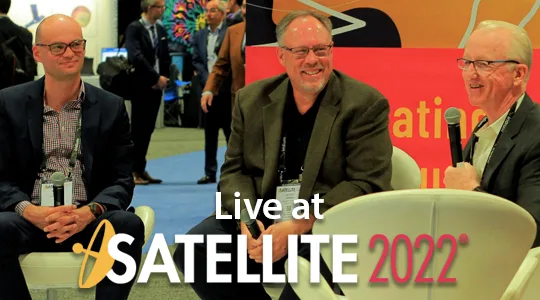
John Gilroy: Welcome to Constellations, the podcast from Kratos. My name is John Gilroy and I’ll be your moderator. Today, we are going to talk about the explosion of low-Earth orbit or LEO satellite constellations, the growth of artificial intelligence and the effect it’ll have on these constellations, both from a technical and a business perspective. To guide us through this topic, we have Nathan De Ruiter, Managing Director of Euroconsult Canada, and Scott Herman, CEO of Cognitive Space, which recently raised $4 million in seed funding for its artificial intelligence-based software, designed to manage imaging satellite constellations. Now, Nathan had an experience with the Constellations Podcast a year ago, only did minor mental damage to him, but he survived it somehow. Scott, question for you, Cognitive Space has been selected to participate in the Amazon Web Services Space Accelerator, a business support program for startups seeking to use AWS to help solve the biggest challenges in the space industry. Scott, tell us what it’s all about and the role of AI as it relates to Earth observation data.
Scott Herman: Absolutely, and thanks for having me on, I appreciate it. So Cognitive Space is really helping organizations fly their satellites, particularly new space entities that are launching new satellite constellations. We do that by bringing the power of artificial intelligence to the realm of mission management, collection planning, order management and comms link coordination. A lot of the new space companies are thinking about how they’re going to build out their ground segment architecture, and ground segment isn’t simply comms, it’s how do you monetize the satellites? How do you bring them to market? How do you take orders from customers and partners? How do you de-conflict that? And then how do you tell the satellites what to do? And this is really where the AI comes in. We use artificial intelligence, a technique called reinforcement learning, to determine potential solutions, potential combinations, of how to task the satellites to best meet the expectations of customers.
Scott Herman: They can be tuned for revenue, they can be tuned for capacity, they can be tuned for revisit or monitoring. There’s a lot of different factors that kind of go into that. What that allows companies to do is basically have a buy versus build decision around how they build out their ground segment. A lot of companies are facing these two to three years of non-recurring engineering and technical risk, schedule risk. So using a service like Cognitive Space allows them to monetize their satellites, focus on the payloads, and be ready to go to business as their satellites launch. AI is a key component of that in determining how those satellites are being put to work every day.
John Gilroy: I’m going to ask the gentleman with the space socks there, Nathan?
Nathan De Ruiter: You like them?
John Gilroy: Yeah.
Nathan De Ruiter: They are another prize today.
John Gilroy: Another prize, his socks, if you ask a question! Nathan, as the application of artificial intelligence to earth observation data is just at its infancy. I guess it’s primarily focused on computer vision applications with very high-resolution satellite imagery, but other applications, including mineral deposit extraction, disaster mitigation, agricultural development, and even intelligence gathering will increasingly benefit from artificial intelligence. So will that lead to new types of value chains?
Nathan De Ruiter: Yeah, definitely. I think it’s a very important point of view, what we have seen in markets. So, if you take a step back, a few years ago we talked about bottlenecks and earth observation, and it was a lot about supply or the right data sets not being available. Now, we’ve seen a lot of new data sets coming to the market with the new constellation capabilities, and the next step is really building and developing the analytics around it. So, to get a data image has a certain value certainly, but the real skill, or upside opportunity in this segment is really developing analytics products. And to your point, there are only really a number of end user applications that are potentially interesting, but all very, very different, right? Selling into mineral extraction versus agriculture is a completely different set of distributors, resellers, as well as end users.
Nathan De Ruiter: So there really needs to be this formation of a value chain or an ecosystem around those applications, and it still needs to be built. I think for satellite companies, it’s going to be one of the biggest challenges or efforts to become integrated into the different kind of user sets. And one of the things that we’ve also seen is obviously you can, as an earth observation company, you can target multiple applications, but at the end you need to focus on one of those specific kind of application areas to be really successful, to really be integrated well in that too. This is at the start, as you mentioned, and I think that market is going to expand pretty rapidly, but in all different ways.
John Gilroy: Scott, we’re recording this in Washington, D.C., at the Satellite Conference and all kinds of people walking around us here looking for opportunities, aren’t they? But there’s some challenges that involve these large LEO constellations, including something called adjacent satellite interference and growing space debris fields. Scott, so what’s the role of AI in these two challenges?
Scott Herman: So the way to think about the way we’re applying AI to the satellites is we’re helping task the satellites and helping them understand what they can and can’t do during their mission. Part of that are things like, where are other satellites at? Do I have stable station keeping? Do I have to do a maneuver to avoid collision and does that impact my ability to generate revenue by collection? In general, we’re pretty fortunate that while there’s a lot of focus on the space debris problem, most satellites don’t have to deal with it every single minute of the day.
Scott Herman: They’re not dodging and weaving through space, but you do have to think about are there potential collision events and how do you manage that? As more and more satellites are going up into space and it gets more crowded, the idea of how do you schedule? How do you coordinate the positioning of the satellites? The maneuverability of the satellites? The station keeping of the satellites? There’s definitely a role for AI in that. The other thing that AI can do is help you understand situational awareness of what’s actually happening in space. So it’s not so much about your satellite, it’s about knowing where the other 10,000 satellites are, and being able to understand not only satellites, but all of the other things that are floating around out there that could impact your mission and your ability to complete it.
John Gilroy: Nathan, we’re in downtown Washington, D.C., if you walk into a federal agency and talk to a CIO, every three seconds, you have to say the word cybersecurity. It’s like a mandate, you know what I mean? This is also a challenge in the area of mega constellations, satellite and terrestrial networks continue to interface and as both become more and more reliant on the cloud, the cyber-attack surface will continue to expand. So AI machine learning can help mitigate that risk, or where does it fit in?
Nathan De Ruiter: A little bit of both, right? It creates some additional cybersecurity risk potentially too but there’s also a way to put additional measures in place and to detect certain anomalies. But certainly, I think cybersecurity around mega- constellations is something that is maybe not discussed enough I think, in my point of view. And it’s not only about the space assets, but it’s a lot about the ground infrastructure, which is going to be exponentially grown or increased over time to kind of make sure that we have the ability to use the connectivity from the constellation.
Nathan De Ruiter: So there’s much more investment required, and honestly, it’s probably difficult to see right now what the risks are, and obviously, if you could use AI for helping in identifying some of those risks for extra protection measures. But again, the problem sometimes with AI is, to build really a very good solid AI product, you need a lot of data sets, and if you’re branching into a very new area, it’s a little bit more difficult, I think. So we will all be dependent on a lot of smart people as well to secure.
John Gilroy: One of these smart people is Scott. So Scott, you read the news reports even over this weekend, commercial news talks about cybersecurity in the federal government, increasing concern. I think one of the people at the FBI said they have to look into more cybersecurity. So where does it fit in, AI/ML, and satellite security, from your perspective?
Scott Herman: So in terms of cybersecurity, a lot of AI/ML is being put against the monitoring of massive amounts of web logs, right? It’s a real time activity and also forensic activity to kind of go through and figure out what’s been happening within my network and do I have problems there? I think related to Earth observation and satellites though, there’s a special cybersecurity problem that people don’t think about as much, and that is the ability to actually change the data itself to represent something different in the images, right? So did you actually see what you thought you saw on the ground? This idea of what’s called a chain of custody and protection of the satellite data is becoming increasingly important. It’s not just an attack that might be a denial of service or a penetration, it’s actually the product. If I’m taking satellite images of Ukraine and I can insert tanks where they don’t belong or I can pull tanks out, that ability to make sure that the veracity of the data is secure is a special cybersecurity concern that relates to earth observation data.
John Gilroy: So Nathan, I get to use a big fancy word here. So hold onto yourself, hold onto your chair here. The global space marketplace in some projections, is expected to approach $1 trillion by 2030. I mean, that’s a huge number! The number of satellites could grow to 50,000 if commercial plans for mega-constellations pan out. As my daughter says, “What could possibly go wrong?”. A lot of problems here. A report issued by Credit Suisse stated that there is economically only room for about three large scale LEO constellations, and if these LEO constellations continue to be deployed, it could lead to destruction of value within the sector. Everyone, should we turn up and listen to that. So what’s the issue? Is it the number of constellations or the number of satellites within them, Nathan? Which one is it?
Nathan De Ruiter: Good question. I think it’s probably not necessarily even both, and I don’t actually fully agree with the statement because there’s a number of things to unpack. So first, 50,000 satellites, yes, if you look at all the filings you added up, you probably can go beyond that. But the interest of satellite constellations is, you can scale your constellation, you need to have a minimum base to operate a service, but then, when the demand grows, you can scale out your constellation. So whether they will really get to the 50,000, or somewhere below and still have a very meaningful business, I think somewhere. The other thing is there are only three, probably not, I think one of the things that you’ve seen right now as well with the Ukraine invasion and if you look at what’s happening there in Europe, there’s bigger things in play than just the pure economics.
Nathan De Ruiter: So if you look at even like, for example, OneWeb they got support from the UK government. If you look at Telesat and SpaceX, they started off with government support. So governments have a certain interest in bringing connectivity. And on top of that, if you look at what is happening right now in terms of military conflict, so other kind of interest of sovereignty and protection comes into place, and I think constellations have a different role to play. So, all in all, I believe there is room for more than three. If you look purely from the economics, yeah, it might be more difficult to have everybody retrieve a very spectacular return when we’re going all together at the same time in the market. It’s going to be very interesting time because a lot of them will enter at the same time. But one trillion dollars? I hope so. 2030 will be soon, but again, we’re happy to see in the next few years that we are getting near that.
John Gilroy: Scott, a lot of economists write and they talk about limits to growth. So what do you think on this topic? Do you think this 50,000 is a limit, or three constellations, is there a limit to this growth?
Scott Herman: I don’t, and with all due respect to Credit Suisse’s side, I strongly disagree with that comment. I think that like most technological revolutions, there are going to be waves of consolidation and then flowering of lots of new startups and new business models and new ideas, and then a consolidation again. Certainly, the room that the mega-constellations take up is something to think about, but space is a really big place, and it has to be managed and you have to find room, but I think that one of the things that’s really exciting about what’s happening right now in the new space revolution, is the opportunity for lots and lots of new companies, new business models, and new technologies to be applied.
Scott Herman: If I thought that there was only going to be three mega-constellations, I would very, very much niche that into things like broadband internet access, right? Because then it’s a competitive play. How many players can be in that particular niche? But when you talk about the realm of space and all the different missions that can go on, IoT, remote sensing observation, the wide variety of use cases around national security monitoring, economic monitoring, environmental monitoring. There’s a lot of room up there, there’s a lot of business models, there’s a lot of money flowing into the space, and I think we’ll see phenomenal growth over the next 5, 10, 15 years, and I don’t see space as a limiting factor for that.
John Gilroy: So Nathan, we have a prediction of 50,000 satellites and then there’s something called utilization of those satellites. Is it 24 hours a day, seven days a week? It probably isn’t, you know? These LEO constellations may be global, but only a fraction of these satellites may be actively servicing subscribers anytime. Some estimates are between 4% and 25%. So since utilization is a key ingredient in the constellation success, can LEO constellations sustain themselves with these utilization rates?
Nathan De Ruiter: Yeah. Another good question. So utilization rates, obviously is one when you’re scaling up, right? Your constellation, so even if you’re ramping up your demand, you’re adding new supplies, so especially in the ramp up period, the utilization rates will be relatively low. Flip side, you do need utilization to keep financing, expanding your capabilities and the constellations. Now, when we look at where demand is, it’s really, I think often discussed, and I’m talking here primarily on the broadband side because I think you can maybe talk about the earth observation side. It’s much more concentrated in areas than we typically think. So we have seen in the kind of next generation of constellations, the architecture it’s built on to be able to pull and push more capacity in the areas where it’s needed.
Nathan De Ruiter: And as you pointed out of course, like 9:00 AM, around Boston, there’s a lot of airplanes that go out, but there’s nothing just yet on the west coast. So you’ll be able to dynamically allocate capacity around certain geographic areas that will help utilization rates, because you can make a better use and allocate this capacity at different places at different times when it’s needed. But there is always trade off and there’s always a maximum amount you can do. If you look at from the old world, how we’ve seen it, GEO satellite world was always ramping up to 80%, this is not what we’re going to expect to see for constellations. So it’s a different mindset. It doesn’t mean a utilization, you cannot close your business case if you don’t read the same utilization rate. So we need to look at it different.
John Gilroy: Well Scott, you live in the Washington D.C. area. There’s a podcast in town called Feds At The Edge, talks about edge computing, that’s where I want to head now. Traditionally satellites, they collect the data and they transmit it back to Earth and pull out what’s good, what’s bad and delete the rest. So is there a role for artificial intelligence, or onboard computing, to streamline, and do the data analysis and extraction up there in the sky? What do you think?
Scott Herman: There is, I’ll put a big asterisks on it because there are some constraints. You’ve got compute power constraints, you’ve got innovation cycle constraints. When I do innovation on the ground, I can deploy every few hours, right? If I’m putting capability up in space, that could be measured in months or even years. So there are some down sides to saying, “Let’s just push everything to the edge.” There are real requirements. So certainly, defense and intelligence has concerns about resiliency in a conflict environment, but in general, I think the way to think about it, isn’t, “We’re going to push AI to the edge and that’s where it’s going to live,” or, “It belongs on the ground and you get this religious war.” The way to think about it is as a hybrid. What are the use cases in space that lend themselves to AI?
Scott Herman: So for example, if you’re doing Earth observation with a visible light sensor, being able to do things like, “This picture was really cloudy. I shouldn’t waste the bandwidth to downlink it,” that’s a pretty compelling case, right? Now you get into some other issues like licensing, do you take the shot, do you got to get it down to the ground anyway to archive it? But in general, there are use cases where you can have some amount of AI processing and space to help out. I think that the goal in the long term, the Skynet goal, right? Where you have complete autonomy within space and the satellites are talking to each other and these peer-to-peer networks and you don’t need the ground or the ground is really used as overseeing, I think that’s where we’re headed.
Scott Herman: But you have to be really careful, because the amount of compute power, the amount of innovation is on the ground. It’s not in a 50 kilogram or even a 500 kilogram satellite in space. Also, if you’re a small company, and you’re building a commercial satellite constellation, the dumber those satellites are, the faster you can rev them, the cheaper you can get them up. So there’s a lot of trade- offs there. So there are very legitimate reasons to push AI to the edge in space, but it’s not a blanket requirement that we’re suddenly going to be skynet it in five years.
John Gilroy: I’ve heard of small satellites. I just heard about dumb satellites, I have to put that in my little terminology list. So Nathan, are you on the edge? What about edge computing? What are the economics of this whole edge computing idea?
Nathan De Ruiter: I think again, it’s a lot about trade-offs that Scott mentioned. If you can make more efficient use of, as you pointed out, especially in the earth observation kind of world but again, I still think they’re going to be a bit limited. In the defense side, I assume still most of them, they want to do all their own analytics. So there is some efficiency gained, I don’t think in my view, but maybe Scott has a different point of view. I don’t think it has a very substantial kind of cost economic advantage. There’s some.
Scott Herman: I would agree with that, and just to follow up, I think another use case that you hear a lot in kind of the monitoring and earth observation world is, let’s process the image on the satellite and do object extraction and detection so that we can tip and cue other satellites. So I take a picture, I instantly see there’s a Russian tank column, I’m going to now cue other satellites in my peer-to-peer network. That’s a really exciting use case. You don’t have to take the time to get back down to the ground, process and come up with a new plan and get it up there. There are programs that are exploring these concepts right now. So I think we’ll see more and more AI pushing to the edge, I would just caution people that it’s not a giant jump and you leave the ground behind. There are really compelling reasons to not do all your stuff on the edge.
John Gilroy: Well, you use the word tank. So I guess it’s time to make a transition from commercial space to military space. Cognitive Space recently completed experiments with military and intelligence agencies. So tell us about this experiment, what do you see as the future of AI in military space applications?
Scott Herman: Yeah, so what Cognitive Space has been doing through a number of SBIR contracts with some different government agencies, is really helping the U.S. government and its allies, understand what they’re going to be able to do with this new wave of commercial capabilities, so it’s defense use of commercial capabilities, primarily around remote sensing. And so what we do is we go out to exercises and we test these ConOps, and we test the requirements and we test the capabilities of the commercial providers. So for example, we just finished an exercise called Arctic Edge where we were orchestrating collection across a number of commercial suppliers, and applying that to real world use cases like custody of moving objects on the ground. We did joint warrior last year, where we orchestrated collection across 500 different satellites and ground stations across about 14 different suppliers, both commercial and government satellites.
Scott Herman: And part of what we’re doing with the AI is we’re determining things like what’s the optimal use of these satellites against a particular mission problem? What are the tipping and queuing opportunities? What are the coverage opportunities? What’s the revisit opportunities? Revisit is a really important concept for global monitoring. You don’t just shoot one and done, you might want it five times a day, you may want it ten times a day, you may only need it three times a week, but those monitoring requirements drive a lot of the defense and intelligence use cases, for example, ISR. It’s this new wave of commercial capability where you’re flying swarms of satellites, you’re flying them in all kinds of interesting orbits, you’re getting these very, very high revisit, it’s not the traditional mapping, or what we’re called, foundation GEO admissions. It’s about monitoring, it’s about ISR, and that’s why things like latency and timing and tasking become very, very important. That’s where we’re applying our artificial intelligence.
John Gilroy: We are recording this from the satellite show. I see people in uniforms in the audience and running around here. So I got to be careful about this, I may get in real big trouble here. Let’s stick to this topic of the military space a little bit here. So AI is being used, evaluating the classification of observation data from LEO constellations, we know that. And these serve national security applications, such as missile defense. So putting you on the spot here, without divulging privileged information, maybe a little expansion on this concept?
Scott Herman: So I think of the application of artificial intelligence to satellites in two primary categories. One is, how do you tell the satellites what to do, right? Most of these satellites are robots, they’re taskable. You’re going to say, “Take a picture here,” or “Turn, take a picture there. Now, downlink your data,” rinse and repeat thousands of times per day. The other place where AI really gets applied is in the exploitation of the data coming from the satellites. So when we think about controlling the satellites, we use techniques like reinforced learning. When we think about the exploitation of the data, that’s more the realm of computer vision, right? We’re taking data, or it may be computer vision, there are other techniques. You may have data that’s not pixel based, you may have other types of AI techniques, you may go against different kinds of data.
Scott Herman: But the idea is that there’s AI for exploitation, and many people think about that exploitation of data side as being a volumetric problem. There’s so much data coming in, I can’t put humans against it anymore like we did in the old days, I need computer vision to handle the volume. I would argue that it’s actually more exciting, but more nuanced. It’s not about how much, how many pixels I need to extract from, it’s about this idea of monitoring and latency.
Scott Herman: I need to be able to do it very, very quickly, I need to be able to do it at a cadence that lets me do pattern of life, and operational tempo, and monitoring of facilities and activities, and to be able to determine anomalies against that. And that’s a much more interesting AI problem than simply, “I need to replace some human analyst in the loop.” It’s much, much more about the timing and latency and being able to support new use cases out there. And one of the things the U.S. government and its allies are really supportive of right now is this ISR use case, right? How do we maintain custody of things on the ground? How do we task and tip and cue other assets?
John Gilroy: Well, I’ve been hogging all the questions here. We got five minutes. We’ve got a person with a microphone so if anyone in the audience wants to win Nathan’s socks or a T-shirt, raise your hand, we’ll have you ask a question. Anyone out there? There’s a gentleman here with a beard.
Audience Member: I thank you very much for this interesting talk. I wanted to ask, recently I heard Elon Musk say the low earth orbit can accommodate 10 billion satellites easily. So if this is the goal, if this is the future, what do you think is going to be the problem with 10 billion satellites in LEO, for example? Is it going to be data downlink, is it going to be maneuvering or collision risk? What do you think about it? Is it feasible? Is this the future that’s awaiting us? Thank you.
Nathan De Ruiter: I think it is. There’s a lot of things to consider here. So yeah, you pointed out the maneuvering, the debris, that kind of thing, but it’s also from a connectivity side of pointers, interference, there’s spectrum rights. There’s a lot of things that come into play to reach 10 billion. Technically, it probably is if everybody’s very disciplined, works together, it’s probably feasible, but I think a lot of people will get very nervous with these kinds of considerations. A lot comes into play from a technical side, from a frequency perspective side.
Scott Herman: So my name is Scott and I’m a space junk denier. No, I’m kidding. But I think it’s really important to think about just how big space actually is, right, and how much room there is for things out there. Now unfortunately, those things are moving really fast, right? They’re moving Mach 25 and when they hit something, it’s bad news and you do get this kind of cascading chain reaction, domino effect that everybody’s really concerned about. The other thing that’s really a factor is there is no global body doing air traffic control and setting all the standards. It’s fairly wild west. If you want to put something up in space, go for it, right? If you’re a U.S. company, you’ve got to coordinate with the FCC and NOAA, and some other agencies. But in general, whoever gets there first, gets there. There’s actually a really interesting company out there right now that wants to put tiny, tiny satellites in a grid around the Earth to basically do domain poaching, right?
Scott Herman: To be able to take that space and go, “We’ve got it. Now, we’re going to sell it for somebody else when it comes along.” So all kinds of really interesting business models headed our way. The other thing that’s really interesting about the space debris problem, is that it’s not universally distributed, right? The argument I made about how big space is would scale if everything was equally distributed, but for example, when we talk about earth observation satellites, most earth observation satellites, this is changing, but most of them actually fly in almost the exact same set of orbits. It’s called a sun-synchronous polar orbit, and they position themselves to take pictures between 10 and 12 over local time over the Earth, because that’s when you get the best lighting for mapping product. So what that means is that you have a whole bunch of satellites that are flying together.
Scott Herman: It’s almost like a NASCAR race, right? You’re sitting in the stands, it’s quiet for a minute and suddenly a whole bunch of cars race by. So I think when you think about things like space situational awareness, or space traffic management, these are very real issues that will be obstacles to getting to the billion satellites in the sky, but there are many different bodies that are kind of trying to figure that out.
Scott Herman: There are many techniques around how do you react to space situational awareness. There’s a lot of startups that are chasing this problem, a lot of them are at this show here trying to figure it out. I think the other comment I would make, and it goes to comms, and one of the constraints is, if they’re up in space, you’re probably trying to get data down, right? And whether that’s telecom or observation data, one of the things that could potentially be a game changer is the role of space-based relay. So you don’t have to worry about a finite set of ground stations and coordinating and queuing up and waiting your turn and waiting to fly over it before you can get it. Space-based relay basically becomes a backhaul in space. And that could really help scale up the number of satellites you can support.
John Gilroy: Well Scott, if you don’t believe in junk, you should see my garage, just full of junk. We are running out time here, unfortunately. Now, this has been a wide ranging discussion. We’ve talked everything from artificial intelligence, to the intelligence community. I’d like to thank our guests, Nathan De Ruiter, Managing Director of Euroconsult Canada, and Scott Herman, CEO of Cognitive Space. Thank you, gentlemen.
Scott Herman: Thanks for having us.
Nathan De Ruiter: Thank you.