Transcript:
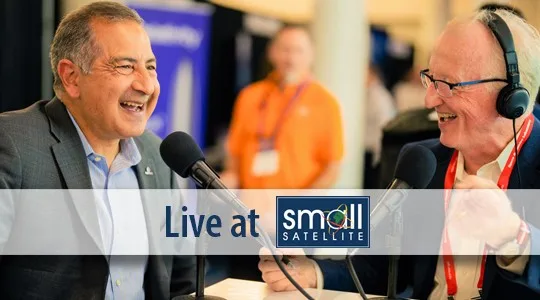
John Gilroy: Welcome to Constellations, the podcast from Kratos. My name is John Gilroy, and I’ll be your moderator. Today, we are at the Smallsat show in lovely downtown Logan, Utah. Our guest is Al Tadros, Chief Technology Officer at Redwire. Al holds a Master’s degree in mechanical engineering and a Bachelor’s degree in aerospace engineering from a little school called MIT. He’s authored 17 publications, has five patents in the field of spacecraft guidance, navigation and control. His company, Redwire, is the new leader in mission critical space solutions and high reliability components for next generation space systems and infrastructure.
John Gilroy: What are we doing here today, Al? We know what we’re doing. We’re here to talk about a few ambitions plans for new missions in the cislunar orbit that cover NASA and commercial exploration and utilizing sustainable operations. NASA and commercial partners such as Redwire are looking to rapidly develop critical technologies to enable human and robotic exploration on the Moon. So what kind of infrastructure is required to support this exploration?
Al Tadros: First of all, John, thank you very much for having me and this is a very exciting topic. It’s a great environment to be talking about this, as well, here in Logan, Utah. So cislunar space and the exploration of cislunar space has been dabbled in over the years. Of course, Apollo actually landed astronauts on the Moon, but to get sustainable presence is our vision and ambition now. And to do that, it’s a difference between setting up a tent on a lot and actually putting up a building, with construction equipment, cranes, laying a foundation. Showing that you’re planning to be there.
Al Tadros: So a sustainable presence on the Moon literally means laying out the infrastructure for it, a power grid with solar arrays, radiation shielding, thermal protection, habitats, landing pads, all the things that you would expect from a city that’s going to exist for a while. And that’s what NASA is leading the way for the world to do on the Moon, and we’re part of that. Redwire is a critical contributor to the infrastructure of the sustainable presence on the Moon, everything from solar arrays that will provide power for the power grid, manufacturing using materials on the Moon. So many things that have to be done and we’re excited to be part of it.
John Gilroy: The young people in college, maybe at MIT, they use this word, sustainable, a lot. It’s a trending word. In the last five years, you can go to Google Trends and see it going up. So sustainable can be applied to fish, to food, to farming, and to our topic today, space. So in your world, what is meant by sustainable exploration? And how do you see today’s lunar efforts contributing to future exploration?
Al Tadros: Yeah, that’s a very good question and a very important question to discuss because as you know, a lot of things that NASA does are the first of, the first time we go somewhere, the first time we image or collect data. Sustainable means that it actually transitions from NASA-led and NASA-only, to commercial- contributed, commercial-included, commercial profit-making, commercial business establishment. So you can think of it as an exploration mission versus a colony or a settlement, and NASA really wants to spur that on, the establishment of businesses and economic returns and profitability, tourism, entertainment. All of that makes it a sustainable presence. That’s part of what we envision and many people envision, is a broader involvement than just NASA and just the government.
John Gilroy: We’re at the Smallsat conference here, and I saw a woman walking by with a NASA backpack, so that’s accepted here. I was in Los Angeles last week, and I was at a restaurant, there was a 10-year-old boy with a NASA T-shirt. I mean, it’s really, really top-of-mind for most people now, isn’t it?
Al Tadros: Yeah. I mean, the NASA brand is just phenomenal in the U.S. and it’s even more phenomenal outside the U.S. You go overseas, and kids will be wearing NASA emblems. A lot of it is in the public media, movies, and TV shows. Even Big Bang Theory had a NASA astronaut, eventually. So I think that’s all part of the story now, it’s all part of inclusion of the broader community. You don’t have to be a rocket scientist from MIT, you can be someone who just has the vision and passion and wants to be part of the economy, part of the private citizens going to the Moon or just seeing the imagery or getting the data. There’s so many ways, everything from lawyers, economists, philosophers, medical, the whole medical field. There’s a lot of involvement now and there’s a lot of excitement about what’s going on.
John Gilroy: I’m glad you used word medical because in the medical world, there’s specific types of vocabulary. There’s a vocabulary for auto mechanics, and of course, a vocabulary for the whole space ecosystem here. There’s a word that maybe that 10-year-old boy may not understand. The word is cislunar, so what is meant by the term cislunar, and what does it all encompass?
Al Tadros: Yeah, so cislunar is a way to describe the Earth and Moon environment. So between here, between the Earth and the Moon, a lot of things have to happen in order to get a sustainable presence on the Moon. It’s the transportation, it’s the depot-ing, it’s the positioning, it’s the launching and landing. So cislunar recognizes the fact that we can’t have an economy on the Moon without being able to operate between the Earth and the Moon consistently.
Al Tadros: In the same way that we have GPS satellites in high or medium Earth orbit, we need to have lunar orbiting satellites for communications and navigation. The same way that we have low Earth-orbiting and geostationary-orbiting communication satellites, we need to have that kind of infrastructure around the Moon and so forth. So cislunar orbit or cislunar environment is just a way to represent that the Earth and the Moon are part of an ecosystem that we have to work in, in order to make it sustainable.
John Gilroy: If you watch a science fiction movie, you figure, “Oh, Al gets in a rocket and goes to the Moon. Hey, easy-peasy.” I mean, you don’t realize all the infrastructure that has to be around to actually do that. That’s pretty boring, that’s the boring part of it.
Al Tadros: Yeah. I guess Apollo 13 is one of the few movies that goes into the details of how you get around and slingshot-ing back and how long it takes. But yeah, there is a distance between us and the Moon. It does take time. It does take orbital mechanics and real engineering to make it happen. And then of course, when you want to come back, there’s also a lot to that. To safely come back into Earth’s atmosphere, land, and come out, and be able to get up and walk even out of the capsule. All that has to be thought through and that’s an exciting part for us as engineers, to make that happen.
John Gilroy: Al, thousands of people from all over the world have listened to this podcast. Go to Google and type in “Constellations Podcast” to get to our show notes page. Here, you can get transcripts for all 100 plus interviews. Also, you can sign up for free email notifications for future episodes. If you look in the next 10 years, my guess is there are going to be dozens and dozens of activities just going to the Moon. And this means increased lunar activity, I would guess. I have read that there are plans to deploy a network of satellites to monitor operations on the surface and around the Moon. So how will the data from this lunar network be accessed and shared? Will there be satellite terminals on the Moon? I mean, you don’t see that in the movies.
Al Tadros: Yeah, sometimes that’s glossed over. But just like here on earth, there will be terminals on the Moon. Communications directly back to Earth, communications up to the Gateway, part of the Artemis architecture. Communications that can support the Artemis Orion capsules, but also communications on the lunar surface. Just like we have cell towers here for all the rovers, for the crewed and uncrewed vehicles, for the habitats, for the explorers, there will be a communication systems to support all of that. And that’s a critical piece that has to be deployed almost before we send a whole lot of people and robots out there.
Al Tadros: In addition to the communications, yes, there are going to be satellites and infrastructure for navigation. We take GPS for granted, but GPS serves the Earth and we need an equivalent system on the Moon. So you can expect that that will be part of the orbiting and the lunar surface infrastructure in order to make it survivable, livable and sustainable.
John Gilroy: I keep going back to that 10-year-old boy in the restaurant in Los Angeles. There’s a whole lot of groundwork that has to be done for 20 years now, someone hops on a rocket and goes to the Moon and people have to think about this carefully. And that’s what we’re doing at the SmallSat show, all these different booths. In fact, your company has a booth here, talking about things like that. I think as Americans, we tend to be self-absorbed and we think that we’re the center of everything and everything cool’s happening here with NASA. But we’re not the only ones in town and I don’t think United States’ partners are the only group interested in the Moon. There’s a concept that people toss about, it’s called Space Domain Awareness. So, is Space Domain Awareness critical for cislunar operations beyond simply knowing that something’s out there?
Al Tadros: Yeah, that’s a very important question and a topic that’s being worked extensively. So it used to be that there were very limited launches. So there was very limited access to orbit and only the largest countries, the superpowers had access to space. And as everyone knows, now that ride shares exist and small launch vehicles, large launch vehicles. SpaceX has been launching every week, a launch every week, which is unheard of.
Al Tadros: No one watches the return to launch beds and that’s going on now. So the reality is that, yes, there is a lot in space and there’s a lot of in space motion or space-to-space relocation of satellites. Space Domain Awareness includes understanding not only what’s in space, but really what their motivations and tensions and capabilities are. You can think of it like air traffic management. You can know that there’s an airplane in the air, but knowing whether it’s a 747 or a Cessna, what kind of range it has, where it can land, how fast it can go, all these things that make it a sustainable air traffic management system is part of what we need to get to and will be getting to in space. So that we, our allies and even parallel explorers that we want to support can all operate safely and reliably in the cislunar environment.
John Gilroy: I’m going to circle back to NASA because it’s so much fun. So NASA has launched a program called DART. I guess it’s the first of, kind of the mission. Can you tell us a bit about NASA’s DART program and what they’re trying to accomplish for this?
Al Tadros: Yeah. So DART is the very first time we’re actually looking at how we might protect the planet earth from an asteroid that might be headed our way. And we’ve all seen the movies with asteroids. And one possible solution is to impact the asteroid at a far distance and that’s been covered in movies, but there is real science behind that, and DART is looking at that. So they launched a few months ago and they’re headed to this asteroid and they’re planning to impact the asteroid with the satellite then look at the difference that impact makes in its motion. And that impact, we can estimate and analyze, but doing this as a test and determining how much impact, how much effect we have on that orbit can start to teach us what we can do if a real asteroid was heading our way and we needed to move it out of the way.
Al Tadros: So an asteroid that might be only 10 meters or so large might not be a big deal, but an asteroid that’s a 100 meters or a kilometer in size is a big deal coming towards Earth so we do need to think ahead how we might address that. It’s a great science mission, it’s a great engineering challenge and just in a few weeks or a couple months, we’ll be seeing that impact. Then the engineers and scientists will look at the data and see the effect that it has.
John Gilroy: And it’s true. It’s not just 10 years now, it’s going to be next month and it’s going to be in the newspaper. They’re going to say, “Hey, NASA’s testing this thing out because the Bruce Willis movie may come to fruition.” We just don’t know.
Al Tadros: That’s right, so that’s coming right around the corner. Redwire is really proud to be part of that. We built the Roll-Out Solar Arrays that are prominent when you see the images of the solar arrays. We also built this navigation sensors, the sun sensors, and so forth that helped navigate its way to the asteroid. So we’re really proud of that exciting mission and exciting engineering.
John Gilroy: And this is an exciting trade show. And if you look around the trade show, you see satellites with Roll-Out Solar Arrays on them, right behind us in fact is one. And so maybe we should describe this for the listeners, what happens is if you think of a satellite and you think of those wings coming off, to get solar power, that’s what the Roll-Out Solar Array is, it helps with power.
Al Tadros: That’s right, yeah. So a lot of people probably can relate to solar panels on their roof or solar panel farms out in a field. For satellites, we actually have to fold them up to get them to fit in the rocket faring. So rolling them up on a blanket, basically, the solar cells is the way that we very efficiently build very large solar arrays and then package them in a smaller volume. Then once we’re in orbit, they roll out. So this is a great technology, it’s been demonstrated now multiple times.
Al Tadros: Once, we deployed them on the Space Station, those are great images of the astronauts, installing them on the Space Station and rolling them out. And that’s over 50 kilowatts of power being generated on the Space Station with Roll-Out Solar Arrays. DART is another mission, commercial satellites are using them now. It’s a really huge benefit to the space missions, to be able to use large amount of power in space.
John Gilroy: Let’s talk about more NASA, more missions. I went to your website, which is all full of stuff and it looks like that Redwire is providing Roll-Out Solar Arrays for NASA as a Gateway, as part of this Artemis program. Now that’s insider talk, Artemis is going to the Moon so it’s going to a news program. So, what is this Gateway, and how will your technology support this Gateway?
Al Tadros: Yeah. So Gateway is the term that NASA uses for the space station. You could think of it as a habitat that’s in lunar orbit, it’s called a near-rectilinear halo orbit, NRHO. So if you’re interested in that, definitely look it up. If you’re an orbit’s mechanics guru, you love it.
John Gilroy: Find rectilinear all day long, it’s straight.
Al Tadros: That’s right. So anyway, it’s near the lunar, the Moon, but it isn’t low lunar orbit and it allows astronauts to go there and use it as a space station before they go down to the surface of the Moon, and then to be able to come up in a vehicle dock and then come back to earth. It’s also used, so it requires power for that purpose. It also requires power to use electric propulsion, to maintain its orbit and to provide communication relays to the lunar surface. So the Gateway is basically a space station.
Al Tadros: Finally, it’s a demonstration of what we’re going to do to go to Mars. When we go to Mars, we have to have space stations at the Moon, in Mars orbit. And we’re going to be doing the same thing, sending astronauts to the space stations and then down to the surface or to the next space station. So this is a really important element for that reason. It makes sustainable presence and extends our presence to Mars and beyond.
John Gilroy: The students at Georgia Tech and other tech schools use this word, sustainable. We got to talk about it again. This is the phrase that pays, sustainable. And from what I’ve read, ROSA, the Roll-Out Solar Array, it enables the word sustainable. Its sustainable power to spacecraft and space. And so, talk about the Moon. So what sort of applications you think ROSA will be powering or supporting on the Moon?
Al Tadros: Yeah, so really exciting. Just the same way that we built Roll-Out Solar Arrays or ROSAs for the Gateway and for Space Station and for DART, Redwire is also building the technologies to be vertically deployed off the surface of the Moon. Now the Moon has a sixth of the gravity of earth, so it isn’t as strong, but to roll a solar array open on the surface of the Moon does require the force or the torque in order to deploy it vertically. So we’re working on that technology. We’re also able to retract it so that it can be relocated and that’s part of sustainability. What you want to do is put the power where you need it and with solar panels, you can do that. So the ROSA’s deployable, retractable, relocated. And finally, we can also mitigate the dust accumulation or regolith accumulation on the solar array. So that’s all technologies that are going into ROSA to make presence on this lunar surface, a sustainable presence.
John Gilroy: Now there is a good vocabulary word, regolith, R-E-G-O-L-I-T-H. Most people is they may not know what that is. And it’s not debris on them, it’s just what’s on the Moon, right?
Al Tadros: That’s right. So just like here, we have dirt or dust on the surface of the earth. The dust on the surface of the Moon, we call regolith. And that has been exposed to space for billions of years, no atmosphere to speak of. So unlike earth, it has no water, no wind, no landslides and all the things. It’s just been exposed to the impact of meteorites over and over again, space radiation, solar radiation, and solar winds for billions of years. And so it’s a different material and different constituent than here on earth, but it is extremely important for us to understand it. And the regolith on the surface can be a dust and negatively impact. But it also is a resource that we are looking at using for In-Situ Resource Utilization for extracting water ice, for extracting oxygen and other things. So understanding the lunar regolith is a very important part of our sustained presence on the Moon.
John Gilroy: My son has a friend who’s a mechanical engineer, and I was trying to put myself in the shoes of this mechanical engineer. And so you have a team of mechanical engineer. You have to design this Roll-Out Solar Array, so it’ll work in space, then redesign it, so it’ll work out with this level of gravity. It’s like, it’s not hard enough. You have to variables in here. And by the way, have to be roll it up as well. It’s an engineering challenge, some of stuff. It’s really not easy stuff.
Al Tadros: That’s right. I mean, the space environment is a very harsh and challenging environment to work in. There’s a whole lot of things that we take for granted here on earth. And you might think that your rooftop is extreme environment for solar panels, space is another layer of that. The surface of the Moon is actually some of the hottest location and the coldest location in the solar system without an atmosphere. With the surface being barren, the lunar surface goes from an extreme hot temperature, extreme cold temperature. And that’s some of the technical challenges that engineers love to work and to solve, so we are doing that. And just like we have megawatts of power here on earth to run buildings and cities, that’s what where our plan is for the lunar surface to have a power grid that provides unlimited amount of power through solar power generation, right on the surface of the Moon.
John Gilroy: Well, Al, I really appreciate. You’re helping our listeners get a better understanding of some of the challenges of exploring the Moon and beyond, huh?
Al Tadros: Yes, absolutely. That’s what they have to look forward to.
John Gilroy: I like to thank our guest, Al Tadros, Chief Technology Officer, Redwire.