Transcript:
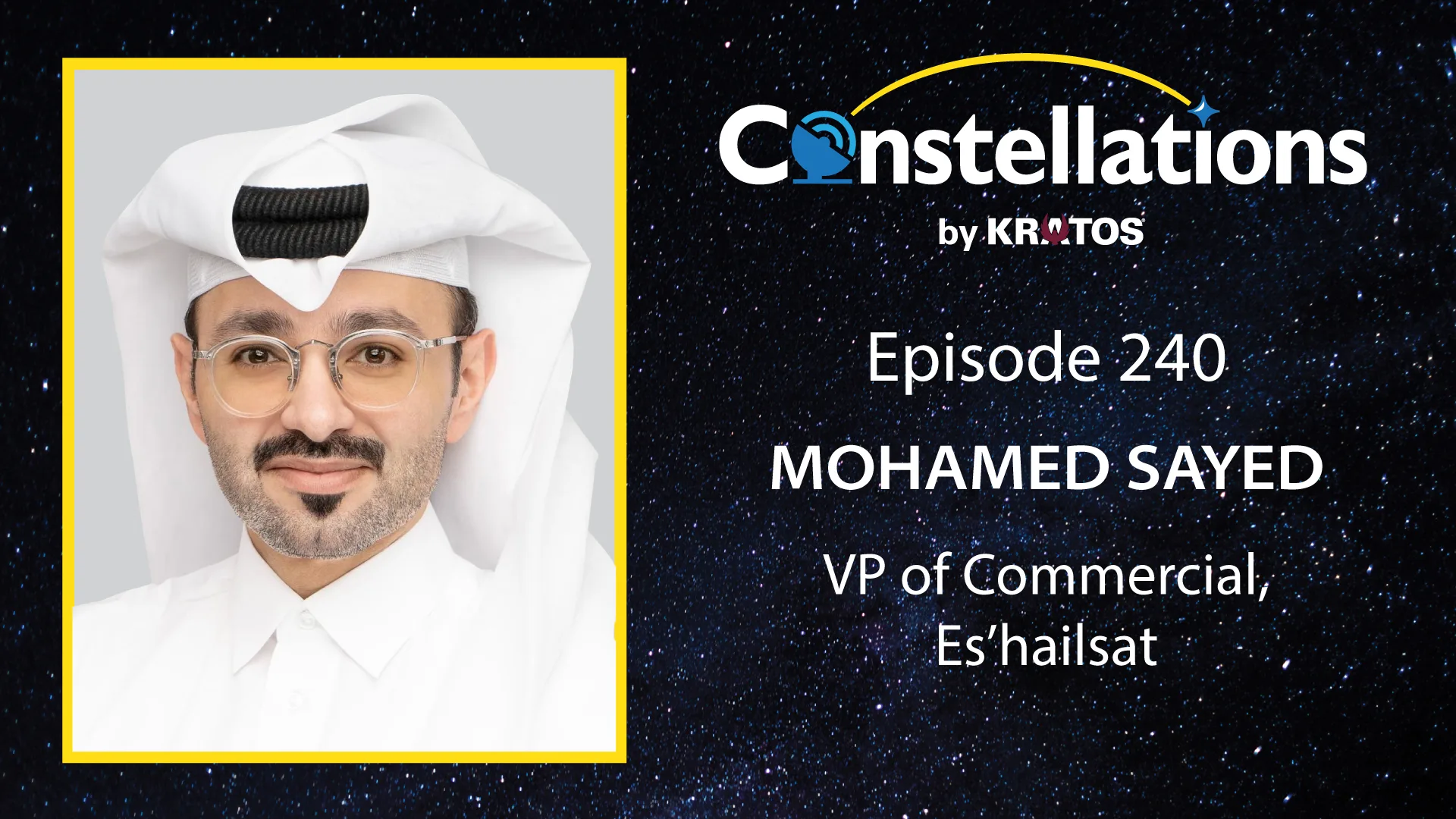
John Gilroy: Welcome to Constellations, the podcast from Kratos. My name is John Gilroy and I’ll be your moderator. As governments across the Middle East invest in sovereign space capabilities and secure communications, regional operators are playing an increasingly important role in shaping the future of satellite services. In this episode, we’ll explore how Es’hailSat, Qatar’s national satellite operator, is navigating the rise of mega constellations, supporting national resilience and digital sovereignty, and helping build a more collaborative and competitive space ecosystem across the region. Today, we are joined by Mr. Mohamed Al Sayed. He is the acting vice president of commercial at Es’hailSat. Mohamed, how are you?
Mohamed Al Sayed: Good, good. Hi, John. How are you? Thank you for hosting me today.
John Gilroy: Wow. A hotbed of activity in space in the Middle East, and just going to jump in here head first. I’m going to ask you the first question. There’s so much going on. It’s amazing. Much of the industry’s attention is focused on mega constellations. How do regional satellite operators remain competitive and relevant in this environment?
Mohamed Al Sayed: Well, John, first of all, let me give you a background of Qatar Satellite Company, Es’hailSat, and how we started. We started as a company that will serve the sovereign of Qatar and serve the satellite requirement in Qatar. So the company went into several phases. The first phase that we want is to secure all the TV channels and companies, oil and gas, and by providing DTH services and VSAT services to them. Then the company evolved and went from phase one to phase two to phase three, and we grow a lot. So there is an advantage to be a local satellite or regional satellite operator and with a local intelligence on what is the need of the stakeholders. And then you grow from this need to be able to offer the same service to other countries and our other regions. So Qatar Satellite and Es’hailSat started on this. We had the advantage. We have sovereign capabilities and we customize our services. We were capable of flexible and customization for our regional services. Then after that, we combine GEO and LEO services. The first thing we did this year, which was very important for us to be in line with the industry, is that we sign our third satellite, Es’hail-3, in partnership with Türksat-Biruni, which has a flexible geo capabilities. And also we sign a partnership agreement with Telesat, which will provide a LEO constellation services through LEO Orbit location. So we combined both GEO and LEO by this two partnership. The first one will secure our sovereign capabilities and we will be controlled and operated by Es’hailSat. And also for LEO because we are not focusing on building constellations currently, we are doing a partnership. So these both combination help us to provide services to all the requirement or customers in the region. To add to this also, before I forget, we have one of the well-advanced teleport in the Middle East. I have visited several teleport in the Middle East. I can proudly say that is Es’hailSat tier four ISO 24/7 operation teleport can provide multi-services, end-to-end services to our customers.
John Gilroy: How do the priorities and decision-making frameworks of regional operators differ from those of global constellation providers? And how does that shape the kinds of services that you choose to develop?
Mohamed Al Sayed: Yes. So we at Es’hailSat have a balance between commercial returns and sovereignty, because as I said, our strategy changes with the time and with the needs that we need to provide to our stakeholders. So we have a balance between commercial returns and sovereignty and with resilience and long-term national capability. We develop services around stakeholders’ needs from broadcast to mobility to government to visa services, combine all these services together. So we did very good focused partnership with several operators in the region, also in the countries that we are focusing in. So we did a very good partnership agreement with Viasat with a company called Saudi NetLink and with EgyptSat to cover Saudi Arabia and Egypt local market, and also Viasat to help us with oil and gas because they have a very high experience with oil and gas services. So these partnership also enhanced the service offering.
John Gilroy: Qatar’s vision 2030 puts a lot of weight on building local capability in advanced tech. So Mohamed, in your view, how is the space sector starting to contribute to that? And where do you think the real gaps still are?
Mohamed Al Sayed: Okay, so I think Es’hailSat played a very advanced role in delivering the outcome of Qatar Vision 2030. We did this by create skilled jobs and strategic infrastructure. For example, Es’hailSat trained the first Qatari satellite engineers, and I was one of them actually. We continued to provide these kind of programs. So we are opening jobs, more jobs for the talented freshmans that graduate from universities and college to be able to choose another industry in the market. Qatar as a company rely on oil and gas. And most of the jobs that we have here in Qatar is oil and gas or military services or other govern. So when you open a new industry like a satellite market and you encourage the young people to look for alternatives and to learn more about space and satellite business, this open good opportunities in front of them. Also, Qatar satellite company had support adjacent sectors through collaboration, such as Qatar Media City, which offer a lot of services for new startups and TV channels, small TV channels to be opened and to provide several services to them. In addition to that, educational outreach and engineering sponsorships such as what we did with the Qatar University to provide them to help them with their research and to build some of the cubic satellite they have. This transfer of knowledge, we think it play one of the important parameters on the Qatar Vision 2030. Also, we built capabilities in managing diverse payloads of defined system and cybersecure operation. These all services will help Qatar to reach the outcome of Qatar Vision 2030.
John Gilroy: So Mohamed, earlier in the interview you gave us your origin story and you talked about listening to the needs of customers. So my question is, how do you see customer needs evolving in the market you serve and what shifts do you expect operators will need to make in response to those changes?
Mohamed Al Sayed: Okay, John, so if you think about it before or the industry before was that the customer comes to you and he would like to rent capacity from you or to sign a contract with you to provide capacity. Now the customer is looking for a managed service, managed outcome services. They are looking for security. They are looking for flexibility. They are looking for multi-orbiter solution. They are looking for a clear service accountability. They are looking for packages that you can provide such as what we did with Viasat and with several partners like [inaudible 00:09:26] Art Media and others. They are looking for end-to-end service. And that’s why what we are doing right now by our growth, by signing Es’hail-3 can dynamically adjust the coverage, provide more beams, provide more frequency, and also bundle the service with the LEO constellations so we are able to provide multi-services to our customers. So this, we call it, and our goal as in our strategy and what we are looking for is to shift. And the customer actually made us do this step very quickly to shift from the satellite operator to multi-service provider. So that’s the change that we see in the market.
John Gilroy: Mohamed, everyone knows that the word sovereignty is really, really getting more and more discussed in the satellite and space community. Governments around the world are placing greater emphasis on sovereignty. So how has that changed the conversation around satellite communications in the Middle East?
Mohamed Al Sayed: Okay. So sovereignty now means taking full responsibility of asset, of gateways, of data path, of operation, and of restoration priorities. So we see this from our government. We signed several MOUs which reflect the demand for trusted satellite and ground infrastructure. And also we can see it by Es’hail-3, which will expand secure flexible capacity and strength communication independency. So governments usually or now currently, they are looking for full sovereignty for satellite service provision.
John Gilroy: Mohamed, I hate to look back [inaudible 00:11:21] because four or five years ago things have changed so much, but let’s say go back four or five years. Five years ago, many countries focused on access to space. Today, the discussion seems to be shifting towards control of infrastructure, data and network operations. So how do you see that trend evolving?
Mohamed Al Sayed: Yes. So what we see now, the real autonomy requires orbital capacity and national gateways. We see the importance. When you talk to the governments and you talk to these countries, they are looking for cyber governance and local prioritization. And we can do this because we had experience and we provide several services to our customer until we reach tier four teleport services in our teleport. So when you have these great infrastructure, you have great cyber security policies and procedures, and you have a 24/7 teleport that can offer with non-stop and non-cut of services, you can reach this trust from these countries and you can reach this trust from the government. So also Es’hail-3 adds a program, mobile orbital flexibility and close services for our customers, which can be seen as add-on to what we are provided to these countries and these governments.
John Gilroy: Mohamed, new services, new changes all over the place here. So how are government requirements changing when it comes to secure communications, data sovereignty, and mission-critical services?
Mohamed Al Sayed: Okay. So now government is looking for access to the full chain. Not like before only the satellite, but now it’s satellite, it’s a gateway, cyber controls, continuity and restoration. So these are the main areas that the government are looking for and trying to control. As I discussed before, when you have the tier four and IOS certification for our teleport, it’s evidence of the disciplines and resilience that we can do these operations.
John Gilroy: What role can satellite infrastructure play in strengthening national resilience during geopolitical disruptions, cyber incidents, or even natural disasters?
Mohamed Al Sayed: This is actually one of the very important questions. To be honest, when we looked at this year and what are the main struggles that we had in the Middle East and what is happening around us. So satellite, I think provides an independent path when terrestrial networks are damaged. If anything happened to these terrestrial, you have the satellite which will provide 24/7 uncut service. We have two operational satellites, Es’hail-1 and Es’hail-2, and now we are signing Es’hail-3. We have our own teleport, which is operated 24/7 connected by global fiber connectivity. And we have satellite fiber backup connectivity, partnership with Telesat, [inaudible 00:14:55], Saudi Netlink, and others. All of these are to complement each other and provide a complete service without any cutoffs.
John Gilroy: The Middle East has emerged as one of the most dynamic regions for space investment. From your perspective, what are the most important developments shaping the Middle East trajectory in the global space sector right now?
Mohamed Al Sayed: So if you ask this question in another way, we can see that a lot of GEO satellite programs have been stopped. This is a fact. So when there is a vision for two countries or two regions together, and there are a good understanding of the needs of stakeholders and what’s happening in the region, it is a good opportunity for these two countries to work together and develop one satellite. What we have done with signing a partnership by building our third satellite with this GEO satellite with Türksat, this is one of the examples. So what we are doing, we know that there is sovereign need more than commercial need for the GEO satellite currently. So we are doing this. And parallel to this, we are also focusing on LEO constellations and how we can complement each other. So yes, demand is shifting. We can see also the demand is shifting from broadcasting to government, energy, [inaudible 00:16:34], mobility, and data services. This is what’s evolving in terms of satellite sector and what is done in the manufacturing of these satellites for the Middle East operators. Partnerships like that, if you have a mutual understanding between two countries or two regions, will help with developing this sector.
John Gilroy: Mohamed goes back to listening to the customer’s needs. So you’re real flexible with that over the years. That’s fascinating. Many countries in the region are investing in satellite systems, launch capabilities, and space-related innovation. So what opportunities does that present for greater regional collaboration?
Mohamed Al Sayed: Yeah, as I mentioned, this open very good partnership opportunities with most of the satellite operators in the region and also international satellite operator. Like what I mentioned just now Es’hailSat and Türksat plan to collaborate on building infrastructure, distribution, and customer reach around Es’hail-3. We signed several MOU with Visa, Saudi Netlink, and EgyptSat to open market in Saudi Arabia and Egypt. Also, we did several services with the countries like Morocco. We built a whole infrastructure for them for the broadcasting with the channel SNRT, which also they are hosting the World Cup, Morocco. So they are taking our also experience when we hosted the World Cup in Qatar and provided a broadcasting service, and we are collaborating with them to provide this knowledge and what is needed. So these opportunities does present great for regional collaboration and partnership.
John Gilroy: As the regional space ecosystem matures, which capabilities do you think will be most important for Middle Eastern players to develop domestically rather than just rely on partners for?
Mohamed Al Sayed: I think the localized mission design, capacity planning, gateway operation, cybersecurity, and service assurance, these are the main focus currently. Also to build operational talent, this is a sustained responsibility, not only for short-term training but also long-term training. Own the application layer. This is very important. Own the application layer, manage VSAT, mobility, media distribution. These all needs to be more developed, and this is what we are relying on with our partner.
John Gilroy: So Mohamed, if we revisit this conversation five years from now, what do you think will be the biggest change in the way governments, enterprises, and citizens use satellite networks?
Mohamed Al Sayed: I think satellite will become an integrated layer of wider terrestrial and non-terrestrial network. I think users will buy a short service, not capacity by orbit. They would like to combine GEO and LEO and local operations. I think citizen will gain border reach and continuity of mobility, remote access, and essential service. People will look into more direct-to-device services as we’ve seen currently. Now people are looking on lowering the cost of the terminals by, for example, using direct-to-device services and satellite. And we see a lot of companies around the world are doing this currently. Several of them, we can see them in the stock market and trying to raise money and to develop this. So I think this is what will happen in the coming five years.
John Gilroy: Mohamed, I think you’ve given our listeners a real good understanding of the innovation taking place in the Middle East. I’d like to thank our guest, Mr. Mohamed Al Sayed. He’s the acting vice president of commercial at Es’hailSat.
Mohamed Al Sayed: Thank you very much, John. Thank you.