Transcript:
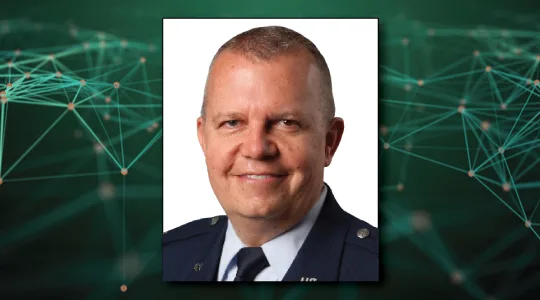
John Gilroy: The views expressed in this podcast or on www.constellationspodcast.com do not officially represent the views of the US military or the United States government. The appearance of US Department of Defense, DOD visual information does not imply or constitute DOD endorsement. Welcome to Constellations, the podcast from Kratos. My name is John Gilroy, and I’ll be your moderator. Our guest today is Colonel Eric Felt, Commander of the Phillips Research Site and Director of the Air Force Research Laboratory Space Vehicles Directorate at Kirtland Air Force Base in New Mexico. In this podcast, we will discuss Colonel Felt’s interests in terms of missions and technology from cislunar and xGEO orbit to proliferated LEO constellations and resilience space. Colonel Felt, thank you for being our guest on Constellations. I can’t wait to dive into this exciting conversation.
Col. Eric Felt: I’m excited about it too. It’s great to be with you today.
John Gilroy: Well, I’m going to hit quick and hard here, Colonel Felt. Please share with us and our listeners, your current position and duties.
Col. Eric Felt: I’m the director of the Air Force Research Laboratory Space Vehicles Directorate here in Albuquerque, New Mexico. We have about 700 researchers here working on space and nuclear technology and we have about $500 million a year in technology projects that we execute.
John Gilroy: Wow. I was doing research on you before this interview. I found out you have a PhD in electrical engineering as well as a top gun. So you’ve got a lot of qualifications, don’t you?
Col. Eric Felt: I suppose I do. In some ways I think of that as ancient history, but it’s all great stuff and I’ve had a good career.
John Gilroy: No, no. I know enough engineers to know EE is the hard one. That’s the tough one.
Col. Eric Felt: That’s what they said back in my day too.
John Gilroy: Yeah, yeah, yeah. Let’s talk about the AFRL here. And so what is the AFRL Space Vehicle Directorate’s mission and priorities?
Col. Eric Felt: I really like to think of ourselves as the big idea pipeline for space technology. And what I mean by that is that we need to be constantly maturing and coming up with new ideas so that the US can maintain our technical advantage against our adversaries, and that’s really important to our way of war, because if we have better technology than our adversaries, then we will be able to deter war. And so in the space domain, what I’m always trying to do is come up with the latest and greatest technology innovations that can make sure that we have a technology competitive edge over our competitors and adversaries. And my priorities and the way we try to go about doing that is, first of all, number one is to accelerate innovation. We have gone through a very important pivot since 2018, when the National Defense Strategy came out and said, “You know what, you need to pay a lot of attention to these peer competitors, especially China and Russia. Look at what they’re doing, make sure we are prepared to deter conflict with them.” And we have done that. We have done that in spades by going through the entire portfolio and looking at okay, how do we innovate faster and how do we make sure that we can maintain our technology advantage in every technology area? Accelerating innovation is the number one thing, that is our mission, and that’s my number one priority. The second thing is that there’s a lot going on in space. In case folks have been asleep for the past year, we have stood up a Space Force. We are in the middle of a space renaissance, a commercially driven space renaissance that makes it the most exciting time to be working in this area since the 60s, really. And so my second priority is to support this Space Force stand up. Make sure that in this new construct, they are still getting their science and technology needs that they require, that they still have a robust, big idea pipeline. And the way we’re doing that is with, one, AFRL that can serve it, that can provide technology for two services. So that’s my second priority is adjust to the new construct that’s out there with the Space Force. They are my number one customer, of course. And then the third thing is to continue to build the strongest team. That’s really our secret sauce is our researchers that we have here and that’s how we are able to innovate so quickly and so robustly. Building that team and strengthening that team and ensuring we have good comradery and working together well with our core team and with the contractors and the startups and the academia institutions, the whole ecosystem of space innovation is really important to accomplishing our mission. So, those are my three priorities.
John Gilroy: Speaking of developing a team. If you walked into a college campus, one of the leading universities and got a bunch of people in the room, engineers and said, “Look, we’re working on all kinds of different things out here, maybe involved with artificial intelligence, directed energy, hypersonic.” You could have them standing up and say, “I’m raising my hand. I want to come out and work for you.” It’s a really exciting place to be, isn’t it?
Col. Eric Felt: It really is an exciting place to be and we’ve seen a lot of interest in very exciting technologies. You’ve mentioned a few of them, but we are returning to the Moon. We’re returning to the Moon with NASA. We’re returning to the Moon with commercial customers. That was super exciting the first time, and it’s really exciting the second time around too.
John Gilroy: Let’s focus a little bit on the Moon here. Can you explain the importance of cislunar or xGEO missions and what the industry should be doing to prepare for the upcoming missions for this orbit?
Col. Eric Felt: You bet. This has been a super important growth area for us over the past couple of years. Again, from our perspective, it’s kind of tied to this National Defense Strategy, and as a whole nation, how are we approaching this space as a war fighting domain? There’s really three reasons that we care about this area. Now, first of all, some definitions. By cislunar we mean, of course the area around the Moon and we care about that. But the term I really prefer is xGEO, which means above GEO. And so, it isn’t just the area around the Moon, but it’s the whole radian-sphere defined by the altitude of the Moon, if you will, that is of interest here. And why are we interested in that now all of a sudden? Well, first of all, there’s a lot of commercial activity that’s going up in that area. One of the missions of the Space Force is to protect and defend these space lines of commerce. And when those lines of commerce extend out to the Moon, we will need to be there as part of our mission. All the commercial activity out there is one of the main reasons that we care about that area. The second is the resources and political advantages. People are talking about mining from the South Pole of the Moon, extracting resources from asteroids. All of those things are very compelling missions, and that’s why there’s so much commercial interest in going there. Those are also the reasons that we need to be able to be operating in that region. The third thing is our competitors are going there. You’ve got a lot of nations that are returning to the Moon and interested in the cislunar sphere. And so it’s just prudent defense strategy that we know what they’re doing in that area. And so that’s why we’re so interested in the xGEO and cislunar area.
Col. Eric Felt: The number one thing that we need to do up there is space domain awareness, and it’s hard. The Moon is at 10 times the altitude of the GEO belt. The overall area that you have to search through is a thousand times as great. And we’re not that great at knowing where everything is at GEO and below. If you imagine trying to now take care of knowing everything that’s going on above GEO, it’s a big problem. So we’re starting with space domain awareness as the number one thing up there. We do need a lot of help and industry can help us with that. And so what I really need from industry at this point is a lot of collaboration and ideation on analysis of what we need to do up there, and what’s the best way to do it. And then system engineering as to what are the best ways to get after the technical challenges? There are some new and significant technical challenges such as how do you do communications, position, navigation and timing? How do you basically operate in that domain, is an important technical challenge, and that’s what AFRL is all about. We can’t wait to get after that, and we really look forward to working with our partners to figure out what is the best way to get after that.
John Gilroy: Well, if I had 10 hours, we could go into all these topics, but we have limited amount of time here. I’m just going to focus on one little aspect of the vast range of activities you’re involved in. Can you describe the technology areas that you’re most interested in from a space vehicles perspective?
Col. Eric Felt: There’s so many, we could talk about this for a long time, but I’ll tell you three of my top things that I think are really interesting. And two of them are new things in space that we’re not doing today. The technology in these areas has really reached a level where we can now do things that were previously done in the air domain, or just previously weren’t able to be done from space. One of those is the proliferated lower-Earth orbit capabilities. You can really have ubiquitous communications, ubiquitous intelligence, surveillance, and reconnaissance from space that wasn’t previously possible. And that opens up all kinds of new potential opportunities and capabilities for our Space Force and for our nation. The pLEO architectures are super exciting and a new technology thrust area for us. The second one, which is also a new capability in space, power beaming and the opportunity to be able to convert solar energy to RF energy and deliver it on demand wherever you want is very potentially game-changing. We have a program called SSPIDR to mature the power beaming idea, not a new idea at all. It’s been around for decades, but it’s now technologically possible. And then the third thrust area that I wanted to highlight here is making our current capabilities more resilient. We have the world’s best space capabilities right now, but they are vulnerable, and we would like to enhance the resiliency of those constellations and those capabilities. So for example, we have a program called Navigation Technology Satellite-3, which for the global positioning system is aimed at making that more resilient so that it can operate when our war fighters need it the most in a high-end conflict. Those are the three technology thrust areas. We could talk all day about some other areas, but those are important things to highlight.
John Gilroy: When it comes to pLEO, it seems to me… Are we seeing the end of traditional? This exquisitely engineered expensive satellite constellations and defense architecture? Is that the end of this?
Col. Eric Felt: No, not the end of those, but I would say it is the end of those as the only elements of our architecture. What we like to talk about now is that we want and need a hybrid space architecture. That means we have some large satellites, some small satellites, some satellites the government owns, some satellites that are commercially owned and operated, some that are very resilient, some that are expendable. All of those things factor into our thinking about the hybrid architecture. It isn’t the end of having a traditional exquisite, large satellites in GEO. But I think those are no longer going to be the predominant part of the architecture. Honestly, my hypothesis, and I haven’t had anybody be able to disprove this yet, but I’m still waiting to be convinced otherwise. But every mission that can be done from pLEO will be done from proliferated low-Earth orbit. And the reason I say that is that there’s just so many cost and performance advantages from operating in that regime. Once you can get the basics down, including lowering the cost of launch, which has largely been accomplished, and making the small satellites that are going to be part of this architect, act like the large satellites that you need, and we’re there on the technology for that. I don’t think it’s the end of the big traditional satellites, but I see a lot of changes in our future.
John Gilroy: You know, Colonel Felt thousands of people from all over the world have listened to this podcast, go to Google and type in Constellations Podcast to get to our show notes page. Here, you can get transcripts for all 84 interviews, also, you can sign up for free email notifications for future podcasts. Earlier in the show, I mentioned this concept of resilience space. What is your perspective on autonomy in resilience space operations? I’m thinking of that movie, 2001: A Space Odyssey and HAL, the sentient computer. How do we avoid creating something we lose control of?
Col. Eric Felt: Well, autonomy is essential. Especially in some of these new regimes that we’re talking about, like the xGEO regime and just the distances involved, meaning you cannot send huge amounts of data quickly back to the Earth for processing and decision-making. You need autonomy for resilience purposes in case you lose your comm link, so you don’t want to lose your space capabilities and really autonomy lets you get inside the enemy’s OODA loop, and that’s one of our goals so that we can decide and act faster than our enemy, according to different various information. So we can’t not do autonomy. Autonomy is essential. I do think it’s worth spending a lot of brain power on how do we avoid losing control of autonomy. My answer there is let’s just proceed cautiously and think carefully about our prime directive.
John Gilroy: Last week, I was speaking with Nicholas Chaillan over at the Air Force. We talked about architecting software and systems and automation came up, but I think automation applies for this discussion as well. What is the right level of automation for satellite operations and defense, especially with considering this pLEO concept you talked about?
Col. Eric Felt: Well, again, when you have thousands of satellites up there, you’re going to have a high degree of automation you have to, and you want to. The level of automation that we need and should have, is much higher than what we have today and look forward to getting after, we have a number of technology projects to fly satellites from the cloud and to automate all of the routine operations. But one thing I want to be able to emphasize about autonomy, I think the limits of autonomy come into play when you go into a war fighting scenario, which is something that is unexpected. We’ve never had a war in space. We certainly don’t want to have a war in space, but we need to be prepared to have one to make sure that we can deter one. And autonomy is something that you have to think through very carefully, because even if you automate all of the routine operations, you need to still be prepared for unusual things that you have not previously seen such as what happens in a space conflict. So that’s some of my thinking on autonomy.
John Gilroy: I think I’m missing a piece of the puzzle in this discussion of automation. I look at automation in the ground stations. How do you look at the complementary grounds infrastructure investments going along with all this?
Col. Eric Felt: It’s really important to look at these capabilities as a whole system. It is not just the satellite up in space, which is often the first thing people look at because it’s such a nice, shiny object, but the satellite itself does not deliver capability. You need a whole system that includes how do you command and control the satellite? How do you get the data down? How do you process the data? How do you disseminate the data? All of that system together needs to be carefully thought through.
Col. Eric Felt: I think we’ve done a really good job of that on our Navigation Technology Satellite-3 Program, for example, but that’s just one example of the importance of looking at this stuff as a system. You can automate many of the satellite functions on the satellite. You can automate many of the ground functions on the ground and you need to make sure that all of those things can work together as a system effectively and can still work in a conflict scenario, in addition, to just the day-to-day routine operations. So I agree with you, it’s important to have a system view of all of that and make sure that you are thinking about all the elements of the architecture.
John Gilroy: When it comes to the AFRL and your specific organization, how is your organization set apart from other military organizations and what gives you this ability to look at innovation and pivot quickly during the development of new technologies?
Col. Eric Felt: All right. I will share our secret sauce with you. It isn’t really that secret, but our secret sauce is that we have some organic capability to do things. What I mean by that is we have actual scientists and engineers that can build satellites here, that can test satellites, that can fly satellites. That gives us a huge advantage over the many other science and technology and innovation organizations in the Department of Defense. What it enables us to do is a couple of things. First of all, if we are told to and need to start working on building a certain satellite tonight, we can do that. I just tell my employees to go start working on that and they can immediately get down to it. You certainly get a sense of additional responsiveness there. More importantly than that, I think you are working with people that intimately understand the technology that they are developing and maturing. That leads to a lot of innovative ideas, as our researchers work closely with their counterparts, industry and academia, you get a great virtuous spiral of innovation activity that only can happen when our government people are very technically savvy. That organic capability, the ability to do a little bit of actual science and technology work ourselves is our secret sauce in AFRL. It’s so fun to see that because it’s also really motivational to our young engineers. Most of them would rather actually build a satellite than work on a PowerPoint presentation to explain how the contractor is going to build the satellite and then sit through a design review of what the contractor has done. It’s also a really motivational aspect to our workforce that they can actually do some hands-on engineering and do it themselves. I think that’s a really important secret sauce capability of AFRL. Something that we absolutely must preserve and grow and use to our advantage.
John Gilroy: My final question here is going to link back to something you said earlier, the big idea pipeline. Can you talk about any of the big ideas that are coming out of this pipeline?
Col. Eric Felt: Sure. I’ve mentioned a few of them already, but let me highlight three for you here that I think are particularly important to how we could conduct war and some of the military capabilities that we could have. The first one I want to highlight and this is coming next year is a XVI. That is the Roman numeral 16. That is a Link 16 radio that’s going to be put on a proliferated low-Earth orbit constellation. Again, we didn’t use to have these kinds of pLEO constellations. This came about from thinking about, okay, well what could we do if we had 1,000 satellites in low-Earth orbit? What kind of communications capabilities would that provide? What we came up with was that the Link 16 radio is the NATO standard, and there are just tens of thousands of them already in use throughout the world, but they are only a line of sight radio. If you want to be able to communicate beyond line of sight, you have to have a transponder. That transponder could be like an airplane that relays the signal, or it turns out, it could be a satellite in lower-Earth orbit. You can’t do this from GEO because the delays are too long. But in LEO, being a transponder for Link 16 is a new thing we can do in space that turns out is really useful to the warfighter because if you get this proliferated, which is something the Space Development Agency rather is looking at, you would have ubiquitous Link 16 communications everywhere in the world with all of our allies, it’s a great potential capability. The Pathfinder Satellite is going to fly next year. If that works, which many thought it wasn’t possible, but by going through the engineering process, we now think that there are no showstoppers. We’ll demonstrate the basic technology and then be able to feel that capability soon through the Space Development Agency, so that’s XVI. That was, again, an idea that just came about from creative researchers thinking about what we could do with some of these new technologies. Another thing along those lines is the SSPIDR program that I already mentioned. Space solar power beaming is again, not a new idea, but we now have the technology to just in a thin structure directly convert the solar energy into RF energy, and then point that beam of power wherever you might need it, we call that power on demand. It could be to an air platform, it could be to a location on the ground, like a forward operating base, or it could be to another satellite. It’s hugely enabling to be able to get the exact power that you need exactly when you need it.
Col. Eric Felt: I don’t think it’s ever… Well, never is a long time, I don’t think in the next 40 years it’s likely to be the most cost-effective way to deliver power to a city, for example, but it’s super useful to be able to deliver power on demand and the SSPIDR project is all about showing the basic technology that would be needed to do that from space. Super exciting new thing we can do from space. The last thing I wanted to highlight here, that’s in the big idea pipeline and coming out over the next few years is new communications frequencies. We have a program called WSCE, which is W and V band space communications experiment. We are about to launch a beacon next year, that will broadly cast at these W and V band frequencies, which are much higher frequencies that we’re currently using for satellite communications. We’ll be able to measure how effectively that beacon transmits through the atmosphere and how effectively it can be used for communications. But it has some great promise because it’s got at least three times the bandwidth of the current frequencies that are being used. Nobody’s using it today. It’s very robust against jamming because it’s a much more directional signal than at the lower frequencies. We’re pretty excited about W-V band communications and the WSCE beacon that’s launching next year. Then followed a couple of years later by an actual experimental transponder. It’s a way to open up some new SATCOM frequencies that will be very useful to our war fighters, especially in a contested environment where we’re super worried about signals being jammed. We have a lot of great ideas in the pipeline. Those are three of them that I’m super excited about in the near term. There are some longer-term things coming too in terms of quantum capabilities and other stuff like that. But just the whole idea that we have this pipeline is our mission. What I want to do is have all these technologies matured to a certain level so that they are ready for the Space Force when they need them to come pick them off the shelf and use them operationally to maintain our technical advantage. That’s what the big idea pipeline is all about. It’s really fun to be able to work in this field and to be able to work in this second space renaissance, which is such an exciting time.
John Gilroy: Well, this was a fun interview. I’ll tell you that much. Colonel, you did a great job in defining concepts like proliferated LEO and resilience space for our audience. I never thought on the Constellations Podcast we’d talk about whiskey, but we managed to get that in as well. Didn’t we?
Col. Eric Felt: I’m glad we get to talk about WSCE. There’s a lot of fun things in life.
John Gilroy: I’d like to thank our guest Colonel Eric Felt, Commander of the Phillips Research Site and Director of the Air Force Research Laboratory, Space Vehicles Directorate at Kirtland Air Force Base, New Mexico.
Col. Eric Felt: Thanks John.