Transcript:
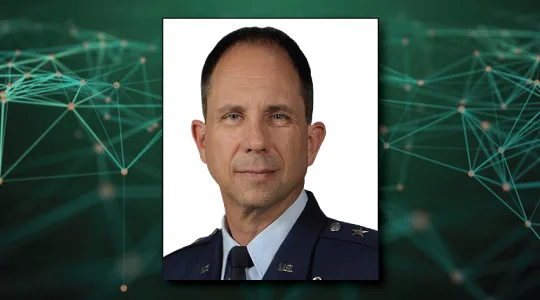
John Gilroy: Welcome to Constellations, the podcast from Kratos. My name is John Gilroy, and I’ll be your moderator. Our guest today is Major General Shaw, the Commander of the Combined Force Space Component Command, U.S. Space Command; and Commander of the Space Operations Command, U.S. Space Force, at the Vandenberg Air Force Base in California.
John Gilroy: Major General Shaw is here with us to discuss two important topics when it comes to the newly formed U.S. Space Force: Space Domain Awareness and wars in space. Let’s dive right in. General Shaw, please share with our listeners your current position and duties so we get a perspective where you’re coming from.
Maj. Gen. John Shaw: Hey John. Well, it’s great to join you and your listeners today from the sunny central coast of California. It was a pretty long duty description that you read off for me. And I think the best way for me to describe that is a quick talk about the two organizations that I work for. And both of them are relatively new.
Maj. Gen. John Shaw: The first and the one that’s made the most headlines, I think in the last several months, is the United States Space Force which stood up back in December of last year, December 20th. And pretty big deal. The first new military branch since 1947. And just over nine months old now at the time that we’re recording this podcast. And made a lot of strides already and been in the news.
Maj. Gen. John Shaw: And I do have a job in the Space Force, and that is I’m the Commander of Space Operations Command, which is the part of the Space Force that fields the capabilities that are then used by joint warfighters around the globe. So it’s a service focused responsibility.
Maj. Gen. John Shaw: Didn’t make quite the same headlines last year, but another new organization is the United States Space Command. And that is what we call in the Department of Defense, a joint combatant command. It’s analogous to CENTCOM, Central Command, that many folks are familiar with or European Command. It’s the way we actually conduct operations and fight wars in the Department of Defense. And that command stood up back on August 29th of 2019.
Maj. Gen. John Shaw: And I also work for that organization. I have a second hat that is a Combined Force Space Component Command that you mentioned, and that is as a subordinate commander to the commander of U.S. Space Command. I’m also responsible for the actual execution of space operations around the globe on a day-to-day basis. So that might be anywhere from making sure that a special operations team gets SATCOM in one part of the world or making sure that GPS is working well in another part of the world for all of our warfighters.
Maj. Gen. John Shaw: So that’s a brief rundown of the two jobs I have and it keeps me busy. But it’s also a dream job in many ways for someone who’s grown up in our space business. And I’m thrilled to be here.
John Gilroy: You know they say that New York is a city that never sleeps. You’re the general that never sleeps. That’s a pretty full plate, isn’t it?
Maj. Gen. John Shaw: Yeah, we stay pretty busy. And you know what? Space never sleeps. You kind of said that, right. The sun’s always shining somewhere and our satellites are doing something somewhere all the time. And so that’s really a tribute to our space warfighters and space operations personnel around the globe.
Maj. Gen. John Shaw: And man, we have people in my command that range from Thule air base in Greenland above the Arctic Circle to Diego Garcia in the middle of the Indian Ocean and many, many points in between. So I’m glad you mentioned that. So I have a chance to point out that the sun never sets on space operations, that’s for sure.
John Gilroy: Let’s move the sun back a few months back to December 20th in the Space Force. So from your perspective, how did we get to the Space Force? And tell us a little bit about wars in space please.
Maj. Gen. John Shaw: Yeah, well, I think I can say that Space Force was not only necessary at the time as Congress and the President agreed, but also was inevitable. And here’s why. For the longest time as we operated our space capabilities, and again through most of my career, we did so in a benign environment. We weren’t being threatened in space.
Maj. Gen. John Shaw: And so I spent a great part of my career actually doing much of what I described earlier, making sure that people on the ground had the space capabilities that they needed and in an optimal fashion. Right? Making sure that GPS accuracy was as accurate as it could possibly be to support an operation say in the Middle East. Or that we ensured that our satellite communications that were used for nuclear command and control were operating in the optimal fashion to help the Strategic Command Commander and the President of the United States.
Maj. Gen. John Shaw: And so we were delivering those capabilities and you could think of it as we were a merchant marine. We were delivering capability across a benign domain to a fight somewhere else. And that’s kind of what I spent most of my career doing.
Maj. Gen. John Shaw: Well, it turns out that you can’t really do modern warfare today without space capabilities. Potential adversaries of ours have noticed that. And so as we’ve seen evolve over the last 15 years or so potential adversaries developing threats to our space capabilities.
Maj. Gen. John Shaw: So what was a benign domain that we could operate a merchant marine on to deliver capability across is now under threat. And so we now have to develop a Navy as well. So we still got to keep delivering those space capabilities, but now we’ve got to figure out how we protect them and defend them against attack.
Maj. Gen. John Shaw: And that’s really why we now have a Space Force. It’s a realization, you know what? We actually need to be able to defend our capabilities in space and prepare for a war that extends to space. And that is the reason we have a Space Force today.
John Gilroy: I was on YouTube or somewhere and I saw some kind of a preview for a Top Gun movie or something and it makes me think of fighting in space. So, tell us how you see the space fight evolving in the future.
Maj. Gen. John Shaw: Yeah, well I think I need to start by saying ideally we would never have a war that extends to space. If potential adversaries develop threats to go after our space capabilities and we don’t defend them, they may be tempted to use them. If we do defend them and protect them, we may deter an attack that may involve a war that extends to space and in so doing, I hope that we would deter war period. So really it’s all about eliminating perceived vulnerability and operating from a position of strength.
Maj. Gen. John Shaw: So what happened? Well, a war that extends into space could probably start with something as simple as electromagnetic interference or jamming. Jamming satellites or trying to jam GPS signals. Or maybe using lasers, directed energy weapons to dazzle. That would mean to make any sensors that are looking down at the earth get blinded temporarily.
Maj. Gen. John Shaw: That might be how it starts. And then it may get to more destructive capabilities. We’ve seen both China and Russia test kinetic capabilities that would destroy satellites in orbit. And that would be a potential way that a war in space could escalate. And our job in Space Force and in U.S. Space Command is to deter such an attack in the first place. And then if it’s attempted to defend against it.
John Gilroy: There are so many possibilities here. Is there a top ten list? Those top two or three things that you really think you’re concerned? That keeps you up at night? Maybe you’re worried about happening the next few weeks, next few days? I mean, some of these are theoretical, but some are actual possibilities that are what they call an existential threat, don’t they?
Maj. Gen. John Shaw: Yeah John. I think the thing that I worry about and I try not to worry too much. I’m pretty positive. I think we’re doing a lot of great things and we have terrific people working in the Space Force in U.S. Space Command. But I think that the thing that maybe concerns me the most is not delivering space capabilities where they are needed by those joint warfighters on the ground or other national security needs.
Maj. Gen. John Shaw: Let me give you an example. Some may remember that the Iranians launched a missile attack against a base in Iraq back in January of this year of 2020 and landed a number of missiles at one of the air bases where we had a large number of military personnel. Well, our space capabilities, and our people operating those space capabilities, detected the launch of those missiles and gave alert immediately and gave a few minutes of alert to those people on the ground so they could take shelter. And as a result, we had no casualties in that particular event.
Maj. Gen. John Shaw: If we hadn’t done our job that day, if we hadn’t been observing, watching for those missile launches and raising that alert and hadn’t notified those people on the ground, there would have been casualties and deaths. And that’s the sort of thing that we just can’t allow to happen.
Maj. Gen. John Shaw: And that’s the thing that kind of concerns me and so that’s what I work on. And what I ask my people to work on is to make sure that we are doing everything we can every day, every minute of every day, to make sure that the space capabilities that are protecting people around the world, that are allowing them to do what they need to do, are delivered.
John Gilroy: You know, it’s quite a sophisticated concern. I mean, I was kind of a silly when I talked about working around the clock, but you folks work around the clock but also around the world. I mean, Iraq is halfway around the world. Things happen 24 hours a day. I mean, it seems like this would be a real pressure cooker to have a bunch of team members working 24 hours a day. Isn’t it?
Maj. Gen. John Shaw: It is a global perspective. There’s no question about that. In the Space Operation Center that’s here at Vandenberg Air Force Base, just a couple blocks away from my headquarters office, we have people around the clock there and monitoring our space capabilities and what they’re doing for terrestrial operations all over the globe.
Maj. Gen. John Shaw: But it also extends beyond that. We were going to talk about space domain awareness today, right? And we also need to know what’s going on within the space arena itself. And it’s not small. You’ll often hear admirals or generals that are oriented towards terrestrial war fighting talking about tyranny of distance across the Pacific or across the European continent.
Maj. Gen. John Shaw: From understanding what’s going on in space, we have a tyranny of volume. And we are looking out pretty far. We’re really starting now to really determine that looking out as far as the moon is something that we need to be able to do effectively to understand what’s going on in the space environment.
Maj. Gen. John Shaw: And that’s a lot of volume. It’s a lot of objects to track. And the way we do it is just with a lot of sensors and fusing that data into a picture that gives us an idea of what’s going on in space. So it’s just not only everything that’s happening on the globe, but if you can imagine backing off from the globe out to the moon, it’s all of that volume as well.
John Gilroy: You know General thousands of people from all over the world have listened to this podcast. Go to Google and type in Constellations podcast to get to our show notes page. Here, you can get transcripts for all 84 interviews. Also, you can sign up for free email notifications for future podcasts.
John Gilroy: I want to talk about the CIC, the Commercial Integration Cell. Can you describe what this Commercial Integration Cell is at the Combined Space Operations Center and maybe mention what is the operational value of working hand in hand with allies and commercial partners?
Maj. Gen. John Shaw: Absolutely John. So that’s a fundamental tenet I think that as we move forward with Space Force and U.S. Space Command is realizing we cannot do it alone. We must do it with partners and it has to be done at the speed of war.
Maj. Gen. John Shaw: You can’t decide that when something bad is about to happen in space, that’s the first time you reach out to an ally or the first time you reach out to a commercial company. It’s something that we have to have relationships built in advance and are continually working on.
Maj. Gen. John Shaw: So just briefly about allies, that first word in my joint duty title is “Combined”. Combined Force Based Component Commander. “Combined”, in our Department of Defense vernacular, means allied. And I’m proud of that because we have an allied presence here at Vandenberg. I have liaison officers from France and Germany and the United Kingdom that are part of our team here. And I also have exchange officers from the United Kingdom, Australia and Canada here on my staff and in our op center. So I’m very proud of that piece of our partnership.
Maj. Gen. John Shaw: When it comes to the Commercial Integration Cell, that was a realization a number of years ago, that we also needed to partner with commercial companies in an operational setting. It wasn’t enough to just ink a contract and take a service, or to just work through the speed of a contracting officer. We needed to bring in some partners so that they too could have awareness in real time of things that are going on in space and help us with any challenges we face.
Maj. Gen. John Shaw: Let me give you a quick example. I mentioned earlier, the first indication that we might be experiencing war extending to space would be a jamming of satellite communications. And so we have a number of companies that are part of our Commercial Integration Cell here at Vandenberg that are satellite communications companies. And if we detect some sort of jamming going on, we’ll let them know immediately. And they can figure out if it’s happening on one of their satellites, it gives them awareness.
Maj. Gen. John Shaw: And by the way, they’re pretty good at operating their networks. They may detect it first and they let us know about it. So collectively we have much greater awareness of what’s going on within the space environment and operate as a team in that fashion. And that’s just talking about satellite communications and jamming. The same could apply to any kind of challenge or issue within the space domain. So we’re very proud to have those commercial partners with us here at Vandenberg.
John Gilroy: Could you expand a little bit more on how you envisioned leveraging commercial capabilities to plan, integrate, conduct and assess global space operations?
Maj. Gen. John Shaw: So one of my close partners lives a little bit to the south and that’s Lieutenant General JT Thompson. He’s the Commander of Space and Missile Systems Center in Los Angeles. And his three-star job in the Space Force is to acquire our space capabilities. And we’ve partnered very closely with his team, especially in the last year, to work together.
Maj. Gen. John Shaw: He has people here up in our ops center, kind of looking at what our operators need, how they operate their equipment, what they would need for any additional capability. And that immediately informs the capabilities that he then develops to support us. So we have a good partnership going on in that regard.
Maj. Gen. John Shaw: So if you extrapolate that, we together are looking across the commercial sector and industry on who can we partner with in that same fashion at the very beginning, working development of capabilities in a rapid development approach. And that is going to involve not doing things in the industrial age model of just five large companies that do department defense work. That’s going to involve a lot of non-traditional companies and areas of expertise in technological development that we’ve only begun to tap into yet. And what it can do is I can guarantee you any cutting edge technological development that the commercial sector is working on, I guarantee you, we have some form of application for that for Space Force and Space Command.
John Gilroy: Final question here General. How is space domain awareness changing from traditional SSA of only tracking object locations and will commercial providers be able to fit in the solution somehow?
Maj. Gen. John Shaw: Yeah. Great question, John, and almost a whole podcast in itself, but I’ll try to do it justice. Again, let’s go back to this benign domain, merchant marine environments. Right? Really what we did when we looked into space was just, “Hey, let’s make sure things don’t run into each other. And if we’ve got two satellites that are coming close to each other, hey, let’s talk. Let’s avoid each other.” Much like you might think air traffic control would be done between airliners. Right?
Maj. Gen. John Shaw: Everybody wants to be part of that picture and nobody wants to have an accident. But now that we’re in an environment that is no longer benign, we’re looking as a government at shifting that whole approach. And the White House and the President issued a Space Policy, Directive Number 3, a couple of years ago that talked to this. That classic mission of doing space traffic management, air traffic control for space is going to transition to the Department of Commerce.
Maj. Gen. John Shaw: And we also have Department of Commerce teammates here at Vandenberg working with us on that activity. What will happen concurrent with that is the Space Force is going to focus more on potential threats. It’ll be more about battle management, understanding if threats are out there and what we need to do about those. And together collectively that more civil approach of space traffic management, and a more national security approach of space domain awareness collectively gets us a much better picture of what’s going on in space and for different purposes and different users under different circumstances.
Maj. Gen. John Shaw: So I think any commercial interests that can help any of that mission set from the more benign of, “Hey, how do we stay out of each other’s way and best practices and avoid unwanted collisions” to helping track potential threats and those up to mischief in space on top of all that. That’s a much bigger mission set for us. And I think any commercial partner who has something to offer would be valued.
John Gilroy: General we really appreciate you taking time and our audience really appreciates you talking about the wide range of topics here, including space domain awareness.
John Gilroy: I would like to thank our guest Major General John Shaw. He is the Commander of Combined Force Space Component Command, U.S. Space Command; and Commander of Space Operations Command, U.S. Space Force, Vandenberg Air Force Base, California. Thanks for listening to Constellations the podcast from Kratos. If you liked this interview, please subscribe, tell a friend and give us a review.