Transcript:
John Gilroy: The views expressed in this podcast or on www.constellationspodcast.com, do not officially represent the views of the U.S. Military or the United States government. The appearance of U.S. Department of Defense, DoD visual information, does not imply or constitute DoD endorsement.
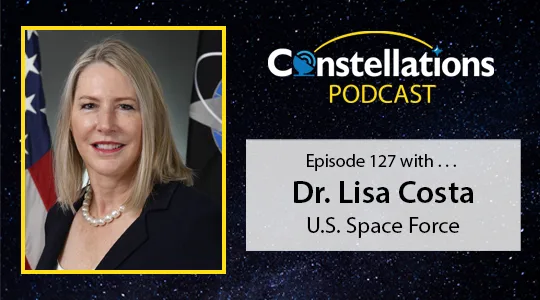
John Gilroy: Welcome to Constellations, the podcast from Kratos. My name is John Gilroy, and I’ll be your moderator. Today, we want to discuss what’s driving the digital technology strategy for the U.S. Space Force. We are joined by Dr. Lisa Costa, the Chief Technology and Innovation Officer of the United States Space Force. Previously, Dr. Costa was the Director of Communication Systems and the Chief Information Officer for the U.S. Special Operation Command. She was responsible for operating and maintaining the Special Operation Commands global network and systems, plus oversaw a $1.2 billion dollar budget and an IT system including cloud infrastructure, mobility, satellite, and terrestrial communications, and DevSecOps agile software development, supporting artificial intelligence and machine learning. Wow. Dr. Costa, with a portfolio like that we’ve got a million questions for you. Don’t we?
Dr. Lisa Costa: I hope you do. I’m looking forward to it.
John Gilroy: Well, let’s start with an easy one, okay? The Space Force has this vision for being a digital service. So what is meant by a digital service?
Dr. Lisa Costa: Great question, John. It’s really fascinating being at the first military service that was formed during the digital age. So, when you think about it, it’s not just an opportunity, but it’s really an imperative for us at Space Force to be born digital. It is an opportunity for us to move toward digital engineering, digital headquarters, a digital workforce, and digital operations. So that is in fact what we are focused on. A lot of the Guardians that we are already bringing in are incredibly brilliant in STEM and the focus is also making them fluid in IT so that they can bring IT to their particular STEM disciplines and be able to automate capability for the Space Force.
John Gilroy: So what steps are being taken to build a digitally dominant Space Force?
Dr. Lisa Costa: First, we’re working with the workforce, and I think that’s incredibly important because Guardians are our most important asset. Our focus has been developing the workforce and then emphasizing resiliency of our architectures and our networks. So, a lot of emphasis has been placed in the Space Force on taking a system that has been developed over decades, right? And you have different technology stacks, completely different architectures from decades past, and then moving that into a more modern technology stack environment and making those capabilities more resilient and able to communicate with modern systems that are being put into orbit every single day.
John Gilroy: And tons are being put into orbit, there’s all kinds of confusion going on up there, many different constellations being launched all the time. So, how do you enable strategic competitive advantages for the force, and can industry play any role in this?
Dr. Lisa Costa: Absolutely. In fact, industry is a critical component of this, as well as academia. We have a university partnership program where we reach out to academia, and this is not only part of our STEM, research, and development programs, but also part of our diversity and inclusion program to reach individuals who may not necessarily think about one, working for the government, or two, going into a STEM environment. And industry, of course, is critical in that they are developing a lot of the capabilities and have a lot of the high demand, but low density resources that the Space Force really needs to take advantage of, right? Experts in optics, lasers, cyber, orbital mechanics, and being able to leverage that expertise that resides in industry to be able to develop new capabilities for the nation and our allies. This is all about ensuring that we have safe and secure transit ways in space so we can ensure that individuals have freedom of access. And then of course, reliable services from space that we take advantage of every 10 minutes, right? In terms of GPS, position navigation and timing, and other capabilities.
John Gilroy: So how will the technologies that you’re leveraging now help us outpace our adversaries, or near-peer adversaries?
Dr. Lisa Costa: So there’s this construct that people say, that we need to “catch up”, right? I’m not a big believer in catching up, I’m much more of a believer in leap frogging. We’re not going to leap frog in a lot of areas, but there are key areas that we can leap frog in. And that’s really what the CTIO office of the Space Force is focused on. It’s really not so much the evolutionary digital modernization, because quite frankly, everyone is doing that. What we’re primarily focused on in Space Force headquarters is the disruptive and asymmetric capabilities that we would be able to take advantage of as a force to compete and to ensure that we and our allies have the necessary space capabilities that we need on a daily basis.
John Gilroy: Dr. Costa, when they write the history of 2022, that word disruptive is going to be used frequently in the history written about this time. So how do current events shape our needs and requirements for the kinds of digital engineering services that are available and where they’re available?
Dr. Lisa Costa: Well, I think there have been a number of incidences that have really identified the need for a continued presence. I don’t mean physical presence necessarily, but a presence in space to monitor and ensure that the assets are safe, and not only our national technical means and those of our allies, but commercial industry assets are safe as well. Look at all of the commercial constellations that are in space, then think about the congestion and potential contesting of space. I think there’s a lot of opportunity here for us to start thinking about how we’re going to manage all of this traffic, and also take advantage of it. There’s really no need for Space Force to necessarily create new capabilities when industry is doing this on a daily basis. And so, the more innovative industry can be, the more we can partner with them, and the more we can take advantage of their skills, their assets, and their on orbit capabilities.
Dr. Lisa Costa: Disruptive, to me, is looking at the entire ecosystem. It’s not just looking at the government investments, it’s really about looking at the entire ecosystem of capabilities in space, and envisioning how one might use those capabilities in new and novel ways. If you’re a military science geek, I’m a huge Clausewitz fan for all of you military scientists out there. I really believe that it’s the time and the novelty aspect of being able to understand what is happening in space, and not only being able to react to, but shape where space is going is a critical requirement that CTIO is prepared to enable Space Force in doing.
John Gilroy: You’re in the DoD, and they talk about the fog of war, and I was listening to an interview with one of your colleagues from the U.S. Navy, and this fits right with what you’re saying. He said, “disconnected, disadvantaged, and congested environments that we are planning to be operating in.” So it isn’t a matter of it might happen, people in the military expect to have this discontinuity and disruption, don’t they? That’s really hard to plan for.
Dr. Lisa Costa: It is and I came from special operations where we had to insert technology into 150 countries on any given day, and a lot of those countries are disadvantaged. So to me, when we talk about tip of the spear or edge devices in Space Force, I don’t think about edge devices as necessarily being edge devices on orbit, I view it as the entire chain of custody from satellite to submarine, or satellite to the individual shooter on the ground. And I think that is the whole promise of the JADC2 construct, that it is not just within a single domain that we have to ensure that data can move freely. We have to ensure that we’re our brother’s keeper, right? Providing capability to all domains from space and I think that’s really a powerful, powerful construct.
John Gilroy: Dr. Costa, thousands of people from all over the world have listened to this podcast. Go to Google and type in “Constellations Podcast” to get to our show notes page. Here, you can get transcripts for all 100 plus interviews. Also, you can sign up for free email notifications for future episodes. I want to switch topics here, maybe talk about software development and the idea of what you’re innovating with here? There’s a concept called “digital twins” that maybe some listeners are familiar with and some aren’t. Creating digital twins from modeling and simulation are expected to foster better integration across the Space Force. Can you explain what is meant by a digital twin?
Dr. Lisa Costa: So if you ask what the definition of a digital twin is to five people you’ll get six answers, right? Because it really depends. It can be a very high level abstracted model, all the way to a precise instantiation of that exact capability but in the virtual environment. So for example, I might be able to have a satellite digital twin that’s been designed by our acquisition team, that a request for proposal has gone out and a contractor wins. As they design it, they are designing it in the digital environment, not on paper. And when they deliver the capability, they’re delivering the assets but they’re also delivering that digital twin model, that very precise model. So I can use that precise model now to train Guardians on what that satellite can do, how it’s built, and how they might be able to develop very interesting tactics, techniques, and procedures using that asset.
Dr. Lisa Costa: I can abstract that, because I don’t need that level of detail when I’m doing force design. So I can kind of raise it up several levels, but just use the basic parameters of that asset to be able to do broader modeling and simulation across constellations of satellites to be able to understand what my force construct needs to look like in Space Force to ensure that these assets can be providing security, cybersecurity capabilities from our different ground stations, etc. So depending on where you sit in terms of defining digital twin is the definition that you’re going to come up with. But the bottom line is we want capability delivered to us digitally in detailed form, we will determine at what level we need that model and where, and then we will abstract it out from there.
John Gilroy: Yes. It takes simulation to the next level. I think you can even include real time data in some of these digital twins where it’s real close to reality, isn’t it?
Dr. Lisa Costa: Absolutely. And that’s really where you get incredibly great cognitive stickiness, right? When you’re talking about training Guardians, the only way that they experience their operational domain is through digital data. So how are we going to give them an environment where they’re going to be able to cognitively understand six degrees of freedom, and then multiple assets in a constellation, potentially operating with and among other blue friendly forces as well as red competitive forces? So it’s really important for us to be able to deliver a experience to the Guardian where they can at least virtually touch and feel those assets and be able to physically and sensorially move them around, understand their capabilities, understand what makes them tick, and then, ultimately what we want them to do, is to feedback information to our acquisition element for improvement.
John Gilroy: So Dr. Costa, it seems like the industry has responded and really helped you in developing these digital twins, haven’t they?
Dr. Lisa Costa: Absolutely. In fact, I recently led a panel at AFA on digital engineering where the focus was on digital twins, and the panel was made up of Lockheed Martin, Northrop Grumman, and Pratt & Whitney GatorWorks. It is absolutely fascinating to see the work being done in digital twins. What I will say though, is that we have to make digital twins more accessible to small business. In other words, it’s pretty easy for a large vendor to be able to adopt digital engineering and to deliver these digital twins to us, but we need to ensure that the tools are there to enable small business to be able to do the same types of things.
John Gilroy: Earlier in the interview, doctor, you mentioned resiliency. And so people listening may think well, why is resiliency so important? And what risks or threats face our network architecture and satellite communication resources?
Dr. Lisa Costa: Well, I think I covered a little bit of this earlier in that we have decades of assets on orbit. Technologies that exist today did not exist even five years ago. So imagine an asset being on orbit that’s 20 years old, the technologies that it has available were never meant to necessarily have massive compute power. It was only meant to collect data and then transmit data to a ground station. There’s nothing wrong with that model except for the fact that it takes a lot of time and it takes a lot of bandwidth to move data.
Dr. Lisa Costa: So ultimately what we’d like to do is to move the processing of the data as close to collection as possible, whether that be beyond the asset itself, or to be able to move that data, or the important data to, for example, an elastic compute capability in space. I will tell you that the Space Force isn’t planning on building that capability. We’re looking to industry to build storage, large storage, large elastic compute on orbit. This is going to help industry provide services to individuals and to organizations, but we in turn will be able to use that processing power to be able to move artificial intelligence and machine learning that, again, was not in existence 20 years ago, closer to the asset that’s collecting information, and then be able to drive other assets and other capabilities in a tipping and queuing construct.
John Gilroy: Dr. Costa, let’s go a little bit deeper with this concept of resiliency here. So what role can commercial satellite providers, and other commercial space partners, play in helping increase this resiliency we’re talking about here in our networks?
Dr. Lisa Costa: So open system standard, when you’re putting capability in orbit, just know that many individuals and many organizations may want to partner with you in the future, academia may want to partner with you in the future so that they can run experimentation. So we would look for, first of all, coverage, that’s a key attribute. We would look for degree of computation on that asset so that different experiments and different algorithms could run on orbit. And then we would look for being able to have that computation be open so that university students that are running simulations, for example, or that are running experiments in space, would be able to code and upload capability and have it run natively on that asset. So there’s this whole philosophy of software-defined hardware, and we don’t have the benefit of being able to just drop new hardware into orbit whenever we want to, we have the hardware that we have on orbit. So, how do you make it do different things that it wasn’t necessarily envisioned that you might want to do on that asset? And I think that’s really a key architectural component for commercial companies that do put hardware into space, to adopt and adapt to, and that creates resiliency and redundancy.
John Gilroy: Dr. Costa, you’ve used the word academia a couple times, and I just want to switch something a little more personal here. So, what caused you to study math? I mean, there’s still a lack of women entering the areas of science, technology, engineering, mathematics or STEM. So, how do you inspire women to pursue STEM careers?
Dr. Lisa Costa: Well, it’s funny you should ask that because I was looking back at the classes that I attended and most of the time I was the only female, or one of two females in the class. It’s pretty evident that this was not a common area that women went into. There was just not a lot of ethnic diversity either and we’re really pushing the concept that look, ‘Space is hard, you need STEM to do space and we need everybody’s talent.’ And I think a big part of that is, we can’t wait until high school and college because if we do we’ve missed the boat. We’ve got to get kids in elementary school and middle school attracted to STEM, and I think a lot of that has to do with helping teachers have training and assets so that they can teach STEM in a way that’s exciting and entertaining and shows that this is of great value to students.
Dr. Lisa Costa: Anybody who has kids and helps them do homework can attest to the fact that their child at some point has said, “I’m never going to need math. I’m never going to need this in my life. I’m never going to have to use the Pythagorean theorem every day.” And we really need to focus on how to make STEM topics like math and science appealing to individuals. But I don’t want to leave an entire group out here. So we are, in Space Force, casting a very wide net in terms of diversity inclusion. And I know a lot of people hate the term STEAM because now it includes the arts, but I will tell you that the arts are absolutely critical for STEM to be adopted because a lot of digital transformation, 90% of it is people. And if we don’t have individuals who understand how to create sticky experiences that people want to use, the technology can be great, but it will sit out there on a shelf and never be used. So I would not discount our art majors out there as well, because they are critically important as well to Space Force.
John Gilroy: Dr. Costa, I think your academic background and my academic background are kind of crossing over here. One of my graduate students is going to launch a women’s networking event here on Thursday morning and I’m going to tell them all about your ability to reach for the stars.
Dr. Lisa Costa: That is wonderful. Thank you so much, John.
John Gilroy: I would like to thank our guest, Dr. Lisa A. Costa, Chief Technology and Innovation Officer of the United States Space Force.