Transcript:
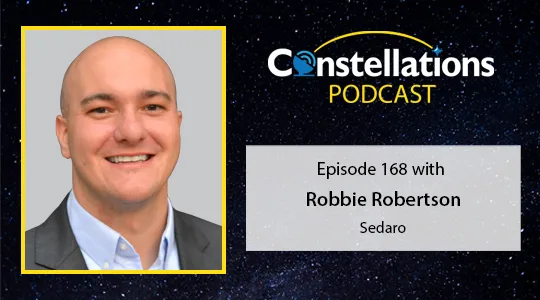
John Gilroy: Welcome to Constellations, the podcast from Kratos. My name is John Gilroy and I will be your moderator. Our guest is Robbie Robertson, CEO and co- founder of Sedaro. That’s spelled S-E-D-A-R-O if you try to look them up. Digital transformation has begun in the modeling and simulation of spacecraft. Today complete complex simulations can occur within minutes as opposed to days. Legacy desktop software solutions and costly in-house machines are being replaced by high performance and scalable simulation in the cloud. Bridging the virtual and physical world has the potential to offer organizations cost savings, cut time to orbit, and improve the entire process for developing spacecraft. Here to discuss the massive potential of digital twins technology is Robbie Robertson, CEO and co-founder of Sedaro, a startup that is revolutionizing engineering simulation and virtualization with digital twins in the cloud. Wow. You go to Google and type in digital twins, you see all kinds of activity. So Robbie, there’s been a lot of hype surrounding the concept of digital twins in the satellite industry. Can you explain what the term means?
Robbie Robertson: Yeah, so first of all, it’s a pleasure to be here, thanks a lot for having me. Yeah, it’s complicated. It’s one of those concepts in software, like anything in software that tends to be very squishy and when something exciting is happening, it can be difficult to understand in the diversity of potential applications, value propositions, different kind of flavors of it. Much like, I think, AI technology, digital twins are similar. So, starting to define digital twins. So, digital twins are virtual representations of physical systems. Fundamentally, that’s what it is. Where the challenges happen is differentiating that from what we’ve been doing for a very long time, what we’ve been doing since we first started using computers to engineer systems. We’ve been virtually representing those systems for a very long time, so we see digital twins as just the next step in that evolution of modeling and simulation of virtualizing physical systems. That next step, and I think what necessitates this new terminology, is really driven particularly today by a transition to much more complex, much more autonomous systems. To make those systems possible, you just need that jump forward, and so for that reason, we think this digital twins term really makes sense. Getting to that next level in practice, at least for our technology, what we think the market and the world needs to kind of create that advancement is simulations that are more integrated, so bringing all the physics together. So the data you see from that thing is really like the data you see from the physical system. Something that is authoritative. So to be authoritative, you have to be integrated with data sources from throughout your organization and throughout your tech stack, all your different tools. So, it’s something that’s leveraging the cloud to make all that possible. The cloud and web application technologies are particularly good at everything that digital twins, everything that modeling and simulation needs. Interoperability and compute power, and then everything that flows down from those like collaboration, like continuous improvement and updating through that interoperability with the rest of your tools and data sources. So yeah, that’s what we think digital twins means, and we take a very broad view of what it means and focus on that foundational technology and allow our users, our customers to unlock all that diverse potential that can come from a better model and a better simulation using our core technology.
John Gilroy: Robbie, when you were playing little league ball, everyone would get a Sun workstation and they would have these mathematicians and finally they could do complex variables and simulate things, and they hit the ceiling with that. There’s a certain limit to what a personal computer can do, there’s just a limit to it. All of a sudden now we have a perfect storm where all of a sudden compute is in the cloud and storage is in the cloud, then we can take someone like you can walk in a room and go, “We don’t need no stinking Sun computer here. We’ve got power here.” And so compute is cheap. So it’s almost a perfect storm for people to say, “What if? Okay, so what if we did this?” And you could play it out digitally rather than actually manufacture it. So it really can save money in a lot of different ways, can’t it?
Robbie Robertson: Absolutely. And it’s all about unlocking that potential. And it’s particularly challenging to unlock that potential in this area of engineering modeling because so much value is given to legacy tools and we totally appreciate that value. Myself and our CTO, we were building space hardware for five years before this. We’re running a lot of those SIMs, appreciating the fact that it’s very much garbage in, garbage out and easy to make mistakes with modeling software. So we kind of came at it with that perspective, but also this realization that dramatically enhanced capabilities were required now and certainly in the future, and the cloud’s the way to do that. So the goal of our whole company is pushing through that cultural technical inertia behind the legacy tools and building something completely from scratch that will be future-proof and be able to grow and leverage these cloud technologies. What you pointed out, the compute scalability, the memory scalability, and everything else that’s great about that whole online ecosystem of software and information to deliver this new capability. So yeah, it’s definitely a really exciting time to be doing that.
John Gilroy: I did my research and I found out you have a PhD from Virginia Tech. I said, “Whoa, I better do some serious research on this guy.” So I got up early this morning and I looked up everything I could on you. I read blogs, I called the police station, said, “You got a police report on this guy or anything?” Nothing came up there yet. And here’s something I found that you stated. You stated, this is Robbie Robertson right here, “Without bigger simulations and closer collaboration, humanity can’t build the future technologies we envision for ourselves.” So can you discuss the challenge you’re addressing in this industry? Is it just a legacy of old tools or so what’s the challenge here, understanding the new tools?
Robbie Robertson: Yeah, so we see all this kind of future technology and media. A lot of us I think can feel disappointed about where we are in 2020 versus where we thought we might be years and years ago. And that kind of quote is around thinking about what’s holding us back, especially in hardware and physical systems. In software, we’ve seen such incredible things that I think we didn’t envision. And the reason for that is the development process for software and the infrastructure that supports software, particularly cloud software, web applications, is so incredibly integrated and collaboratively developed and just inherently scalable. And that’s a benefit. There are a lot of things about software that you just can’t directly replicate with hardware. Like I can ship as many copies of the software as I want at no additional cost to me. I don’t have to manufacture the thing. But I think there are many things about that whole software ecosystem and the development process behind it, which has been conducive to that massive and kind of surprising level of innovation and new technologies. We want to apply that to hardware. To apply that to hardware, we have to virtualize the hardware and we have to do that in a way that is scalable and collaborative, that can collect input from all the stakeholders and allow organizations to benefit and cross-pollinate from each other’s work and integrate their systems. It’s extremely difficult to do that with physical systems relative to software systems because physical systems are dominated by physics. A lot of disparate physics drive the performance of this system. You’re trying to virtualize thermal orbit dynamics. If we’re talking about spacecraft, aerodynamics, networks like you were talking about with Chris Taylor from Aalyria and their digital twin solutions, all these things for a particular system have to be brought together to kind of realize that massive innovation and scalability that you can kind of glean from a bigger, better simulation.
John Gilroy: Robbie, hundreds of thousands of people from all over the world listen to this podcast. So I like to boil things down so they can understand whether they’re in Ethiopia or Brazil, I don’t know where they’re coming from. They meet me at trade shows and I don’t know, Poland, all over the place. So to give a sense of the advancements in simulation and modeling of spacecraft, can you provide an example of an organization using this new approach and how it compares to the legacy approach?
Robbie Robertson: Sure. So I think a great example comes from some work that we’re doing with this space development agency. They are delivering these technologies that are more automated, more distributed. So meaning they’ve got hundreds of satellites that they’re going to build and deploy that are doing what a monolithic satellite used to do and doing it better. So they’ve got this big complicated system, spacecraft from many different vendors of many different types, all working together to deliver a unique capability. It’s extremely labor intensive to manage that constellation using legacy approaches. So operationally, they need to find ways to solve problems that were traditionally labor intensive in an automated way.
John Gilroy: There are many luminaries in the satellite business and everyone has a different prediction of how many satellites in the next 10 years. I got to the point where I just randomly pick a number, I’ll believe it. There’s thousands and thousands they say. So we know there’s going to be massive growth. So let’s establish that. Okay, so how has the massive growth in satellite constellations impacted the need and use of digital twin software?
Robbie Robertson: It’s necessitated. It’s really driving it, and you’re seeing that at any constellation company. I mean, one of the first big constellations was Planet’s imaging constellation. You can go back to publications and say the SmallSat conference proceedings from many years ago where they presented these totally new approaches to managing their constellations that involved in part simulating that complete system and then having the computer recognize when something might be wrong and take an action to fix it. You just can’t have an operator sitting at the console and a team of experts behind it who built the spacecraft for every single vehicle that you have up there. So for all big distributed systems, whether it’s a big constellation or a fleet of autonomous trucks or whatever it might be, you need greater automation and to drive that automation to train an AI to automate it, or to just build in any other kind of what if type process to determine what actions to take because you operate that big complicated thing, you need simulations.
John Gilroy: I have negotiated many contracts and there’s usually a statement of work involved in, I hate the phrase, “adds moves and changes.” It’s just I run. It’s just so time consuming. And that happens with the satellite world too. So there’s delay of launches, we have no control over the weather and there’s design changes. And so how does digital twin software help minimize these common challenges in spacecraft development?
Robbie Robertson: If you have an authoritative model of the thing that you’re building or the thing that you’re about to launch or the thing that you’re operating, you can use cloud compute to just continuously “what if” every eventuality, every potential risk to your system from an adversary and from a military perspective, or weather effect that might delay your launch or whatever it might be. You can catalog those and then you can be “what if”-ing constantly in the background so that you can have that continuous decision support and that decision support can be automated. It can take action without a human loop or it can just be presenting those recommendations to users. So much like AI tools potentially being in the background and using historical knowledge of something to make recommendations continuously, you can do that with digital twin simulations. If you haven’t done that thing before, you haven’t flown this exact satellite before, it’s going to be compute intensive, but you have this massive value of continuously evaluating all these potential outcomes and scoring them so that you can drive that kind of super responsive decision making.
John Gilroy: I mentioned that thousands of people all over the world will listen to this podcast, but everyone all over the world is pushing change and trying to get better and faster, and a lot of brilliant people are working on this and they like to have better tools. So how does your software empower engineers in their efforts to advance the development of the spacecraft?
Robbie Robertson: So we provide them with a collaborative platform in which to build the model of the system, and we leverage a lot from software development approaches to enable that and make it like that incredibly innovative software development that I was talking about earlier. So they have a Git-based and Git’s what software developers use to manage all the versions of the things that they’re building. We use a Git-based system to manage these multi-physics, so fully integrated interdisciplinary models of the space vehicles and of all of the scenarios that they want to kind of exercise those space vehicles in. We also give them open source interfaces to integrate the simulations with any of their heritage tools. As I mentioned earlier, those heritage tools have a lot of value and we understand when someone says, “We don’t trust Sedaro’s physics model for our battery,” they can integrate that battery in the loop with our simulation and then we give them really powerful modern analytics. So we use all the wonderful things that have come out of big tech companies and been open sourced around 3D playback and time series charts and all the other kind of bits and pieces that are super important there and expose that through a web interface to not just the people who are building the models but the entire organization. We’re unlimited head count always, and we think that’s essential. We’re not licensing and sharing keys to the software and everything like that. If a company or a team gets a license to the software, it’s unlimited head counts. They can kind of bring everyone in the loop and accessing and integrating their stuff with that authoritative model.
John Gilroy: There’s always strengths and weaknesses to any innovation. I talked about Sun workstations before, but Sun workstations, you could control your environment very carefully and no one could get in and there’s weaknesses to newer systems, too. So what are some of the drawbacks and limitations of digital twin software in terms of spacecraft development?
Robbie Robertson: The most substantial limitation is the change involved in adopting this new approach. There’s a good reason that there’s so much inertia behind the heritage tools. So much about modeling and simulation and engineering software is unlocked by having experience with it, by understanding how to best leverage it and most efficiently leverage it for what you’re doing. Whether you’re designing the power system or the control system or the network, there’s going to be a way to use it that’s most compelling and useful. And so there’s this hump to get over and integrate the technology and digital twins deliver enough multiples of improvement in efficiency and capability over legacy approaches that people are getting over that hump. But that’s the biggest challenge, I think.
John Gilroy: I have a friend named Dave Linthicum. He just published his twenty-third book and it is about cloud computing, what a surprise. And he talks about cloud washing and cloud native. And within this community there are like throw chairs in the boardroom fights over defining specific terms. So let’s go to a generic term instead of a specific term. So what role does cloud computing play in terms of your spacecraft simulation software?
Robbie Robertson: So our software doesn’t actually have to run in the cloud, and it can also be hybrid cloud and you can be running part of the cluster on local infrastructure and part in the cloud. It’s designed to be flexible that way, and that really came out of early on a lot of the challenges around our government customers getting their hands on a cloud environment and getting us into it to run the software. All the current customers are running it in the cloud, but yes, we don’t have to be in the cloud, but we’re built to leverage what the cloud provides, which is that scalable compute. I’ll say that it’s not a difficult argument to make that our software is cloud-native. It is a microservice-based, scalable architecture where when you run a simulation, we actually pick the optimal number of computers to stand up in the cloud to simulate that exact system and network them together specifically to simulate the system you’ve clicked to go on. And likewise, the database scales as you have a bigger SIM streaming more data, the data processing nodes that post-process data, they scale based on the problem you’ve given to them. So definitely a cloud-native build from the ground up cloud-native architecture, and that infrastructure is essential to adoption of our software. I just said there’s cultural kind of challenges and implementation challenges around making this transition to new approaches that are enabled by digital twins. Having that scalable infrastructure that’s just there for us to leverage is essential in removing another barrier, which is like, I don’t want to stand up a high-performance computing. I don’t want to stand up a supercomputer to run big SIMs. I just want that to happen in the background. And Sedaro will manage all that supercomputing stuff and that big infrastructure piece of it, that IT part of it and the cybersecurity and everything else. It just looks like an engineering tool to them and they’re unlocking all that potential through our technology. So we’re really kind of the gatekeeper between folks that want to build digital twins big simulations and that scalable infrastructure.
John Gilroy: Well, you articulated that concept of Cloud-native very well. Welcome to the game. That’s going to be debated much in the next few years. Here we are in Washington, DC, so we have the obligatory Washington, DC question and we can look out the window and probably see in Alexandria the capital from here. Digital twin software has been embraced by the government. So is the commercial sector also taking advantage of this technology or is it just gubbies?
Robbie Robertson: Absolutely, and there are industries outside of space that are ahead in leveraging that technology, and they’ve been doing it for a while. So they’ve been delivering that kind of leap forward in modeling and simulation to enable things that they’re doing. Different flavors. The ones that have, at least one example that has been particularly important has been in the automotive industry. So twinning, creating virtual environments for autonomous vehicles so that they can train the AIs using synthetic data generated from those digital twins. And so they needed to, they didn’t have sufficient data from cars that they’d operated because they weren’t legally allowed to operate them yet in order to train those AIs to recognize when there’s a bicyclist driving in front of the vehicle and whether that happens under a bridge at night or in the middle of the day. So they needed that synthetic data. They created digital twins to do that. The government has more of a mandate to carry out this digital transformation. So we have taken advantage of that broad incentive across particularly the Space Force, given the size of the Space Force and the importance of what they’re doing and the need to move very quickly given the activities of our near- peer adversaries. And so it’s been an easy pitch to make. Plus they have the most complicated, largest systems. They have the most benefit from integrating those systems and managing the complexity of decision-making about what they acquire and how they operate it. So I think that that’s the reason that we’ve had the most luck in integrating with those customers, and we’ve really focused on them because that’s an easy value proposition to make. On the commercial side, there are a number of companies that are utilizing digital twins as it becomes more familiar and people just kind of come into their trade space selecting which tools to use, how to do things with an understanding of this new technology and the value it can provide, they’ll continue adopting it more and more. We have had 70 commercial entities either trial or have licensed the platform, and some of those include legacy prime contractors, large software companies doing government contracting work. So again, a lot of it feeds into those government systems because their biggest, most integrated and complicated to manage. But definitely seeing value on the commercial side, which is essential because you don’t get away with high level digital transformation incentives on the commercial side. You have to really deliver value and provide multiples of improvement over legacy tools. So we’re excited to see adoption on that side as well.
John Gilroy: So in the aerospace world, we know a little bit about you and your company, and I think your simulation technology is being used to develop spacecraft and UAVs. People know that. Let’s move out of our comfort zone. Okay. So are you considering supporting the development of new products for other applications?
Robbie Robertson: Absolutely. The roadmap for our product involves opening it up more and more so that our users can actually apply that underlying technology to any system. I usually use the example of they can build a spacecraft, they can simulate a spacecraft. We also want them to be able to simulate a toaster oven. Whatever you want to do, you build a model of it, you build your physics for it and you can simulate it at scale in the cloud and collaboratively model that thing, integrate it with the rest of your systems. So that’s what we’re moving towards and it’s really happening in a continuous way, being a cloud web application, we push out updates on right now a six-week timeline. So we’re always, as part of those updates, adding features to these built-in models and the templates that users can leverage for spacecraft and aircraft, for example, right now. And also opening up control to our users so that they can do the same things that are what we call the modeling and simulation team do when they build in new model types and new physics into the platform.
John Gilroy: What a relief. Tomorrow morning I can have a digital twin for my toaster oven and test out my avocado toast on different settings and not use the real bread.
Robbie Robertson: It’s important.
John Gilroy: Don’t waste a good bread on that, which is essentially what we’re talking about is saving money and development and a lot of things to do it before you actually commit to the mistakes, especially if it’s a piece of hardware. Yeah.
Robbie Robertson: Build a digital twin. Have it shoot you a text message every morning about the optimal amount of time to put your toast in.
John Gilroy: Well, listeners don’t know this, but I have a virtual crystal ball here, perhaps a digital twin of a crystal ball of the real crystal ball, and so I’m going to present it to you virtually here. So how do you see digital twins technology evolving over the next five years?
Robbie Robertson: I think it’s going to become an essential component of any particularly large technical organization. It’s going to be enterprise software. Modeling and simulation is no longer going to be something that is siloed and kind of ad hoc and bespoke for each small group or individual within an organization. This digital twin paradigm is going to bring that together and it’s going to get linked into how they do things across the enterprise, not just when there’s a physical system to twin, but from that concept phase carried all the way through. So that’s where we want to see digital twins, and that’s where we expect to see it in the next five years.
John Gilroy: Robbie, I think you’ve given our listeners a real good handle on how digital twins can save money and time for a whole wide range of applications. I’d like to thank our guest, Robbie Robertson, CEO and co-founder of Sedaro.