Transcript:
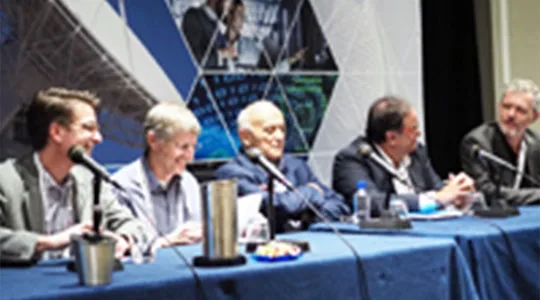
Thierry Guillemin: Good afternoon. I hope you still have some attention left in you. We try to make this as entertaining as possible. Let me first introduce this distinguished panel. We have starting on your left, Eric Watko, who is the head of products, marketing and strategy at SES.
Eric Watko: Networks.
Thierry Guillemin: Did I forget any-
Eric Watko: Nope, you got it. Just SES Networks, yep that’s it.
Thierry Guillemin: Dan Sullivan, who is the CTO of Kratos, RT Logic, and I believe we can probably say it’s the federal arm of Kratos-
Dan Sullivan: RT Logic is the federal side of the business, right.
Thierry Guillemin: We have Ken Betaharon, an old friend of mine, who is a CTO of ABS and used to be with me at the Intelsat. And then, Pedro Molinero, who is the director of operations at Hispasat. Pedro I think represents two people here. He represents himself, and he also represents my friend Antonio Abad who could not join us today, who is the CTO of Hispasat. So, it’s a double hat for you, Pedro. I hope it’s not too heavy. So, I cannot tell you how happy I am to have all of you here because this morning I was asked about the future of satellite communications. Well, first I had to admit that I did not know the future, which is a very embarrassing thing to do. And then I kind of expressed some hope that our panel this afternoon would know much more about it. But, I did. So, now it’s time to get a little help from my friends. So, this morning we touched on a few things that in my view are not really reversible. The race to higher and higher throughput for better economics. In particular, the flexibility of software defined payloads. And maybe this one is more controversial than you will tell me, the multiple orbit systems, combination of GEO and non-GEO systems. So, I have your first question to get started on all this. If all the systems are being forecast to be built today in GEO, or LEO, or MEO are actually built, it will be in the next five to 10 years. A huge amount of capacity that’s coming to the market. And there are a number of existing satellite applications that are growing, of course, maritime and aero and cyber backhaul, and others, government applications. But, I was not totally sure that it was enough to absorb the terabits of capacity that are coming. So, a question maybe for all the operators on the panel is what do you think are the new applications, the new services that will actually use all this new capacity that’s coming? So, who wants to take that first?
Pedro Molinero: I’ll start.
Thierry Guillemin: Pedro, the courageous one.
Pedro Molinero: Okay. Well, first I have to say that we have built even at Hispasat this kind of controversial because we are started at the very beginning in a world in which analog television was the maximum. And a few years, we were just focused on the television. At that time, the threat was really, well, we are putting one or two channels, 18 megahertz in a standard transponder. Then what will happen if we have small channels of four megabit per second? Then, this would be maybe, a tremendous problem for us on the economics. Well, time passed really and at the end, everything I just say just before in your presentation goes to an increase bandwidth to mend this increase in megabytes. And we were never just at the beginning not really planning for something like that. And satellites need to be adapted to that. Then, for the time being I cannot respond really what should be the magic solution for the increase in capacity in order to outsource, this terabit per second capacity. Let me say, everybody’s talking about blockchains for understand applications. Then why don’t we have a niche into blockchains for doing that. Virtualization is another issue. Then maybe those trends that in the past were right, maybe in the future we continue. But, for sure, as you said prediction of future is almost impossible in some cases.
Thierry Guillemin: So, you talk about the trend that is there and that has always been there towards growth. Now, aren’t we talking about another scale? I mean, the kind of numbers we saw this morning where maybe something like two terabits per second available today in orbit combining everything that’s there. We’re talking seven, eight years down the road about maybe eight times that. So, that’s another magnitude. And Eric, what do you think this capacity would be used for?
Eric Watko: Yes, this is a question we take head on internally at SES Networks because we’ve made quite a bit of investment in a lot of the capacity you’re talking about that’s going to come online with mPOWER, and some of our SES Next fleet to satellites for 17. And the way we look at it is we’ve dug into the numbers. And what we mean by that is beyond the traditional, or the expected growth in mobility government markets, which are very well suited for satellite is that the next one we looked in is the fixed data. And if you look at the trends of the data’s that we as an industry are less than 1% of a six trillion dollar terrestrial networking service capability. We’re nothing in the grand scheme of that. But, we’re going to bring on a lot of capacity. So, how do we get into that market segment? And some of the concepts we do is that if we reduce that barrier of entry, we make our economics more suitable is we’re starting to look into markets that are quote, unquote, part of the fixed data, but the next step beyond that. In other words, a lot of people as you sit here in your rooms, you’re connecting to services that are based in the Clouds. So, Cloud base services. Enterprise ICT services that are Cloud based. How do we provide access to those at a reasonable price that are beyond the connectivity in a fixed data market segment? Right, how do we show the value to a Telco, or an MNO to adopt more of our connectivity services to get them, those people onto those networks and services? So, we’ve looked at the statistics. We build it. Our capacity is predicated not just on those other segments you talked about, but how we feel we can grow the volume, if you want to call it that, in the fixed data segment to bring on some of these Cloud based services, some of these Cloud providers. If you look further down the pipe, all that’s going to be predicated around that. So, how do we get that to the users that are maybe not as accessible today?
Thierry Guillemin: So, a combination of more cooperation with the Telcos probably.
Eric Watko: Yep.
Thierry Guillemin: And the price point that is probably more to their liking that could get these barriers down.
Eric Watko: Correct.
Thierry Guillemin: Right. Well, Ken, how do you see that? And maybe a little twist to the question for you because you probably represent an operator that is less global than Eric, than SES. So, there is probably an additional component for you, which is how to get to these economics Eric is talking about when your market is maybe more regional, and maybe does not justify to invest big CapEx and big, big satellites. So how do you see that? And then, you can also tell us about the recent applications you think might drive the growth.
Ken Betaharon: First of all, I think I just might tell you ABS is not just regional. I mean, we are almost global, and we cover every place in the world we touch except the United States. We actually touch the east coast of continental US as well. So, we have the coverage all over the place. But, we start as a regional one. Just to answer your question about the future, I’ve been around the block many years now. And I remember in my previous job at one time they were predicting that oh, the network is already large enough with only eight satellites. We don’t need anything beyond eight. And that was 35 years ago. But, then you go to all these marketing people. They have also this, I think, exaggerated predictions of what’s going to happen. And let’s assume even if they are right 20, or 30% of what they predict, the majority of it you can absorb by terrestrial network, really, not for a satellite. Satellite is a very, very niche market. Nevertheless, there is a growth there. And there is a market out there. And we have looked at different services, and looked at the data services of the fastest growing really business we have today. I mean, people want to be able to, I mean, if you look at the broadcasting for instance, where you have the BTS services, that has flattened, or is going down now because people want to watch what they want, when they want it not necessarily what people tell them to watch. But to answer your question, one of the things we did is very difficult to really compete with the big Goliath in this business when you’re very, very small one. If you look at our operational costs is a lot less than the big operators. I mean, we don’t have fancy bendings, we don’t have really fancy facilities. We have our aux satellite operations center in very low grade parts of the world. We have lots and lots of capable people who like to live in their own region. They don’t want to go elsewhere. And that’s one thing. The second thing we do really, we had to reduce our costs. And if you recall about four years ago, we were the first operator. We actually were willing to go and buy 100% electric proportion satellites. Most big operators, like I was in a couple of proportion seminars, they almost poo-pooed the whole idea of who wants a whole, all electric satellite because it was never going to work. Second thing we did, which was a first again. We actually, because of the lighter mass of the satellites we were buying, we managed to launch two of them on a new rocket, Falcon 9. Everybody against, oh, this is a big risky thing to do, but when you look at the economics of it we were paying right now, Falcon, is advertised at 62.5 at that time was like 55, 56 million. So, launching a satellite for 26 million dollars, that was a tremendous savings. Plus, because we were the first customer of all electric satellites that Boeing was building at that time, they gave us, I would call it, so called introductory price. It was not really that introductory, but it was better than you normally would get. We passed a lot of that cost, the reduction in cost, to the customers. And that really helped us to be able to go from one satellite operator to eight. We have de-orbited two of them. Now, we have six. And we have a very, very large customer base everywhere except over Northern America, that’s all. So, we really had to be creative. It’s very hard to compete with the big boys. And, but you have to be creative, and we managed to do it. But, you have to think out of the box constantly.
Thierry Guillemin: Yeah. Yeah. So, you touched on reducing the costs of these pretty massive investments that satellites are. And that’s been a question for me, and we touched on this, this morning because so far the best way to reduce the cost of the capacity has been to add more capacity on the same spacecraft. But, should you look at it, the costs of the spacecraft construction itself has not changed a lot. And I mentioned an SES initiative this morning. I think, Eric is probably better placed than me to talk about it, which I believe is called SES Next, as potentially a way to change the economics in GEOs. So, can you tell us a little bit about this initiative maybe, Eric? And whether this is in your view the way to go for cheaper GEO? And if you have other ideas of the kind to improve economics?
Eric Watko: Yes. So, the concept of SES Next, really has been born out of a lot of the heritage we’ve done in our MEO constellation. So, even before we moved into that, if you look at what we have in mPOWER, which is our next MEO constellation that’s fully funded, is it is a fully digitized, fully software kind of beam forming capability that we are putting in orbit, and MEO. We took those same concepts of fully digitized payload along with the ability to have any kind of programmable satellite antenna beams and all that. And said, “What happens if we just change the economics and say could be a satellite for any orbit, that could be a GEO or MEO, but it’s fully reprogrammable?” And it really becomes not a technology conversation of just high-throughput versus ultra-high-throughput versus very high-throughput satellites. It really becomes an economic conversation that if you have an architecture that can be designed and developed to go on orbit at any orbit at any slot, and then can be programmed on the fly that you better then build your pipeline of your manufacturers of what they can build. And then, if you even go one step further than that is if you go and you make it not an exclusive type of arrangement so that let’s say, industry type of standard almost, if you want to think about it. Then, you increase the volume, which then drives down the total economics of the problem. So at the end of the day, SES Next is one partial technology where we want to go and as far as fully programmable payloads, and beam steering and all that stuff. But, it’s also the economics of how you procure satellites, and who you work with as your partners, and how you work with them and go from there.
Thierry Guillemin: So, it sounds like this has more chances to work if there are more operators ready to play the game because you are able to come to manufacturers and start talking volume, right? And that’s really what you want. You want economies of scale. So, just curious, have you approached your colleagues here on the stage already to talk about how they might cooperate on this idea?
Eric Watko: Me personally, no. I would say that would probably be part of the payload team and the core corporate technology team that runs that program. So, I don’t know if they reached out to them, but yeah, that’s the concept. We first are working through it with our manufacturers, right? And don’t know if it’d be us going to them, or the manufacturers going to them, right? I don’t think there’s a preferred path to do that.
Thierry Guillemin: But, it’s most definitely trying to have the same requirements so that the manufacturers-
Eric Watko: It’s making them flexible requirements just like we were talking about virtualization. And you look at all these concepts that we talked about today, right? It’s having a flexible pull of resources, or systems that can allocate and get the data where it needs get to in the right forms. So, it’s the same concept, just extended one step closer to the physical layer, that being the satellite.
Thierry Guillemin: Has Martin tried to quantify how much could be saved on the costs of a spacecraft buy with such an approach?
Eric Watko: Probably, I don’t know if we would divulge that yet because that’s part of the underlying business cases that we’re driving towards.
Thierry Guillemin: Pedro, how do you find this idea? Is it something Hispasat would be interested in working on?
Pedro Molinero: Well, the virtualization and the standardization to understand-
Thierry Guillemin: You may want to take this a little closer.
Pedro Molinero: The virtualization and the standardization for satellites I think is something that has been mostly like the Holy Grail for several years. And of course, these will come with a relax in prices.
Thierry Guillemin: That’s the goal, right?
Pedro Molinero: Well, yes, this is the goal. And I think this can be obtained. But, well, in addition to the virtualization also we have to find a solution on how to coordinate on the frequency arena with ITU field to our satellite. That is something that for the time being is totally unknown. It means for a time we will have our coordination process that this base in a mode, that this totally fixed for the lifetime of the satellite. And this mode can be adapted according to the needs. Then, we are going into this direction and maybe we’ll have to solve also the problem on how to make the evolution of this coordination all of the time. That this something totally new for idea. But, is a challenge, I think it can be solved. Then, we share the view, but for sure the scale is not the same as for SES and Hispasat. We are more a regional before a regional operator. And then we can support those ABS of virtualization, and understand the decision if really the price goes down dramatically. Something that can be substantially presented to our CFO people for instance.
Thierry Guillemin: Yep. It’s probably Catch 22, right? That’s the way to get the prices down and precisely to bring some volume. Last question on this particular subject. I know, Eric, that this initiative used to be called, GEONext, and now it is called SESNext. How significant is it to remove the GEO term of this?
Eric Watko: Yep. So, for us it’s very significant. Like I said, we have, we’re the only ones with an operational MEO constellation that is operational productized off and running. We have obviously a large GEO fleet. I told you we’re making a significant investment in the next generation of mPOWER for the MEO fleet. And we already have a significant investment of our HTS fleet of 15, 14, 12, and 17. And we just see that growing. So, the reason we kind of moved it away from just a GEO is we want to broaden the concept to MEO and GEO. And we know there’s a lot of talk out there about what’s going on at LEO, and the economics of scale that go on there. So, yeah. So, why lock it into one orbit where we as part of our strategy still view that a multi-orbit solution is a good approach to take. That gets the users, right, our consumers, the customers what they want the way they want it. And so, instead of dictating and say, “You’re only going to get services through this orbit at this way and this time,” all right. Let’s make it a little more open. In the context of you can provide hybrid solutions, or hybrid capability and connectivity that then gives them the option of getting the right application to the user, over the right orbit, with the right specifications, and the right inherent characteristics of that connectivity service.
Thierry Guillemin: Yep. And it’s, I mean, it’s interesting because we read the press, and you see that some manufacturers are talking about maybe getting rid of a GEO part of their business. And in this context, this question I have, does it really make sense to get rid of one particular orbit if you operators are looking for standards that really apply across the board independent of the orbit? So, what’s going on there is potentially a standardization of the space segment. And someone in the room here asked a question this morning. How will operators differentiate if the satellites are the same for everybody? And the answer is well, let’s look at the ground. And so maybe it’s for a question for Dan. But through all this big changes coming, a lot of capacity, new applications, and flexibility, how can the ground infrastructure best support this evolution, or this revolution maybe we could say in the space technologies.
Dan Sullivan: So, I’ll go back to what Eric said about the growth in the Cloud industry and in networks in general. And one of the things I wanted to go back to your question about capacity growth because it’s interesting I think Stewart said this morning, that even though satellite capacity is growing at unprecedented rates, it’s still a much slower growth than what’s happening in the terrestrial and the overall network provisioning around the globe. And so, that growth means that there’s demand from users. And I think what we’re doing is we’re traditionally measuring ourselves by the amount of bits that we push through our network, which is actually irrelevant. It’s really a question of how many users are we serving. And how well are we fitting into the infrastructure globally on the planet, which includes terrestrial, includes aero, and all of the other regimes. So, what we see on the ground is more and more of a desire to integrate seamlessly with the Internet, with the Cloud backhaul, with high capacity fiber infrastructure, and all of the data processing and data distribution and caching that goes on. You talk about, you talked earlier about watching television on the Internet, right? Well, there’s a huge data flow, and processing, and caching aspect to that. That’s all Cloud based. And so, what we’re seeing in the ground architecture is the need to seamlessly integrate with Cloud architectures. And that’s getting down to the point now of beyond what we just heard from SJC, and JSAT with virtualizing the command and control infrastructure. But, actually doing the same thing in the COMs world. Literally down to the analog to digital converter at the COM side. And so we’re seeing the growth in digital IF architectures, the elimination of lots of dedicated hardware and analog equipment in the ground stations. And the move toward the use of Cloud based and software defined virtualized ground processing. I think we’re in the infancy of that right now. We’re seeing it sort of in the command and control side, and in some of the traditional fixed satellite service processing functions. I think we’re on the cusp and we’re seeing it moving further and further into the comms chain. So, I think we’ll start to see less and less hardware in our ground stations. We’ll see less dedicated ground stations, and we’ll see more gateways that are general purpose, and can talk to many different satellites, or service many different customers. And we’ll see seamless integration to the backend Cloud infrastructure that’s really servicing all our users.
Eric Watko: And if I can just add to what Dan said because that’s a model that we replicated because you started your question with how do we then differentiate ourselves is that if you go back as an analogy in time. I used to work for Cisco, and had nothing to do really with satellite, and really just looked at how service providers differentiated themselves. And really, every service provider, AT&T, Verizon, Deutsche Telekom, BTU, you name them, they were beholden to the equipment providers on what are the capabilities they could deliver. And they had no ability to differentiate themselves, unless they went to an equipment provider and said, “Can you get me a new router that does X, Y, and Z,” first. Then they were just first to the market because then they sold it to the broader. What has changed as Dan was just saying is the software defined networking. So, if you see what AT&T has released in their Domain 2.0, which is a fully reprogrammable software defined networking capability that they pushed out in architecture a set of standards in 2014, roughly right? Almost three or four years ago. That model is now changing the economics of how these service providers have taken it into their own control of on top of common infrastructure that’s virtualized, they can come in and differentiate themselves through how they tailor that service. How they deliver the service to the end customer that’s not beholden to equipment providers necessarily, but through their own software means of how they get that to a customer. And so you take that model, and I think we’re seeing all the pieces of the puzzle come together in our domain now. As we talked about several of the technologies today is you could see us heading in that same direction quickly. And there’s a couple pieces we still need to figure out, but that’s our strategy. And the way we look at it is we’re going to differentiate ourselves by looking at a fully end to end programmable system that we can deliver a service to a customer, or a group of customers any tailored way that meets their needs, right? And that’s how we’ll start to really focus on differentiating ourselves per market segment.
Thierry Guillemin: And you believe in these customers being able to use resources regardless of whether they come from your infrastructure, or from another operator infrastructure? Is it something that’s also in the picture for you to starting sharing resources like that?
Eric Watko: So, yeah. There’s a couple concepts you could build on that one. One is that we use the same terms that he just mentioned there, being seamless and frictionless, right? And then it’s not just a terrestrial road it is how you’re seamless and frictionless to other operators. Because again, there’s not just one global network operator on the ground today. They’re all seamless and irreparable themselves. And I guess that they got a six trillion dollar market out there that continue to grow. Those economics, economies of scale come from that interoperability amongst not just the ground segment, but also across potential operator segments. You get scale that way, you get interoperability that way, you get economies of scales and standardization that helps reduce that total cost of ownership that then gets you into new markets that you maybe didn’t think were accessible in prior lives.
Thierry Guillemin: So, Dan said rightly in the end it’s about how many users you are able to reach. And of course, at user level whether it’s consumer or not, there is a user terminal. And seems that many of the economics would be changing. But, big part of the economies that have to change is how much does it cost to get and to install this user terminal? So, maybe a question for you, Pedro. Do you think that enough is being done fast enough on user terminals in order to be able to support the expansion of services that’s coming with this new capacity?
Pedro Molinero: Well, I think there is a good range at the moment for doing activities on grounds and specifically on user terminals. Today, we are living in a world in which we have one service that is attached to a certain sector, to a certain terminal, to a certain provider. It means it’s something that everybody has let’s say some terminals that doesn’t belong to anybody specifically. But, they are always providing services to the final user that is let me say, is the king for that. Then, I think, what is the market worldwide? The more important for that has been presented today is to have the flexibility on the ground addition on the space segment. But, at the end is a fraction, really of the whole business. The more important part of the business is on running. Then, we have to push really all the service, sorry, all the user VSAT, and terminal providers in order to make default. And maybe one of them really is standardization at the end. You will have, I will say finally a box that will come with software that should be from a VSAT provider in Newtec, or Gilat or whatever. Then, for a satellite operator, this is something right because at the end we can serve really the client with the most repeat service at any time. This is one side. But, I’m sure to have I would say not tied to, tie in’s to a certain sector and to a certain provider. I think this is something that has been done on the Telco industry for years and years. And then, maybe on satellite we will have to play the same.
Eric Watko: Now, we’re with you, right? That was the last piece of the puzzle. If we talk about digitization, and re-programmability of payloads, and all these smart gateways, and beam forming, and all that that’s the last piece that’s still kind of fixed is the VSAT providers, right? The ground equipment providers. Yeah, they’re virtualizing stuff, but how do they make it more reprogrammable, or standardized, or the ability to change waveform depending on the fly, or depending on segment that might be optimized for one segment, or one application or another? I get the use of that. But, yeah, that’s that last piece of how do you standardize that piece of the ground equipment that really then enables us as service providers to deliver that best service to the user who’s going to consume it? So, we’re assuming that’s that last boundary.
Dan Sullivan: And it’s interesting to see the same dilemma in the terrestrial side as you guys are just talking about. The forces that are, should you have a standardized payload that everybody is sharing a basic design and using it maybe in a different way? Well, the terrestrial terminal providers, they’re in a fight also. We saw the attempt on standardization around DVB-RCS, which basically failed because the terminal providers said their discriminators in how they compete with each other, and generate value, or to have special sauce in how those waveforms work. And so, I think you have the same dilemma on the terrestrial side on the terminal side of they have the same problems to overcome. It’s how do they cooperate and still have business value, and still maintain a viable business?
Eric Watko: But it comes down to the software, right? And that’s where you guys as Kratos, you’re looking at what’s the value added software that you can help deliver that service, right? How do you get it to market quicker? How do you make it more programmable and dynamic? The value, yes, there’s value on bits per hertz, 100% agree, right? You need full utilization of the asset and the resources you put on there. But, there are other keys that lower the cost and provide the best value to the end user. And that’s the software that fits on top of it that I think everyone in the value chain has to look at and explore.
Thierry Guillemin: Well, so when maybe that’s a question for Ken. Everything that is said here makes a lot of sense. And now, this is talking about cooperation between the different players in market. At a level that frankly, has not happened so far. We are in an industry that is known to be very insular. Of course, this cannot last forever. We all know that. How do we break the mold? How do we make this happen? This cooperation, and this working together on standards, on open standards. Do you want to take this Ken?
Ken Betaharon: Sure. I think if you want to just go back there is definitely a pressure on the price that the customer is willing to pay us. Our cost has been fairly fixed. If you want to stay with the standard way of doing things, I guess we’re going to go out of business because it’s going to be very, very difficult to stay in business using the same type of payload, the same type of ground station. So, what has happened? Unfortunately, I don’t think operators have taken any initiatives on their own. Industry has taken initiatives. Satellite manufacturers have tried to do digital payloads. Ground station people have tried to do digital antennas for the ground, for instance. And you mentioned the DVB-RCS. If you look at for instance, there is a standard DVB-S2X. I talked to virtually all the satellite manufacturers. Everyone of them, I’m sorry, ground manufacturers. Everyone of them said, “Oh, we’re going do it, but there is a little bit of a twist that if you use ours, you’re stuck with us.” You cannot, I cannot go buy from A, or B, or C, or D. Okay, so we need to work together somehow. I don’t think we’re going be able to at least, this is my view, share the same resources because necessarily you don’t have to buy a very, very large satellite. One thing which has happened as a result of all this new LEO systems, and MEO systems I think has gotten us, at least from our side, to start looking at how to build satellites. How to really deploy these things differently than what we have done traditionally. I mean, we cannot do business as usual. There is no reason why you should go buy, spend three, 400 million dollar, buy a very large satellite. Why can’t you spend that money and buy 10 or 15 very, very, much smaller one? And that may be even more beneficial because you can deploy the different orbits of the slots. I’m a very geocentric person. I mean, let me qualify that one first because that’s all I’ve done my life.
Thierry Guillemin: You are geocentric, but you want to do a constellation in geo.
Ken Betaharon: No, no, no. Constellation as a geo covers the whole globe, it’s free. I mean, that’s called the constellation. In MEO, it’s like 10. The LEO is like 800, 900. And people don’t realize, even if you have like in the OneWeb announcement, they are not mentioning their objective of building a satellite under a million dollars each. When you build 900 of them, you’re talking, what, a billion dollar right there. And this is a hardware to put in there. And you have to have a tracking antenna. You come up with something that claims 10 terabits of data on the whole constellation, but only maybe about two, or 300 gigabits of it is over where people live. The rest of it, what are you going to do with it? So, it all sounds very good. And I don’t want to get in the debate of LEO, or GEO, but-
Thierry Guillemin: But you did a little bit.
Ken Betaharon: But there were 11 announced systems in the 1990s, out of which only two took off. Technically, they were successful, financially they went bankrupt, both of them. The other nine never even after spending hundreds of millions of dollars never took off the ground.
Thierry Guillemin: So, it’s an interesting point because this always a question, is history repeating itself? I see at least one big reason why it may not be the case. And this big reason is that I see GEO operators being really committed to non-GEO capacity. And one example is Telesat. I mean, when you go to the website of Telesat, and you read what they say about you it’s quite a shift. I mean, for a GEO operator to be so enthusiastic about it. It’s interesting. Another case is of course, SES and MEO, and that’s not only SES committed themselves to MEO, but I recently doubled down with mPOWER. To me, to a certain extent, this train has left the station. And now, it’s more a question of how you use this capability.
Ken Betaharon: This is a payload. I mean, I think that’s the future. I mean, no question about it. I mean, if you talk to people who are looking at digital payloads right now, not just the satellite manufacturers. There are two or three independent companies, which are trying to do that. That basically, one claims that you can replace all the SVGAs, all the filters, all the receivers, everything else with one large chip. That’s it. I don’t know that’s going to happen or not, but at least that’s the future that the thing is going to be. But, some sort of that is going to come out ultimately. Some part of that is not going to be 100%. And then the very near future after this not hearing my life probably. But, at the same time if you look at the, like you said history repeat itself, you always seem to have solutions looking for a problem for it. That seems to be the approach we are taking because there are lots of money out there, they don’t know what to do with it. They say, “Okay, I made lots of billions of dollars here. Let’s go and build a satellite constellation.” I mean, the MEO system that they just signed, they signed for a billion dollars. That’s a lot of money to invest these days. It’s not a simple amount of money. It’s not a few hundred million dollars. People are talking about delivering basically about 60, 70 gigabits of throughput for 25 million dollars delivered in orbit now with these smaller satellites. So, you have to look at that really in perspective. You can throw a billion here, a billion there, a billion there, how are we going to recover all that? At least for us, that’s very, very difficult to really justify for us. If you’re looking for smaller satellite with a digital payload, and for instance, we are not looking for a high- throughput with many, many spots. I mean, I like this idea of having a hopping beams so I can emulate equivalent to a hundred spot beam with only 10. I can move them around. That’s a lot simpler, a lot cheaper to build. It’s like the old TDMA. Efficiency’s not 100%, it’s slightly less, but nevertheless, you can actually get very good throughput and very good performance. But, that’s how you can compete. Otherwise I think we’re going to, it’s very difficult. I think I mentioned to you this morning. In our previous association, we used to sell one megahertz of bandwidth per month for $8,000. Now, it’s four, or $500. But, our cost is still fixed.
Thierry Guillemin: Yep.
Ken Betaharon: So, you have to reduce the cost if you want to stay in business really.
Thierry Guillemin: So, and back to this question of differentiating, or cooperating, or both. From the standpoint Dan, of a company like Kratos, are they supporting the operators trying to meet? What would you expect from these operators in order for this standardization to really take off? For things really to change because so far, my impression is everybody comes with their own requirements, and thinking their solution is best. But, that’s not how you get to the economic of scales we have been talking about.
Dan Sullivan: Okay, so we’re amongst friends here, so I’ll give you the real answer and not-
Thierry Guillemin: Nobody would repeat anything that’s been said here.
Dan Sullivan: I don’t see a big prospect of the different operators and the different providers coming together and creating standards that remove their ability to differentiate each other. I just don’t. But, I do see the commonality coming more at the network layers. So, if SES can provide a service that is Internet accessible, can provide transport, can get to the mobile users, can get to the different users that need satellite communications, that service is now accessible. And it can be traded by a customer against a service from Intelsat or any one of the other providers. On the ground side, that’s the area where we’re focusing is on sort of that network layer, that network edge capability. So, that a ground system can serve multiple users, and maybe a terminal can serve multiple users. We see a lot of innovation in the commercial SATCOM community. There’s also some innovation going on in the US government commercial SATCOM, usage of commercial SATCOM. And we’re working a program right now where we’re doing a pilot with the US government to create a sort of a universal ground terminal. And it’s really similar I think to what you talked about as sort of a box goes on the terminal, makes it accessible over multiple satellites. So, we see our customers trying to roam, trying to do the kinds of things that we take for granted when we turn our phone on here in Annapolis and it works. So, I think we see people trying to solve that problem in different ways. I don’t see an ability for a standards group to sort of come together and force the satellite operators. And I think new entrants into the market are going to bring their own perspective on this. If you’re a Google, or a Facebook, or one of these sort of new space entrants that might be poking around the edges right now, they’re looking at this as a network transport problem, not a satellite problem. And I think it’s just a fundamentally different way of looking at the market, and what technology you need to go enter the market. It’s going to be disruptive. It’s going to continue to disrupt. I think we’re just at the beginning of that whether it’s multiple orbit regimes, low cost satellites, different payload concepts, integration between different kinds of assets on the terrestrial and the satellite side. Ken Betaharon Low cost terminal?
Dan Sullivan: Low cost terminal, same thing, right.
Thierry Guillemin: You touched on the US government innovation and do you feel that there’s been a shift there where commercial innovation has actually taken over a little bit in the past few years? And what of the commercial ideas are really most interesting for your government customers today? How do they, when they look at this, what do they want to use?
Dan Sullivan: So, I think there’s sort of two parts to that because the government as a many head, especially the US DOD is a many headed hydra. I think in the use of commercial SATCOM, they are very much stuck in their old ways. They want to provision bandwidth. They want to deploy it and use it across different constellations around the globe. And a lot of that is driven by the fact that it’s very expensive to recapitalize user equipment. It’s military user equipment. There are special security requirements, strange waveforms, and legacy things that are hard to change over. That said, there is a renewed emphasis I think in the government space on next generation satellite constellations, and use of space in a much more cost effective manner. Less for comms, maybe more for earth observation, and other kinds of missions. We do see a lot of energy pouring into the smallsat arena. You talked about the million dollar satellite. And what goes along with that is technologies like [S-per- rings 00:45:57] and things where you can launch 30, 40, 80 satellites off one launch. That does begin to change the economics of how those constellations would operate. So, there is a lot of innovation going on. It’s not all in commercial SATCOM. Even in the COMs arena we see the need for protected COMs, special waveforms for anti-jam, and anti-interference, and something else like that coming much, much more to the fore, as the RF environment gets worse, and worse. Especially, in a sort of military situation.
Thierry Guillemin: Yep.
Eric Watko: I’ll just add to that because beyond the technology innovation especially for MIL SATCOM, COM SATCOM type services, the government has shown innovation even on the procurement methodologies, right? They used to stuck to their procurement processes and guidelines. Now, they’re looking to expand beyond that to get access to COM SATCOM in a much lower cost effective manner where they need it to … They demonstrated that, and they’re applying it today from us and others, and different vehicles where they’re showing innovation as well just beyond the technology access part of it.
Ken Betaharon: Have you tried the government, because we tried the, of course, we don’t have innovation directly there because who, resellers. But, to get them to actually commit to multi-year contracts rather than one year contract because of a budgetary thing. Because one year contracts, they always get the highest price. Multi-year one they get a better price, but they don’t seem to be interested in committing to multi-year.
Eric Watko: So, yeah. So they, the US government cannot commit to multi-year contracts just because of the budgetary regulations they have. So, they’ll never ever do that. But, there are other contract vehicles. And yes, we can talk up on, but yes, we do in our SES GS group, as a vehicle by which is not a multi-year contract, but it’s structured differently on how they can procure services over a duration within a single contract vehicle.
Thierry Guillemin: Looking at the watch here, do we have five more minutes, Jim?
Jim: Five more minutes, Thierry.
Thierry Guillemin: I think we’ll use a bit more than what we were given, but it’s interesting conversation. Maybe a last question for, and I want each of you to weigh in on that. It seems to me that when operators are clear on what their vision is, and what their wish list is technologically, the industry responds pretty well. I think that’s what happened with software defined satellites. We started talking about flexible payloads seven, eight years ago, and at the time, manufacturers were not sure how to approach that. It could be more expensive, etc. And now, we’re getting to something that’s really a reconfigurability and software defined. So, we probably need to be clear with the industry as to what our wishes for the next 10 years are. And I wanted to ask each of you what, if you had one item to put on this wish list for the next 10 years, what would it be? What is the one thing you want the industry to give you?
Pedro Molinero: Well, we have to choose only one?
Thierry Guillemin: Okay. You can do two.
Pedro Molinero: All right.
Thierry Guillemin: We have five more minutes.
Pedro Molinero: Okay, well, I think one of them for sure is the flexibility. Flexibility I think is one of the highest because at the end maybe we will try yes, to bring what is the future in the next three years. Maybe, we don’t know what will happen in the next year. Then, on this project with our case, flexibility is the only way, yes, to live with a world in which the themes are changing. And we don’t know what should be the next application, or the key application for something. Then, flexibility is the maximum. But, at the end flexibility is really to pass the ball to the satellite suppliers, to the manufacturers. And maybe we have to find out to read more what does flexibility mean? Okay, then we have played in the past flexibility from very low level to the maximum one. So maybe so we will define it by artificial intelligence, or whatever. I don’t know really. But, maybe we have to define this flexibility level in some extent in order to try to focus on this objective.
Thierry Guillemin: Ken, what wish do you want to be granted?
Ken Betaharon: I think, I will echo what Pedro was saying. I think I would probably call it the flexibility is very important. Our ultimate wish is to get, to be a newcomer orbital diagnostic satellite design because if you go on the ITU list and you try to do new filing, all the big operators have filing almost every two degrees around the globe, although they are not using them. They just more like a preventing you from going there. So, I want to be able to get a satellite. And I think the industry has been very receptive to be really fair to them. When you talk to them, they give you as much flexibility to be almost as orbital agnostic and as flexible as possible. So, if you deploy a satellite at a particular location because the filing is fairly new, or is not senior as other ones, and you respect those who have been there before and you don’t want to interfere with them. And be able to really provide services and if like I said, you have been allocated a smaller satellite. If I build two or three small one and business does not develop at the particular orbital slot because you cannot really predict the future. I’ll be able to move it to someplace else, and start services there. I think that’s where our industry has been very good. I mean, both the Europeans, and the US manufacturers I think they are working on those sort of things.
Thierry Guillemin: Okay. By the way, Ken, before we finish, I’m sorry if I suggested that ABS is a regional-
Ken Betaharon: No, no. We were regional to begin with. We are not 100% local. That may be a better way to put it.
Thierry Guillemin: Dan, while you are not an operator, per se, but what’s your wish?
Dan Sullivan: So, I sort of have two answers I guess, not being an operator. One of them I think is coming to a method to agree on how a spectrum is going be managed. And we didn’t touch very much on this today, but as we start talking about multiple orbit regimes, multiple landing areas, in mixed constellations. I think we have a major unsolved problem in how a spectrum gets managed globally. And it’s just going to get worse, right? As more and more varied constellations come online. So I think that’s probably the one thing that I think industry could get together on and begin to cooperate. And then, to go along with that though, there’s a lot of voices in the satellite industry that are not represented by traditional GEO’s SATCOM operators, or SATCOM operators, right? I mean, there are emerging concepts in LEO and in the small SAT arena. OneWeb is one. Maybe one or two of these will survive. And they need to be part of that conversation because I think over the years, the GEO COMM SATCOM market has come to a very well entrenched understanding of what it means to do comms from GEO. And I think the new entrants into this market, they just think differently. They think about networks. They think about users. They think about IP traffic, and eyeballs on Facebook. It’s a much different way of thinking. And I think we, so we need to get some more voices into the conversation going forward if we’re going to actually succeed.
Ken Betaharon: I think those new entrants really have made us think differently, which is good, in a really positive way.
Thierry Guillemin: Eric?
Eric Watko: Yeah, I think we hit on most of the concepts today that I don’t think would add differently to it. We are making plenty of investments in areas that we haven’t had to date, right? We already talked about the payloads, and the beam forming. But, even on the flat panels, right? That publicly leave announced our supporting the development of three new innovative flat panels that drive down costs there beyond what’s available in the market because that to the point of low cost terminals that are efficient, right? It’s two parts. It’s one, the antenna, but then it’s two, the modems. And like I said, I would just highlight that’s the one area we have yet to really focus on, but we’ll start to on the equipment providers is how do we make that more programmable, or software defined, or whatever you want to call it, virtualized, standardized? All those words -ization above it of doing that because we agree, right? It’s going to happen. The convergence is going to happen at the network layer. But, that would be the last part is how do you, if you’re delivering in an end-to-end service, do we have a system that can orchestrate at all layers of the network across the whole thing that take care of your satellite resources, your assets, your licenses, your spectrum? All the way down to your resources on the ground, at the gateways, and the terminals beyond that into your network layer, to your application layer, and so forth. Because, that’s the other part of the piece of the puzzle we’re missing is that orchestration, end-to-end, to really get that service to that end customer the way they want it to. So, those two pieces are probably the ones that we look down the horizon at. We need to make our investments, or ask of the industry to focus on as well with us.