Transcript:
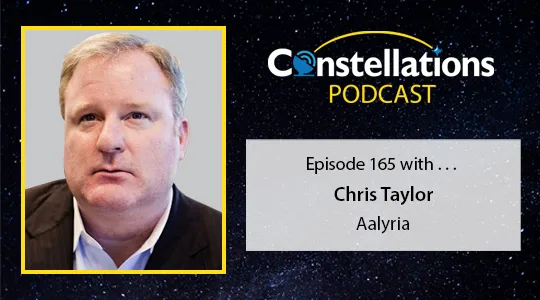
John Gilroy: Welcome to Constellations, the podcast from Kratos. My name is John Gilroy and I’ll be your moderator. Today, we talk about connectivity everywhere and network orchestration. Our guest is Chris Taylor, CEO of Aalyria, an aerospace tech company with the mission to create connectivity everywhere and to ensure that the demands of our time be brought together as one. Chris, we’re going to jump right in here. Your company Aalyria won a contract with the Defense Innovation Unit, the DIU, for hybrid space architecture. Can you explain what hybrid space architecture is?
Chris Taylor: Sure. And first of all, John, thanks for having me on today. It’s a pleasure. Commercial companies want to sell their services to the U.S. government. The U.S. government wants to make use of those services. The challenge is that we put a lot of things in space that don’t really speak to each other yet. So the idea between a hybrid space architecture is how can we allow the U.S. government to take advantage of everything that the commercial space community is trying to offer and make use of it across all of their networks going forward? So the idea behind that was the hybrid space architecture, Defense Innovation Units. Bucky Butow, who’s the head of the space portfolio, put this whole program together. The only way that we can do it though, because none of these things were ever designed to speak to each other is to create a common control plane. And that’s where Aalyria and our Spacetime platform comes in.
John Gilroy: Wow. Spacetime platform, sounds like science fiction, doesn’t it?
Chris Taylor: It does indeed.
John Gilroy: Well, let’s talk about something that’s important for the people in the Pentagon. It’s network resilience. Whenever I’ve talked to general or someone down there, they really get perked up when talking about resilience because that’s really important to them. So obviously network resilience is critical for this architecture we just talked about, but how do you ensure resilience between the network nodes?
Chris Taylor: It’s a great question, and you are right. The network resilience is something that is at the forefront of everybody’s mind in the Department of Defense. So personally, Spacetime’s digital twin model allows us to simulate the entire network environment in real time, which then enables us to identify possible vulnerabilities, anticipate points of failure before they happen. We have predictive algorithms that consider factors like weather conditions and signal interference, and even physical motion of network nodes, satellites, aircraft, ships, ground stations, et cetera. And we’re able to adjust network routes and configurations proactively before something bad happens to them. And the way we do that is because we have a unique capability to make before break when it comes to network connections. If a wireless link is predicted to fail due to any reason, the system proactively establishes alternative routes to ensure uninterrupted service for our customers. And this is achieved without any sort of packet loss and ensuring that there’s data integrity across the entire network. And then of course, one of the biggest things that we’ve done is our APIs are now open and they have the ability to dynamically express our network requirements, your network requirements to include resilience criteria. So if there’s a high priority, sorry military operation requiring secure and resilient communications or a commercial application looking for optimal data throughput, the Spacetime platform can adapt its network orchestration to meet those demands. And then finally, I think what is important is that Spacetime was designed as inherently multi-domain. So if a satellite link fails, Spacetime can reroute traffic through terrestrial or maritime nodes. But if a terrestrial link is compromised, then the traffic can be routed through aerial or satellite nodes. The adaptability that we’ve created allows us to build inherently resilient networks that can withstand various forms of challenges, whether it’s natural disasters, system failures, or other unpredictable events. So the whole combination then of predictive analytics, dynamic rerouting, customized network requirements and multi-domain capabilities together ensure network resilience between the nodes and that’s all inside Spacetime’s architecture.
John Gilroy: Chris, I think years ago the ethernet was designed with make before break thing, and I view that as like two-dimensional chess, but as a satellite component, all of a sudden it’s three-dimensional chess. The complexity goes way, way, way up with this. And so one of the challenges of integrating satellite into terrestrial networks is the delay involved. This is going up. So how do you deal with the delays from LEO and GEO in a network that’s changing rapidly without dropping data and disrupting traffic?
Chris Taylor: Sure. And you hit the nail on the head. Particularly from GEO into terrestrial networks and with rapidly changing topologies, it becomes even a greater concern for everyone involved. Again, the make before break capability of Spacetime, which I just mentioned, is really critical. By proactively understanding adapting to the expected network conditions, we can set up new links before old ones degrade or break. This minimizes the risk of dropping data and disrupting traffic, but even as the nodes are moving or other conditions change, weather interference, et cetera. So the system, the space form platform calculates and anticipates the latencies that will occur with any of these changes and then optimizes the network accordingly. And I should say this optimization happens in about 200 milliseconds. And then again, with already having a digital twin of the network environment, it allows us to really understand the position, orientation, motion of any of the nodes in the network in real time. We can model the entire network down to the expected latency for each potential link, which is wonderful. And this way we can prepare and adapt to inevitable delays, whether they’re from a GEO satellite or from some other long distance link, if you will. And then you mentioned DTN delay-tolerant networking. We have built-in capabilities for schedule-based routing of bundle protocol data units already in Spacetime. Bundle Protocol, as you know, is a cornerstone of DTN architectures, which are designed to cope with these kinds of extreme delays and disruptions. And while the features is especially relevant for cislunar and deep space applications where the speed of light delays and planetary obstructions come into play, it’s an inherent part of our platform and it allows us to offer a unified networking solution that is actually delay-tolerant across all domains from terrestrial all the way through deep space.
Chris Taylor: So with proactive link management, predictive modeling, and the support for delay-tolerant networking, DTN protocols like Bundle, Spacetime is uniquely equipped to handle the challenges of latency and delay in all of these rapidly changing network topologies. And that’s really the thing, isn’t it? The new normal is rapidly changing network topologies, and that means everything has to change with it. If you take, for instance, five GNTN capabilities for my life, the cell phone infrastructure of the planet has been around static cell phone towers, and now we’re about to put cell phone towers in space doing 17,000 miles an hour around the earth. This is a different and dynamic topology to be working with. So as we continue to move through delay-tolerant technologies, but also paying attention to anything that is latency related and has to do with rapidly changing networks, Spacetime is equipped to handle those things already.
John Gilroy: I got some gray hairs in my head. I remember back in about 2006 when Cisco came up with using the word unified as well. They called it unified communications. It was the early stages of VoIP, but this is just, it’s so different. It’s just worrying about satellite transmissions on top of existing terrestrial network. It’s just, complexity here is almost beyond I think what most people can understand. Let’s jump over here to some remarks you made at the World Satellite Business Week Conference. You talked about creating a capacity and capability of subsea cables, but putting them in space. Now, how would you do it? And secondly, why do you need to do it?
Chris Taylor: Well, to be clear, I didn’t say we should put subsea cables in space. That would be confusing. But in the course of talking to the reporter, we talked about being able to put the same capacity or close to it as a subsea cable.
John Gilroy: Ah, that makes sense now.
Chris Taylor: Yeah. The other part of our company, the hardware part of our company, which we call Tightbeam, an homage to the TV, the Sci-fi show, The Expanse, our free space optics capabilities, we can drive 100 gigs per second plus from ground to space, space to ground and space to space. And as we begin to put more sophisticated satellites with more compute and swap into space, kind of like the K2 satellites that are being developed out in El Segundo, we can take advantage of all of that high-speed bandwidth that coherent light free space optics provides. Remember the majority of free space optics products today or non- coherent light just means that they use on-off keying to modulate their operations where we’re using coherent light free space optics, which means when they’re in phase and in color, we’re able to deliver 100 gigs per, 400 gigs per, up to terabit per second capability going forward with basically the same modulations that are available in today’s RF program. So being able to drive that type of capacity into space is basically the same thing as any other technology development over history. You give really, really smart people, a better sandbox in which they can innovate and discover. For instance, you asked why would we want to do it? What if the earth was suffering a devastating weather event or some other really debilitating event and infrastructure everywhere was destroyed? We may only be able to rely on a space-based communications infrastructure to restore services, to communicate with each other, et cetera. So the idea of more is better has been prevalent in tech development since the beginning of tech development, and we’re excited to deliver that capability to both commercial companies and of course governments and allies to be able to use that type of capacity to develop new ways of moving data and communicating with each other.
John Gilroy: Chris, I’m taking notes here, and when you talk about all communications on earth being in trouble, difficult and just going to space, it does sound like an episode of The Expanse, doesn’t it? I mean, something playing up with this interview, The Expanse.
Chris Taylor: Such a fantastic show, such a fantastic show.
John Gilroy: Okay. You live in the Washington DC area. I live in the Washington DC area, and I think you have said that from the government side, if you can connect everything we touch through sea, air, land and space, it becomes a strategic deterrent. Can you expand on that please?
Chris Taylor: Sure. The U.S. and other state and non-state actors evaluate strategic competitor capabilities all the time. If we’re able to create a seamless ability to integrate all of our systems in all domains, the result of that may be that there are no clear moves to make against it. You might infer that a strategic competitor would make different decisions, particularly away from kinetic activity that could result in the loss of life on both sides. If we’re able to show that we have the capability to do things that they simply cannot do and for which there is no move that would be worth the cost that it would impose on others, and thereby making it just simply not worth the effort to combat it gives us all a chance to take a couple breaths and step away and say, maybe we don’t need to get into this fight right now.
John Gilroy: Let’s take this technology issue and examine it a little closely. So why do we need more technology to provide more bandwidth usage? What else can we use besides spectrum for bandwidth?
Chris Taylor: Well, I think as you know, spectrum is finite. And not only that, it has a filing priority system that gives some companies advantages over others. It’s highly inefficiently used today as well. Spectrum, RF spectrum has properties that create interference and that also make it obvious that you’re using that spectrum, by being able to trace it back to advice or platform. So there are limits to its use to include speed, but on the other hand, using coherent light in commercial frequencies that is wholly unregulated. It’s not really easily discernible and it has a terabit, multi terabit per second bandwidth associated with it. So you start to rebalance the character of the capacities that are able to deliver to both consumers and to government needs, and companies and governments can then take a look and say, for this particular case, I may want to use RF, for this particular case, I may want to use light, free space optics, optical. So the idea is that you’re broadening the choice, you’re increasing the speed, decreasing the detectability, and really opening up a whole bunch of capability where it otherwise didn’t exist.
John Gilroy: You mentioned different technologies there, and so the question really is how can you help satellite companies make better use of all these new assets? For example, HTS high throughput satellite?
Chris Taylor: Yeah, it’s a great question. Spacetime was designed as a platform from the ground up to help satellite companies generate more revenue and extract more value from all of their assets on the ground and in space. By delivering the ability to serve more customers more effectively, Spacetime is a value multiplier for new assets in space as well. I mean, just look at the number of mergers that are going on between satellite operators. So now GEO companies are buying LEO companies and they’re getting together and they’re deciding to put a MEO constellation in space. And I’ll go back to what I said before. None of those things, zero of those things were designed to speak to each other, but Spacetime can help them do that. The other thing is, as the needs of customers, whether they be commercial or government, increase in sophistication and demand, we’re able to offer satellite operators and others greater options to enhance their SLAs. And right now, this is the best way to do it. When we understand there’s native interoperability with not just U.S. space needs, but those of all of our allies, the return on investment for new assets start to become game-changing for all of these operators who are using Spacetime. Even more than that, satellite operators who own spectrum have a lot that is inefficiently used, right? So imagine being able to use a platform like Spacetime whereby you could advertise your unused spectrum for some price on the market that another satellite operator could use to fulfill a business need or a government mission. And you could advertise this in a marketplace such that it would make all of your unused spectrum more profitable for you as a business. And we’re able to do that today. So we’re excited about all of the uses of our technologies to simply make the economic case that satellite operators and their investors have set off on even stronger and allow them to make better use of the assets that they spent so much money on.
John Gilroy: It’s amazing. If you get on the highway, you see these trucks that have LTL on them, means less than load. And so what they can do is they can negotiate and fill up that load to make it more efficient. And you’re taking this hardware concept and applying software based and dynamic. It’s really interesting application of this concept. So let’s talk more about this software-defined technology. So you can connect more networks and more orbits. Okay. So does that apply to satellite networks? The ideal SATCOM system would tap into all satellite resources. Is that capability available today?
Chris Taylor: It really is. Since the U.S. put up its first satellite just after Sputnik, I think that was 1958, there have been generations of brilliant engineers and scientists who have been enabled by compelling business leaders and have created an in-orbit set of extraordinary assets of what we can do today in all orbits. Independently, they have already overcome many undeniable challenges, certainly of gravity first, but these satellite operators, we need to see them as pioneers. Truly we do. But when we use Spacetime as the platform to take these disparate and bold accomplishments and sort of weave them into a fabric that takes all of this exploration and links it into a map of new opportunity, we are able to take advantage, to squeeze out every bit of value of all of this amazing discovery that’s been happening for the last 70 years. We realize that we’re standing on the shoulders of these pioneers who’ve been at this for many years. For instance, we just announced, I think you may have seen at World Satellite Business Week, our partnership with Intelsat. I mean, they’ve got roughly 60 years experience in putting things in orbit and making them do things that benefit people on earth. And so we get it. We are happy to partner with them to help make what they’ve done even more valuable across all domains to really be able to move data seamlessly and effectively between space and earth, and then ultimately to cislunar and beyond.
John Gilroy: I’m going to quote the world-famous Chris Taylor here. So I think you once said, “We have created the digital cartilage and autonomous brain.” Can you explain what you mean by this analogy? It’s like a digital Frankenstein or what are you talking about here?
Chris Taylor: Yeah. I would argue about world-famous, but thank you for that. So we designed Spacetime with open API. You can find them on GitHub. Anybody on the planet can go to GitHub and download our APIs and build toward those APIs to be able to make use of the Spacetime platform, which is a really important step today because for the last 40 years, people putting things into space had very bespoke control planes and they were designed, even today’s vertically integrated constellations are designed for their orbital shell, their altitude, their frequencies, et cetera. They’re built for their system and then they use that system to sell their wares to folks. I think we took a different approach. What we wanted to do is say, what if you were able to connect any amazing discovery at any time and make use of it? Whether that’s the commercial or the public sector. And how do we make use of all of that in the most efficient matter? When we think about the dynamic demands of networks today, our API system was built thoughtfully so that we could redesign network planning philosophies and approaches to reduce time and cost and increase business and mission success, but do so together. One plus one is supposed to equal two, but if you can create a platform that sees one plus one equals 58, everybody wins. And I think that is what we meant by digital cartilage. Our open API is able to accept anything that’s discovered and bring it into the Spacetime platform. The other thing is we have a brilliant solver platform that is able to reconfigure and I mean wholly reconfigure, John, to include sending the messages to every node in the network in 200 milliseconds. So that is virtually seamless to a user who said, hey, I need this data to go from A to B, and I kind of don’t care how it gets there. Go. And so we’re excited about this. We feel like the approach should be, how do we make use of everything? We didn’t want to create something that says, I built something and it can only be used with my thing. We think that’s just too limiting.
John Gilroy: Well, Chris, I want to jump from digital cartilage to artificial intelligence. Now AI, going to gas station, they talk about AI, it’s just everywhere. It’s such a broad term, but my question to you is regarding AI, is it the enabler to managing and making all these connected networks more efficient?
Chris Taylor: Well, for us, AI is an ongoing and will be an enduring part of our research and application for both Spacetime and for Tightbeam. So not just about connecting networks better and faster, but within our Tightbeam product, our free space optics product, being able to use AI to better mitigate the varied weather anomalies between two points that heretofore have sort of caused great limits to what you can do with free space optics. And so we’re using it for both of our products, product lines. And so currently Spacetime uses really sophisticated numerical solvers and algorithms that are wildly effective. But as we learn more about the capability of artificial intelligence, we will continue to incorporate those in the platform, but also we want to make sure that to your point, AI is everywhere. It’s all the hype, but when you get down to whether or not it is actually good for your particular thing, it requires a lot of research. You don’t want to throw AI in just for the sake of saying that you’ve thrown AI in. You may not get the results that you want.
John Gilroy: Yeah.
Chris Taylor: But our ability to really understand it with some of the greatest minds from Google and Meta and Amazon, Imagineer, all of these wonderful people that we have in Aalyria are really working hard to make the future of our platform far more AI enabled, but we want to get it right too, if that makes sense.
John Gilroy: Yeah. Well, Chris, I went to your LinkedIn profile, and this is certainly not your first time at the rodeo. You’ve seen a few things. So when you look at your career, you look at your position now. What have you realized when it comes to how your technology will affect humanity?
Chris Taylor: Well, thank you for the deep question that I probably,
John Gilroy: You have three hours to answer that.
Chris Taylor: They should have had a few chapter or something for that. So if you take a couple of steps back and look at the demands of connectivity for humanity, you realize that a lot of humanity is really underserved. I mean, just look at it here at home. Think about how many Americans don’t have access to high speed broadband because the population density in their areas doesn’t meet the threshold for investment by telecom or media companies. In some ways, for instance using our typing product free space optics to create a back haul infrastructure where the cost would otherwise would be prohibitive, can permit companies, telecom companies to invest in these communities, these less dense population centers without the cost that goes into it. Trenching fiber costs a lot of money, and in places you can’t trench fiber, think about this. The Southwest United States, in most cases, 300 days of sunshine and clear days, but there are a lot of native tribal lands across which you cannot trench cable. But with a free space optics solution, you don’t have to, and you can still deliver the amount of capacity that a telecom company or media company would require in order to deliver services to currently un- or underserved communities just here in America. I always use this example, one day we’re going to get optical capability to aircraft, and aircraft wifi will be much better. You’ll be able to get one gig of capacity to every seat on the plane at some point. And wouldn’t that just be amazing? I don’t know if you fly a lot, but there are good days for wifi on a plane and there are bad days for wifi on a plane. So all of these things, the ability to get more people connected to the things that they would like to be connected to is a net plus for all of humanity. No matter where it is. Light goes wherever. Everyone on the planet sees some sort of light every day. And if we can use that light, in this case, our Tightbeam free space optics, and then properly orchestrate it with Spacetime, you can cut the costs of delivery by 80%, but double the capacity and the SLA that you can deliver to these new and current customers that you have all over the world. So that’s just one way. There’s all kinds of different ways to use what we’re doing, but if we can connect people, people can participate more readily in the global public square, and I hope we’re able to be a big part of that.
John Gilroy: Well, Chris, we’ve talked about everything from Spacetime to Tightbeam to digital twins, and everything else. I think you have given our listeners some creative concepts when it comes to networking satellites. I’d like to thank our guests, Chris Taylor, CEO of Aalyria. Thanks, Chris.
Chris Taylor: Thanks for having me, John. I really appreciate it.
John Gilroy: Thanks for listening to Constellations, the podcast from Kratos. If you like this interview, please subscribe, tell a friend, and give us a review.