Transcript:
John Gilroy: The views expressed in this podcast or on www.constellationspodcast.com, do not officially represent the views of the U.S. Military or the United States government. The appearance of U.S. Department of Defense, DoD visual information, does not imply or constitute DoD endorsement.
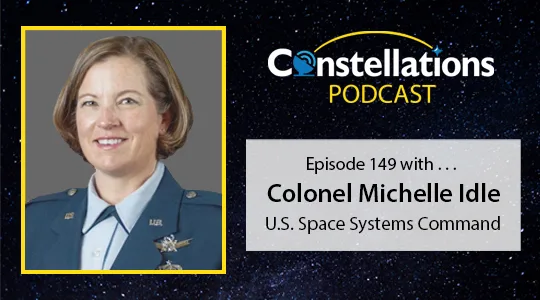
John Gilroy: Welcome to Constellations, the podcast from Kratos. My name is John Gilroy, and I’ll be your moderator. Today, we’ll talk about how industry can better partner with the military and best practices for the government to adopt new commercial capabilities. I am pleased to welcome our guest, Colonel Michelle Idle, the Mobilization Assistant to the Commander, Space Systems Command, Los Angeles Air Force Base, California. Well, Colonel, we’re going to jump right in, so hold on to your hat. You work with both the government and the industrial complex. So how can industry better partner with the government and intelligence communities?
Col. Michelle Idle: Well, Space Systems Command is acutely aware of the need to rapidly and effectively partner with our allies, our industry, and other government agencies to effectively integrate untapped innovation and technology. We launched recently the SSC Front Door Initiative to help improve our outreach into the commercial and small business sector. In particular, we really want to try to access those businesses outside the traditional space and defense industries. In fact, if you’d like more information, you can actually access Front Door on our Space Systems Command website, which is at www.ssc.spaceforce.mil. You asked about how do we better partner? From where we are in the government, anything that industry can do to help us satisfy the Honorable Calvelli’s nine space acquisition tenants is going to help us to improve our partnerships. The Service Acquisition Executive has chartered us to improve how we do business. Some of these tenants are really focused on government efforts, but there’s things the industry can do to help influence some of them, such as build smaller satellites, smaller ground systems, and minimizing non-reoccurring engineering. So these are things that a company might consider in their proposals. Another thing that Mr. Calvelli asked us to go after was to make sure that we’re delivering ground systems before we actually launch spacecraft. Again, that is something we’re going to be looking to industry to really help us to make sure that we can execute. Two of the other nine tenants are holding industry accountable for results. So that is a burden on us as the government but we need industry partners to help us to make sure that we’re staying on track with these different projects. The last one is, again, pretty self-explanatory. It is to execute, help deliver capabilities that actually work, deliver them on schedule and on cost. We have to be as fast as we can. Our adversaries are busy acquiring their own systems and we need to be able to provide our warfighters with the equipment that they need going forward.
John Gilroy: What’s interesting about talent, all the talent in the world is not in Los Angeles, and it’s certainly not in the East Coast. It’s everywhere in the United States and I think this is an endeavor to reach out to different communities and bring them in because, who knows, some person may be in Minnesota and know a lot about specific topics that are interesting. I think the whole idea of outreaching to new people is going to bring in all kinds of new ideas for your particular problems. So let’s get in some of the details here. How do you create intentional collaborations across government and commercial entities? How do you create a community that provides this value that you’re looking for, this flexibility?
Col. Michelle Idle: When I look to that question that you sent John, one of the things that I thought about was how we’ve got to get out of the mindset of a transactional relationship and more into a partnership model with these commercial entities. That’s how people operate, right? Instead of focusing on the “I give you money and you give me a good or service,” we need to move to a partnership model where we’re collaborating together for the good of national or maybe even international security purposes, which is going to create a better environment for all of us to move forward. In a scenario like that, we have industry maybe giving us additional information, helping us to build a better request for proposal and asking the right questions of industry so we can get to where we need to be as a country. They can really help us, I think, to ask the right questions and get after the threats that we’re facing in the next decade or so.
John Gilroy: I think the whole idea of you appearing in a podcast like this just opens you up to new ideas in this community that follow the Constellations Podcast here. Let’s talk about speed. Commercial companies all try to adapt because they’re competing. They’re trying to beat the next guy down the street, Joe’s Donuts versus John’s Donuts or something like that. So when it comes to adoption, what hinders the rapid adoption of technology in the government and intelligence community? So what are the fetters on that?
Col. Michelle Idle: We are very large. In fact, the Department of Defense is the largest employer in the world with 3.4 million service members and civilians. You’ve heard the saying, right? “It takes a lot to turn the big ship.” In a smaller organization, I think it’s easier to change and adapt to some new standards or pivot to adapt some new technology. In the government, we’ve got to make sure that whatever we acquire will operate on the systems we currently have in place. We’ve got to make sure that they meet some minimum security standards so we don’t open ourselves up to losing valuable data. We might be able to pull something in at a localized level and often we do that, we’ll do a beta test with something and get it in there, but we have to prove that that is then going to work on a larger scale before we can really jump in and purchase something on a large scale like that. What the government really has to decide, I think, is what level of risk that they’re willing to take in order to move faster. What current security constraints are we willing to maybe reduce some of the scrutiny, so that we can incorporate something faster and that’s a hard thing, especially if we’re coming from a government entity. We don’t want to put any critical data or systems at risk with a new acquisition. I’d like to say we’re going to get there, but it is definitely a process to be able to rapidly adopt something new.
John Gilroy: I see parallels in the commercial world, banks and insurance companies, they have to be very wary about any information they expose to the general public or expose to anyone. So they have to be careful as well. One issue in the federal government is data silos. Can you give us an example of data silos and why they’re an issue?
Col. Michelle Idle: Absolutely. I think space is a great example of that. We have a pretty antiquated data transport system. If you look at a lot of the systems we have out there, they were originally built many, many moons ago. So our connectivity in some cases is like AOL dial up. This is why we’re trying to get after some new efforts like MeshONE-T and how we’re exploring both terrestrial and space networks to improve how we actually transport that data. We recently showcased an effort with Anduril to connect one of our sensors to the command and control center back at Dahlgren via Starlink, which has been in the news quite a bit lately. The whole reason they did that is because the actual terrestrial data line was severed in a storm so it was a great opportunity to show kind of like we talked about in that last question, how we could pivot and really get after something different. Because we do have these very slow communications lines, we can only send very structured data. So we can’t stream a movie over Netflix. The data has to be in very specific formats to go to these command and control sites from our space surveillance network. We’re also trying to look at how we can make adjustments to send full fidelity data as well as different formats of data to our data warehouses, trying to upgrade some of the processing software so that we can handle these different data types and that’ll allow us to, again, be able to have more information available to our users. The modern systems can often handle the data types, but the sensors themselves might be so antiquated that they only give out limited information. That’s actually another Space System Command effort right now, is trying to exploit what we have. So we may not be getting all the data that we want from a particular sensor, but how can we actually leverage or better leverage what we are getting? One of the other things with regard to the data silos is competition. We previously operated in a state where our country, the United States, actually controlled the ultimate high ground and space was not a contested environment. In that situation we developed systems with the idea that data’s just going to flow from our satellite to our ground site, then to a specific command and control center or maybe even a contractor facility but it was never intended to be shared. It was very specific data that went for a very specific purpose to very specific people. We’ve done this for decades, but now we’ve got to pivot like you’re asking about with data silos, with the understanding that this information’s all got to be shared with a broader space enterprise. Then the last piece of the data silos is probably the most obvious, it’s security, with respect to what we’re actually getting from space. That information is at a pretty high security level and in many cases, we have these high secure networks that don’t talk to other networks for good reason. That’s natural stove piping, really. We have some efforts underway to try to connect those really secure networks with the appropriate other networks and to be able to share the data with people that actually have that need to know. So piping is a very real problem and we’re doing our best to get after it, but in a pretty methodical manner.
John Gilroy: Well, I really appreciate your reference to AOL and I’m so glad you didn’t say floppy disc, get your floppy disc and install AOL on your machine, because that would definitely lose us some listeners today. Wonder how many people really know what AOL is that are listening to this podcast. It’s getting smaller and smaller, I think. You brought up the concepts of interoperability, that’s got to be difficult in secure environments like this. All kinds of difficulties are presented here in this discussion. So are there methods Space Systems Command uses in identifying what the commercial industry can do that could support Space Force needs?
Col. Michelle Idle: Absolutely. One of our tenants here at Space Systems Command is buy what we can. We’re trying to really get after what already exists out there in the commercial industry, so that we don’t have to reinvent the wheel or spend time building something that we could buy off the shelf. Since May of last year in 2022, we’ve been holding monthly industry events and reverse industry events. Reverse industry days is kind of a new concept where the Space Systems Command officials get together with other Department of Defense stakeholders, so industry, and other folks that might have an interest in whatever the topic is within the actual Department of Defense as well. We talk about what the problems are and the threats that we’re trying to get after, and we then listen. We listen to what the commercial industry can actually bring to bear to help solve those problems. The reverse piece of this is that we’re actually doing this before we actually put out those requests for proposal. So we’re trying to gain information about what already exists out there, what’s commercially available before we ask a vendor to provide us a proposal. We are doing those events, some of them are standalone and sometimes they’re in conjunction with existing conferences. That allows us to capture the vast amount of commercial space industry expertise that is participating in those events. In fact, the number of commercial space companies that have stood up in the last couple of years is growing. So we definitely don’t want to miss an opportunity to learn from what’s happening out there. We’re also starting to look at new mission areas like in space servicing, assembly and manufacturing, as well as space mobility. How do we get cargo up to space so we can help the future commercial infrastructure that won’t just help us as a space force, but also civil missions like what NASA is doing with going back to the moon and cislunar. We’re looking at how to take existing requirements and future force designs. Again, we’re trying to get after that buy before build so we can leverage commercial capability where it does already exist.
John Gilroy: The Constellations Podcast was launched back in 2017. It was a small step for man, but a giant leap for podcasting. Today, thousands of people from all over the world listen to Constellations and thanks to you, we’ve grown into more than just a podcast. Sign up for the Constellations newsletter to receive articles on current industry issues, podcast summaries and contributed blog posts at constellationspodcast.com. Whenever I talk to people at the DoD about new technology, well first of all, it’s hard to keep up with what’s going on because there’s so much stuff going on. Then we have these acquisition personnel that are working eight hours a day and then they got to spend, I guess, eight hours a night just trying to keep up with all the new stuff and see where it fits in. I mean, the whole world of acquisition is a different story, but it’s got to be very difficult to do that. Does the SSC have a contracting approach to rapidly leverage these commercial industry capabilities, and if so, how responsive is it?
Col. Michelle Idle: Well, we’re working on changing how we do business, both from how a requisition is actually received, how our systems are acquired, and how they’re delivered. We’re looking for a unity of effort across all those mission areas and getting together with our stakeholders as well, we’re all in this together trying to get after the right answers. Definitely not something that happens overnight because we are the government, but we are looking at how we can pivot to do things faster and better and be innovative in our thinking. One of the things that we’re working on right now is our SATCOM issues. We have a commercial services office. We’re looking at how to leverage PNT as a service, so position, navigation and timing. How we can get commercially collected data to feed into some of our systems, and use existing commercial infrastructure potentially for on-orbit servicing, assembly and manufacturing. There’s a lot going on that we absolutely want to take advantage of. We are utilizing our SSC Front Door that I mentioned earlier, to connect with some of these companies, and bringing those non-traditional partners in to help them navigate the complex government acquisition process. We recognize that SSC’s got to be available and accessible to the commercial industry, and that industry does need some different paths in order to do business with us. So we’re working very hard to try to shepherd these new folks into our system. With that front door, we’re actually positioned, I think, to better facilitate engagement with these non-traditional industry partners, which is allowing us to identify faster some of the capabilities that are out there that we might be able to leverage from a military advantage. There’s a wide range of missions I think that we can go after with that. We do also try to look across the entire technology readiness level spectrum, the TRL levels, so potentially looking at some technologies that aren’t quite as mature yet, but recognizing that they might play into our systems in the near future.
John Gilroy: Colonel, I’ve been recording interviews for a few years and I was taking notes as you were speaking. I wrote down PNT as a service. I’m just wondering if I had said that phrase four years ago, that would’ve raised some eyebrows. “No, what’s going on here?”. Maybe even two years ago that would raise some eyebrows, but it was kind of an interesting approach. It’s pushing the boundaries conceptually of how to identify what to buy, how to buy it, where does it fit, and maybe this innovation will give you some of this speed that you need.
Col. Michelle Idle: Absolutely. We’re not the only ones in the business anymore. It’s great.
John Gilroy: Let’s talk about disruption and disruptive technologies. When you evaluate these new disruptive technologies like we’re currently seeing in virtualization and digitization of satellite ground system networks, how can these disruptive and advanced technologies become adopted to legacy space infrastructure? Kind of like the satellite control network.
Col. Michelle Idle: Well, we talked a little bit earlier about some of these legacy systems and some of the limitations. So there’s really two major ways that we can incorporate disruptive technologies into the existing architectures. One way this could be done is through our sustainment and recapitalization efforts, so modernizing the antennas or the corresponding antenna cores. That allows us to do some upgrading. Another way is through developmental efforts that fall outside of those sustainment activities. You were talking again about visualization. We have cloud hosting and full schedule automation. There’s an upcoming effort called Enterprise Resource Management, ERM, and that’s actually going to replace a portion of our satellite control network with regard to the scheduling function of that. But again, for something like that to be effective, it also has to be able to support our legacy users who may have limitations, and the satellite control network itself may not actually control and maintain those baselines. So if we tried to get after this machine to machine interface that ERM might bring to us with an automated capability, we’re going to also have to look at those legacy missions and look at what they have to update and upgrade in order to continue to operate with the system. So it’s not necessarily just a plug and play with that. It might be couple years before that upgrade, ERM, is actually in place as we try to look across that entire legacy system. But the goal is to try to incorporate some modern technologies. Again, looking at what solutions already exist, some of which the government already owns, like a classified cloud or as we go down this path, whatever contractor ends up working on this solution for us may present us with an idea that we’re not aware of yet.
John Gilroy: Well, I’m glad you brought up the legacy at one end and the legacy at the other end, because they both have to communicate somehow. That’s something I think people forget, hard to focus on both parts of the equation here. Let’s talk about more current events here. When we see Ukrainians relying on commercial assets, with all the commercial imagery and satellite communications from non-military sources. What do you think of future commercial integration with the U.S. Space Force, both how do you plan and how you envision conducting future operations?
Col. Michelle Idle: Well, I think we’re already in the future, where I think we’ve seen that with some of the things in Ukraine, right? The utilization of those commercial assets. I mean, it really highlighted how fast the commercial market is advancing in providing those capabilities. So again, alluded to it earlier, we are not the only ones in the business anymore. In fact, even the National Reconnaissance Office has jumped on board, they’re buying electro-optical and synthetic aperture radar data from commercial sources. Both the Space Force and U.S. Space Command are ingesting commercial space domain awareness data. The Joint Task Force Space Defense Commercial Office is using some of that to actually do some space domain awareness. In fact, they’re actually operating completely on commercial data. That Space Domain Awareness marketplace is actually being used as part of the Department of Commerce’s pilot for their future role taking over space traffic management from the Space Force. So when we hand that mission over, I think it’s an opportunity to do business differently. Essentially what’s going to happen is the Department of Commerce is going to be the FAA of space traffic management, and they’re going to take over the safety of flight and kind of the space traffic control functions that the Space Force currently owns. But again, we’re going to keep looking across all of our mission areas, looking at what’s already out there, what commercial industry continues to bring, and try to integrate those into our war fighting culture constantly because things are always evolving.
John Gilroy: Well, I think we have a new motto for the Space Force, “We are in the future.” That was a great line. I could see it on a t-shirt, maybe not as a motto for a whole organization. The amount of information sharing that’s taking place with other nations and with the world to counter a near peers invasion of a neighboring country is unprecedented. Do you think that an open and competitive market working together with government is sustainable?
Col. Michelle Idle: I sure hope so. We already talked a little bit about that intentional collaboration, and I think that’s where we’re going to need to go if we’re going to get after solutions faster. We really have to move to this cooperative business environment with a focus on that common objective. Space Systems Command recognizes our need to partner with our allies, with industry and even other government agencies to effectively and efficiently integrate this untapped innovation and technology. There are instances where we are working with some of our fellow folks in the space enterprise and utilizing contracting vehicles that they already have in place, data sharing amongst each other. Again, trying to get ahead and be collaborative as much as possible.
Col. Michelle Idle: I do think looking forward that this cooperation and unity of effort is key for us to maintain our edge over our peer and near peer adversaries. We have some commercial relationships where we can really leverage what the industry is bringing to bear, to build these systems that are going to help us create a strategic advantage. I also think in that collaborative environment, we have an opportunity to really push each other, both industry and government, to really advance these national capabilities, which is, at the end of the day, really what we want to get to, right?
John Gilroy: Colonel, you’ve talked about data silos and partnering in communities, and I’m sure after this interview our listeners have a better understanding of how to get 10,000 military and civilian professionals to work all together. I’d like to thank our guest, Colonel Michelle Idle, Mobilization Assistant to the Commander, Space Systems Command, Los Angeles Air Force Base, California.