Transcript:
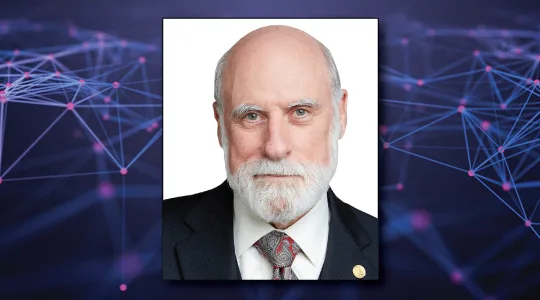
John Gilroy: Welcome to Constellations, the podcast from Kratos. My name is John Gilroy and I’ll be your moderator. Our guest today is Vint Cerf, Chief Internet Evangelist from Google. Most of our listeners here know who Vint Cerf is, but I’m going to give you a quick nutshell of his background.
John Gilroy: Vint Cerf is considered to be one of the fathers of the Internet, having been the co-inventor of TCP/IP, having led influential work at DARPA, and at MCI. Since 2005 he has been Google’s Chief Internet Evangelist.
John Gilroy: Well, let’s start off quickly. What the heck is an evangelist anyway?
Vint Cerf: Well, you know, an evangelist is somebody who tries to convince you that you should adopt his or her religion. My religion is Geek Orthodoxy. I’m trying to get everybody online.
Vint Cerf: I actually didn’t ask for the title though, it was kind of ironic. When I joined the company, Larry, Eric and Sergei said, “What title do you want?” And I said, “How about archduke?” That sounded like a great title.
Vint Cerf: They went away and they came back and said, “You know, the previous archduke was Ferdinand and he was assassinated in 1914 and it started World War 1. Maybe that’s a bad title. Why don’t you be our Chief Internet Evangelist?” I said, “Okay, I think I could do that.”
John Gilroy: Yeah, that sounds pretty good. True confessions here, I’m a history major, and when I look at what you do, which is really kind of a communications type job is what I think, you’re a communications guy at large.
John Gilroy: If you look at it from a historical perspective, 3 or 4000 years ago, these Sumerians are writing on clay tablets. Then there’s papyrus. Then this guy named Gutenberg. Then Samuel F. B. Morris, the painter who co-developed Morse code. Then we have a couple of guys who developed TCP/IP and it worked pretty good in the world. And you’re looking at the next step, aren’t you?
Vint Cerf: That’s it.
John Gilroy: How’s that? History in a nutshell.
Vint Cerf: There we are. Actually, your point about communication is pretty important and it’s a lesson that I tried to teach my engineers. You don’t do anything the size of Internet without getting a lot of help. There were many, many people who were persuaded that they wanted this to happen too. This is called salesmanship.
Vint Cerf: In a sense, if you can’t sell your own ideas, you’re not likely to do anything very big. So that lesson was not lost on me. I’ve spent a lot of time being the Internet evangelist even before the title was bestowed on me at Google.
John Gilroy: Just a quick history here, 30-40 years ago you started working with TCP/IP and developed it, and there were a lot of problems that had to be overcome just distributing all throughout the world. Now there are different problems when we have to look at distributing information into deep space and other planets. Is that right?
Vint Cerf: Absolutely true. In fact, in 1998, just after we had a successful landing of the Pathfinder on Mars, a small team at the Jet Propulsion Laboratory and I got together and asked ourselves, what would happen if we had a network in space like the Internet that could support manned and robotic space exploration, unlike the use of point-to-point radio links, which had supported all of our exploration up until that point? We began working on the design of what could become an interplanetary Internet.
Vint Cerf: Ironically in 2004, you may recall the two rovers successfully landed on Mars in January, Spirit and Opportunity. To make a long story short, the original plan to have them transmit data from the surface of Mars back to the Earth’s Deep Space Network didn’t work. We ended up reprogramming the rovers and the orbiters, which had been sent to image the planet ahead of time so we could say where the rover should go, those were reprogrammed to become part of a store and forward network.
Vint Cerf: Ever since that time, since 2004, all the data coming back from Mars has come back through the store and forward network, which is the way packet switching works, which is the way the Internet works. Now we’ve gone on to, not only develop, but standardize protocols, which can lead to an interplanetary Internet. We’re very excited about the unfolding 2020s as we’ll start using those protocols for space exploration.
John Gilroy: In the early seventies, the beginning days of the Internet, when a communication was attempted, there’s some kind of a ping or some kind of a, do you want more? I’ve got too much information. Let’s wait, go back and forth. And that was worked out through the protocol.
John Gilroy: However, on a planet like this, store and forward, is a little bit of variation on that, isn’t it? The store could be for 12 hours before it’s forwarded instead of 12 milliseconds.
Vint Cerf: That’s exactly right. Two things or so are different about this network. The first one is that the speed of light is too slow.
John Gilroy: Wait a minute. There’s a quote. The speed of light is too slow.
Vint Cerf: That’s a T-shirt. Well, here’s the problem. The distance between Earth and Mars when we’re closest together in our orbits is 35 million miles. And that takes three and a half minutes one way at the speed of light. When we’re farthest apart in our orbits, it’s 235 million miles. That’s about 20 minutes one way and 40 minutes round trip.
Vint Cerf: If we’re writing protocols that are interactive and the interaction takes 40 minutes round trip time, this is not very interactive. So we can’t rely on the same protocols that TCP/IP uses, which is designed for a much lower latency.
Vint Cerf: There’s a second problem. Planets are rotating and we don’t know how to stop that. The problem is that devices on the surface, a rover for example, the planet rotates and we can’t talk to it until it rotates back around again. So it is a variably delayed and disrupted environment. We recognized this fairly early in our ’98 and ’99 exploration and concluded we needed a delay and disruption tolerant networking technology, which we have now developed.
John Gilroy: That’s the, I guess the acronym now is DTN, is that right?
Vint Cerf: DTN stands for delay and disruption tolerant networking.
John Gilroy: That’s why I have you on the Constellations podcast. I heard you were deeply involved in NASA and trying to encourage them to improve their interplanetary communications.
Vint Cerf: That’s exactly right.
John Gilroy: What’s that experience been like? Good? Bad?
Vint Cerf: Well it’s been enormously satisfying because it’s a small team of people who began with this passionate mission, and then have grown participation from the other laboratories of NASA. Virtually all of the labs now have some role to play in either the design implementation or deployment and use of the interplanetary protocols.
Vint Cerf: We’ve been vastly aided by the manned mission group, which of course is responsible for the International Space Station among other things. They’ve deployed and used these protocols and helped us find bugs and fix them to make this more reliable.
Vint Cerf: So on the whole, it’s been a very, very good experience.
Vint Cerf: The more difficult part to be honest is finding funding for this kind of work because it’s infrastructure. Often infrastructure takes a back seat on the bus to mission. Mission is very focused on getting a particular set of information from a particular location and getting it back to the scientists who are trying to figure out how does the universe work. And so sometimes, infrastructure doesn’t get the same level of attention that it deserves, because without it, you don’t get any results.
Vint Cerf: There’s been something of a persistent struggle to get proper support for this, but I think we’re largely over that hump now that we’ve got functioning software running in the International Space Station and prototype software supporting the Mars missions.
John Gilroy: And we have a guy named Elon Musk who’s really pushing everyone to the whole idea of Mars. If he gets to Mars, what protocols should he use to communicate back to the infrastructure?
Vint Cerf: First thing I did was to send a note to Elon saying, “We’re ready for you whenever you have your mission ready to go.”
Vint Cerf: Elon’s done something else or planned something else, which is also quite dear to my heart. That’s putting up this gigantic array of low earth orbiting satellites he calls Starlink. There are on the order of 12 or 13,000 of them.
Vint Cerf: The thing that’s important is that, it may be that he’ll be able to reach every place on the planet here to deliver Internet service, which means it would be hard to escape being connected, as opposed to working to get the remaining 50% of the world’s population online. So I’m a big fan of what Elon is trying to do, both on Earth and subsequently on Mars.
John Gilroy: Let’s snap a finger and say we have a fully operational solar system Internet. The first function would be communication? Or what would be the priority of functions for it?
Vint Cerf: Well, the primary function is always communication, but then it’s also data gathering and the infrastructure that allows both humans and robotic systems to communicate.
Vint Cerf: This is not just for deep space communication. It’s also important to allow multiple rovers, for example, on the surface of a planet to communicate with each other, to communicate with astronauts or to communicate back to earth with data that we need in order to figure out what’s going on in the world. That’s the primary purpose of the interplanetary Internet.
John Gilroy: When I look at the early days of the Internet, and both you and I were around then, I think one impetus for starting it was to share data. That whole idea of data is going to apply even more when it comes to interplanetary travel information, isn’t it?
Vint Cerf: Well, data is of course the primary reason for going out into space in the first place. It’s to try to understand more about where does the universe come from and how does it work. There are surprises afoot at every step.
Vint Cerf: The most recent big surprise that I know about is the discovery that the universe is not only expanding, but the expansion is accelerating. Brian Schmidt, who’s now the vice chancellor of Australian National University, was in the team that discovered this, and of course now everybody is wondering why. The answer they give is dark energy, which is not a very satisfying answer since when you ask what is that, everybody says, “We don’t know.”
John Gilroy: Speaking of dark, what about the dark web? We know what’s happened to the Internet, kind of the obverse of the Internet is the dark web. Could this interstellar Internet have a dark side as well?
Vint Cerf: Well, I suspect that any neutral communication system will have the potential for a dark side. I’m sorry to say that we see that here on this planet. The fact that the Internet is highly accessible and affordable contributes in a way to that problem.
Vint Cerf: I think the interplanetary Internet won’t be quite as readily available, and it may be somewhat more expensive, and oh by the way, we put in more security in that design than we did in the original Internet design. So I hope that there will be less of that than we’ve seen here on this planet.
Vint Cerf: But partly, the manifestation of this dark web is the result of very low cost of access, low barrier to access to the Internet. Which on the whole should be a good thing, but it clearly gets abused.
John Gilroy: You’re an evangelist for Google, we know that. I think if we know one thing about Google, they have a lot of data. Now, it’s my humble estimation there are a lot of people working in companies that are data rich and information poor. We may be at a point where we’re bringing in all this data about Venus or Pluto, and so what? That’s the whole thing. I think we have to balance somewhere between importance and unimportance of the data being brought in.
Vint Cerf: Well, first of all, we hope that there will be a lot of data available for Venus, Mars, the other planets, the asteroids and the comets and so on.
Vint Cerf: The second thing of course is to understand what that data means. For that you need to have theories. You have to have models of how things work. Then you have to see whether or not the measurements that you’ve made support the models that you think describe how things function.
Vint Cerf: So I’m actually a big fan of collecting more data as long as we can match it up with the theory that should predict what that data looks like.
John Gilroy: You know Vint, thousands of people from all over the world have listened to this podcast, Constellations. If you’re listening now and you’re in France or China or India and want to have regular alerts and updates, go to ConstellationsPodcast.com and click on Kratos and sign up and we’ll tell you about our next exciting guest. But no one as famous as Vint Cerf and that’s for sure.
Vint Cerf: Well, one is glad to be of service.
John Gilroy: In the early days of the Internet, you were lucky to get that modem to work. In 1995, I finally saw that Netscape browser and it moved, and I said, “Wow, home run.” No one ever thought about privacy, and this is in concern, this building and building and building. What about privacy in space stations?
Vint Cerf: A very good question and very important for many different reasons, not only for the astronauts themselves, but to think about some of the possibly proprietary experiments that might be going on on the International Space Station when one wants to be able to protect the data that is being produced. So cryptographic means are very important. Access control is very important. On top of the socially important notion of privacy.
John Gilroy: In many areas of cybersecurity, people are talking about zero trust. What they’re saying is firewalls, that’s your father’s firewall. Those don’t work anymore. The bad guys are ready inside the perimeter. There’s no DMZ because everyone’s right there. So people talk about zero trust and identity management more than anything else.
John Gilroy: Where does cybersecurity and identity management fit in this whole discussion?
Vint Cerf: Well, first of all, zero trust is actually a very good place to start. We take the same view here at Google. We build systems that assume all networks have already been compromised, and so we make heavy use of what’s called end-to- end cryptography, end-to-end strong authentication.
Vint Cerf: That by the way is going to be very important not only for personal transactions, you want to make sure you know who it is you’re transacting with on the other end of the net, but it’s also important for the Internet of Things. You don’t want a device that’s managing the security in your home to be accessed or controlled by a non-authorized party. Again, strong authentication being very, very important.
Vint Cerf: Also for protecting the information that sensory systems may be collecting, whether that’s a web cam for example, or simply a temperature monitor. That information could be abused by parties who don’t have your best interests at heart.
Vint Cerf: So once again, strong authentication and cryptography are helpful.
John Gilroy: When I think of Internet of Things, IoT, I think of my refrigerator, I think of maybe a healthcare device. I never think of the rover Opportunity. That’s an IoT, isn’t it?
Vint Cerf: That’s true. It’s absolutely true. Of course, I always worry that refrigerators have software in them now, and if they can be invaded and the computer taken over to do things in addition to what the refrigerator is supposed to do, the refrigerator may still keep the ice cream cold, but it might also be used to attack Bank of America.
Vint Cerf: I always worried about a headline that said 100,000 refrigerators attack Bank of America. I used to think that was funny. Now it’s not funny anymore. It’s a potential hazard.
John Gilroy: Made away with all the ice cream or something.
Vint Cerf: Yeah.
John Gilroy: Let’s transition more about cloud computing and multiple clouds, the ability to move data easily from one to another. I think other companies are looking at hybrid clouds and transferring information from cloud to cloud, and that could be information from another modem or from deep space. What kind of risks are involved in that?
Vint Cerf: I’m very, very interested in the notion of intercloud communication because in 2019 that’s a little bit like the Internet was back in 1973. We had networks but they didn’t talk to each other. Today, we have clouds that typically don’t talk to each other, but could usefully do so, either to talk to a company’s, a private cloud, to a public one, or actually moving information back and forth between the more public clouds. So I’m a big fan of all that.
Vint Cerf: Of course, being able to take advantage of the special functional capabilities of different clouds, including the hybrid one, which has proprietary information, it is quite valuable. And so building a system that allows an intercloud-like view I think is an important objective.
John Gilroy: I have a daughter who’s an English major. I’d love her to delve into literature that you’ve written, other people who’ve written about clouds. There’s cloud bursts, there’s cloudlets, there’s the inner cloud, there’s the hybrid cloud. I mean, so many words, and it’s a very difficult concept for many listeners to understand. Maybe give us a thumbnail sketch of these different variations of clouds?
Vint Cerf: Well, first of all, the reason that it’s called cloud or cloud computing is because when we were first designing the Internet, the protocols didn’t care about the details of the underlying networks, so we drew them as if they were little clouds. We said we didn’t care what was going on inside, you just connected-
John Gilroy: On a white board, yeah.
Vint Cerf: Yeah. We would just literally draw something that looked like a cloud. So later people started talking about cloud computing because in the cloud you didn’t care where the surface computers were. They’re somewhere in the cloud. But we don’t care where as long as we get access to them and they do what we need them to do. That’s where I think the cloud term cloud computing came from.
Vint Cerf: But we talk about intercloud, we talked about all these other things. It’s simply a way of describing the interactions among the computers and the networks that make up the multiple cloud system that today we call the Internet.
John Gilroy: In the 1980s if you met someone that said, “I work in the cloud,” typically that was telecommunications.
Vint Cerf: That’s correct.
John Gilroy: It wasn’t computer. It wasn’t TCP/IP. It was the telephone system. So it looks like the term has been appropriated from the telephone people back 20 years ago.
Vint Cerf: Well perhaps, although I don’t recall borrowing that term. We did borrow, we borrowed a different term, two terms.
Vint Cerf: We borrowed the term protocol from the diplomatic community, because the protocol told you how to interact and in what form you would interact, in this case for computers to talk to each other. But we also borrowed the term gateway, which is a telecom term, to link the various computer networks together.
Vint Cerf: I don’t recall deliberately borrowing cloud from the telecom world, although I worked in the telecom world, and so I might have somehow borrowed it without realizing it.
John Gilroy: Well the name of this podcast is called Constellations, so I guess we have to talk about constellations, one sort or another. There’s a couple ones out there low earth orbit, one’s called SpaceX and OneWeb, and some people say, “Well, this will give billions of people on Earth access to the Internet.” Is that one advantage we have for these new systems coming out there?
Vint Cerf: Well I certainly hope so, because getting access to the Internet in the rural parts of the world or out in the middle of the Pacific Ocean has been quite a challenge.
Vint Cerf: Two things have happened that surprised me though.
Vint Cerf: One of them is a rapid proliferation of undersea cable connecting continents to each other and islands to the Internet. I had not anticipated that there would be economic utility in trying to pull optical fiber in so many places, but there has.
Vint Cerf: The satellite-based systems, especially the low earth orbiting ones, are extremely attractive because of their low latency. Whereas going to a synchronous satellite is a quarter of a second up and down, a satellite that’s only a few hundred miles up introduces very, very little latency. So it will be more like operating on a terrestrial fiber network. And yet it allows broad access all over the planet. If you have these satellites that are in polar orbit, for example.
John Gilroy: You know, one geographic area where the cables are trying to merge with a lot of satellite systems is Goonhilly in the UK there. It combines them both doesn’t it?
Vint Cerf: That’s exactly right. Goonhilly Downs is where we had one of the ground stations of the original packet satellite network way back in the late seventies and early eighties.
John Gilroy: They were instrumental in the Apollo launch and satellite signals coming back to the United States, and very few people know about that station.
Vint Cerf: That’s true. That’s true. I was out in Canberra talking to some of the people there about the moon landing, and all of the hassle and trying to get communications to make sure we could get the video from the landing and the exit EVA from the landed spacecraft. That was a nontrivial exercise. There was a lot of panic trying to get that all to work.
John Gilroy: You know, I hear buzz terms all the time, and one phrase I heard four or five years ago is artificial intelligence. I said, “I don’t care if it’s artificial or real, I just give me some intelligence or other.” Where does AI fit in this whole topic of clouds and information from deep space? Is it part of the solution or part of the problem?
Vint Cerf: You know, I can’t resist observing that there is the search for extraterrestrial intelligence called SETI. The question is, why do we do that? The answer is, well, we didn’t find any intelligence here on Earth, so we’re looking for some out there in the universe somewhere.
John Gilroy: Somewhere, maybe Mars.
Vint Cerf: Artificial intelligence is a subject of great interest to the Defense Department. The Advanced Research Projects Agency was funding research in the 1960s in this space, and that’s in part what caused us to build the ARPANET, the predecessor to the Internet, was to connect those academic institutions to each other.
Vint Cerf: I think we should be very careful. It’s a burgeoning field now because of machine learning and special purpose hardware to allow us to build neural networks at great depth. However, we also know that these systems are brittle. They don’t always do what we expect them or want them to do.
Vint Cerf: So we should be very careful about giving too much autonomy to the things that we call artificially intelligent to make sure that we don’t suffer when they make mistakes. Of course, an obvious example of this would be a self driving car, which could become a missile if you weren’t careful about it.
John Gilroy: Well, we’ve all seen the movie, we’ve heard the term singularity when the robots are going to take over. It doesn’t seem like you’re a real proponent of singularity happening maybe this year? Maybe 50 or 80 years from now, but not in the next couple?
Vint Cerf: Well, we should have Ray Kurzweil here with us, another colleague here at Google, who is quite enthusiastic about the potential for the singularity. I think he’s estimated it’s either 2029 or 2039 when this might happen.
John Gilroy: Mark your calendar! Mark Your calendar!
Vint Cerf: Right? He wants to upload himself into a computer and then explore the rest of the galaxy, you know, hopefully with a longer lifetime than our weak biological systems can manage.
John Gilroy: This is not a movie. This is a real thing?
Vint Cerf: Well, he believes that the rapid growth in computing capability might actually offer an opportunity.
Vint Cerf: In the meantime, many of us, including me, see this simply as an opportunity to augment our own capabilities. Douglas Engelbart at SRI International ran the Augmentation Research Center where he said computers would help augment our capabilities so we could do things faster or better or at larger scale, which is exactly what’s happening.
John Gilroy: It’s future time now. Look into the crystal ball and see what’s going on in the next five to 10 years. Back in the days of SRI, I don’t know if they could’ve predicted Netflix in every home in America. I mean, 40, 50 years changes perspectives on things.
John Gilroy: What about the next 40 or 50 years? Where do you see us all heading?
Vint Cerf: Well, 40 or 50 years is a long time to look ahead. I look back in 1969 and I ask, could I have seen 2019? Only in some of my wildest dreams.
Vint Cerf: Well, we know for sure that bandwidths will continue to increase, that access will continue to increase in terms of accessibility, penetration and so on.
Vint Cerf: I think that we saw Netflix and others become feasible because the capacity of the network had gone up dramatically over time, and I expect that we’ll continue to grow.
Vint Cerf: I think the network will tend to disappear from view. We don’t really see it much now. You pull out your mobile and you expect to have connectivity, you don’t have to plug in to something or fire up a modem like you were referring to earlier. I think that we’ll just assume that the communication is there at all times, that anything can talk to anything else.
Vint Cerf: As a designer of products and services, connectivity will be the least of your problems. Figuring out what information you can provide to a user or gathered from a user to be helpful will be at the top of the list of challenges.
John Gilroy: Well, Vint, I’ve got tons and tons of questions, I want to talk about China and protocols and standards and what’s going to happen, but we’re running out of time here.
John Gilroy: I’d like to thank our guest Vint Cerf, Chief Internet Evangelist from Google. Thanks, Vint.
Vint Cerf: It’s a real pleasure to be on the show.