Transcript:
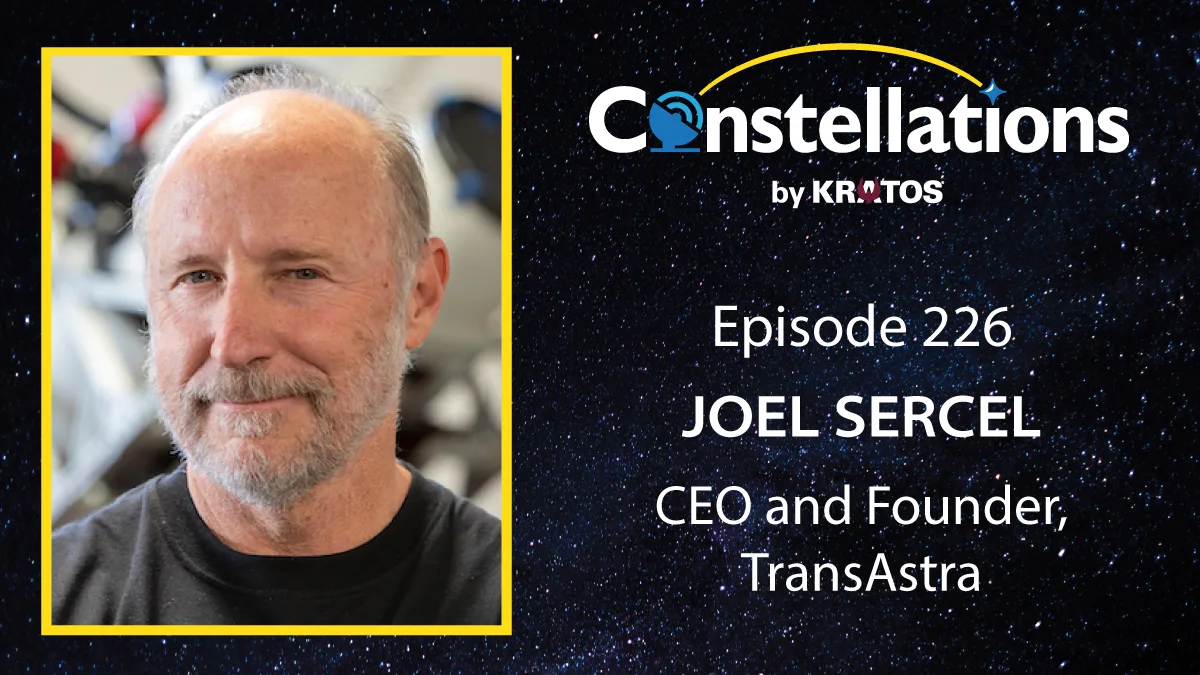
John Gilroy: Welcome to Constellations the Podcast from Kratos. My name is John Gilroy, and I’ll be your moderator. The Earth’s orbit is full of space junk like out-of-service satellites that completed their mission long ago. One study even estimated that 100 trillion pieces of space debris are floating outside the planet. This space junk can cause collisions between satellites and existing debris, or even endanger astronauts aboard the International Space Station. So how can this space junk be removed? Here, to discuss a pioneering new technology that may be able to help address the space debris challenge is the founder and CEO of TransAstra, Joel Sercel. He is going to share some insights on space debris capture technology that has the potential to make space more accessible and sustainable for future generations. Joel, are you ready to jump in?
Joel Sercel: You bet. Hi, John. How are you today?
John Gilroy: Pretty good, good, good. So how big a threat really is orbital debris to the satellite industry?
Joel Sercel: It’s a pretty big threat, but it’s manageable. It’s not existential. It’s one of the things that a satellite builder has to keep in mind when they’re planning a mission, and you really have to be careful about it. It’s not nothing. And as we get this exponential explosion in the number of satellites, it has the potential of becoming much worse. However, if the space community, the international space community can operate in a responsible way, I think it can be managed effectively. So it’s not the end of the world, but it’s something we really need to take seriously and be careful about.
John Gilroy: Good, good, good. This concept of space debris has been talked about for a while now. So what lessons has the space industry learned from past satellite breakups or collision events that inform today’s debris mitigation strategy?
Joel Sercel: Sure. There have been a bunch of lessons that have been learned over the course of the space age. I think the biggest lesson is don’t use kinetic satellite weapons in low Earth orbit. And don’t intentionally have satellites collide. Be responsible about collision avoidance. So there have been, each of the great space powers has done experiments and demonstrations in low Earth orbit that have to do with weaponry. And satellites have been disrupted and essentially blown up, possibly intentional collisions between satellites. And why that’s so bad is let’s say you have two satellites and they each weigh about 2,000 kilograms, maybe as much as a big car. If you have two cars that collide on the Earth, they might have a collision speed of 100 miles per hour. That creates a lot of small debris and that sort of thing. But the magnitudes of the velocities are so much higher in space that people just have a very hard time picturing it. When satellites collide or when big pieces of orbital debris collide with each other in space, these objects are moving at relative speeds of as high as 10 or even close to, in worst case, 15 kilometers per second. Think about that 10 miles a second. So their closing speeds are vastly higher than the speed of a high-powered rifle bullet. And so they create massive debris clouds of debris ranging in size from microns to millimeters to centimeters to chunks of metal. That’s really the dangerous thing when collisions happen. So one is we really need to have a good moratorium on kinetic weapons in low Earth orbit. Second, we need to be responsible about end of life disposal. So satellite goes up there, it has a life of a year, two years, three years, something like that. Then it’s done. You need to put it in a safe orbit at the end of that. And the US has been very good about that. You can’t get permission to launch a satellite without a good end of life disposal plan. SpaceX has a really great strategy for this. They fly most of their Starling satellites at such low Earth orbits that the satellite has to be operational with its propulsion system working to stay in that orbit for an extended period of time. And as soon as the satellite goes defunct or reaches the end of its life, the atmosphere slows it down over a period of weeks, months, or maybe just a couple of years, and it de-orbits, cleans out its own orbit. It’s really no weapons, have an end of life disposal plan, and don’t just leave things in orbit with no plan to deal with it. Those are some of the lessons.
John Gilroy: When you try to design a debris removal mission, so what are some of the unknowns before the launch?
Joel Sercel: Well, it depends on what you mean by debris removal mission. So TransAstra’s orbital debris removal technology is called our Capture Bag. We’re very proud of the Capture Bag. We recently flew it on the International Space Station in October outside the Space Station in an air lock called the Bishop Airlock that’s owned and operated by Nanoracks, which is a private venture. And we had a very successful demonstration of the Capture Bag. It was brought up to the Space Station by astronauts, installed in the airlock by astronauts. And then our team worked with the Nanoracks team to actually operate the Capture Bag in the airlock out in vacuum and microgravity, demonstrating multiple deployments and retractions of the Capture Bag to show that it can work for orbital debris mitigation. We’re very excited about that. And we can build Capture Bags at all different sizes. From the small one we flew on the Space Station, which is about a meter in diameter. So think about three feet, a yard, something like that. And we now have a contract with NASA, jointly funded by NASA and our private sector investors to build a really big Capture Bag, 10 meters. So 10 meters, more than 33 feet. That’s a very big Capture Bag. We can capture lots and lots of big objects with that. And Capture Bag can be used for cleaning up orbital debris in low Earth orbit or in other orbits that have traffic regulation issues such as the geostationary orbit. So the way that we would plan a Capture Bag mission is we would identify a target that needs to be taken out, captured and removed. And the strange thing about this is even though there are literally thousands of satellites in low Earth orbit, recent studies show that in terms of orbital debris and potential collision avoidance issues, there are only about 50 significant objects big enough for Capture Bag of different sizes. That if you were to clean those out, you’d deal with half of the problem. So it’s not that big of a problem because most of the satellites in low Earth orbit have been put into low Earth orbit in responsible ways by responsible actors in the modern era. A lot of the more dangerous objects that are up there that are sort of out of control, defunct, in orbits that are likely to cause collisions were put up there a long time ago before we really learned these lessons. Put up by, actually some of them date back to the Soviet Union or more recently by the Russian Federation. And so just taking care of on the order 50 of them could have a huge impact. But TransAstra isn’t the only game in town. There are other companies that are looking at taking care of little small pieces of debris, which are a really big hazard in low Earth orbit, and probably not applicable for Capture Bags. Basically hitting them from a distance with big lasers to partially ablate them or cause radiation pressure on one side of the objects to deflect their orbits. I think that’s a really clever and interesting technology that has a lot of promise.
John Gilroy: I’ve discussed this for several years. Some people talk about harpooning debris, all kinds of… Didn’t know where the Capture Bag fit in. So maybe it’s size of a debris removal. Is that where it fit in?
Joel Sercel: Well, Capture Bags can be scaled. The smallest Capture Bag that we’ve built in our laboratory is small enough that it folds up and fits into an enclosure with all the hardware for it about the size of a coffee cup, what an aerospace engineer would call a 1U enclosure. That little Capture Bag can open up to something that can capture an object the size of a watermelon, roughly. That’s the smallest we can make them. We have designs for Capture Bags that would go into enclosures the size of a walk-in closet, that when the bag deploys, it can be the size of bigger than a tennis court, big enough to capture an asteroid that might weigh 500 tons. So Capture Bag is a very highly scalable technology that can deal with objects of all different sizes. The advantage of the Capture Bag over some of the other approaches is that the object can be spinning or tumbling, as long as it’s at reasonable rates. And it doesn’t have to have fixtures that you can grab onto. So there’s some really nice orbital logistics technologies where companies have developed robotic grappling systems, magnetic grappling systems, that sort of thing, that can grab an object. But in order to grab the object, first they have to do a docking with the object, which is a very expensive and complex thing to do because they have to match the rotation rates exactly. Then they have to grab the object either with a grapple fixture, which means the object had to have been designed to be grappled. Or it has to have some kind of a mechanical structure in it that their end effector can grab. So it limits their applicability. You would never want to harpoon a satellite because you’re probably, in the process of harpooning a satellite, you’re probably going to create more debris than you’re going to mitigate. In fact, people have also looked at using nets. We think nets are good. We actually have plans to put nets inside of our Capture Bags. But the reason the Capture Bag is all enclosed is so that when we capture the object, if other little pieces of debris break off, it doesn’t breed more debris in low Earth orbit. I remember years ago in the late 80s, I was actually doing a study of an advanced propulsion technology in collaboration with a plasma physicist who happened to be a space shuttle astronaut, who’d been up in space on the space shuttle a few times. And he told us, he was giving me and some of the other people involved in this high technology study that we were doing. He gave us a tour of one of the space shuttles. And he pointed to one of the windows in the cockpit of the space shuttle. And he said, “On my last mission, I was up there. And all of a sudden we heard a big bang like something had hit the shuttle with a sledgehammer.” And they tried to figure out what it was. They inspected the thing, where did the sound come from, that sort of thing. And they finally looked in one of those triangular windows on the space shuttle, which has glass about that thick, about two inches thick. When they looked in it, it had been hit by an object that had embedded itself halfway into the glass.
John Gilroy: Wow.
Joel Sercel: It almost blew the window out. Had it blown the window out, it would’ve killed everybody on the space shuttle. When they got back to the ground, they looked very carefully at the window to make sure it was safe to do a reentry and so on. It was. They came back to the ground, they inspected the glass, and the object that had hit that and done that damage was a titanium paint flake about three millimeters across. That gives you an idea of the energy levels that we’re talking about. And the Space Station has been hit thousands of times by orbital debris. And it actually has bumper shields that have been designed into the system to make it tougher to handle orbital debris and micro meteor impact.
John Gilroy: When I think of cleanup, I think of a cleanup on Earth, and we pretty much know how that’s done. Everyone knows that. I have read about that for years. So my question is, what are the physical and orbital dynamics challenges that make debris removal so complex compared to, I guess, a simple terrestrial cleanup?
Joel Sercel: Yeah, so the big difference has to do with the velocities. And it’s very difficult, even for an engineer who studied this for decades, just to really comprehend and internalize the magnitudes of these velocities. So there are only a few thousand satellites in low Earth orbit, and then there’s a swarm of debris of all different sizes. And I think in your intro, you said that studies have shown that there could be up to a trillion tiny objects. Well, it would only be a trillion if you went down to extremely small particle sizes. Engineers refer to the size distribution of the objects as something called a power law. Some people might remember. It’s an exponential equation that some people might remember from high school. And what it says is every time you go down in size by a factor of 10, you go up in the number of objects by maybe as much as a factor of 1,000. So for every 10 centimeter object, there might be 1,000 one centimeter object. And for every one centimeter objects, there might be 1,000 one millimeter objects and so on. So to get to that number of a trillion, you’re really talking about things that are down in the size of dust particles and so on. But even a millimeter particle can be dangerous if it hits an optical surface or a delicate instrument on a spacecraft. So the tremendous size distribution is part of the problem. But the real difference is the velocity range. People, layman, and sometimes I’ve even seen engineers and people that even work in this field, make some reasonably some kind of ignorant statements about the fact that, “Oh, a low Earth orbit is so big. It’s such a huge environment. And you’re talking about the whole Earth, thousands of kilometers, a few thousand objects, like the chances of collision are nothing, that’s no problem. Think about there’s hundreds of thousands of ships at sea, they’re not colliding all the time. So people are blowing this out of proportion.” Well, the difference is a ship at sea is going maybe 20 miles an hour, whereas each one of these objects is going at eight kilometers per second. So it’s going around the Earth something like 15 times a day, going through hundreds of thousands of kilometers, millions of kilometers a year. So it’s covering so much ground and there’s so many particles covering so much ground that there’s all kinds of opportunities for collision. Although we can’t really know exactly where these objects are because small particles, their trajectories, the path that they take in space, are constantly being perturbed slightly by the sun’s radiation, by changes in the atmosphere, all that sort of thing. So you think you know where it was, you go back and say, “Okay, in two weeks it’s going to be in this spot.” You go and look, it is not there. It’s a real challenge. So it’s the velocities and the uncertainties on the positions that are the real problem. Now, the biggest constellation in low Earth orbit and space at all by far is the SpaceX Starlink constellation. I used to keep track of how many satellites they had up, but they’re launching so many that I can’t keep track of it anymore. But I think at last check it was 6,000, but I don’t know what the number is. Probably by the time this podcast goes, it’ll be 10,000. I don’t know. But what SpaceX keeps track of all the different known satellites. And with their thousands of satellites, there are many conjunctions where they can come close to another object. But because of the uncertainties on the trajectories, they could hit. And by the way, this happens at Space Station all the time also. Space Station is a big object. Sometimes they actually have to maneuver the Space Station to reduce the probability that it would have an impact with a big object. It gets these little micro hits all the time, but if it hits something big, it would be game over. When I say something big, I mean something the size of an iPhone would be a catastrophic collision for the Space Station or for any other object.
John Gilroy: I’m thinking about the number of these space objects out there and it leads us to the discussion about a scalable solution.
Joel Sercel: Sure.
John Gilroy: So how do you approach designing a debris removal system that’s not only effective in orbit, but also affordable and scalable for the commercial space industry?
Joel Sercel: Yeah, so that’s exactly what we’ve done with Capture Bags. So Capture Bags, these are made of relatively inexpensive engineering materials depending on the specific application and target and what the customer wants to do. It could be like a Nomex type material or Kapton, which is a pretty common space material. These are usually done ripstop, but it’s relatively inexpensive. In the field of aerospace engineering, the soft materials is called soft goods. So our Capture Bag systems are made of soft goods, gas handling systems, and mechanical mechatronics systems. And the way it works is the soft goods are fabricated. They’re sewn up by precision artists. Designed by our engineers, sewn up and folded up tight so that there’s no air entrained in them or very little air. And then put into what we call a Capture Bag enclosure, which is a mechatronics system. Mechatronics is the blending of mechanical, electrical software, moving parts, and space like robotics. And then we have a gas handling system. And the way that works is when it gets into space, the Capture Bag enclosure opens up and the Capture Bag starts to deploy with a little bit of the entrained gas that we couldn’t get rid of. And then we inflate these tubes that are built into the device. We call them struts and ribs that hold the bag open with these inflatable struts and ribs. Then when we go to capture an object, Capture Bag tied to a spacecraft that’s doing the proximity ops operations, does a rendezvous with the object, and then the Capture Bag flies over the object. And when the object is inside the Capture Bag, the end of the Capture Bag closes around to make sure that the object is not going to get away. Once the object is squarely inside the Capture Bag, we turn off the attitude control system on the carrier vehicle and cinch the object down and hold it tight. Once it’s tight and secure so that the dynamics of the object don’t interfere with the control dynamics of the carrying spacecraft, then we de-spin. Typically, we match the spin of the object before we capture it. That’s not always the case. And we de-spin and then we can move to another orbit. We can carry it to a safe orbit where it’s not going to be colliding with something else. Those are referred to as disposal orbits. Or it could be de-orbited. The whole Capture Bag can be separated from the carrier spacecraft to de-orbit or go into a safe storage orbit. That’s the process. So the thing about it is the soft goods, the gas handling system, the mechatronics on a Capture Bag are about 10 times simpler and cheaper than a robotic solution. And this is something that we can reproduce for tens of thousands of dollars a copy for the small ones, or a few hundred thousand dollars a copy for the big ones. So it’s much cheaper than any other grappling system that we’ve seen. And we have a standard interface. It’s like an app that can go on different types of carrier vehicles. So we work with different industrial partners to put our Capture Bags on their carrier vehicles. So we’ve designed it to be safe, simple to use, robust, and inexpensive. And I hope that that description describes how it achieves those goals.
John Gilroy: Yeah. Well, I’ve got to ask the consultant question here with KPIs involved and all that stuff. So as debris removal goes from concept to demonstration to operational systems, so what are the key performance metrics the industry should focus on?
Joel Sercel: So basically what it comes down to is one thing is you need to identify the high value targets to take out that are the ones that are really causing a threat. And sometimes that’s not obvious. The ones that are most important to take out are in orbits where they’re likely to be bombarded with other pieces of debris to create more debris. There’s this exponentiating process that it’s almost like a critical mass situation. Where big pieces of debris turn into many more little pieces of debris and that’s what you want to avoid. So you have to identify the high value targets. And then the question is, what’s the cost per target for taking care of that material? So it all comes down to cost-effectiveness. One of the things that we found is that many of the high value targets tend to be in orbital planes with other high value targets, and that’s important. What it means is we can put a Capture Bag on a carrier vehicle, go into an orbital plane, and clean up four or five objects in that orbital plane with the same Capture Bag. And the way we do that is we can keep the Capture Bag open between captures and use nets to do individual captures. So the Capture Bag outer enclosure prevents debris from getting out and creating more debris, but we can use nets inside the bag to capture multiple objects on the same mission. So it has to do with, it’s basically in business, it’s all about cost-effectiveness, which brings up the biggest challenge. Some of the biggest challenges with regard to orbital debris cleanup have to do with government regulation and law. And this is one of these conundrums that humanity faces that has to do with a concept of in economics called the Tragedy of the Commons. John, are you familiar with the concept of the Tragedy of the Commons?
John Gilroy: No, no, no.
Joel Sercel: Okay. Well, it’s a concept in economics, actually dates back, as I understand it, to the early British colonies in North America, New England, where a village would be formed and everyone in the village would have their own plot of land. They would do their farming and raise their animals. And then there was a common green that was sort of the common purview of everyone in the village. And the idea was if your animals needed to graze, you could take them to the common green and graze. What immediately happened is that everyone preferred to take their animals to the common green and save their land because that was a cost to them. And so the common green immediately became a mud stampled useless area. Because everyone benefited from it, but no one took responsibility for taking care of it. This is the sort of situation that we have with the explosion of plastics in the ocean right now. The oceans are in the commons of all humanity. They’re not owned by any one sovereign state. And so many sovereign states dump plastics in the ocean. They’re collecting together and forming this microplastics disaster in the oceans. And there’s no incentive to keep people from dumping plastics in the ocean. It’s a similar kind of situation in space. And what many economists say is the only way to deal with this is governments have to come in and impose a fee or a cost structure or motivate it, make it a business proposition to clean up. Then there are rules and regulations in place in space right now that make the business proposition for orbital debris cleanup harder than it should be. Now, this problem has been dealt with in the oceans. Say, for example, why is it that derelict ships don’t drift into harbors and collide with all the ships at anchor in a harbor? There’s a really good reason for that. And that is in the law of the sea, there’s what are called salvage rights. If you just leave a ship in the ocean, anyone can go pick up that ship and they now own it as a salvage. There are no salvage rights in space. So you can leave derelict spacecraft and there’s no motivation for anyone to pick it up or clean it up. Also, liability law. If you leave a derelict spacecraft in space and it goes and collides with someone else’s spacecraft, it costs them millions of dollars in damage, there’s no simple way that you can sue them. And what if the derelict spacecraft was originally owned and operated by a government like the Soviet Union that doesn’t really even exist anymore? It’s a real problem. So one of the things that’s happening is the community is coming together with legislatures and such to form regulations that motivate in terms of liability, salvage rights, and penalties associated with dumping, the maritime equivalent of dumping, that financially incentivize companies to clean up their mess afterwards. And so one of the business… And it’s starting to work. So one of the business models, one of the things that the government has put in place that’s very helpful, is you can’t launch into low Earth orbit or just launch a spacecraft. You can’t get permission until you have an end of life disposal plan. Now that we’ve flown our Capture Bag on ISS, and we’re doing some other demonstration work right now, I can’t make some announcements about that now, but I wish I could. It’s like days from being able to make some announcements. But once Capture Bag is validated as a flown and tested program, then a company can plan to put up a constellations of satellites. And say, “Our end of life disposal plan is at the end of life, TransAstra is going to fly up there and clean all those satellites out of that orbital plane with Capture Bags.” And they can pay us an initial deposit upfront and then we can have a payment schedule that makes sense. And they don’t have to pay for their end of life disposal upfront. It comes near the end of the mission. So the cost of money, the interest that they would have on that, it’s more cost-effective for them. This is a business solution that can work and we’re seeing really good traction with that.
John Gilroy: You touched on economics. Let’s take a little different angle at economics here. So how do you see the economics of satellite constellations changing once orbital debris cleanup becomes mainstream? Maybe just what you mentioned, prepay?
Joel Sercel: Yeah, exactly. You prepay, but not for the full fee, just a down payment. So if your satellite, let’s say that orbital plane is going to have a life of five years. You don’t want to have to pay for your end of life disposal at the beginning of the five years because now you’re paying five years of high interest on that investment that you put in. But if you can make a modest down payment to secure it and you have a business plan that gets it so that you can pay near the end, that’s good for the satellite operator and it’s also good for TransAstra. Because we can put the contract on the books and the satellite operator can show the FAA that they have a meaningful approach to end of life disposal that is not an upfront cost like all the other methods. Another benefit of this financially is one of the driving limitations on the life of a satellite in low Earth orbit is orbital drag makeup. Now, the challenge with orbital drag makeup is that the atmosphere is highly variable. If the sun is a little more active, the atmosphere boils up and you can get two orders of magnitude, 100 times more drag on your satellite than you anticipated. In order to show with high reliability what the end of life performance of the satellite is, the engineers who design the satellites have to plan the propellant load for worst case atmosphere. And if they’re going to use their propulsion system to de-orbit satellite at the end, they have to carry propellant not only for atmospheric drag makeup, but end of life disposal. If they have to always carry that end of life disposal propellant for the end of the mission, it cuts the mission short. Whereas instead, if they work with us, they can plan to use every gram of propellant for station-keeping. And once their station-keeping is up, now they’ve gotten the full life out of the satellite, they’ve gotten more revenue. And then with our low cost capture mechanism at the end, we can go through and clean up the orbital plane.
John Gilroy: Earlier you mentioned regulations. Let’s make a transition here to partnerships. So what kind of partnerships like NASA, Space Force, or private satellite operators are most critical to scaling these technologies?
Joel Sercel: Sure. Well, I mean, partnerships with NASA and the Space Force have already been incredibly powerful and helpful with TransAstra. We have some other partnerships not quite at liberty to talk about right now. But there are other sponsors that are making it possible for us to productize Capture Bag, which we really appreciate. So our first work on Capture Bag actually came from NASA NIAC funding, the NASA Innovative Advanced Concepts Program. And we were developing Capture Bag for asteroid mining, and that is still the big financial play here to go out and capture asteroids using Capture Bag. Bring them into stable orbits and use that to create resource spaces for humanity’s massive industrialization space. So the NIAC program paid us for initial work on Capture Bag. Then the NASA SBIR program, the best part, in my opinion of the NASA SBIR program is this really cool subprogram they have called Ignite. And in the Ignite program, you have to show the economic feasibility in the private sector of your technology and show matching funds from investors. And it’s through the Ignite program that we’ve actually developed our Capture Bag technology and matured it tremendously. Both through the NASA Ignite program, we won a NASA Ignite phase one, then a phase two, then a phase two extension, and now we’ve won something called a CCRPP. It’s a $5 million program, half NASA and half investment, where we are actually building and flight qualifying a full 10-meter Capture Bag. The Space Station or the Space Force also funded us with a phase two SBIR where we built and demonstrated a three-meter class Capture Bag in our laboratory. And we have other sponsors that we’ll be able to talk about soon that have helped make all this happen, including CASES, which is an organization that helps NASA with Space Station as a national laboratory, that provided some of the funding for our recent flight on the Space Station demonstrating Capture Bag in space.
John Gilroy: What role do international agreements or policies play in incentivizing or regulating debris removal activities?
Joel Sercel: Well, it’s huge. I mean, there are international agreements between space fairing nations, including the ITU, the International Telecommunications Union, that regulates bandwidth, frequency bands for communications, that sort of thing. But right now it’s not strong enough. I would say the best and most optimistic international agreement in space that I can think of is the Artemis Accords. Now, the Artemis Accords are very important to TransAstra. They don’t really go directly too much to orbital debris, but they go to asteroid mining, which is our next big application of Capture Bag technology. And it has to do with agreements that companies and countries and organizations that invest in space can benefit from those investments. That’s a super important international agreement. And I talked about it earlier. We do need to do better in terms of international agreements, things like salvage laws, liability laws, that sort of thing. We’re not where we need to be yet.
John Gilroy: You mentioned entrained air earlier, very few people understand the difference between entrained air and entrapped air. So these skillsets are kind of unique here. So from this workforce and skills perspective, what new disciplines or expertise are becoming essential as debris removal matures into operational fields?
Joel Sercel: Well, it’s not so much new disciplines, it’s more like advancements in existing disciplines. So one of the things that TransAstra has deep expertise in is something called Space Domain Awareness. People don’t know that TransAstra actually owns and operates one of the most cost-effective deep space SDA networks on the planet. In fact, I have a crew of engineers right now in Spain installing our latest observatory in Spain, one of our Sutter TKO observatories. Our ground-based telescope technology, basically our telescope technology is all about finding and tracking faint moving objects in space. SDA has been effectively around as a discipline for decades. It used to be primarily NORAD. Now it’s being commercialized. So it’s not so much the creation of whole new fields, it’s more like the maturation of the field. The maturation of the field of how you find, fix, and track objects in space, how you predict their motion, and the modeling and simulation associated with that is getting better and better and better. That’s a big one. And then another area of tremendous improvement, for decades, there has been the technology of proximity operations in space. The ability to, for one spacecraft of either with astronaut, a human spacecraft with astronauts or robotic spacecraft, to approach another spacecraft and engage in its proximity, control its position, and be able to do things like rendezvous, birthing and docking with the other target. In the past, that has been the province of nation states and multinational corporations. It’s a very expensive proposition. It’s not so much that it’s a new field, but it’s being democratized with modern computer systems, AI, machine learning, and sensors. It’s becoming cheaper and cheaper and more routine to be able to do that kind of stuff. And these are the kinds of technologies that we need to do orbital space domain awareness. The ability to find and track objects in space is critical to this. Proximity operations. And then just the other big thing, and I think I can’t overemphasize the importance of this to your audience. The other big thing is cost-effective space systems. So it used to be that organizations like, the organizations that built spy satellites or NASA, JPL, places like that. They built these exquisite systems that took thousands of people and billions of dollars to put together. And even still today, these organizations are building satellites that cost a billion dollars for 1,000 kilogram satellite. So think of that, a million dollars a kilogram to build a satellite. Meanwhile, launch costs have been coming down and within the next few years, launch costs will probably fall below $1,000 a kilogram. People say it’s two or $3,000 a kilogram. That’s actually a bit of a myth. No one actually gets that good of a price except for little corner things. But the launch cost is getting so much lower than the development cost of the hardware that there’s a mismatch. But the new space industries are orders of magnitude more cost-effective than the old space industries. So it’s not that there’s a new fundamental discipline, it’s that people are learning to build space hardware and software and operations 100 times cheaper. That’s the game changer. And that’s what’s going to allow many new industries to exist in space that didn’t exist before. Just in the last six months, people have become aware that data processing in space is going to be a big deal. It’s been obvious to those of us in the industry that have been studying this deeply for decades that that was going to happen. The only question is when? And now it’s going to happen sooner than people thought. Another thing is there’s been disciplines of overhead imagery, whether it be visual imagery, radar, passive radiometry, imaging the Earth to make sense of what’s going on on the Earth. That used to be the domain of spy satellites and weather forecasting, weather satellites that were hugely expensive, the province of nation states. We are moving into the domain where we’ll have upwards of 100,000 satellites in space and many of them will have instruments looking at the Earth. And the amount of data that we’ll be pulling in will be drastically more than has happened in the past. And the data usage, because it’s so much more cost- effective, will be much more widespread. So space is changing in a big way.
John Gilroy: When I think about the listeners for this Constellations Podcast, I think they’re going to be very interested in this concept you kind of touched on was using your bag to capture asteroids.
Joel Sercel: Yeah.
John Gilroy: People have been talking about this also, they’re talking about networks. But also finally you can mine space and do all kinds of things. So I think this asteroid capture thing is interesting. So most of the things you’re doing are really enabling this whole idea of asteroid mining missions, isn’t it?
Joel Sercel: Yep. So everything that TransAstra is doing is about developing the tech and the capabilities to enable asteroid mining. We’ve identified a population of about 15,000 asteroids constituting a mass of about a million metric tons, that are close enough to the Earth in terms of their energetics, the amount of rocket fuel, the Delta-V needed to go get them. That it’s within the state-of-the-art for us to go get them now. We don’t have the engineering systems. We have to use state-of-the-art engineering systems to build that and do that. And we are in the final stages of putting together the deal to make that happen, to go out and get 100 ton class asteroid by the end of the decade. I’m not ready to make an announcement on that today, but it is a matter of just a handful of days or weeks until we’ll be able to make our first announcements in that area.
John Gilroy: My oh my.
Joel Sercel: TransAstra’s technology is organized into four fundamental areas. We call them detect, capture, move, and process. Detect is our Sutter ground and space telescopes. Sutter is named after Sutter’s Mill where they discovered gold in California. We are using our telescopes to prospect asteroids. Capture is our Capture Bag technology. We’ve actually designed Capture Bags to be able to capture 1,000 ton class asteroids. Move is propulsion technology. My own PhD is in plasma physics and space propulsion from Caltech. We have propulsion technology to do that. And the last one is material processing. Asteroid mining is a material processing problem. Right now, we’re on the verge of the revolution of low cost space access. That’s a big deal. Low cost space access and low cost manufacturing of massive proliferations of satellites in space. It’s already started, but it really hasn’t gotten into full swing yet. Countries like the Chinese are going to catch us on that very soon. What’s the next leap that keeps the United States and the West ahead? The answer is space materials, millions of tons of materials in space that we can manufacture from. Actually moving the manufacture of space hardware from the ground into space to further multiply what we can do in space. Massive data centers, massive constellations of imaging systems. And with low-cost space access and manufactured large structures in space, it will be affordable for thousands of people to travel into space. That’s the next revolution and it’s enabled by asteroid mining.
John Gilroy: Well, Joel, here it is in 2026, people are looking at 2030 already. So I got to ask you the 2030 question. So looking ahead to 2030 and beyond, how do you envision the space debris removal industry evolving alongside commercial space expansion?
Joel Sercel: Space debris removal industry is a support industry for space, and it will be a solid industry at the level of hundreds of millions of dollars a year. It will not be a huge multi-billion dollar industry, but it’ll be important. Space debris removal will become less critical as operators become more responsible with good end of life disposal. And so where you draw the line between debris removal and end of life disposal, we see it more moving into Capture Bag for end of life disposal. That’ll be important. But by 2030, we’ll be at the cusp of a further exponential increase in the number and size of satellites and space platforms built. And that’ll be about when we are bringing back our first 100 ton asteroid that will unlock the next revolution of the 2030s. And that will make it… And in 2030, it will become obvious that we’ll be building million ton outposts in space out of asteroids. Because we will have brought back the first 100 ton asteroid and shown that reuse of that capability is a thing. And so it’ll be a very exciting time to look forward to the future. And the valuation of the enterprises doing that will be in the many billions of dollars.
John Gilroy: Wow, Joel, I think you’ve given our listeners a real treat today. They have a better idea of, whole this idea of capturing not only other satellites in space, but debris and asteroids as well. It’s been a really fun interview.
Joel Sercel: Great.
John Gilroy: I’d like to thank our guest, Joel Sercel, founder and CEO of TransAstra.
Joel Sercel: Thank you so much, John. It’s been a delight being with you.