Transcript:
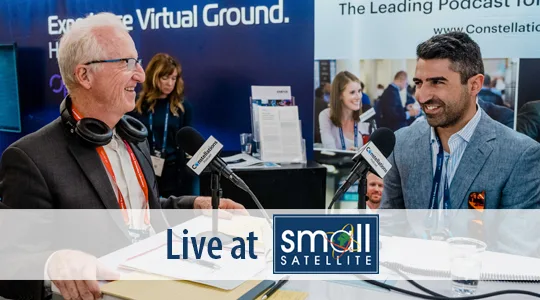
John Gilroy: Welcome to Constellations, the podcast from Kratos. My name is John Gilroy and I will be your moderator. Today, we are recording this from the floor of the SmallSat conference in lovely downtown Logan, Utah, and our guest today is Spencer Boyajian. He’s a professional research assistant at an organization called The Laboratory for Atmospheric and Space Physics, commonly referred to as L-A-S-P. We’re going to talk about LASP, Colorado University’s oldest research institute. Now, LASP has done a lot of space projects and we are here in the floor of the SmallSat show and he probably can talk to everyone on the show about some of the stuff they’ve been doing there. First of all, talk to us about LASP. Is it brand new?
Spencer Boyajian: No, it’s certainly old, LASP predates NASA, actually. It originally started as the Upper Air Laboratory because we weren’t quite to space just yet, and then started with sounding rockets, putting science payloads on sounding rockets, heliophysics, paving the way for some ADCS pointing on top of sounding rockets as well. Some really, really cool history. LASP did a lot of work with the US Navy and Air Force shortly after World War II, launching science payloads on captured German B2s in the White Sand Missile Range.
John Gilroy: There’s a novel there somewhere, isn’t there? I think.
Spencer Boyajian: Yeah, yeah.
John Gilroy: Yeah, maybe you should write it.
Spencer Boyajian: That’s one of those photo albums your mentor whips out and really makes you feel cool to work somewhere. And so, since then, we’ve gotten into all kinds of space science, helio science, earth science, astronomy, planetary. We’ve really focused on instruments. Lately we’ve been taking in the capability to do full spacecraft as well, not just instruments. This is for NASA or other space organizations, like the Emirate Space Program. Basically a total end-to-end design, build and test and operation facility.
John Gilroy: Great. LASP has a program called INSPIRE, and I did a little research on it. It seems to provide hands-on experience for students to design, build, and operate satellites that return with data for scientific and societal impact. So, it sounds state-of-the-art. It’s a 65-year old group, but it’s state-of-the-art stuff here. So, can you explain how the INSPIRE program works?
Spencer Boyajian: Yes. So, INSPIRE was emboldened by some of the success of our early CubeSat programs here, CSSWE, which was an NSF-funded proposal. That won that money in 2007, it launched in 2012 and it yielded almost 28 peer-reviewed publications including Science and Nature. For the lab, that really proved that CubeSats could do science and train students. And so MinXSS was another mission that lasted shortly after that. And after the success of those two missions, we really started to have a group together at last, that wanted to try and make this an international program to train students and capacity build. And so, we looked at how we ran things internally. We wanted to try and export this style. How can you use that on an internationally collaborative mission? So, many rules and compliances need to be learned. And so, we had a gathering of Institutes of Higher Learning, CU, IIST, that’s in India and NCU in Taiwan. Those were the beginning groups to start INSPIRE. We started to then decide what responsibilities could be divvied up between each of the INSPIRE partners, who would be responsible for what. Part of this program really is more veteran space research facilities working together with the newer players in the space industry and trying to help bridge the gap via collaborative missions.
John Gilroy: And I’ll tell you here at the SmallSat show, the phrase that pays is international. I mean, you could walk around here and collect passports and pick, I don’t know how many, 10 countries, within this first 10 feet just around here. So, the bad news is, there’s good news and bad news. You’ve had lots of success, but the bad news is the Space Foundation has documented an ongoing five-year decline in US STEM undergrads. It’s not good. Almost everyone is excited about space, but many students feel it’s out of reach. As the space economy continues to just explode here, it’s blowing up everywhere. This is having an impact on the available workforce. So Spencer, how do you think your university’s role is in preparing and encouraging students to become part of this world that’s all around us?
Spencer Boyajian: Extremely happy with the stance that our university has. They’re very forward in getting students hands-on and not just on EM hardware, flight hardware and ops. The INSPIRE program, especially, was focused on trying to train students and get them to a destination, whether it is the workforce or institutes of higher learning. INSPIRE had 30 plus students, a quarter of which went on to get some PhDs. Some of them went professional. I did a master’s myself, Amal Chandran had mentored me and that’s what brought me into INSPIRE and into the professional world as well. And now, I’ve been given the same opportunity as well to choose students to join INSPIRE, and try and get them into the profession.
John Gilroy: Yeah, one fourth out of 30, that’s a pretty good batting average, I’d say. I’d say you’d make the majors with that.
Spencer Boyajian: This is across many universities and so, maybe some of them are defending this year, so don’t quote me on it just yet.
John Gilroy: Oh, no. I think anything close to that. I did radio for many years and if I use an acronym that I don’t define, I always get in big trouble. So, I have to define INSPIRE, International Satellite Program in Research and Education. So, that’s what INSPIRE is all about. So, INSPIRE inspires people within international education. It’s great. So, if we take a look at INSPIRE, is there some overarching global objective?
Spencer Boyajian: Yes. It’s capacity building and space engineering. For it to be sustainable, they need to be both science and tech demos. A lot of our industry is focused on tech demos or when a university or an organization is trying their first CubeSats, they usually go for tech demo type stuff. Adding science to it and having that extra facet really makes it sustainable because science can bring in more funding for the next mission. A lot of CubeSat programs get that first mission off the ground, whether it’s rocky or not, and then the what’s next hits them. Having science gives you a return for what you’ve put up there, other than your capacity building. You’re going to capacity build no matter what your first mission is. If there’s science on it, that’s going to really expand the future potential, whether it’s proposals or funding from agencies.
John Gilroy: Speaking of acronyms, you mentioned earlier NSF. Science is the NSF part, so it’s got to be an integral part of everything you folks do.
Spencer Boyajian: Of course.
John Gilroy: Makes perfect sense to me. Well, let’s look back in history, maybe a short period of history for LASP. In 2016, I think you folks did preliminary design work on your first CubeSat. I think it’s called INSPIRESat-1 or something like that. INSPIRESat-1 or IS-1?
Spencer Boyajian: Yeah, it’s called IS-1.
John Gilroy: So, was it a joint effort between LASP and other groups, or just within the university or who collaborated on this?
Spencer Boyajian: Yes, this was an international collaboration. The three primary collaborators were CU, NCU in Taiwan, and IIST in India. And this collaboration was initiated to ensure that each research institute has weight and something to learn from the mission. IIST contributed the OBC, CNDH layouts. They worked together with NCU on EPS designs. NCU provided a payload, the CIP, the compact ionosphere probe, and CU provided bus building, flight software, solar panels, radio. Really again, highlighting how INSPIRE works, where you have these very veteran space research facilities trying to help these entering entities gain that experience.
John Gilroy: Good. We’re going to talk about this in a few minutes, but I want to talk more about the progress of this first CubeSat. If the planning started in 2016, it went for a few years before it launched. So, what did it take? Was it just everyone getting coordinated? Was it a financial problem? So, what did it take to get this CubeSat off the ground? What did it take to get it launched?
Spencer Boyajian: So, once some of the initial funding was put forward by CU, we started speaking with these partner universities bringing their sources of funding together as well. Like I mentioned before, NCU contributed what was initially the main payload, the CIP. And so, them contributing an instrument is part of the deal we all make with each other to help us get to the finish line when it comes to covering costs internationally. It’s very hard to exchange dollars across borders, but it’s very easy to exchange hardware that you sign contracts on. And so, that was very useful for us. One of the biggest things we faced though, was the language barrier. Different cultures, having students that maybe have never worked internationally before, definitely a big hurdle to face. Getting visas for students to travel. Every year, we did a summer program in Boulder, a meetup and workshop together. And so, getting visas for that was extremely important. I guess, one of the biggest hurdles that I can think of that came of this international collaboration was a discrepancy between Cal Poly’s CubeSat spec and ISRO’S CubeSat spec. Cal Poly’s spec 3U is larger than 300 millimeters actually, versus ISRO’s is actually 300 millimeters. And so that 3U CubeSat that we started working on designing in 2016 actually was scrapped for IS-1.
John Gilroy: Whoa.
Spencer Boyajian: And we grew to an almost 12U satellite. That work wasn’t for nothing because that 3U structure that I designed actually went on to fly as INSPIRESat-2 under NCU with another CIP instrument. The reason we ended up growing to almost a 12U for ISRO is because they did not have a 6U qualified deployer.
John Gilroy: So, you just double it, huh?
Spencer Boyajian: So, we had to double it.
John Gilroy: Wow.
Spencer Boyajian: And it was allowed in our launch. And so, that was a very unique experience to be given now room for a second payload, a bigger mass satellite. Ring deployed instead of dispenser. And so, a lot of things changed and we were able to try and make the most of this change and it not only be more work. It did directly translate to more than twice the science. And as we learned from a COVID delay, it made us more robust to being placed in a suboptimal orbit. Because of the delay in launches throughout, we had to get less picky with the orbits we were okay with. And so, being able to add that second payload made us more tolerant of more orbits because we had different forms of science we could perform at different times and positions.
John Gilroy: The Constellations Podcast was launched back in 2017. It was a small step for man, but a giant leap for podcasting. Today, thousands of people from all over the world listen to Constellations, and thanks to you, we’ve grown into more than just a podcast. Sign up for the Constellations newsletter to receive articles on current industry issues, podcast summaries, and contributed blog posts at constellationspodcast.com. Well, this interview, I’m going to structure it like GEO, MEO and LEO. So, the GEO we talked about last and the MEO may be INSPIRE because I asked you the objective for INSPIRE. So, the LEO is going to be the IS-1 itself. So, what was the overall objective for IS-1?
Spencer Boyajian: The overall objective for IS-1 was ionosphere science and solar science using the CIP and DAXSS respectively. Examining the midnight temperature maximum in the ionosphere, the turnover and seeding of activity in the ionosphere every day. It’s the number one source of GPS ranging errors. And so, by better understanding and modeling the ionosphere weather every night it changes, would be the contribution there. Ionosphere science modeling, increase in accuracy in GPS systems. And then DAXSS, the dual aperture X-ray solar spectrometer, that’s the solar science payload. And that was the added payload that had the luxury of being added to the satellite after we grew. And that was just sitting on the shelf as a flight spare from another CubeSat project.
John Gilroy: That’s nice, nice. There are people all over the world listening to this and they may want to go to your website because I went there this morning and there was an article about is the sun really hairy? It’s like that’s a draw, that’ll get someone to read that. And the reflection of the lessons you learn from the slower information, isn’t it? Is the sun hairy? I don’t know if that’s going to get me my PhD, but maybe something different. I want to talk about instruments now and the role of instruments in this different collaboration or consortium, whatever you want to call it. So the IS-1 one carries an X-ray spectrometer from LASP that was funded by NASA. So what is this spectrometer measuring and any insights yet so far with it?
Spencer Boyajian: Yes, so that spectrometer is what we call the dual aperture X-ray solar spectrometer. It’s the secondary payload on IS-1 now. It was sitting on the shelf as a flight spare to the MinXSS-1 and 2 program. This was an improvement on the instruments that were flown on MinXSS-1 and 2. Sitting on the shelf for so long, like I mentioned before, we had to choose a suboptimal orbit. This suboptimal orbit actually had more sun time than night time, and so the solar payload was able to take advantage of this. It’s examining soft X-rays around the sun. These are very hard to observe since they are the dullest light in the X-ray coming off the sun. But the DAXSS is more than 400 times better signal to noise ratio than the MinXSS-1 and 2 payloads. It can measure the soft X-ray range, which is understudied, leaving coronal and photosphere knowledge gaps. It gives a great plot, showing the abundance of elements changing during solar events. And we were really lucky actually, in getting the spacecraft commissioned quickly enough to observe solar events within two weeks of commissioning.
John Gilroy: Earlier we mentioned this whole concept of the spacecraft bus. And from what I’ve read, the INSPIRE spacecraft bus is an open domain hardware architecture developed jointly by partner universities. That’s a plural and everyone wants a seat at the table, maybe the head of the table and you gotta elbow Spencer out cause you want to get the head of the table. And so, how do you manage that kind of program so everyone has a voice in the design or sees the table?
Spencer Boyajian: So, we did have to get all of the PIs to agree with each other, which must have been the hardest decision.
John Gilroy: 20 years.
Spencer Boyajian: Luckily enough, two of the PIs were close friends since their schooling for their own PhDs. And so, there was a lot of chemistry there at the higher levels of the program, which I think was very necessary, such that no leader felt like they needed to be the president. All of them felt okay being equal shareholders.
John Gilroy: This was a round table.
Spencer Boyajian: Yes, this was a round table. Often oval because there’s a lot of us. And so, we classified it as fundamental research between institutes of higher learning. That classification involved going through each of our subsystems with our export compliance people and verifying there’s no ITAR materials within. Only segregated subsystem that we had to isolate on all of the INSPIRE missions was the ADCS system. That’s usually at our CubeSat’s level, the only kind of information that’s not open. And so, that needed to be kept safe with the rest of our LASP facilities and controlled information. While the rest, things like the OBC, EPS, these are open source designs that were being worked on jointly and often being finally tested at LASP but most of the layouts coming from abroad.
John Gilroy: Spencer, let’s bring our audience up to date. We’ve talked a lot about historical actions and everything else, but several of the space missions LASP has been part of are still going on. And so, the question is, how do you track these missions? Do you have antennas at the university to work with? Does the data you receive from these satellites get processed or how does this all work?
Spencer Boyajian: Yes. So, we have a ground station at LASP and mission ops. Our mission ops at LASP is actually quite prolific. It’s a very strong department of ours. We get students involved and we actually have students operating some Kepler telescopes, things like that. But we use all of our own equipment. We have a UHF ground station, S-band, and between those two, we’re usually able to operate all of our spacecraft. If we need X-band, then we will go out to a servicer, AWS or KSAT, similarly. But it’s extremely useful being able to use UHF, both if you can get license coordination with the amateur band, very useful for making first contact with your satellite shortly after launch. Instead of having to wait for a pass over your own ground station, you can see your own packets coming down into someone else’s ground station. And so, having your own ground station is perfect, but being able to look for your satellite with others’ ground stations is a big pro. And so, that’s the mentality we have at LASP, where we’d love to do all of our ops, but if it’s better for us to reach out, we will.
John Gilroy: Well, here we are at the SmallSat Show, as I said earlier, and there are regular commercial companies here, big and small. There’s military people here. There’s also a lot of universities. I mean, some very prestigious universities have booths here. And I would guess if we did a survey of these universities, not many would have their own ground station. I’m just taking a guess here. So, it’s a very unique place for someone if you’re interested in this business, this is a great place to learn more and have all this ability with colleagues and developing new things and, oh yeah, I got a ground station on my own place here that you can really do a whole lot with. So, everyone talks about transformation and changes. And I think the business is transforming a lot in the last few years. And we look at the early days of LASP and today, a lot of changes. So, what kind of transformative scientific discoveries has LASP been a part of?
Spencer Boyajian: So, one of the ones that stuck with me was UARS. I feel like it was a hot topic when I was growing up. It was a satellite, the upper atmosphere research satellite, and it helped scientists understand the energy input, chemistry and dynamics of the upper atmosphere. And it was one of the missions that confirmed the hypothesis and role of chlorofluorocarbons in ozone depletion and clarified chemical processes that can cause that antarctic ozone hole. And so, this one really stuck with me as a cool discovery that LASP had because it was something that was identified when I was younger as a problem and we as a society corrected ourselves and it’s begun to reverse. And so, really incredible.
John Gilroy: Well, Spencer, you did a wonderful job on this interview. I think what you have done, you have inspired our listeners to follow LASP. Got to use both those words in the end here. I’d like to thank our guest, Spencer Boyajian, professional research assistant at the Laboratory for Atmospheric and Space Physics.