Transcript:
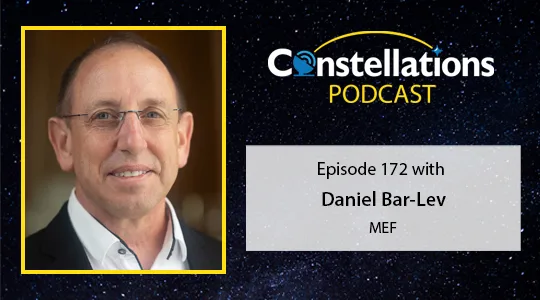
John Gilroy: Welcome to Constellations, the podcast from Kratos. My name is John Gilroy and I’ll be your moderator. Our guest is Daniel Bar-Lev, Vice President of Strategic Programs at MEF. Satellite has often been viewed as a transport of last resort, however, that is rapidly changing as satellite networks digitally transform and adopt standards to become like today’s mainstream telecom networks. In this podcast episode, find out how standards, such as Carrier Ethernet, are playing a critical role in enabling satellite and telecommunications networks to converge to deliver services such as enterprise network extension, SD-WAN, and IP services to hard-to-reach areas. Here to discuss the critical role of standards is Daniel Bar-Lev, the vice president of strategic programs at MEF. Daniel is responsible for the development and implementation of a range of strategic MEF programs that enable MEF’s 200 plus members to accelerate the transformation of their networks and operations. Daniel has been involved in the networking industry for over 25 years and has held a variety of executive level positions. Well, Daniel, we’re just going to jump right in here. MEF has been around for more than 20 years, it’s well known in the telecom and technology industry, not as much in the satellite industry. Can you explain what MEF is and why it is important for satellite operators and technology partners to be familiar with your organization?
Daniel Bar-Lev: Hello, John. Yeah, thank you. Excellent question to kick off. So let me introduce you to MEF. MEF is an industry consortium. We actually facilitate collaboration and consensus between many stakeholders in the telecom industry. The way we do that is by bringing together our members of the consortium and enabling them to have the discussions and the work that will result in that consensus, which we typically see as standards documents. So just think of us as a group of over 200 companies, the likes of AT&T and Verizon and many other service providers as well as vendors, technology providers, the likes of Cisco and Juniper and Ericsson and Nokia. Altogether from our 200 plus membership, we have about two thirds of our members are what we call service providers. You might think of them as carriers or telecom providers, and the remainder are a wide range of technology and solution providers.
John Gilroy: Daniel, I was taking notes down, and so I think your motto should be reaching consensus for 20 years. I think there’s a lot of people in the world maybe can learn how to do that.
Daniel Bar-Lev: So, actually it’s an interesting point and we take it for granted. But the DNA of an organization like MEF is based on the idea of win-win, where competitors get together and they say, look, it’s better to have a unified consistent market where we can all interoperate and do business where than a fragmented one of many islands and silos. So you get the likes of AT&T and Verizon and many others working together for the advancement of the industry as a whole and a better market.
John Gilroy: Well, I like the whole concept of win-win. If you look at MEF in the last 20 years, it looks like it’s helped telecom and cloud providers accelerate their enterprise digital transformation over these decades. The satellite industry is a little different. It’s in the early stages of its own digital transformation journey. So, what lessons from the telecom industry transformation do you think could be useful for the satellite industry?
Daniel Bar-Lev: I think what we can learn from the terrestrial part of the telecom industry over the years is that that shift from everything in hardware or mostly in hardware, the solution, and a little bit of software, has transformed to a lot of software and very little hardware. That was very painful for the terrestrial part of the telecom industry. It’s taken us many years to get there. We call it software defined networking today. But that transformation has allowed a lot of agility in the telecom industry because now changing software is much easier, it’s much faster, it’s much lower cost than changing hardware. So being willing to put more of the solution in software is just critical in order to keep up with the rapidly evolving needs of the enterprise and many other parts of the consumer market, if you like, in the business market for telecoms. So I think the lesson would be don’t be afraid of software. Bring in that software expertise. Don’t try and lock everything into hardware and make the best possible solution from the get-go. But enable software because that is the gateway to the future, I think, not just for the satellite industry, but for many, many other parts of the telecom industry.
John Gilroy: Well, I, for one, realize that the pioneers get all the arrows. I imagine the people in the space and satellite industry should be appreciative of all the arguments and debates that have gone back and forth and ironed out at least some of the common standards. Let’s go back to the space industry here. We hear a lot about satellite telecom network integration and the idea of providing seamless interactions between the two. So how do standards such as Carrier Ethernet facilitate that seamless interaction between service providers?
Daniel Bar-Lev: So if we go back to the roots of Carrier Ethernet, John, really what is Carrier Ethernet? It’s being able to run Ethernet over any type of network over any type of distance. So Ethernet originally back in the eighties emerged as what we would call a local area network technology, LAN. So when PCs started appearing in offices, connecting them together, it could be done in a variety of ways. The way that won out was this Ethernet. So a network of PCs, of computers, in the office was done with Ethernet, but it only worked over a campus area. So what MEF did back in the day, back in 2001, 2002, was to get together service providers and technology providers and say, well, why limit Ethernet to the campus? Let’s make Ethernet suitable for very, very large distances. Originally it was the metro and then that grew to global. Let’s run an Ethernet not only in the campus but all around the globe.
Daniel Bar-Lev: The beauty of Ethernet is it can run over any type of physical infrastructure. So back in the day they were doing it over coax, would you believe? Then they started doing it over copper, cat five, now cat six. Then they said, well hold on, why limit ourselves to copper? Let’s do it over fiber, let’s do it over wireless. So actually Ethernet networks and Ethernet services can run over any type of infrastructure and any digital infrastructure, of course. So satellite is another digital infrastructure. So from the point of view of an Ethernet service provider, it shouldn’t matter whether it’s running over a satellite or whether it’s running over a submarine cable or whether it’s running over a pair of wires from the front of the building. So that’s what makes it seamless. Counterintuitively, if the satellite industry can make itself invisible from that point of view, then the carrier Ethernet service and the user of the carrier Ethernet service benefits, because they can basically get their Carrier Ethernet running anywhere, including over satellite.
John Gilroy: Yeah, it’s almost agnostic in some aspects, isn’t it?
Daniel Bar-Lev: Absolutely. That’s the beauty of what we call layering in telecom, where we define these services, for example, Carrier Ethernet service so that it can run over any infrastructure in an agnostic way. It’s agnostic the type of infrastructure.
John Gilroy: Well, everyone likes examples and specifics, so I’m going to have to ask you for one here. So Daniel, can you give me an example of a service being enabled between different connectivity providers and vendors and how the use of standardized service definitions and protocols helps make that connectivity seamless to me, to the end user?
Daniel Bar-Lev: So let’s take an example, John, of a big retailer. I won’t mention names, but think of a huge retailer in the US that has an international presence as well. They’ve got sites all over the world and they need to connect them. Everybody that’s working in their different outlets and their warehouses and their offices, they need to feel like they’re all on one network. We know that obviously in some places they’re hard to reach, other places much easier to reach. So you might have a retailer that’s got sites connected over fiber in, let’s say, New York. But in a location where they’ve just set up a new warehouse, there isn’t any fiber running there, so they use a wireless connection point to point, wireless connection. Perhaps in another area, they’ve got a factory or some type of other premise where they’re using private 5G. So they’ve got their own wireless campus and they want Ethernet basically to be the unifying connectivity service for everybody. So they go to their service provider and they say, look, here are all the locations around the world that I need to have this type of bandwidth and this type of service. That’s what I need. The service provider will say, okay, I can deliver a Carrier Ethernet with these capabilities, and I will make sure that it runs over whatever infrastructure is there, whether it’s a first mile copper or whether it’s 5G or whether it’s satellite. So that would be an example of where a retailer or some other enterprise uses an Ethernet service regardless of the infrastructure.
John Gilroy: So Daniel, let me connect the dots here. So we got fiber, wireless, 5G, maybe even satellites. So one ring to rule them all. That’s what Ethernet’s winding up to be here, isn’t it?
Daniel Bar-Lev: Exactly. One ring to rule them all.
John Gilroy: So let’s go back from fiction to reality here. Ethernet’s not fiction, Ethernet’s everywhere. It’s become a ubiquitous networking technology that I think has displaced almost all other legacy data transport. Maybe some of the older people remember stuff from IBM that never quite caught on. So the question is, how can the wide deployment of carrier Ethernet services enable satellite networks to become much more mainstream and address a larger market?
Daniel Bar-Lev: So carrier Ethernet, when we started defining carrier Ethernet services back in 2001, there was no carrier Ethernet, there was no market. Today it’s an $80 billion a year market. So it’s obviously taken hold and been very, very successful. What the satellite industry is able to do is to come along and say, as we evolve our technology, as we evolve our capabilities, we can deliver bits, zeros and ones, to more and more places at lower cost, at higher speed. As that technology evolves all the time, it becomes more and more attractive as a solution as part of a carrier Ethernet service. So you mentioned reaching places that are hard to reach otherwise, but it could well be that it’s becoming so competitive. What satellite technology and connectivity can offer today is something that’s very, very directly competitive with terrestrial, in some situations. As we see the emergence of IoT, internet of things, we see that its mobility. Mobility is a key thing there. So satellite is really good for mobility. Obviously we know from aircraft and ship that satellite has a huge advantage there. But even in areas of cities and outside conversations, IoT needs all the time connectivity. So satellite could be relevant there.
Daniel Bar-Lev: So I think that what it boils down to is if satellite can deliver at a reasonable cost, a competitive cost, and it can deliver speeds and low latency, nobody will care whether it’s satellite or fiber or fixed wireless or whatever. That’s what it’s being judged on. From what we’re seeing in the market today, satellite definitely can deliver that. So I think very relevant for many, many use cases and that list of use cases is growing all the time.
John Gilroy: Well, let’s take a look at a use case here. Let’s take a use case that maybe involve deploying a satellite service. Today, due to its manual and proprietary nature, it can take weeks to months to deploy a satellite service for a customer. So Daniel, can you explain how MEF’s Lifecycle Service Orchestration framework can enable satellite service providers to deliver services much faster, maybe in minutes? Can that even be done?
Daniel Bar-Lev: Yes. So this is all part of the transformation that we’ve seen in our everyday lives. Actually John, we call it cloudification or the cloud experience. So, there was a time when we would have to get in a car and drive to a retailer and buy whatever. Today we get online and we go to an online retailer, the likes of Amazon, and we place an order and it gets delivered. That’s become a very, very natural experience for us as individual consumers. Well, the same is happening in the data communication space. Google and AWS and Azure of Microsoft, they deliver, compute and storage as a cloud service, and you can spin up compute and storage in seconds or minutes. We think that’s very, very natural today. That’s what we need to do for the telecom industry as well. Connectivity needs to be that cloud like experience, and that’s what MEF is doing with our LSO work. Basically we’re saying everything needs to be automated. If you want to get something done in seconds or minutes, that has to be automated. You can’t have human intervention. So when you want to get a price quote, you need two machines or two systems talking to each other to get that information. You can’t have people in the middle if you want it done in seconds or minutes. Or if you want to place an order. The same that we have with our online experience for retail.
Daniel Bar-Lev: So what MEF did was it said, okay, for all the systems and computers to be able to talk to each other in seconds or minutes, they need to have an agreed language, an agreed interface that everybody’s using. What we call APIs, application programmable interfaces. Those APIs, if they’re standard, if everybody’s talking using the same type of interface, using the same terminology, then those machines, those systems can exchange information. Whether it’s do you support this location? What products do you deliver? Do you deliver satellite connectivity? Do you deliver how much bandwidth and so on? How much is it going to cost? I’m placing an order, I need an invoice. All of that is done automatically and that is the way to move forward. So that is where MEF has basically made its impact on the industry by making interoperability at the business level, as we would say, through the business lifecycle and also the operational lifecycle between different companies, between different entities. We have standardized it. So everybody’s using the same approach that enables automation. As soon as the satellite industry adopts what MEF has standardized, then it becomes a player. The satellite industry stakeholders can then also become part of the supply chain for the telecom industry.
John Gilroy: Well, Daniel, let’s go back to standards here. I’m sure if you went to Google and just typed in the word standards, you’d get more responses you could even handle. So, bunches of standards out there, we know that. So what other standards has MEF developed that are important for the satellite communications community to know about? So let’s focus on ones that apply to our audience.
Daniel Bar-Lev: So the business types of interfaces, and I’ve just mentioned those all the way through from what we call address validation through order to billing and settlement. So that’s one area. The second area is operational. In other words, things like detecting faults in the service, being able to track the performance of the service. That’s another area that requires standardization of the information, that path back and forth, both between the satellite stakeholders in the network and their customers, telecoms for example. Or between the telecoms, the service providers, and their enterprise customers. So standardization, both of the business layer and the operational layer. That’s what’s key here.
John Gilroy: Well Daniel, I think I mentioned that Ethernet’s everywhere. Well, it sure seems like 5G is giving it a competition here. 5G, with its inclusion of non-terrestrial networks, I think it maybe holds the promise of much greater integration between satellite and telecom networks. So what role do you see MEF playing in terms of this increased convergence?
Daniel Bar-Lev: Yeah, so 5G is a short distance solution, relatively short distance. We’ve seen this with the cellular mobile industry for decades now, you need what we call back haul. So you can create 5G coverage, but at the end of the day, you need to connect it back into the rest of the network. That’s where the satellite industry is increasingly attractive because you put down a 5G cell in a location and you need a high speed back haul, you can do it with fiber or you can do it with a satellite. So this is a very, very important use case. That integration of the business layer, of the operational layer and the physical layer, is very, very much within reach.
John Gilroy: MEFs members, that is, say your members, they make up a global ecosystem of network cloud and technology providers working together to deliver connectivity. We know that. So what value do you believe the satellite service providers can add to this existing ecosystem?
Daniel Bar-Lev: Their range, their flexibility, their ability to deliver services in very, very short order. We’ve seen this with the stories in Ukraine, for example, or in other crisis hit areas. So I think the satellite industry is a very important stakeholder in the telecom industry now. It can deliver bits, zeros and ones, at very high speeds, very quickly, to many, many places in the world. That’s the importance here.
John Gilroy: Now today, the number of satellite operators and vendors are MEF members or MEF certified. So how are satellite industry members using MEF standards to advance their businesses? Maybe you have an example here.
Daniel Bar-Lev: Yeah, so we’ve seen a number of satellite players, both the technology vendors supporting them, but also the satellite service providers joining MEF and demonstrating that they can deliver carrier Ethernet services over their infrastructure. That’s been happening since 2018, and it’s happening with increasing frequency now. We’re seeing satellite companies both on the service provider and the technology provider side, demonstrating that they can conform with standards, that they do conform with standards, and that they can integrate into these telecom supply chains very, very easily. So yes, we’re seeing more and more examples of leading players doing that.
John Gilroy: Well, we know MEF’S been around for 20 years and it sure looks like most of MEF’s membership expertise is in terrestrial connectivity. So what is the top request you get from the satellite community to help expand MEF expertise in non-terrestrial connectivity?
Daniel Bar-Lev: I think that the satellite industry, as it understands more and more about interfacing into the telecom service providers, it’s realizing that the whole difference between terrestrial and wireless and satellite is effectively blurring. It’s going away. From the point of view of the telecom service providers, it doesn’t matter. What they’re looking for is that ability to deliver zeros and ones, digital services. So just being able to play by the same rules as any other type of infrastructure player means that that differentiation is just going away. I think we won’t be talking about satellite and terrestrial as if they’re two different worlds. I think they will become part of one world, just like local area networks, wide area networks. We don’t talk about those anymore. It all becomes seamless. We talk about the cloud and we talk about private premises as if it’s all one. Those lines are being blurred and they’ll disappear. I think we’ll see the same with terrestrial and satellite, thanks to the great work that the satellite players are doing now in terms of integrating themselves into the supply chains through standard.
John Gilroy: Daniel, earlier you mentioned AWS, and they have a brand new initiative and it’s called the secure Tactical Edge. Now I don’t see any secure tactical edge without some nods to standards because they’re very important in that area. So let’s look forward, let’s look ahead here. So how do you see the future of the satellite industry involvement with MEF?
Daniel Bar-Lev: So in general, where MEF is going now is we are leading what we call network as a service. What is network as a service? Network as a service is cloudification of network services, making it possible to reach locations with services on demand. But not just connectivity, cybersecurity aspect and many other aspects, storage, compute capabilities, all bundled into one offering. Where we see the satellite industry is being a player in that new NaaS, that new emerging network as a service market, which is a forecast to reach trillions of dollars. So there’s a very important part for the satellite industry to play in that and be a part of that emerging market.
John Gilroy: My, you’ve articulated your answers very well here, Daniel. What I think you’ve done is you’ve given our listeners a better understanding of some of the challenges of a standards organization moving into the brave new world of satellite and space. I’d like to thank our guest, Daniel Bar-Lev, Vice President of Strategic Programs at MEF. Thank you, Daniel.
Daniel Bar-Lev: Thank you, John. Been a pleasure.