Transcript:
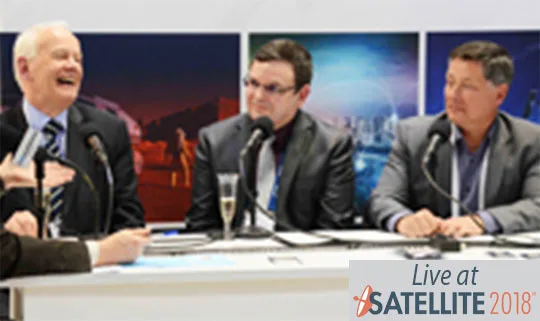
John Gilroy: Welcome to Constellations, the podcast from Kratos. My name is John Gilroy, I’ll be your moderator today. Well here we are sitting at the floor of Satellite 2018. I went around the room and grabbed three people arbitrarily to have a conversation about satellite interferences. Not all that happened at all. Today we have a panel discussion. We have Martin Coleman, who is the executive director of Satellite IRG. We have Mark Steel, he’s the Vice President of product development from Inmarsat. And we have Bob Potter, Vice President, Signals and Ground System Technology at Kratos. We’re going to talk about interference and what a coincidence that we have the 20th anniversary of the Satellite Interference Reduction Group. Round of applause, 20 years. Good, good, good. Boy, 20 years ago I was just in grade school. That’s amazing that you guys have been around that long. Earlier today we had a podcast and I talked about the BBC. But actually when looking at all three of you and I hear the accents, we might as well have another BBC introduction here, because everyone’s from England in this show. So interesting. Martin, tell us about your background first.
Martin Coleman: Well yeah that goes back. The best way to describe it is this is my 48th year in telecoms. So we’re going back a bit. But the most interesting thing I can say is that I am actually officially the first person on this planet that dealt with satellite interference in 1978 at a new Earth station called Madley in the UK.
John Gilroy: Wow. Plenty of experience.
Martin Coleman: Yeah. Then someone said, “Do you want to run this group?” “And what group’s that? Oh that group.” So there we are. Bring it up to date, there’s the connection.
John Gilroy: Mark Steel. Tell us about your background please.
Mark Steel: I’m originally from the UK. I was in the Royal Air force for a number of years and retired, and somehow ended up in the US. I spent probably 30 years here now. Worked for many companies from Cobham to Inmarsat and had my own company here for a while. Been in the satellite industry all of that time, so it’s been an exciting time. Somehow I managed to get linked up with Martin many years ago and seems to be a rash on the side that I can’t get rid of.
John Gilroy: You drew the short straw, didn’t you?
Mark Steel: I did draw the short straw, yeah.
John Gilroy: Master’s Degree in electrical engineering so you must know something technical, huh?
Mark Steel: Just a little.
John Gilroy: A little bit, yeah.
Mark Steel: A little.
John Gilroy: Don’t admit to it though.
Mark Steel: No, I won’t.
John Gilroy: Bob Potter, your background please.
Bob Potter: My background is in RF engineering. I’m originally with land/mobile two way radio. 20 years ago I came here to the states, started working for this little satellite company dealing with satellite interference, which is what is now grown in to be a part of Kratos, and satellite interference mitigation solution set. About 15 years ago I actually joined IRG, so I’ve been around since 2004, and it’s been a wild ride.
John Gilroy: Sounds like you’re the puppy of the group then, huh? Just the youngster.
Bob Potter: I guess so.
John Gilroy: So Martin, we’ll go back to you.
Martin Coleman: Yeah.
John Gilroy: We walk around the show here and it’s pretty obvious that there are thousands of new small satellites that are launching all the time. Here’s the easy question, how’s that going to affect the whole satellite industry and interference.
Martin Coleman: Wow, there you go. Well right now we’re in a good spot, because they’re not all up there yet. The problem is we’re sort of at a point where we understand what we’ve got. The problem with what effectively is the Leo situation with added nanos, small sats, cube sats, whatever you like to call them. What is that effect? We’ve got some clever bunnies on our panels and in the group. It’s a vexing question that whether anybody’s really worked it out. Actually we’re sort of starting to face a little bit of the unknown. We’ve got the ideas. Everybody says it’s going to work. I think it would. I’m excited about it as a business and where we’re going, I think it will happen, but you know what, we have to be careful. What we’re trying to do now is really focus on what are we going to do now before we just run into the brick wall? We’re normally chasing our tails and we take 10 years to catch up with the problem. We need to be ready and be done in six months.
John Gilroy: Mark Steel, it’s pretty obvious that the people around here are optimistic about these constellations. In fact there’s a guy from China who walked up and started talking to us, and he said, “Well there’s a cloud above the cloud,” talking about constellations. So are you optimistic about this new development or what do you think is going to happen?
Mark Steel: I’m not so sure I’m optimistic, because at Inmarsat I’ve been very lucky that I have a, what I will call a baby. A brand new architecture both on the ground and in space. Over the years we’ve found that there’s a number of problems with manufactured equipment causing a multitude of issues. Again, in the same sense I’ve been lucky that we haven’t had to deal with an infrastructure that was in place. We’ve actually created it from the ground up. The stats are pretty frightening in terms of what we’ve found in the marketplace, and I still think we’ve still got a long way to go for industry to drive the challenges to help us in the reduction of interference.
John Gilroy: Bob Potter. Optimistic? Pessimistic? What do you think is going on in the next few years?
Bob Potter: Actually the more I dig into this, the more optimistic I am. I think there’s a lot of thought being put into the Leo constellations and how they can coexist with the existing user spectrum, but I think that any RF engineer will tell you that the more people that are using the spectrum, the more likely it is you’re going to get interference. But they’ve thought it through. There’s a pretty good technical story to it. The proof of the pudding is when they’re up there, right? So we’ll see.
John Gilroy: Well Martin, we are recording this, so I can’t legally say that you have a glass of champagne in front of you, so I won’t. How’s the champagne? 20 years at the IRG. Tell us what they do and some of their goals, and what kind of companies they work with.
Martin Coleman: Well I think the ultimate goal at the beginning and it still is, is actually getting the engine room of satellite operations together. The problem with this whole issue is that it’s not a one company problem. It crosses boundaries that we all have no control over. How much politics you put into this, whatever you do, we don’t have a lot of control, so we have to work together. Right from the point where Intelsat became partners, working with the next guy who came along who was Eutelsat. Once that happened, those two operators in the background had to work together to resolve issues. That group was formed because we weren’t resolving those issues, and it put a forum in so that we could socialize the engineering problems. It’s not fun because customers and satellite operators themselves don’t really like talking about this. The good news is now pushing 20 years ahead, not only have we added tools thanks to the clever people around here some of them Kratos, other’s elsewhere, and products. It’s in products, things we’ve got into products. It’s fantastic. There is a difference and we now can talk about it, which I think is probably the biggest achievement. It’s less scary. But nonetheless it’s critical.
John Gilroy: Mark Steel, I’ve done podcasts for the aerospace industry and many times when these groups get together they focus on standards and that seems to be exactly what they talk about every event they come. Does the IRG focus on standards or what do you focus on?
Mark Steel: From a view, I think bringing the industry together to understand that there is a problem, and there has been a problem. There are across the globe a number of standards that many people try to adopt too. I think the realization is that a lot of the standards are measured, and have they been measured against reality? We’ve seen a lot of information passed into some of the testing that we do, and we mandate type approvals at Inmarsat that is not being, should is say, truthful?
John Gilroy: That’s an interesting phrase.
Mark Steel: In some cases, yeah, and it’s a problem. I think the fact that bringing the industry together in these groups leads to awareness, and it certainly drives some of the thought process that we have at Inmarsat in what we do to try and reduce interference for ourselves as well as our competitor operators. I think it’s been a good move for Inmarsat to be part of the IRG.
John Gilroy: So Bob Potter, when Martin was speaking I wrote down “reality check”. Then I wrote down what a lot of consultants have to do. They call it a beautiful lie or the ugly truth. So what IRG tries to do is present some of the ugly truth, huh?
Bob Potter: Well it’s true. The organization was formed by engineers who were trying to work together to solve a problem. So yes, the ugly truth had to be exposed.
John Gilroy: It’s true, yeah.
Bob Potter: Something that maybe many of the marketing people from those companies didn’t necessarily want people to expose.
John Gilroy: Maybe marketing people from IRG should adopt that. “Come to us for the ugly truth,” huh Martin?
Martin Coleman: Exactly, great start line. Can I take that please?
Bob Potter: Yeah.
John Gilroy: But that’s really what it is.
Martin Coleman: It is, yeah.
John Gilroy: It’s company people getting together, and they have to close doors and say, “Hey, it’s dirty laundry time.”
Martin Coleman: Yeah but the real trick is that our team has got now the method to change that horrid conversation and be able to pitch it so that we can get that awareness out there. You know the education awareness bit so that people understand it, the marketing people understand it. We’re getting more people that ask us questions from the marketing because they’re starting to get questions from their customers. It’s becoming a little more discussed and open. It is a big jump from where we were 20 years ago struggling with a new thing, which for a while got worse. But now we’re in this balanced place and it’s nice. But it’s getting uncomfortable and we’ve got this new exciting era coming. And it’s going to come. Whatever we think what shape or form, but it will. We’re going to have to deal with it, and our job is to try and get on top and ahead of it. Tricky, because we don’t have so much reality at the moment, but it’s all about that messaging. It’s all right. We’re an input group. We’re socially an input group. Crossing boundaries, because in space there are no boundaries. We all need space clean of whatever. I mean debris, don’t get us onto debris and everything else. That’s another subject. It’s got to be kept clean and the only way you can do that is to work together.
John Gilroy: Mark Steel, I have three raised children, and earlier in the day did a podcast. Talked about when my kids were teenagers, there were unintended consequences normally involving automobiles. We know people put stuff up in space and sometimes there’s unintended consequences involving interference. My question to you is where do you draw the line between unintended and intended, the benign and the intentional. There’s a grey area here with interference, isn’t there?
Mark Steel: There certainly is.
John Gilroy: With my kids too.
Mark Steel: Yeah, mine too. Big time.
Mark Steel: I think the problem is if you look at some of the stats that the IRG has actually been able to collect over the years with the members, it’s been very interesting to see how some of this interference has come about, where it’s originated from and I think the overall awareness of the group to see what everybody is seeing has certainly highlighted that there’s a combination of effect here. It’s not just one area. It’s just a lot of things that come together, whether it’s poor equipment on the ground, whether it’s lack of training. There’s just a number of things that have put us in this situation, and I think what the IRG has done is brought the industry together and made us aware. Certainly it drives Inmarsat in some of our processes to be more conscious of our competitors, and not to put things out there that potentially will cause interference. I think it’s a big picture that we can look at now rather than looking at it self- centered and just, “It’s only me that it affects. I’m not worried about anyone else.” We have a great deal of networking ability when we’re in this group. The true stories come out and we can react to them.
John Gilroy: Yeah, yeah. Bob Potter. My son and I talk about professional football. In professional football there’s this thing called interference. It stops the game and then you get called for interference. What with all these new constellations out there, do you think the amount of interference is going to increase drastically, or what are your projections for all these new constellations out there? Are they going to play by the rules or just ignore the rules?
Bob Potter: Well that’s a very good question.
John Gilroy: Football question.
Bob Potter: The rules are there for a reason, and as I said at the beginning, I think the Leo constellation people have actually done a lot of work to ensure that they’re going to be a good neighbor and good steward of the spectrum, which is a finite resource, and they are the secondary user of that spectrum with the geostationary guys being the primary.
Bob Potter: So if you look at some of the work they’ve done, they’ve got a pretty good story of how they’re not going to interference with the geo guys, but who knows. Small antennas are transmitting on satellite, and small antennas we know from the studies and the work that we’ve done within IRG are part of the problem of causing interference. As Mark alluded to earlier, type approval. Suddenly antenna patterns are not quite what they said they were when they got type approval, because they’re just stamping these things out. So yeah.
John Gilroy: A year ago when we were developing this podcast, one of the working titles was the Spot Beam podcast. We thought about Spot Beam, we thought about constellations, why don’t we be Constellations? So when you think about constellations, Martin, how are the traditional operators doing … what are they doing to protect themselves from the new guys coming in?
Martin Coleman: Oh wow. Now you’re getting out of my league. I have to just look. I’m the reactive guy that just gets involved with the problem. I don’t know. I can only take a view that it will work because everybody needs everybody else. I don’t think a satellite as being us and that we’re terrestrial now and the battle of spectrum and everything else. This whole community is a telecoms network, all of it, terrestrially or in space. So whatever we do, it all will be there. Everybody will win. Whether the picture actually looks the same as we see it in a trade show now in terms of companies and what they do is another matter. I see change in the way, how perhaps satellites are operated. They may be under a different format. I think that will change as an industry. I think that’s how it will become more one, not just us and them. It feels a little bit still us and them. We heard the word hybrid gets mentioned. It’s always been a hybrid. I started in… when I transferred out.. I am not a satellite guy. Are you ready for this? I’m the infiltrator. I’m the international switching guy. I’m you’re terrestrial nightmare. But guess what, we were joined in together in 1978. I actually have a picture on my mobile phone proving it. I look better then, by the way too. You see what I mean? This has been always a hybrid.
John Gilroy: Nothing new.
Martin Coleman: It’s just going to get really complex. But I think it’s a winner. I don’t think any of this is bad. I’m actually excited, but I can’t tell you the market strategies. Not my expertise. These guys, much better at it.
John Gilroy: Mark Steel, I did my research on you before the show, you know. I did my kind of interesting facts about you. I found out that you might be a Manchester United fan, is that right?
Mark Steel: That is incorrect.
John Gilroy: Oh no. What are you a fan of then, what team?
Mark Steel: It’s Liverpool.
John Gilroy: Liverpool, that’s what it is. Liverpool has to play together as a team.
Mark Steel: We do.
John Gilroy: We fit all these different vendors here. All these different groups of companies, antennas and standards. So how can these people play together as a team?
Mark Steel: That’s a very interesting question. For the last, I think it’s almost five years now I’ve been part of a group of five other operators that includes Intelsat, Eutelsat, SES, and a few others to name. Trying to set up a minimum antenna performance standard for the industry, and it’s taken those operators that long to agree a baseline. Of course getting there is being problematic because we all have our own business and commercial needs that have driven us to a set of requirements to drive business individually. So bringing in just those six together has been problematic and if you think now globally we’ve got all these other operators that we need to bring in. Trying to get the whole satellite industry from an operator as one team is going to be a big challenge. We’re slowly starting to open the doors to additional operators, but each new operator is going to be a challenge to the standards that we’ve set in requirements today. It’s going to be an interesting ride this year because the Somat group is actually set September 1st, which is the date that we expect to see those minimum requirements coming out of antenna manufacturers.
John Gilroy: Bob Potter, I’m going to ask you the obvious question. Here we are at Satellite 2018, downtown Washington DC, not too far from here there’s a little hill. They do a lot of regulations there. What’s the role of regulations, and where do regulations play in terms of interference? Don’t talk about politics or religion.
Bob Potter: Engineers don’t do regulation.
John Gilroy: No we don’t talk about regulations. Don’t talk regulations.
Bob Potter: Well you started out with some questions about standards, so the regulators are usually the ones that set the standards. Unfortunately we’re talking global, though.
John Gilroy: That’s the problem.
Bob Potter: Which really comes to the ITU. The ITU more or less sets guidelines than they do regulations, and leave it to the individual countries to set their own regulations. Here in the States it would be the FCC. In the UK it would be OFCOM. Regulations come from them. Though what they’re trying to do on the global basis for satellite, let’s say for instance, Leo constellations, they’re actually setting an equivalent power flux entity limits for what they should be radiating. Those satellite companies have been taking that very seriously, which is great for us because we’re able to measure that and tell them what they’re doing. The theory is, given the scientists have gotten it right, if everybody behaves themselves and stays within the EPFD, then we’re all going to be happy campers. But we’ll see.
John Gilroy: You know Martin, I do a lot of speaking at technology convergences. I have to sing a contract. I have to say artificial intelligence before every single conference.
Martin Coleman: And you should, you should. This is good.
John Gilroy: So where does artificial intelligence play in your world?
Martin Coleman: It’s a very good question. I have a dream, that’s an interesting though. We … My vision. It’s mine at the moment. They’re all trying to play catch up. They’ll get there. We need to create what I call a digital assistant. In other words, Opex costs have to be kept down. Well, they’re forced down, let’s say. Capex is different. Different. It’s a one off, steady, can be planned. My theory is that we’ve got to embrace AI and machine learning. I’ve got to say the word quantum, because they told me to.
John Gilroy: That’s next years, it’s got to be the Q word.
Martin Coleman: Quantum, yeah, yeah, yeah. You got to have the Q word. And it’s not Eutelsat’s satellite. Sorry Mark.
Martin Coleman: No, AI, machine learning, is our future. It’s the future in our toolbox. Remember, IRG is dealing with the reactive problem of dealing with interference. It’s happened, now we’ve got to fix it fast. That’s what the groups got to do. People like GVF are the proactive at dealing with trying to get the standards, the antenna performances, the training. The parts that are proactive.
Martin Coleman: We’re always going to be slightly one step, but imagine having the machine able to just absorb data, everything from weather patterns to just what’s going on in the ground stations. What’s coming up, what’s going down. Where services are. We’re quite good as humans doing tasks, but this is serious multitasking. If we’re going to manage this complex network, our toolbox is going to end up with tools with AI and machine learning in them. We’ve actually got a panel, I’m going to advertise this. We have a panel tomorrow, everybody, and you will all attend at 11:15, and we’re going be going heavy into this, so watch this space.
John Gilroy: Very good. Mark Steel, we just talked about tomorrow. I want to talk about theoretically tomorrow, four, five, ten years down the road. Do you think Martin’s AI will be applied to your problem, and in seven/eight years you’ll be sitting back with your feet up smoking cigars and not worrying at all? Where do you think it’s going to head?
Mark Steel: I hope it’s sooner than five to seven years, honestly.
John Gilroy: Because you can’t take it anymore.
Martin Coleman: Pay me more.
John Gilroy: Can’t take it anymore.
Mark Steel: That’s right, pay me more.
Mark Steel: No, I think Martin’s point is very valid. I think there’s a quantum leap that we’re going to take-
Martin Coleman: Thank you, oh, this is good.
John Gilroy: The Q word! It’s mandatory! Next conference, mandatory!
Mark Steel: Q word, yeah. That’s easy that way.
Mark Steel: I think there’s a big need to take this step forward. There’s so much data available today that we can analyze, we can use, but we don’t have the ability at this moment to take it all in and use it. I think over the next few years, that’s going to become more of a reality. The big data.
Mark Steel: We’re going to be using that to a more predictive than the predictive analysis on equipment failures, and we’ll be out to challenge ourselves as an industry to drive, to give us hopefully that clean area in the world where we can operate without interference. We will get there, but I think there’s a need for us all to come together and work as that team. Liverpool.
John Gilroy: Bob Potter. Before the show, a gentleman from Atlanta walked up and I was talking to him. I kept thinking of Atlanta. When I was a young man, Atlanta was a very hot place, there was any air conditioning. Air conditioning has solved the problem of living in Atlanta or Miami. Do you think in the future, the problem of interference will ever be resolved?
Bob Potter: It’ll be mitigated.
John Gilroy: Oh, there’s a lawyer like word.
Bob Potter: Rather than solved. I think there will always be interference of one kind or another. That’s just from the analysis that IRG did right at the beginning. Why was interference happening? It’s equipment failure. It’s human error. So let’s start looking at those things. How do we get our equipment more reliable, better longevity? How do we get you humans out of the loop, so automation. Let’s put more automation in. To do real automation then you need some intelligence, machine learning, about what’s really happening. You can stop the equipment failures by using the predictive analysis that Mark talked about and now actually saying, “Okay, now it’s time to swap this equipment out, because its end of life is two days away or whatever. I think we can live with it, but will we actually stop it from happening? No.
Martin Coleman: Can I interject here?
John Gilroy: Yes you can, Martin.
Martin Coleman: Because here’s the other thing. A message to all the commercials out there, the marketing. Look. You want to go more services, right? You want to grow exponential and beyond. We’re here to try and keep, while you go exponential we want interference, which will be there, to stay linear, maybe a linear growth, small linear growth.
Martin Coleman: If you don’t help us fix that, interference will go exponential as it was 20 years ago. Then, dear commercials, you won’t have a satellite system left. So do not think commercials or marketing, you’re out of this game. You should be in our room learning too. That’s a message. Listen and learn.
John Gilroy: Wow. Mark Steel, listen and learn. Final comments here? Nothing to do with Liverpool I hope?
Mark Steel: No. I think there’s a rumor floating around that interference will be gone when Martin retires. So we’re looking forward to that. No I think it’s interesting, if you look at the overall picture around interference and interference mitigation, how little money we actually invest as a community in interference mitigation. I remember a number of years ago Martin, I showed a video of Red Bull doing a demonstration on top a hotel in the Middle East. It cost them about four billion pounds globally to do this marketing event. We’re nowhere near that fraction as an industry, and I think as an industry, as a whole, we should be putting more money into supporting interference mitigation across the globe.
John Gilroy: Bob Potter, we’re going close up with you. Have any final comments here about interference in the satellite business?
Bob Potter: I think that the industry is moving towards mitigation techniques, whether that’s because of signal canceling or more dynamic frequency allocation, channelization on board satellites, or even phase directs to put hole into the antenna patterns to mitigate interference, so I think we’ll get smarter and smarter at doing that. We’ll get better and better solutions. I think interference is a fact of life, but we’ll just be better able to solve or work through that interference.
John Gilroy: I’d like to close on smart and smarter and better and better.
Martin Coleman: Can I just add, since it’s IRG’s birthday. I would just like to repeat a very big thank you, not only to the two guys next to me, but to the group as it is. We are small. But the group has achieved a hell of a lot in the last seven years. A hell of a lot. You guys might not see it, but did you know how much mitigation technology is now in the product out there, in our member products? So the message has not just gone because we’re smart and doing it at the satops, and the Kratos mitigation tools. That technology and ideas have now driven into products. We’ve got product after product out there that can now help stop and make sure customer services survive it. That is a big thank you.
John Gilroy: And unfortunately, gentlemen, we’re running out of time. I’d like to thank our guest Martin Coleman, executive Director at Satellite IRG. Mark Steel, Vice President, Product Development, Inmarsat. Bob Potter, VP, Signals and Ground System Technology at Kratos. And I’d like to end with a toast. All three of you have the champagne in front of you and here’s my toast, are you ready?
John Gilroy: May all your joys be pure joys. May all your pains be champagne.
Mark Steel: Thank you.
Martin Coleman: Thank you sir.
Bob Potter: Thank you.