Transcript:
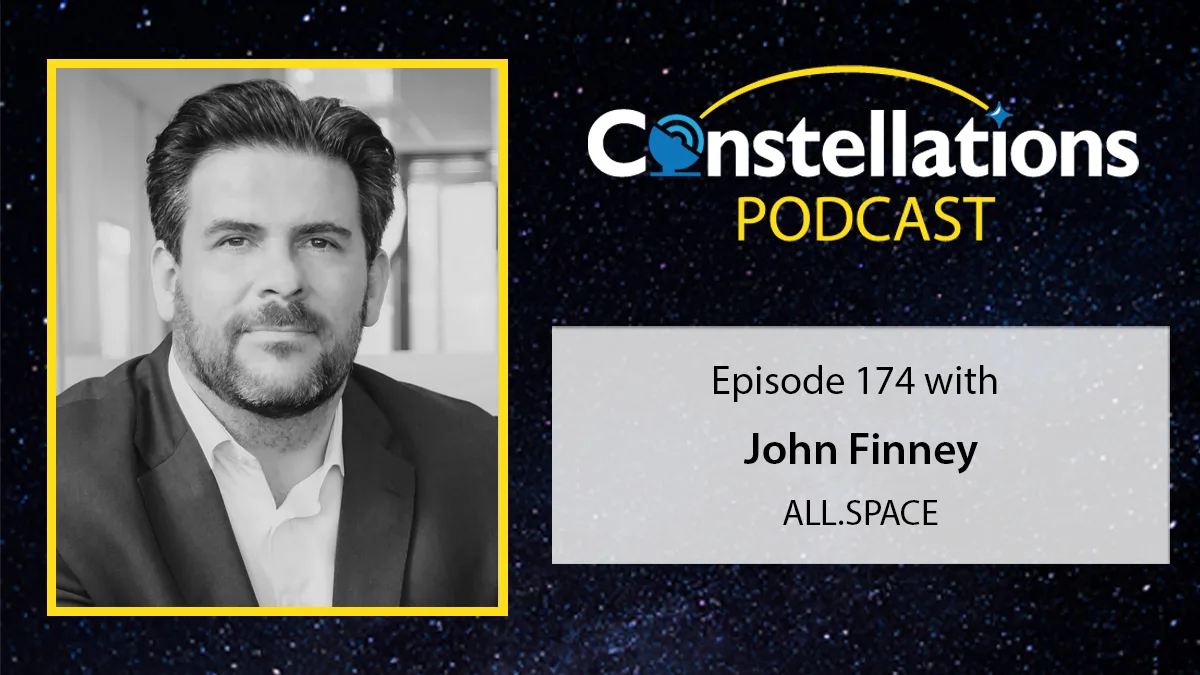
John Gilroy: Welcome to Constellations, the podcast from Kratos. My name is John Gilroy and I will be your moderator. Our guest today is John Finney, CEO and Founder of ALL.SPACE. In the history of space, satellite terminal designs have expanded and changed with the needs of end use cases and at the mercy of demanding applications, but not more than in the past 10 years. Today, we will be talking about changes, driving satellite terminals to become smart terminals. Satellite terminals were traditionally designed for a single mission, a single orbit. During today’s podcast, we’ll discuss how advancements in terminal technology are providing faster and more flexible operations on the ground, and how a smart terminal can leverage artificial intelligence and machine learning to increase resiliency. Please welcome John Finney, CEO and Founder of ALL.SPACE to explain the details on this dramatic satellite terminal transformation. Whoo, all kinds of things change here, John. I guess there’s no secret that the way we do things in space and on the ground for different applications like Earth observation and Satcom is changing. Needs are changing, demand’s changing. Everything’s in a state of chaos. So what are the changes driving antenna innovations on the ground?
John Finney: Yeah, so let’s break it down to what’s really happening with traditional antennas in this new multi-orbit world. When you hear multi-orbit solution from the market, which is particularly parabolic antennas and phased arrays, what they really mean for the legacy platforms is juggling multiple antennas or a single antenna with single connections that are desperately trying to switch orbits. But here’s the catch. When they switch, it’s like dropping the ball. Frames and packets, mission-critical data. They simply get lost, connections break, and sometimes the backup satellite that they’re hoping to connect with isn’t even in the picture. It’s blocked. Imagine being in the thick of it in defense, and suddenly in those critical moments that matter, your encrypted link goes down because the antenna couldn’t handle the switch smoothly. That’s not just inconvenient, it’s a potential mission compromise. And we take that very, very seriously here at ALL.SPACE.
John Finney: So this is where we stand out. We’re not about playing catch up with the orbits. We’re about keeping you ahead with simultaneous full performance links. Yes, you heard that, right. That’s simultaneous, concurrent full performance, independent full aperture links, no compromises, no patches, no fixes. Full aperture performance, simultaneously connected to multiple networks in multiple orbits at the same time. And so whilst the legacy platforms are picking up the pieces from drop connections, we’re holding steady, we’re maintaining multiple connections across different orbits without missing a beat. Just last week, we put our technology proudly to the test with a major NATO customer. So, picture this. Rough seas a motion profile hitting Sea State 8, and our system, it didn’t just hold up, it excelled. We were keeping a solid grip on both MEO satellites and GEO alike without dropping a single packet. Despite that motion of Sea State 8 and doing so through handover, performing make before break, handovers whilst simultaneously connected to another satellite. That’s the kind of reliability and performance we’re talking about, it’s game-changing, it’s mission-securing, and it’s proven in action across every single orbit.
John Gilroy: In the introduction, I use the word “Resiliency,” and that kind of summarizes your remarks here. I mean, resiliency is so important for a lot of organizations, especially in the military, of course. So John, my question is what are the key technology differences between a traditional terminal and a smart terminal? Is this whole packet loss? Is that what it is?
John Finney: Yeah, I mean, if you put together everything I just said before, it means that the game’s changing fast, right? With the advent of HEO, MEO and LEO constellations, there’s basically this massive push for connectivity that can keep up with the pace of operations, especially operations that are going to face a highly contested environment, particularly in defense. We’re moving away from those one-way conversations of single-link traditional dish and phased array systems, and we’re placing ourselves at the center of a multi-orbit enablement. We’re orchestrating simultaneous connections from the edge of the network, ensuring your overall data has the highest utility no matter what the network conditions we’re effectively conducting the orchestra, so to speak. We have the technology now to seamlessly move data between satellites, ensuring mission success even in the thick of the action. So if you look back, traditional systems were like old-school landlines. They were reliable in a fixed spot, but not really practical for on the move, given that the platform and the satellites are now moving if we’re thinking about Constellations. So now imagine having a multi-dimensional communication tool that’s our smart terminal platform. It’s not just about talking to more satellites. It’s about smarter conversations. It’s ensuring every piece of data finds the best path. We’re dodging the interference and we’re slipping past any blockages. It’s basically a leap now into a future where communication adapts on the fly, keeping our forces connected, keeping them informed, and one step ahead at all times.
John Gilroy: John, if you look at the last 10 to 15 years, it seems like most electronics are getting smaller and better, but I guess that was the way of smartphones for a while, and all of a sudden they’re nearly a size of an iPad again. So the demand for mobile communications seems to center around this smaller is better thing again, but there’s always a task of getting maximum performance, and power utilization as well. So how does space, weight and power play into the design of smart terminals?
John Finney: Yeah, space, weight and power is definitely a very, very important factor in any antenna design when you’re in the field. For our customers, every inch and every pound matters, our smart terminals are designed to punch above their weight. We’ve made these terminals compact enough to fit into the tightest of spaces, particularly for military platforms, and yet robust enough, since our terminals are designed to meet the mil standard to handle multiple data streams like a pro, it really is about giving our forces the agility to move fast and set up anywhere. So what we’re trying to do here with our platform is offer an enabling capability that basically turns any spot where the customer is on the pause, into a command center that’s on the move within minutes. And what we’re learning, especially in the wake of the lessons learned from Ukraine, is that flexibility is crucial, whether it’s a quick pivot in strategy, or setting up communications on a remote outpost. What the U.S. defense, it’s a stated space force-published policy, but it’s really being echoed and followed by the whole of NATO. What they want is a fluid meshed network architecture. So that means if a satellite is taken out, if a link is jammed, if there’s a blockage in the way, if you’re on the pause and you need to get on the move, you need to have simultaneous comms from platform-to- platform, platform-to-node without any restriction. And that’s basically what we’ve been able to accomplish with our smart terminal range.
John Gilroy: John, in about a month we’ll both be at the SATELLITE show in Washington D.C. and let’s say you’re at the booth, you meet someone, you get introduced somehow or whatever. And so if you just had to give them in a nutshell, one, two, three, what are the main benefits here of a smart terminal? Just bang, bang, bang.
John Finney: Yeah, so if I met that customer in the elevator, so to speak, I’d say very simply… Let’s talk about the customer and what they’re really trying to do. That means placing ourselves into what does it look like when the customer is really in the heat of operations, where every second counts. Our smart terminals are like having an ace up your sleeve. We are ensuring that no matter where you are, your communications are clear, they’re secure, and they’re uninterrupted. They’re the backbone of modern command and control. We are giving the capability to enable decisions based on real-time intelligence. It’s not just about keeping the links open, it’s about making those links unbreakable, and ensuring that every piece of critical data is delivered without fail.
John Gilroy: Now, I’m sure at the trade show coming up, an important phrase is going to be at the edge because in Washington D.C. everyone’s talking about at the edge. So let’s talk about the edge. Where and how does compute happen? Is it all tucked away inside the antenna or is there some form of compute outside the antenna?
John Finney: It happens wherever the customer and we are really focused on defense right now. Wherever the customer feels, they get the highest utility of compute. So we are at the edge in terms of where our technology will be deployed across thousands of platforms in the battlefield, land, sea and air. So we have integrated a range of Edge compute options. We also fully believe in mission agility so if a customer comes along with a specific requirement for a specific type of Edge compute node, we’ve built an architecture that allows us to slot those in a little like SIMs into phones. We’ve done the same approach with modems, same approach with layer two, three switch routing, and we’ll also host some of our own operational software capabilities on those Edge compute nodes ourselves, as and when the customer wants to select them. The question becomes is what are the compute functions that you are trying to orchestrate at the edge of the network? Some of our customers, for example, are using the Edge compute node to host top-secret containerized software that gives them the ability, for example, to host metadata that gives secure and privileged access to their cloud services. Other customers are using the Edge compute to take advantage of our operational software capabilities. Things like multi-orbit position, navigation, and timing, meaning it’s unjammable and unbreakable. That’s what multi-orbit PNT will bring, and that’s something that we’re pioneering as one example of a software capability. In some cases, the data that we are able to access is incredibly valuable, and will be passed back into the core network, and that will either drive the possibilities and the implementation of lots of software capabilities that we’ve stacked into the terminal, or it will just be information that they use to process as a means of gathering intelligence as to what’s happening in the battlefield. So you’re really only limited by your imagination as to what you can do with Edge compute. When you combine it with multi-link, multi-orbit connectivity. You can also shift your compute. In other words, if for example, you’re trying to optimize the performance of the link, you can, in real time, selectively choose to have some of the compute functions happen locally rather than in the core of the network to free up more of the bandwidth for mission-critical data. What we’re going to do as a company is continue to push the boundaries of the policy enforcement, not just at the traffic or the link level, but also how you think about managing your compute resources, both in the cloud or in the core of the network and on the Edge, integrated into our terminal.
John Gilroy: You just said the highest utility of compute, and if you see what’s going on in the market today and what’s trending, this flexible compute usually can be combined with machine learning and artificial intelligence. So what are some of the ways that a smart terminal can generate and leverage this information for end users?
John Finney: Well, when we say smart terminal, to be clear, we are only talking about ALL.SPACE. We are the only ones today that have that capability for simultaneous full performance, concurrent connections across all orbits field- proven and demonstrated time and time again to NATO customers. What I will say, without giving too much away, because we’re a private company, we don’t believe in telegraphing to the competition, but when you have that unique capability, links, or beams as we call them, their first utility, of course is passing communications data traffic. But the second utility can be to ingest lots of RF data to act as sensors, and be aware of what is available, what is not available, what is happening, what type of interference environment we’re in, and do really, really sophisticated things that can be processed either locally, in real time, because our platform is essentially an Edge orchestration device or it can be processed in the core of the network. And you’re absolutely right, AI and neural networks is definitely a key part of our thinking, but we’ll announce more about that when the time is right.
John Gilroy: You mentioned ingesting RF data, kind of a sophisticated approach there. So this is advanced technology. So how can this advanced technology help the military on the ground?
John Finney: So the way I like to explain this is in terms of the status quo for the industry. If you go to Target or CVS, and at the moment you get to the point of sale, you’re at the cash register, and it just so happens that at that moment, which is the critical moment that matters for an enterprise, the point of sale just so happens that at that moment their primary connection were to fail, I guarantee you that you’ll still make that transaction using your chip and pin, using your credit card, because it’s simply failing over to a second connection with a second network provider. Here, lives are at stake. We know from Ukraine that both Russia and Ukraine have been extremely effective in collapsing the time period between identifying a target in the battlefield, particularly command posts, weighing that potential target up against others, going through the decision-making process, selecting from a range of assets, whether it be they cyber or certain types of weapons, implementing the command to strike, and striking within the space of 30 minutes to an hour. Whereas conversely, we are seeing command posts in the U.S. and across NATO that are effectively tented cities that are in the cross tears at this point in time, and not really suitable for the modern battlefield. So there needs to be a requirement for agility. There needs to be the requirement for terminals to operate on the move offering simultaneous connections, platform-to-platform, platform-to-node, platform-to-regional-node, ally-to-ally, so that we can have allies operating as a single enterprise whilst also having their own connections back to their own core network. So that agility on the move is really what we are pioneering now, right? Is that it gives up that capability and in doing so, what we’re offering is a level of resilience for that data. That means in the critical moments that matter, that means it isn’t going to plan. There is a scramble, whether it’s to move your command post quickly, or it’s to medevac an injured soldier out of a particular environment, or whether it’s to call in additional support, whatever that be at that precise moment. The very, very last thing you need is your communications to come down. And I am the only CEO and founder in our segment that has served in military special forces and intelligence community comms. So it’s no surprise that the terminal that we have developed here is designed with a fantastic group of highly- talented individuals within the company that all think and feel the same way about making sure that our technology is both physically resilient, and network resilient so that when those moments happen, as they unfortunately do, we will not be letting the side down. We will not be worrying about a tree in the way of a single link. We will not be worrying about moving low latency traffic between satellites and handover. We will make sure that whatever needs to be passed is passed in the heat of battle and to do that, you’ve got to have that resilience in the critical moments that matter. That’s the new way forward for our industry because it’s not simply about us. We are coming in at the same time as all of these new satellites are coming to bear with fantastic capabilities. Edge compute on board, look at the SESM power constellations. It’s fantastic in terms of the number of individual links that it can generate. Inmarsat GX7, 8, and 9, the new HEO network that’s going up in their partnership with Space Norway. The Viasat systems, the Telesat Lightspeed, the Amazon Kuiper, and the European Iris constellation. Wouldn’t you want to access any of that that you need from wherever you are, whenever you want it, without having to think about the risk of the data not being either secure or becoming interrupted? That’s what our warfighters deserve. That’s what we’re delivering.
John Gilroy: John, you brought up Target and CVS so let’s maybe focus our beam on some commercial areas here. So, give me an example. What are some commercial use cases or applications where smart terminals can make the biggest difference?
John Finney: So, the reference to smart terminal really means us. What it means to us is satellite, multi-orbit, artificial intelligence, real-time terminal. That’s what a smart terminal means in the way that we use it. Of course, there are many commercial applications that are really eager to see our technology. I mean, a simple one is commercial aviation. What does the passenger really need? And we’re all experts in this subject, right? We all know what we want when we get on board.
John Finney: We absolutely want the best of live TV combined with the highest speed data in a bring-your-own-device world. Well, if you think about the economics of delivering broadcast live TV, it certainly isn’t the high-speed data connections that you get from MEO and LEO systems. It will always be GEO because you’re distributing that broadcast system over a couple of continents to all aircraft, and it’s a great utility for GEO satellites in terms of broadcast signals. And then if you want the higher speed data, well, we’re now in a constellation era, and that’s where you will often secure the highest throughputs per passenger. They’re two different orbits. Now having two antennas on board an aircraft under a single radome, it has a tax, and that tax is in fuel drag caused by the additional weight of the antenna and the additional cost.
John Finney: So, right now, there are a number of the major integrators in Aero that we are engaged with. Right now, however, we know that we have a strategic capability and we are very much considering to keep our technology in the lane of defense. I think that is a most likely the outcome for our company. There’s a reason why, for example, you can’t buy an L3 Harris antenna and put that onto a yacht. The same with GD, and the same with Raytheon, and the same with Cubic. So we’re at that point now where we’re seeing so much traction from NATO forces that want this new level of resilience, seeing the impact of what’s happening in the modern battlefield through the lens of Ukraine and obviously the world is changing around us. At this stage, we believe that we’re really likely to stay as a defense contractor. And so I can’t say to you with certainty that we will actually deliver our products to commercial markets in the future. We never say never, we’re having those discussions. We’re certainly looking at the possibilities, but we want to make sure that we retain the strategic value for the U.S. and NATO allies.
John Gilroy: John Finney, I think the military, of course, are interested in security, but commercial companies are interested in security as well. So how does a smart terminal support a more secure communications network?
John Finney: Yeah, I mean, I think it’s broader than just the terminal. Once you have multiple paths, it means obviously if you are contested, or you are facing interference or you are under a cyber threat, you can simply move the traffic across to another connection without that connection breaking. The nature of constellations and spot beams themselves is that you have to be inside that beam in order to jam it, which is a major advantage compared to GEO. If the satellites themselves are moving, it creates another layer of complexity, and broadly speaking, a natural level of protection. What we are focusing on for defense is increasing the amount of instantaneous bandwidth so that we can make sure that we can operate on the tactical protective waveform inside small footprint spot beams, and that the customers can basically frequency hop within a wide instantaneous bandwidth within each of the links, in order to offer the highest level of security for their traffic.
John Gilroy: John, I opened up this interview by referring to 1975. Well, let’s flip it. Let’s look into the future. So let’s just jump five years into the future. How do you see smart terminals evolving?
John Finney: I think smart terminals will evolve to become as much about sensory capability as they will be about communication. It will be an environment that ingests and reads all of the RF environment that is within the field of view from the antenna. It will be a collection agent for anomalies. It will allow for mission planning before the Humvees even roll out into a battlefield, for example, knowing where they have the highest probability of success. We will see greater abilities to integrate preemptive blockage, to integrate multi-orbit position navigation and timing to be incredibly secure and resistant to jamming, but also to be able to move into operational capabilities that I can’t really talk about on this forum. But if you think about once you have an ability to censure RF environment, well, you can do sophisticated things if you have the right compute and software capabilities, as it relates to things that look very much like ISR. And so then it becomes a smart platform and ALL.SPACE starts to be more of the F-35 of antennas, frankly, right? We’re focusing on beam agility, the physical agility with the integration of many different third party hardware components at modem switching, Edge compute and more. And it’s really about offering our customers as much agility as to which networks they operate, how the traffic moves across the network, but know that they can take our technology anywhere, in any temperature, any terrain, any part of the world, and be able to pick up and access all of the satellite ecosystem that’s available to them without any restrictions. And so then it becomes much more than an antenna. It transcends being a terminal and starts to become a platform that sits at the edge of the network, but is central to their operations.
John Gilroy: Wow. Beam agility. That’s the first time I’ve heard that phrase, but maybe we’ll hear it a whole lot more in the future. John, I think you have given our listeners kind of a Hitchhiker’s Guide to Smart Terminals. I’d like to thank our guest, John Finney, CEO, and Founder of ALL.SPACE.
John Finney: Thank you.