Transcript:
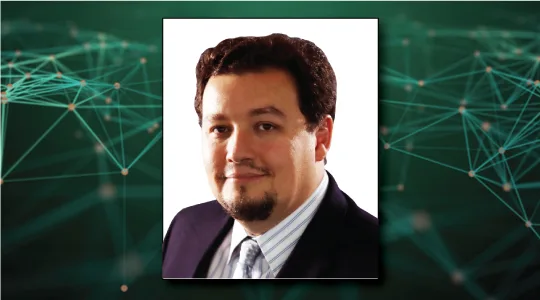
John Gilroy: Welcome to Constellations, the podcast from Kratos. My name is John Gilroy and I’ll be your moderator. Our guest today is Alexandre Vallet, Chief of the Space Services Department in the Radio Communication Bureau of the International Telecommunications Union, the ITU. Today, we’ll discuss the regulatory implications of the exponential growth in small satellites.
John Gilroy: More than 8,500 satellites are projected to be launched between 2019 and 2028, according to Euroconsult. With so much growth on the horizon, regulatory efforts will be challenged to keep pace. Many key questions will need to be answered. What role will regulatory efforts play in terms of protecting the spectrum, helping to avoid interference, and ensuring a level playing field for new and incoming players? With us today to shed some light on these topics is Alexandre Vallet, the Chief of the Space Services Department in the Radio Communication Bureau of the ITU. Alexandre will share his insights on the role of regulation and the rapidly growing and evolving new space world. Alexandre, how are you?
Alexandre Vallet: Very well. Thank you for the invitation.
John Gilroy: Good. You know, with so much rapid technological development in the satellite industry, how is that affecting the role and the pace of policy from the International Telecommunications Union?
Alexandre Vallet: Well, in fact, the ITU is quite well-positioned, because we have a quite unique way to manage international policy among the United Nation systems. We are one agency that has a way to manage treaties with frequent review of them. So we review our treaties, managing the radio spectrum, every four years, which allows us to keep pace with the technological development, noting as well that one of the requests from the companies that are innovating is also giving the stability in the regulation because if regulations change too often, then there is no way for them to use the innovation, to put their innovation on the market, and benefit from the innovation they have invented. So there is a subtle balance to find between the change in the treaties and the stability that are needed by the industry to be able to put in the market some innovation.
John Gilroy: So to use a sports analogy here, it’s kind of about a level playing field you try to achieve with this balance, is that right?
Alexandre Vallet: Yeah, absolutely.
John Gilroy: Good. Good. So what are the specific regulatory challenges posed by these mega constellations out there?
Alexandre Vallet: Well, in fact, the main principle that we rely upon, which is cooperation between member states to find solutions to share the same radio spectrum and orbit resources, will remain valid with mega constellations, however, there will be a big change in the field of the complexity of the interference computations. Our system is based on the idea that if you have a satellite project, whether a GSO or non-GSO, what you will do is that you will publish it in ITU, and you will coordinate, negotiate, with other projects to be sure that you don’t interfere with the operations of the other projects. Up to now, these negotiations were quite easy, technically, in the sense that it was mainly some C over I computations done in quite static environments. For example, two GSO networks, they are very static links.
Alexandre Vallet: Now, the big challenge is that with mega-constellations, you need to model these constellations, and you need to compute the statistics of interference produced by each other. So when the constellations are not so large, the required complexity is not a lot and it’s manageable. With the advent of really mega-constellations, then the complexity is going up and therefore the need for more accurate and more efficient way of computing interference is now also starting to appear.
John Gilroy: You know, it used to be you would manage thousands of constellations. Now you’ve got to manage potentially tens of thousands of constellations. You’ve got to wonder if the old model will still be able to expand to that different scale.
Alexandre Vallet: Well, first there is an important point, I think, to remind you that not all the projects that are on paper, or on the table, will eventually come to fruition and will be launched. So there is a lot of ideas proposed, but not all of them I think will ever be used. So the level or the number of satellites that are going to be operated is probably going to be smaller than the one that is actually discussed in the press or in the announcements from companies.
Alexandre Vallet: This being said, you’re right that the number of satellites that are ultimately going to be orbiting the Earth is going to significantly increase. But the main thing to remember is that the negotiations and the management of this interference are really between the operators, not so much between the satellites themselves. And the number of systems affected will not be so high. So in my view, the interference will remain manageable because the number of players that will operate such constellations will remain quite limited.
John Gilroy: That makes perfect sense to me. You know a popular word in this community is cubesats and small satellites, smallsats, very popular. Can they get to access the radio spectrum resources in a practical manner?
Alexandre Vallet: The answer is yes, provided that they accept to devote a little bit of time to reading the regulations how to get access to these resources and also provided they accept to plan a little bit in advance in this aspect of this project because I often meet with SMEs or universities that found that getting access to frequency resources is a long process. Then I ask them, “Okay, so when have you started your project?” And some universities say, “Oh, we have started five years ago, but we have not decided to ask for any frequencies until we have finished the building and the manufacturing of the satellite.”
Alexandre Vallet: The problem is that it’s a little bit too late to call to ask for frequencies when you have finished the construction of your satellite. You should do it a little bit before in your process, in your project, so that it’s one of the numerous aspects of the project you should manage. And in my personal view, my encouragement is that as soon as you start manufacturing a satellite, you should also start asking for frequencies. And then you have perfect time to get your frequency in time for your satellite to be launched.
John Gilroy: You know in the United States, the marketing people have this phrase, first mover advantage, and I think it may apply to your world as well. Is there some room available in the geostationary arc for new entrance?
Alexandre Vallet: Well, the first thing to remember is that, when you speak about GSO arcs, it’s important not to speak about it only in terms of orbital locations, but as a couple of orbital locations and frequencies available because, if you only look at one side of the coin, it may not look so nice. But if you look to the two dimensional aspect, frequency and orbital location, yes, definitely there are a few, of course, going in higher frequencies. C-band and Ku-band now are really much used. There is not a lot of room available yet in C and Ku. But if you go in higher frequencies, then yes, there are still some holes.
Alexandre Vallet: Another thought that is interesting to note and to see is that there is room, even in C and Ku bands, for some small GSOs. That is to say, if you try to find an optimal position on the GSO arc where you want use all the Ku-band spectrum, it’s probably going to be very difficult. But if you want to use part of the Ku-band spectrum over a certain, limited area, with a small GSO for example, then you will find a lot more opportunities.
Alexandre Vallet: And I have noted, for example, that there is some ideas of now doing small platform in GSOs that would not try to use so many transponders or frequencies as the traditional big GSOs, but will really focus on a specific market. And the advent of this new kind of GSO is interesting also because it fits very well with the remaining part of the spectrum and orbit resources that may end up being available in Ku and in C bands.
John Gilroy: You know, recently there was news in the last couple weeks about a possible collision that almost happened up in the sky. LEO orbit congestion can only be avoided or at least limited by end-of-life de-orbiting policy. And so what is the role of the ITU and can such a policy be enforced?
Alexandre Vallet: Well, strictly speaking, the ITU is not responsible for the aspect of the satellite end-of-life because this is purely a physical aspect of the satellite life, and the ITU deals with the use of frequencies by satellite. This being said, we have noticed that most people now are interested in the topic and agree that tighter rules are necessary. The enforcement of them is, in my view, mainly a national issue. And it’s probably up to each nation to start enforcing such rules.
Alexandre Vallet: Up to now, we have seen that there are a lot of discussions to find the right balance between the sustainability of the space environment and the economic burden on the space companies. But I hope that more conclusions will be drawn up in the next two years and we’ll start to see some national implementation on this aspect.
Alexandre Vallet: And you know, it’s not so much that we need a lot of countries to start enforcing such rules. If we start with two or three leading countries, then a lot of others will follow. And then it will be a virtuous cycle.
John Gilroy: That makes sense. Earlier in the interview we talked about a level playing field. So Alexandre, how can you insure equitable access to the radio spectrum with so many constellations out there? I see all kinds of press releases.
Alexandre Vallet: Yeah. Well, as I mentioned before, it’s important to distinguish between the press releases and the actual implementation. There will definitely be either consolidation or some projects not being able to be financed. This being said, how to ensure equitable access with constellations? The fact is that, contrary to the GSO satellites, which have a very specific interference environment, constellations also bring with them a lot of flexibility, in operational terms, because if you have many satellites in view, you can choose the one that is less interfering with your other constellations. You are not necessarily forced to choose the one that creates an interference problem. And that’s the kind of flexibility that we don’t have in GSO. And this is, in my view, the point that will makes possible for many constellations to coexist, is that the constellations share with them and their flexibilities.
John Gilroy: Well, I never thought of it from a flexibility perspective. But it makes sense, doesn’t it? You have options and choices there you may not have earlier.
Alexandre Vallet: Yes. The only thing is that you will have to accept to trade away some of these operational flexibility that maybe you wanted to design to maximize your cash flow. You will have to take a part of it to also share with others and coexist, but it’s probably the inevitable way to ensure coexistence.
John Gilroy: Yeah. Now, Alexandre, thousands of people from all over the world have listened to this podcast. If you’re listening now, go to Google and type in Constellations Podcast to get to our show notes page. Here, you can get transcripts of all of our 67 interviews. Also, you can sign up for free email notifications for future podcasts with well-known gentlemen like Alexandre, here. Another question for you. You’ve got a good perspective on this. What kind of trends do you see in the interference cases affecting satellite systems today?
Alexandre Vallet: Well, the good news is that we see less and less politically motivated interference cases. Definitely in the last five years, these cases have significantly decreased. The bad thing, I would say, is that we see more and more piracies. Piracies, in the sense that some companies or some earth station users monitor the empty parts of satellite payload and try to use them without buying them. This may be quite crude, simply you monitor and use them, but this may sometime involves a more subtle and elaborated way. For example, the piracies made by companies that can sell a capacity that they don’t own to people, for example SNG users, that legitimately pay and that believe that they own the right to use the capacity, that start to use it, and then the satellite operator discovers that this seems to be pirates, but when they contact them, they discover that they have paid something and that they were, of good faith, trying to use the satellite.
Alexandre Vallet: So the piracy can be also damaging. And this kind of appearance definitely needs a little bit more enforcement and more attention. This is a kind of a case that is linked, I would say, with transparent bent pipe satellites. You can’t do that with an HTS satellite because you cannot monitor what part on the spectrum is empty. Then the other trend that we noticed is the increase of terrestrial interference into satellite reception, mainly in the lower bands, in L band, or S band. With these, we have more and more cases.
John Gilroy: Well, earlier, we talked about LEO orbit congestion. Let’s talk about MEO here too. What do you think the impact of new satellite constellations such as LEOs and MEOs will have on an interference standpoint?
Alexandre Vallet: Well, I think it will completely redefine the nature of what we call acceptable interference. So we might have some small interference events in telecommunications, but up to now, if you operate in a GSO environment, GSO to GSO, your link is interfered or it’s not interfered. It’s very black and white. So either you are completely interfered or you are not.
Alexandre Vallet: With non-GSO systems, interference can be much more subtle in the sense that you are not going to be interfered with one hundred percent of the time for sure because the moving aspect of the satellites will make sure that this will be dynamic interference. Then, the question is what kind of metrics and what kind of criteria are to be used to define acceptable interference in terms of interference time, or the full length of the inferences. Maybe it is acceptable to be interfered with for 10 seconds every one month. Or maybe, for other systems it will be one second every one day, things like that. And to be honest, there is currently a lot of theoretical documentation on that, but I think with the advancements of real constellations in orbit, so we’ll see, with feedback from operational teams, that we’ll really be able to cross check with theoretical documents to determine what are really the acceptable interference in a LEO environment or MEO environment.
John Gilroy: Yeah. Let’s talk a little bit about the C-band spectrum now. Satellite and 5G are scoring off with available C-band spectrum with some conflicts. Knowing that a number of countries still run emergency services on C-band, how is the ITU trying to settle that dispute?
Alexandre Vallet: First of all, the world radio conferences have identified the lower part of C-band as a potential place for the growing 5G networks or mobile networks. And therefore, the answer is to start with this lower part of C-band before going up. Then, some countries need to use more mobile spectrum upward. And generally, these countries are also those that do not need so much satellite links. So what we do is that we emphasize the fact that it’s really a national decision based on national situation and needs. There’s not one size fits all. It really depends on how much spectrum you need for mobile, how much spectrum you need for satellite, and we believe that there is no reason why there is not enough spectrum for both kinds of usage.
John Gilroy: Wow, very optimistic. A trendy word here in the United States is the word hybrid. An hybrid networks will make it more difficult to distinguish space from terrestrial networks and associated providers. So what can be done to avoid massive interferences due to lack of coordination in this area?
Alexandre Vallet: Well, I think when we speak about hybrid networks it’s important to clearly distinguish between two aspects. Most of the hybrid networks that we see currently are of course combining terrestrial and satellite components, but they do that in different frequency bands. So the terrestrial part is in one frequency band, the satellite component is in another one. And as such, there is no interference coming up.
Alexandre Vallet: Then, there is a lot of interest into having hybrid networks where both the terrestrial and space components would use the same band. And for example, you have it in North America the ATC, in Europe, the CGC, the complementary ground component, that are starting to be deployed. Up to now, there is not a lot of deployment and therefore it is difficult yet to assess whether there will be an increase of interference or not.
Alexandre Vallet: In my personal view, as long as a hybrid network sharing the same frequency band has a kind of central control, the interference is manageable. If it really becomes operated by various providers in the same frequency band, then this may become more challenging, but it is currently not really foreseen in the next five to ten years because it will also imply to change the way you license spectrum in many countries. Because normally when you license spectrum in many countries, you license it for one user at a time.
John Gilroy: I see. Yeah. Well, we just talked about terrestrial networks. Let’s go to Mars. So how do you see spectrum management occurring on the Moon and Mars and beyond?
Alexandre Vallet: Well, very good questions. Currently, we already have some provisions, mainly those that are designed for space research, designed for all the space missions that the big space agencies are launching outside to the deep space to study the solar system or the galaxy. So we already have some spectrum allocated for that, but not so much, it’s true. We have also some provisions to protect the shielded zone of the moon. So we have specific provisions to maintain the shielded zone of the moon, radio interference free. And of course there is a network of space agencies, the Space Frequency Coordination Group, that ensures coordination between all the space missions.
Alexandre Vallet: Now, the big questions for the future is what about the spectrum for the commercial space exploration? If the plans for commercial space exploration become reality, then there will not be enough bandwidth within the currently allocated spectrum. So we will need to search for additional spectrum for these kinds of missions. And such work in fact is going to be done in ITU-R Study Group 7, which is one of the study groups that we have in ITU to deal with all scientific and research services. So this can be done. This is certainly going to be done based on the current foundation that we have. But yeah, probably maybe in the future, we’ll have radio regulations for the Moon and radio regulations for Mars, who knows.
John Gilroy: Wow, so Study Group 7 is going to be where it’s at in the next few years, huh?
Alexandre Vallet: Yes.
John Gilroy: That’s great. Alexandre, unfortunately, we are running out of time. I’d like to thank our guest, Alexandre Vallet, chief of the space services department in the Radio Communication Bureau of the International Telecommunications Union, the ITU.