Transcript:
John Gilroy: The views expressed in this podcast or on www.constellationspodcast.com, do not officially represent the views of the U.S. Military or the United States government. The appearance of U.S. Department of Defense, DoD visual information, does not imply or constitute DoD endorsement.
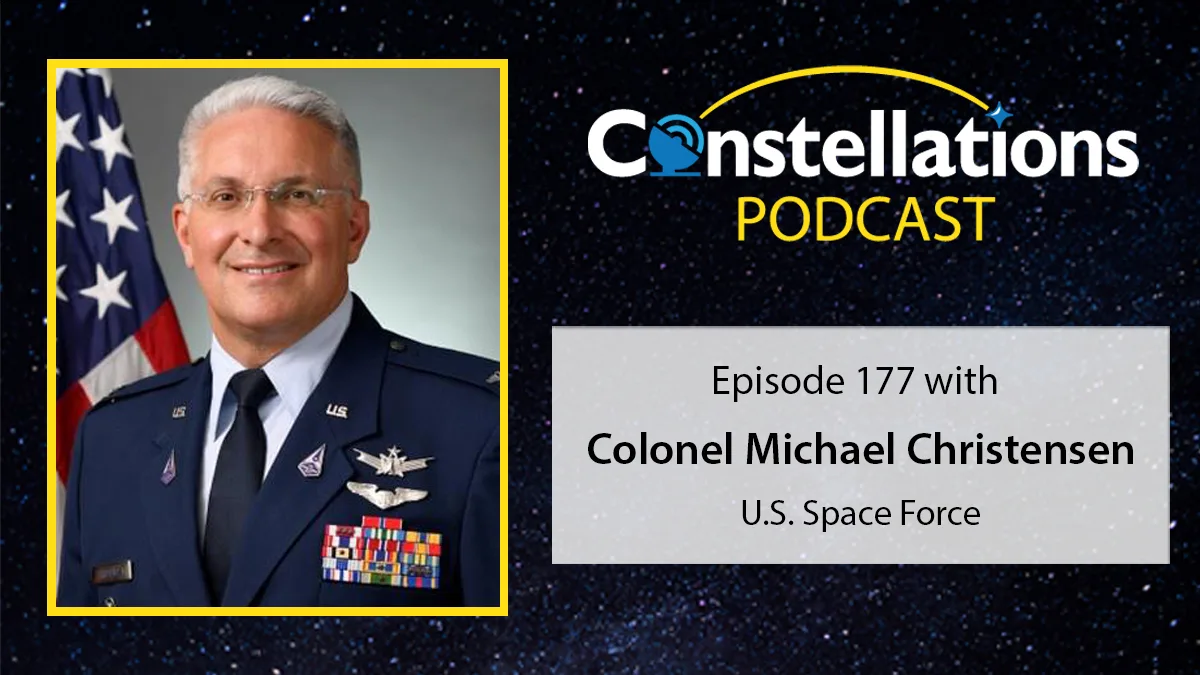
John Gilroy: Welcome to Constellations, the podcast from Kratos. My name is John Gilroy and I’ll be your moderator. Today, we’ll be talking about the U.S. Space Force Space Test enterprise. Our guest is Colonel Michael Christensen, who resides at the Pentagon. He is the director of test and evaluation for the U.S. Space Force. He reports directly to U.S. Space Force, Vice Chief of Space Operation, General Guetlein. Colonel, we’re just going to jump right in here. We are honored that you’re able to take time from your busy day to join this podcast. First of all, tell us a little bit about your role at the Space Force, please.
Colonel Christensen: Sure, John, thanks for having me on board here as one of your guests for Constellations. My job ultimately is when we go into battle or prepare for battle or work on deterrents and having space superiority is to make sure when we go employ these systems that we use, that they work, ultimately. So my job is to train, equip and make sure that the service has systems that are working as they expect. It’s once said in our history, we’ve heard, “Speak softly and carry a big stick,” is probably the best way for foreign policy. Well, we need to make sure our stick works and that it’s not incorrect, broken or something. Or if it is, we need to understand how and where it is and maybe we need to turn our stick a little bit, so when we have to make a schwack with it, it doesn’t break on us. So that’s really my job is to ensure that the Space Force’s assets that we employ and that people that we train on them work and that they’re understood completely.
John Gilroy: And the challenge is the asset isn’t sitting in Kansas. It’s in outer space. And so all kinds of complexity there isn’t there?
Colonel Christensen: Absolutely. It is very complex.
John Gilroy: General Raymond, the former and first U.S. Space Force Chief of Space Operations, he said that we must transform our historical approach to test. So what is the historical approach? And I guess how is testing currently being facilitated?
Colonel Christensen: Yeah, sure thing. The past test methods were based on a benign space environment. If you look back in the history, the early days of space, things just free-floated as they needed to. They followed Kepler’s laws and went around the earth and that was it. Nobody messed with them. We all, like our ancestors … Ancestors makes it sound like it’s that long ago, but it really wasn’t. But when Sputnik went up, our parents grandparents would tune in the radio and listen to the beeps and squeaks and nobody seemed to be too concerned. It was okay. So there was a precedent that we could have a flyover and free domain in space and this space has been proliferated. And now that our systems on Earth that we go to battle with rely so heavily on space, there’s an idea that’s evolving among the peers, the various superpowers to, hey, space is now a strategic environment that if we can go after those systems, we could alter the order of battle potentially and tilt the scales into our favor.
Colonel Christensen: I come from a flight test background when I used to test airplanes. One thing was to make sure when I tested the F-16, for instance, that I knew what its flight envelope was and I verified the flight envelope and took it to the point where that plane would no longer fly as it was designed to fly so that we could let those operators know, hey, these are the areas that are of concern. So we could change our tactics to make sure they work. Now with space, like I said, being contested very much like our air domain, land, and sea, we now have to take that same mindset to testing our space assets and confirm that can they have enough thrust to evade something? Do they have the ability to turn at a certain altitudes or certain timings and change orbits? We need to understand those and what are those limitations so that we can incorporate those in our tactics, procedures and techniques and train our operators so that they can use them when they only have a split second or a few minutes to make a decision. Of course, it’s space. Nothing happens really fast. But the point is to have the ability to understand their trade space and what they’re able to do and when it degrades our capability and when we can still maintain the capability in a contested environment.
John Gilroy: Colonel, testing is such a huge topic here. There’s a word that’s associated with it. It’s called integrated. So if I’m not mistaken, I’m pretty sure that the Space Force is looking to implement integrated testing service all through services. So what is meant by integrated testing and why is that important anyway?
Colonel Christensen: Yes, so the service recognized early on that integrated testing was important. And when we say integrated testing, first off, if you talk about it in a lot of historical platform or historical nature, integrated testing means developmental testing integrated with operational testing because you want to be able to test the system as it’s being developed to make sure that it meets the operational ends. We’re going that a step further. Not only are we integrating operational and developmental testing together, but we are actually making our operators part of our test teams. So we’ve created what you call an Integrated Test Force, ITF is the term we use in the Space Force, to where we take operators and we have trained testers, people of my similar background conducting and running these tests. And then we have acquirers, the people who have to go off and engage with the developers and the contractors and I guess have the contracting authorities, have them all come together so that we are now making sure that what we are testing meets the requirements that the operators have to provide because the services’ job is to provide trained capable operators to the joint force commanders to help win or deter through our joint forces. And so to ensure that we’re meeting those requirements of what, say space operations command, one of the field comms within the Space Force wants to train their operators for, we got to make sure that we are taking into account that training and those conditions that they need to meet in our systems so that we’re stressing those systems, so that we can understand how well those systems will perform. And if they can be fixed early, then we have the acquirers involved in that, part of this ITF, so they can go back and make contract changes, requirements, adds, little tweaks potentially, and the earlier, the cheaper it becomes as opposed to waiting until the system’s on orbit. We’re trying to do it integratedly so that by the time the system gets on orbit, it works and functions as everyone thought it should.
John Gilroy: Colonel, it’s one thing if you have a set environment like an academic environment, and this happens and this happens, but there’s so much new things going on. All kinds of new technologies coming in. In fact, the emergence of new capabilities and technologies seems to be a relevant factor in the Space Test enterprise. So what are these new capabilities and can you even talk about them?
Colonel Christensen: Yeah, so testing, obviously, you’re talking about some of your nation’s most exquisite things, right? And our job is to figure out a way to test things. And so that way, part of the tactical and strategic advantage is to kind of keep things quiet as much as you can. So we have to rely on technology to make sure that we can test the latest and greatest things that physics and science can bring us without necessarily revealing our hand. It’s like going to a poker game. You don’t want to play poker and have all your hands up there facing up, so all your players betting against you know exactly what you have. So we’ve got to keep the cards turned over. So to do that, we’re relying heavily on digital and we’re using a lot of modeling and simulation. And that’s where a lot of our things are taking place in this. We’re building up an infrastructure for testing, I’ll talk about a little later potentially, where we’re taking our on orbit assets and using those to inform our digital models so that we can ultimately test out and stress our systems in a digital environment before they’re even built. And that’s really the technology push that we’re going to because I’ve got to maintain a service, a fighting force that’s second to none, so that we are able to continue to protect our homeland and operate as we choose. But yet, maintain a deterrence capability. So it is a tight balance. So obviously not everything we can talk about. But for the most part, it’s really just trying to, how do I test the thing, make sure the stick works, going back to that analogy and what its weak points are without necessarily revealing it. So we’re relying heavily on physics-based modeling and simulation.
John Gilroy: Yeah. And you’re in a world where every day you show up for work, there’s new technologies out there. And so if you have 10, 15 new technologies, maybe the ones you can leverage are the ones you want to focus in on. So how can you leverage these new technologies to assess a system’s abilities and constraints?
Colonel Christensen: So we look at the requirements of what we need. We try to project out where we’re going. But then we take those requirements to our commercial base and we ask them, what do you have? What’s there? And then we also go and use our labs to help develop things. I go back to case in point when we wanted to go to the moon, we’d never been to the moon before. And the engineers at NASA charted out a path of what they needed to go to the moon and realized, you know what? There are some things that we need to invent that we don’t know what they are yet to get us to the moon. And we’re in some of those stages here where it’s our job to we have an X in a plan here, and that we need to develop that. So we work heavily with the labs, the national labs, as well as the service labs to invent the technologies and the capabilities that we need that the commercial industry might not be ready to deliver at this point.
John Gilroy: When people who are listening to this, they hear “lab”, I imagine someone in a white coat physically testing something in a chamber or something, an air test or something because it gets realistic results. And so how can you get realistic results in a real challenging scenario like outer space? And can all this be accomplished through software?
Colonel Christensen: Yeah, the Space Force needs an agile capability to test and train its systems and its operators to be effective in conflict. The ideal synthetic training environment includes aggressor forces informed by intelligence personnel to perform as a thinking adversary and mission specific plugins, enabling operators to train like they’re going to fight. We also need operational test and training infrastructure, what we call OTTI, which is an umbrella term to describe the collection of distributed enterprise-wide test and training systems and processes to effectively integrate and synchronize to establish and sustain our combat readiness. So ultimately, OTTI includes the basic physical infrastructure as well as other structures, digital structures and organizational processes needed to be effective in a eventual conflict, or if there ever was a conflict, or they needed to push to test. But yeah, all this comes together under OTTI and it’s multifaceted, so it is complex.
John Gilroy: So Colonel, it does sound very complex, OTTI. Is there something maybe that the commercial industry can help with?
Colonel Christensen: Collaboration with mission partners is essential to accomplish the Space Force’s critical set of roles and functions. In terms of what they can do, they continue to be innovative. That’s really it. That’s one thing that we have to our advantage is the innovation that comes out of this country is phenomenal. The things I get to go see and be exposed to, it’s incredible. So I think we’re on a good path. We’re on a good course. There’s nothing more that the commercial industry can do at this point because they’re already doing it.
John Gilroy: Good, good. Earlier, we talked about new technology. I’m going to talk about a new dimension. And you folks have a new dimension that’s rapidly evolving, which is the threat environment. So can you talk about this environment? Is this one reason why you’re looking to change your approach to testing?
Colonel Christensen: Yeah, you don’t have to turn on or go back too far, right? Turn on the television or read the local news and see what’s at stake with our current security environment. Threat’s real. It’s increasing in scope, scale complexity. Current simulators only verify if the system works properly. They do not test countering threats from an adversary like I mentioned earlier. We’ve got that old paradigm where things just free float. And it wasn’t until recent things. One of those examples is look at back how a lot of the cosmonauts and astronauts were put at risk at one point recently with a anti-satellite kill that happened from Russia causing debris. So you can see that there are demands from the environment. So the Space Force demands combat credible capabilities, proven and demonstrated, to protect and defend our way of life. And that depends on free access to space said by you in a release last year, actually, I believe.
John Gilroy: Colonel, I think the Space Force is associated with this organization called the National Space Test and Training Complex. Some people refer to it as the NSTTC. So is there shared responsibility here and who does share the responsibility?
Colonel Christensen: Yeah, so NSTTC is a subset of the OTTI that I talked about. The OTTI encompasses test and training completely. Where NSTTC, it’s a complex of all of our testing. So what we get from the lab results on orbit and whatnot, we streamline these and put these all together. But like I said, the threat’s real and it’s increasing in scope, scale, complexity. And again, our simulators only verify if a system works properly and we need to be able to do a test in a threat-contested environment. So the responsibility is on us to make sure that we are testing things to take them to their breaking points so that we understand them and can actively develop procedures and techniques that allow us to modify what we do to make sure that we maximize those systems.
John Gilroy: Colonel Christensen, I have a question now that I never would’ve asked before COVID. In fact, wouldn’t have asked in the last three or four years, but it’s kind of an appropriate question. So does the NSTTC have a physical location? Is that a modern question? It’s a modern question, isn’t it?
Colonel Christensen: It is. So I get asked that a lot. The NSTTC stands for National Space Test and Training Complex. And it comprises of our physical and virtual environments that come together through hardware in the loop testing simulators, chambers, and whatnot. And they’re all connected through various means. And so to answer your question poignantly, no, it’s not one location. It is a complex. It has multiple locations worldwide.
John Gilroy: Yeah, I mean post-COVID, I think commercial organizations, everyone gives that type of answer. I mean, it’s the most efficient way to handle things. So earlier I talked about the commercial industry. And so we’ll focus on these industry partners. Will they be able to help you with this complex, with the NSTTC?
Colonel Christensen: They do. Matter of fact, I reached out to one of your podcast fellows, Robbie Robertson, who works on digital modeling and simulation and I’m actually meeting with him a little later on. Didn’t know he existed until I was listening to your podcast, but we’re going to talk about some of this stuff. And he’s coming out of industry to help me understand what the state of the art is in terms of modeling and simulation to help inform what I do as a service in terms of our modeling and simulation capabilities. So like I said, industry is being creative. They’re out there looking at those hard problems as they are right now. And I think just being in touch with them through forms like this is really important. You only know what you know and getting in touch with the right people is incredible. And so kind of a quick thank you for having this podcast because I’m about to make some contacts I would not have had otherwise.
John Gilroy: Good, good, good. Colonel, anyone listening to this interview would say, they’re forward-thinking here. They’re not on the leading edge. They’re on the bleeding edge and pioneers get all the arrows. And with you leading these new initiatives here, you got to have some challenges. So what do you think are the real challenges to successfully implementing the Space Test Enterprise vision?
Colonel Christensen: Yeah, the department’s top priorities are, of course, defending the homeland, deterring strategic attacks against the U.S. allies and partners and deterring aggression and building a resilient defense ecosystem and joint force. So the biggest challenges that I have goes back to, I think the second question that you’d asked me was the shift in mindset. I’ve got a whole culture that we’ve spent decades just looking at, does the system work in space? And now I have to look at does the system work if it is in a contested environment, if it’s being looked at as a target or if it’s being threatened by any other means? How do I make this system reliable and resilient so that I can effectively operate on the ground using it as a force multiplier without it being taken out? And that’s really it. It’s the shift in thinking and buying into the whole integrated testing.
John Gilroy: Colonel Christensen, I think you have given our listeners a better idea of how the Space Force works and a detailed understanding of your Space Test Enterprise. I’d like to thank our guest, Colonel Christensen, director of test and evaluation for the United States Space Force.
Colonel Christensen: Thank you. Thanks so much for having me.