Transcript:
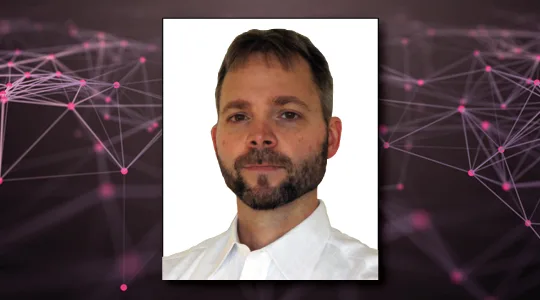
John Gilroy: Welcome to Constellations, the podcast from Kratos. My name is John Gilroy, and I’ll be your moderator. Our guest today is David Mitlyng, CEO of SQT. Now, what would a podcast about space and satellites be without a mention of physics? In today’s case, quantum physics as applied to satellite communication. Joining me today is David Mitlyng to provide some perspective. David is the CEO of SQT, a company that claims to transform the world’s networks for the quantum revolution.
John Gilroy: Mere mortals have a hard time grasping the concept of quantum physics. Perhaps we can start by asking David to explain some basics. Next, we’ll transition to how quantum communications works. What are the advantages of utilizing quantum communications versus the classical traditional RF or optical? SQT is one of only a handful of companies that specializes in quantum technology in the space industry.
John Gilroy: Well, Dave, I went to LinkedIn, looked at your background. You’ve been in the quantum area here for a little while now. Could you tell me a bit about your history and what made you decide to work with this fascinating technology?
David Mitlyng: Yeah, no, and thank you, John. I appreciate the chance to talk to your audience about the magical world of quantum communications. It’s a new and emerging technology that’s probably new to some of your listeners, but I think it’ll be something that will be more mainstream and widespread within the next few years. Yeah, my background, I started out in the space industry. I worked a couple of decades for major satellite manufacturers.
David Mitlyng: In 2015, I made the jump to an optical communications startup called BridgeCom. It was, while I was there at BridgeCom, I was going to these free- space optical communication conferences, that I first learned about quantum communications. At the time, it was kind of treated as a subset of optical communications, kind of a niche thing, but it was fascinating because I looked at that and started doing more research, talked to colleagues that were working on these advancements, and started to realize that there were some very interesting real-world applications, particularly around secure communications that quantum communications solved.
David Mitlyng: So, I had the opportunity a couple of years ago, a colleague of mine from SES was kicking off a startup and asked me to join. So, we got funding in 2019 for two startups, actually, SpeQtral, which is a Singapore-based startup, and my company SQT, which is US-based. And from there, it’s been a fun and interesting ride. SpeQtral launched their quantum communication satellite last year. It was a 3U CubeSat called SpooQy-1. And now we’ve separated a bit as a company. We’re a bit focused on different markets and different applications. But yeah, it’s been a great opportunity, and things are going very well.
John Gilroy: Yeah. The way to remember it, SQT, the Q stands for quantum. That’s how to remember that one. That’s good.
David Mitlyng: I think that’s a rule. Any quantum startup has to have a Q in there somewhere.
John Gilroy: Yeah, it’s mandatory. It’s written somewhere. I don’t know where, but it’s written down somewhere. To jump into this concept of quantum communications, I guess from my academic background, I try to put into the topic of quantum physics, I guess, and would imply that. But for me, it’s a hard concept to understand there is a great pop cultural reference to quantum mechanics, believe it or not, and this reference is to the Weeping Angels monsters from the TV show, Dr. Who. And they use a quantum lock defense mechanism as they turn into stone once a living creature observes them. So, can you give us maybe a quick dummies explanation of quantum mechanics and why certain quantum particles go where they go?
David Mitlyng: No, I could try. Quantum mechanics is hard. Everybody who’s gone through the introductory level of quantum physics understands it’s difficult because it’s not intuitive to how we understand the world around us. The process that you just mentioned, this idea of measurement and observation, wave function collapse, and around superposition, it’s just very odd compared to the way we look at classical physics.
David Mitlyng: The example I use is a baseball. If you take a baseball and you throw it 92 miles an hour, not only are you going to be drafted by the Major Leagues but also, the baseball travels 92 miles per hour whether you measure or observe it or not. That’s the foundation of classical physics. But at the quantum level, at the small particle level, it behaves differently. This was first realized over 100 years ago when these original brilliant physicists realized that an electron orbiting a nucleus, they didn’t have the equipment to look at it and tell what’s going on there. They originally looked at it as the same way we look at a satellite orbiting the earth, but in reality, after doing some calculations and some serious math and observations, they realized that it’s actually not in this defined position in orbit. It’s actually in a cloud of positions, a superposition, and that when you observe it, you measure it or you interact with it, it then collapses into a single position. It’s mind-blowing now, but it was mind-blowing then. That is one of the fundamental properties of the quantum realm versus classical physics.
David Mitlyng: I didn’t want to take up the whole podcast. We could try to get into the details and weeds of all these different quantum properties like superposition and wave function, and entanglement, and all these interesting quantum properties. I think the important thing is here that what was once oddities that spawned papers a 100 ago has now fueled what we call the second quantum revolution. The theories have been turned into papers, that have turned into experiments, that have turned into very practical applications and systems. And now these quantum properties are being utilized for a wide range of new technologies, things like lasers and semiconductors, and quantum tunneling. We’re now harnessing them in what we’re calling the second quantum revolution.
John Gilroy: Good. Dave, I’m going to try to maybe slice and dice this further so we can maybe pivot over to space here. So, an argument can be made, I think there may be three branches here that I’m thinking of quantum technology, there’s quantum communications, quantum computing, and maybe quantum metrology. So, which one of these general fields apply to space, and how does that happen?
David Mitlyng: Quantum communications. So, I’m glad you brought that point up because we are confused a lot for a quantum computing company. If there’s one, again, major takeaway from this podcast is, no, we are not a quantum computing company. Quantum technologies, like I said, the second quantum revolution has spawned those three main pillars you just said. Quantum computing is the most famous. Fundamentally, you are harnessing entanglement, entanglement of stationary particles to create cubits, and then these cubits that are used for information processing and doing some new and interesting things similar to a computer.
David Mitlyng: Quantum communications is fundamentally different because we deal with entangled photons. Photons are particles of light, and because they are particles of light, they travel at the speed of light. So, they’re what we like to call flying cubits. Photons are kind of the foundation of pretty much all long-distance communications, whether it’s RF or optical communications or whatever. Now, we just have a design and system where we are manipulating the quantum properties of these individual photons, rather than taking large quantities of photons and modulating them to transmit your bits and bytes.
David Mitlyng: And now the third leg that you mentioned was quantum metrology. That’s also a super interesting field. There are actually some space-based applications for that. But that includes things like just quantum sensors, atomic clocks, measurement devices. So, just a different type of quantum technology has different applications altogether. And like I said, my company is focused on quantum communications.
John Gilroy: Years ago, David, when I was studying cybersecurity, I learned acronyms like PKI and AES, and all of a sudden, doing research for this and I hear of something called QKD. So, let’s dive further into this quantum communications. What is quantum key distribution, and how does it work and what benefits does have over the traditional ways?
David Mitlyng: Yeah. So, like I said, quantum communications is fundamentally what’s used for a wide range of applications. When you have entangled photons, there are some interesting things you can do, and one of those applications is the secure distribution of encryption keys, which is known as quantum key distribution, aka , QKD. It’s also called quantum cryptography. But to be clear, personally, I don’t like the term quantum cryptography because it suggests that this is a type of cryptography. It’s not. It’s really just a way to very securely send encryption keys.
David Mitlyng: The way this works, most QKD systems use entanglement, entangled photons. So, we have the hardware, the systems that can create these pairs of photons that are entangled, and through the magic of entanglement, they share the same information. So, I can measure one of those photons, say a satellite, I can measure one of those photons, and I can send the other one to the ground to you, John, and you measure yours. And because they’re entangled, they are the same. You measure yours, you know what mine is, and we can use that to create… It’s inherently random, so that’s why you can use that to create an inherently random string of bits that can be used for an encryption key. And then you and I, we both have the exact same set of encryption keys. You turn around and use those keys to encrypt our normal communications.
David Mitlyng: Now this is very valuable for secure communications because those photons are entangled, any photon that I send to you if it’s intercepted by an eavesdropper or somebody trying to spoof the signal, the entanglement is broken and we would both know that. And that’s the paradigm shift here. That’s what makes it so secure. There’s no other way you’re going to distribute encryption keys where you know where somebody has intercepted it. And now once we know we’ve done that check between us, we verified that there hasn’t been an eavesdropper, that our encryption keys are good, we have that level of comfort to use that to encrypt our communications and, therefore, get that level of security.
John Gilroy: So, that would eliminate the man-in-the-middle attack, wouldn’t it?
David Mitlyng: Yes. Yeah, absolutely. The way the encryption keys are distributed today, you mentioned PKI, that’s public key infrastructure. Right now, public key infrastructure relies on sending out these encryption keys via normal channels, but the man-in-the-middle can intercept them, and you just count on the fact that they can’t crack public key encryption. But that’s going to collapse pretty soon because quantum computers have the capability of cracking public key encryption.
John Gilroy: Yeah. And that’s what people are looking for down the road here. I want to go back in time. You talked about 100 years ago and all these physicists were making these profound statements. There’s a guy back there named Einstein. He just dismissed quantum entanglement as spooky action at a distance. Spooky. Now, I see there’s a satellite out there called SpooQy-1 CubeSat. I guess that’s a nod to this. And was Einstein wrong for just dismissing quantum entanglement?
David Mitlyng: It’s very interesting because this is a fairly famous flaw in Einstein because he was right on so many things. And I will make the argument that he was actually fundamentally right about entanglement. Entanglement actually came about as a thought experiment that Einstein and a couple of those scientists came up with, and it was really his way of not dismissing entanglement, but really arguing against some concepts of entanglement with this so-called idea that any particles that are entangled contain hidden information. We now know, I mean we’ve done many, many experiments to prove that entanglement exists, entanglement works, and that these entangled particles, no matter how far away they are from each other, share the same information, and that when you measure one, you know the other one instantaneously regardless of their distance.
David Mitlyng: Now, fundamentally, Einstein didn’t like that because that would seem to suggest that entanglement could be used for faster than light communications. If I had one set of my entangled photons here, and the other set were on Mars, there’s a lot of sci-fi ideas that, “Hey, we could use that just by measuring the things that we would know… We could instantaneously communicate between here and Mars.” But it doesn’t work that way. I mean, we’ve verified that the information is contained within those entangled particles, and even though they come to the same state instantaneously, they don’t transmit the information because we would still need speed of light information to get the understanding of what the other particles are doing.
David Mitlyng: So, entanglement is spooky. I mean, Einstein was right about that. It’s still one of those concepts that we all try to wrap our brain around. There are a few theories on what’s going on there. But definitely, John, someday when we’re all vaccinated and then get together, and for the price of a cup of coffee or a beer or something, we could wax about the philosophy behind entanglement and what that means. But again, I got to come back to the key point here, which is entanglement was once something that scientists argued over, they didn’t like it, but now it’s been proven with experiments, it’s been demonstrated in the lab. And now we have hardware, real practical hardware and systems, that can create these entangled particles, entangled photons, and move them, transmit them, receive them. It’s now at that point where it’s gone from research environment now to some very practical applications. And again, that is, really, the foundation of this second quantum revolution.
John Gilroy: I’ve researched this a little bit, and from my understanding, SQT focuses on the application of quantum clock synchronization, which can be used for position, navigation, and timing application. Am I getting close to understanding? Is that right?
David Mitlyng: Yeah, absolutely. Yeah. You’ve done your research. Yeah. I mentioned before QKD, quantum key distribution, as an application for quantum communications. There’s also this new application, it was invented by my co-founder, called, quantum clock synchronization. It’s essentially using those entangled photons for very secure and very accurate time transfer. It’s a method of synchronizing clocks over very long distances. So, I mentioned before, you can use those photons and send them, and you create that string of bits for encryption keys. Well, this is just a different application for it where you still get that security that comes from the entanglement, but you’re leveraging that very tight time correlation that comes when these pairs of photons are created to allow you to synchronize your clocks at the sub-nanosecond, even potentially sub- picosecond level.
David Mitlyng: Yeah,. Now, you sit there and say, “Well, what’s the use of that?” Right? I mean, why do I really need our clocks synchronized that well? Right? I mean, for most of our daily applications, “Hey, if our clocks are together, a couple of seconds apart, big deal.” Well, it turns out that clocks and timing synchronization is very important for a wide range of applications, the most obvious which is position navigation and timing. Pretty much all clock synchronization comes from GPS, satellites, or signals from global positioning type systems. And the more accurate that you have the clocks between your GPS satellites and your receiver, the more accurate that you will know your position.
David Mitlyng: And on top of that, it’s secure because that’s also a concern with GPS-based systems that GPS or RF signals are effectively easy to jam. They’re easy to spoof. Foreign countries have been doing this for years. Anytime they roll in somewhere, they can spoof the GPS signal and make you think you’re 100 miles away from where you really are. It also turns out, too, that synchronized clocks and timing across networks is also very important for a range of other commercial applications, things like data fusion, telecommunication networks, financial transactions. They all require precision among the clocks in their networks, as well as the security, making sure those clocks are stable and don’t degrade and go down if something happens.
John Gilroy: David, I’m taking notes as we’re speaking, I write down position, navigation, and timing, I’m thinking about what’s going on on Mars right now. I mean, boy, that’s a good example of position, navigation, and timing. It all has to work to the nanosecond. I mean, that a good illustration of what we’re talking here.
David Mitlyng: That’s a great analogy. We just recently won a study phase contract with NASA, and that is actually one of the things that they’ve expressed interest in this technology. When you have a satellite going to Mars, going to the Moon, you got to ask yourself, “How do you synchronize the clock on that satellite? How do you synchronize the clock on the satellite going out to Mars?” Everything we count on, we just rely on GPS for our base timing system, but once you’re beyond the GPS orbits, yeah, you need something like quantum clock synchronization.
John Gilroy: Yeah, we interviewed Vint Cerf, he’s trying to do the internet to Mars, and the bits and bytes are nothing for him. This is really the problem of how do you do this at a tremendous distance? David, thousands of people from all over the world have listened to this podcast. Go to Google and type in Constellations Podcast to get to our show notes page. Here, you can get transcripts for all 90 plus interviews. Also, you can sign up for free email notifications for future podcasts.
John Gilroy: I want to jump back to a paper you wrote for Accenture. There also seems to be an irony, when it states in the paper, that quantum computing is developing rapidly and poses one of the biggest threats to secure communications. Can you expand on that a little bit?
David Mitlyng: Yeah. No, this is actually a fairly well-known problem with the existing way we distribute encryption keys, public key infrastructure, PKI. PKI, it’s fairly robust today. It was invented in the ’70s. It works because classical computers can’t crack public keys, but quantum computers, there was… Shor’s algorithm, which was a paper written in 1994, described how quantum computers, once they reach a certain capability, 4,000 cubits or so, they can easily crack existing public key infrastructure. So, that’s the impetus for a lot of this research and development into QKD systems. QKD systems are future proof. I mean, because you’re relying on the laws of quantum physics, you can set up a QKD system to distribute encryption keys and, basically, protect your network against the ability of quantum computers to crack public key encryption.
David Mitlyng: So, that’s why you get these fancy taglines, these mottos, saying, “Hey, transforming the world of network for the quantum future,” kind of thing. It’s basically, hey, look, you got to get your network, you got to upgrade that part of your network now, before quantum computers reach that point where they can crack the existing infrastructure.
John Gilroy: The language in the street is that those fellows over the Pentagon with their feet up smoking cigars thinking they got encryption, well, it could be two or three years from now that encryption is going to be beaten. Isn’t it?
David Mitlyng: Well, the guys at the Pentagon, they have some pretty hardcore encryption methods and some distribution methods. Even, I think, within the military, I mean, they use couriers some young private or whatever.
John Gilroy: Yeah.
David Mitlyng: Yeah. But yeah, you got to prepare, if you’re especially a commercial network. The government is already preparing for this, but it’s everybody else that’s starting to wake up to this threat.
John Gilroy: Your company, SQT, is only one of a handful of companies working with technology in this space arena. Who are the other folks working on this, and what are they up to?
David Mitlyng: Yeah. No, I mean, there’s actually been a ton of companies… I think the last couple of years, there’s been a number of startups that have spun out similar to us, other research labs in universities. Most of these companies are focused on the terrestrial fiber-based QKD. The major developments, actually, is a company called QuantumCTek in China. I’ll talk a little bit about this. But yeah, China is a leader in quantum communications, space and terrestrial. QuantumCTek, they just went on the IPO and the Shanghai stock exchange last year. It was a record breaking IPO in China. But there’s also a number of other companies. ID Quantique in Switzerland, Toshiba in Japan, Cubitech here in the United States.
David Mitlyng: Now, on the space side of things, there’s only a few companies. There’s ArQitin UK, SpeQtral, the company I mentioned before based in Singapore, QEYnet there in Canada. But again, there’s more startups coming out all the time because there’s an understanding that funding needs to occur within these different government initiatives to spawn this. The fundamental limitation with quantum communications over fiber is just you can’t repeat a quantum signal. So, the photon travels 100 kilometers or so across fiber, and then it needs to be repeated. But you can’t easily repeat a quantum signal, and if you do, you have to secure that node. So, space is really important if you want to get long distance QKD or QCS, quantum communications.
David Mitlyng: And like I mentioned, I mean, China is dominating in this field. They launched a space-based QKD demonstration satellite in 2016. They did a number of groundbreaking experiments. They’re releasing papers on it all time. And that project was so successful that the Chinese government has doubled, tripled, quadrupled down on this. They’re putting billions more into developing a global QKD network. They’re launching far more LEO satellite, GEO satellite, underground stations. They’ve already got extensive QKD fiber network in place in China. Everybody’s playing catch up to where China is today.
John Gilroy: Jump back here to the paper, the Accenture paper. It talks about the need to prepare our networks for a post-quantum world. What does this mean, and how do you see the technology growing within the next decade and beyond? And are we going to look at China as our opponent or partner in all this?
David Mitlyng: Well, that’s a problem with secure networks and secure communications. Right? Everybody’s a little bit leery about working with Chinese suppliers. Definitely a lot of companies or groups are embracing the lead that China has taken. But we’re all, and I say we, the United States, Europe, UK, Japan, Korea, we’re all playing catch up, and it’s showing with some funding initiatives coming out around quantum communications. In the United States, there was The Quantum Initiative Act. It was a $1.2 billion law that was signed in 2018, late 2018. It spawned the development in the United States of the Quantum Economic Development Consortium, a great group that is going out educating people and creating advocacy, building up the resources necessary to deploy these things. Chicago Quantum Exchange. I mean, there’s a number of very great developments going on in the United States, as well as other parts of the world.
David Mitlyng: And that’s been beneficial for my company, it’s been beneficial for all of us. When you got this new kind of technology and you’re trying to take it from the research lab out into the commercial world, this government funding and sponsorship is a big help to take it out and bridge that gap to make it a commercially viable system. For us, SQT, I mean, we’ve got a number of, what they call, SBIR contracts. That’s been great for us to build a bit of momentum. We’ve developed a commercialization plan, a fairly robust one that will get us to the point where we can start offering a quantum clock synchronization system and service with one satellite. And now we’re talking to you, we’re talking to the general public, talking and educating about telecommunication and financial institutions, other network providers on the value and importance of quantum communications.
David Mitlyng: And I think, again, it’s a great to be part of the Constellations Podcast because I want people to understand that where we are today with quantum communications is similar to where we were five, 10 years ago with optical communications. It’s a new technology, but it serves a very valuable purpose and can be used smartly with future satellite and terrestrial networks to provide a level of security that just doesn’t exist today. So, 10 years from now, I can tell you there’s a few pie in the sky things that you can do, applications we can do with quantum communications. QKD and QCS are starting points, but there’s this vision of entanglement distribution across a satellite constellation that will one day be the backbone for a quantum network. A quantum network is essentially using entanglement to network quantum computers. So, there’s some interesting things we could do in a couple years, within a year, but also within 10 years.
John Gilroy: Wow, that’s just an amazing discussion. Wow. Incredible. David, I think we’ve covered a wide range of topics today, everything from Dr. Einstein to Dr. Who. I’d like to thank our guests, David Mitlyng, CEO of SQT.