Transcript:
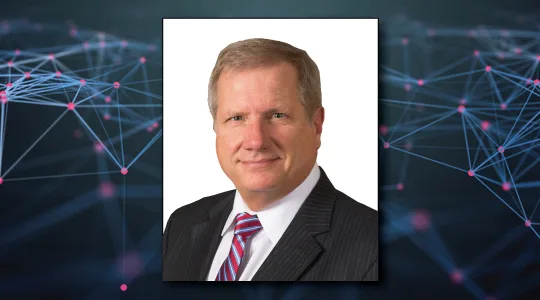
John Gilroy: Welcome to Constellations, the Kratos podcast. My name is John Gilroy, I’ll be your moderator today. Our guest today is Rick Lober, Vice President and General Manager, Defense and Intelligence Systems Division of Hughes Network Systems. Rick, how are you?
Rick Lober: I’m doing great, John. I’m happy to be here.
John Gilroy: I know a little bit about your background, but I think a lot of the audience here might not know, why don’t you give us just maybe a thirty second summary of what your background is?
Rick Lober: Yeah, I’m an electrical engineer by training and started out as a design engineer in mostly radio communication products and then moved up into project engineering, program management and then P&L management. At Hughes, my group takes the commercial technology that they make and then sells it to the DOD and other government users.
John Gilroy: Well, this is a very interesting place to be in space and time because the federal government is getting bombarded with requests to do more with less and you have some commercial solutions that may help them.
Rick Lober: Yeah, especially in the communications area. It’s rapidly evolving on the commercial side and the government needs to keep up. So commercial industry, most of it is working very closely with government to get commercial products that’ll bring costs down and capabilities up.
John Gilroy: Last time I spoke to you, you told me that your company motto was innovation delivered. That’s a pretty bold statement.
Rick Lober: Yeah, but it really goes to the core of Hughes. Hughes Network Systems has been around since the mid-70s, typical story starting in a garage in Rockville, Maryland. We invented a lot of what is V-set today or at least made it to producible in large format so we’ve got some very deep roots in satellite communications and have taken that now to bring satellite internet to consumers in unserved areas, enterprises you use every day, and government and defense applications.
John Gilroy: Well, good, Rick. You have some innovation there and supply really well in the commercial area, talk about the federal government here, so what is the industry doing to help agencies address issues of constrained resources and aging systems?
Rick Lober: A lot of things in the communications area, costs continue to come down and capacity continues to go up so we try to make sure that the government is seeing those type of products and those type of advances. With that, one of the larger components of government defense is personnel costs, so we try to improve network management systems such that we can have less people, say, in a room running a large network than what was done, say, 5, 10 years ago. Hughes, even though we are a satellite communications company, we also do a lot of terrestrial communications, so, smarter ways to get data over fiber and cable. A hot topic there right now it’s called SD-WAN, software definable wide area networks, that allow you to optimize things in a way which is much more efficient than, say, even five years ago.
John Gilroy: Yeah. I was on your twitter feed and I saw #SD-WAN this morning. Interesting. Let’s take a look at this commercial innovation applied maybe to the military, what role do you think commercial satcom will be in evolving new types of military missions and the increasing need for bandwidth?
Rick Lober: I think it’ll be a key role. We’re always going to have military satellites, they’re key, they’re very specialized, but if you look back 10 years ago at the height of the Iraq, Afghanistan war, about 80% of the bandwidth being used was from commercial companies. And that was done almost fairly urgently as the war built up, and I think the DOD probably paid a little bit more than it needed to on some of those short-term leases. Looking forward, we are working closely with the DOD to make commercial part of the answer as a plan to program, not something that is done after the fact. So I think you’ll see both.
John Gilroy: Is this where the hosted payload would fit in?
Rick Lober: Yeah, hosted payload. Hughes just did a hosted payload for coverage in Brazil, and we were able to turn that around very, very quickly, so we see the DOD being able to do the same type of thing, partial leases of satellites, possibly prelaunch type satellites. The DOD gets, say, a 20% share for capacity in certain parts of the world. Network interoperability is another thing the industry is working closely on to make sure various commercial networks will talk together along with DOD networks.
John Gilroy: I meet military people all the time, I go to events, and I bet you’ve heard this and I’ve heard this from people, they say that they can get better connectivity on commercial airlines right now than what you’re getting on some military planes. It sounds like an opportunity for Hughes.
Rick Lober: Yeah, that’s true. We are one of the first to do it on commercial airlines with Southwest Airlines and we’re continuing to expand that. We’d like to offer the military the same thing with a worldwide network and equipment that’s a little bit lower cost than what they’re using, but it’s important to keep—particularly troops in route to a mission—connected 24/7 because the situation may be very different when they land six or eight hours after they took off.
John Gilroy: I’ve heard all kinds of acronyms, my deal with the federal government and in information technology there’s an acronym called DR, disaster recovery, but I think the real DR is for hurricanes. I think that is where organizations and businesses like yours can help respond to real disasters with people getting flooded out of homes.
Rick Lober: Yeah, we have been. We’ve just shipped, I think, over 100 terminals to Puerto Rico for charitable relief; we’re working with FEMA and DHS in Puerto Rico, and satellite is a great technology for that because you can set up a relatively small earth station, if you will. It’s a one meter antenna and a small box that goes with it, and pick up right from the sky. Where cellular infrastructure takes a while to rebuild, even underground fiber and cable can get flooded out or dug up, so satellite is usually the first place you go for disaster recovery.
John Gilroy: Well, the first place I went when I heard about the Puerto Rico disaster, I went to Google trends and typed in satellites, and Puerto Rico is like the third search term found there, so there is a lot of association with disaster recovery and satellite, all kinds of innovation there. One innovation is high throughput satellites, HTS. How is the government and military taking advantage of new HTS services and bandwidth to support these missions?
Rick Lober: The government right now primarily uses a satellite they call WGS, wideband global satellite. They are looking at how they’re going to replace that in the future because satellites typically only last about 15 years. As part of that, they have done quite a few funded studies with the companies like Hughes, RT Logic, Intelsat, others, that make or support HTS satellites. So they’re taking a hard look at it. So we are seeing about a ten times capacity increase in these generations of HTS satellites.
John Gilroy: When I think of satellite technology, I think of a dish and a satellite and maybe more stationary, but in some military applications you have to be moving all the time, possibly on the water, ground, mountains, humans, individuals. So comms-on-the-move, that fits in with some of the products you have, doesn’t it?
Rick Lober: Yeah, comms-on-the-move is a lot of what we do, both ground and airborne. Airborne, usually it is getting data down to the ground, video-data, other data that might be collected for surveillance, vehicular can be right on the battlefield, so we are really trying to push communications to the forward edge. There is a little bit of a two-edged sword there, if you’ve been following on what’s going on with some of the large army systems in terms of trying to keep complexity at a minimum for these newer, more capable systems.
John Gilroy: When I sat down with you the last time, you talked about Hughes, and I wrote down another phrase, is innovation is doing the right thing for our customers, and so what you are trying to do is you are trying to listen to your customers and see what kind of successful commercial technology will apply in many different military situations, is that right?
Rick Lober: Right, smaller, lighter, lower costs. Military has a particularly tough task and burden in that often times soldiers are carrying this equipment into the field, so we tried to innovate with technologies that will allow for smaller equipment size, smaller antenna size, antennas become targets so you want those as small as possible. That is where some of the innovation that Hughes has generated over the years is being applied to the DOD.
John Gilroy: Up the road here in Arlington there is a trade association, there is about a thousand in Arlington, and it is for UAVs, and they talk about all kinds of innovations with bandwidth, resiliency, security, where does your company fit in with that product?
Rick Lober: Yeah. As I said, we started with some airborne communications in Southwest Airlines and then took that to large UAV manufacturers. General Atomics just selected us recently to upgrade their satellite communications on their UAVs, and we are going to bring them a product that is smaller, more efficient and lower costs. So it has been a good start.
John Gilroy: Earlier I mentioned wifi on a plane, now, if I’m sitting on a plane watching a movie on my phone, I’m absorbing a lot of data, however, a UAV is probably doing the opposite, it’s vacuuming a lot of data. You have two applications that seem like it’s just satellites, but this is two different types of communication, isn’t it?
Rick Lober: The architecture is flipped, which was a little bit problematic at first using commercial technology because we are primarily trying to get data into the plane, where a UAV you are trying to get data out. We have solved that. And commercially, we just demonstrated 50 megabits per second into the plane where in the past that was probably closer to ten UAVs. We are doing typically about 50 megabits per second out of the plane, which will give you HD video fairly easily.
John Gilroy: Well, we went down to Arlington, now we are going to go to downtown DC. There is a company that is based there, it’s called Measure. And drone is a service company and they work with architects and construction people and safety inspectors to inspect towers. And it looks like there is all kinds of new environments, new applications for UAVs, aren’t there?
Rick Lober: Yeah, quite a few. The larger UAVs that we are working with are used already for firefighting, they were just used in the California fires. They are used for agriculture, obviously, search and rescue. The smaller ones, you got Amazon talking about delivery by small drones, as the industry sometimes calls them, so I think you’re going to see a proliferation of commercial uses, particularly when the larger UAVs are allowed to fly in commercial airspace, which is coming soon.
John Gilroy: I’ve had a little silly topic about UAVs and watching movies in a plane, but there is some serious things going on with the military here and they can’t afford to have a system fail. I mean, if I am in a plane and I can’t see my movie, well, no big deal. But, if there is a military situation, they got to have a reliable solution. It’s got to be resilient, doesn’t it?
Rick Lober: Yeah, resiliency is pretty key because sometimes in a UAV, somebody may be giving a command to fire some type of a weapon so you don’t want to see a blank or a loss of video signal. We work hard to ensure that with some of our technology. And then resiliency in the bigger case is just making sure sat-com is there through a variety of means, whether it be military or commercial.
John Gilroy: When I went to your Twitter feed this morning I saw the #SD-WAN, I also saw the #resilience, so it must be something important, it must be part of the DNA in Hughes.
Rick Lober: Yeah, resilience is important, I think, for everybody. You get a lot of false impressions out there that maybe I have got two providers for my telecom service to my building, but they may be going over the same fiber cable that can be cut. Or you are the military and you are using a single satellite. So commercial industry, there are hundreds of satellites up there and with these low-earth constellations you are talking about maybe thousands of satellites in a constellation that gives you plenty of resiliency or choices.
John Gilroy: If you are technically adept to be able to switch off between satellites and between systems because of resilience that’s the tough part. So what developments are taking place in the arrow and mobility environment to deliver this conductivity on demand anywhere?
Rick Lober: Well, I think commercially, you are going to see just about every airline, every airplane out there having internet over satellite. They tried it from the ground, but that doesn’t work so well when you are over the ocean, there is no cell sites. So we are rolling out a new product for the commercial airlines that will give worldwide connectivity and we see that being able to be applied to the military also, so whether it is troops or leadership flying around, we can give them connectivity while they are in route to a mission.
John Gilroy: What about something as large as an aircraft carrier? I mean they are going to demand some higher-speed connectivity, and that is a flexible environment, isn’t it?
Rick Lober: Yeah, I think the aircraft carriers … You have about 5,000 people there, right now they are typically getting about 25 megabits per second into a carrier, which is about what we do into a home now for the consumer-
John Gilroy: That’s amazing. Think of that.
Rick Lober: It’s a little bit more challenging in the middle of the ocean, but I feel they are going to need a lot more, even just the maintenance of some of these new platforms and the software downloads and updates that you may want to do and the amount of bandwidth that will take in addition to everything else you are trying to do.
John Gilroy: Well, there are so many innovations in the area of satellites and new space and all kinds of things, so looking at maybe five years down the road, what kind of advancements do you see taking place in supporting the military and intelligence in the area of communications?
Rick Lober: Well, I think the LEO constellations are going to play an important role. LEO means low earth orbiting. You can actually see these things in the night sky, they look like moving stars. We are working with a company called One Web that is going to launch about 800 LEO satellites to serve unserved parts of the world and we see military application for those types of satellites due to the resiliency and the overall capacity of that type of network.
John Gilroy: I can remember when it was front-page news just one satellite, now you just tossed that word out there, “well, 800”. I mean think about that number, it seems common to you, but I’m sure if you just walked down the street and told someone, that is a big number. That is a difficult number to just coordinate and structure.
Rick Lober: Yeah. I mean they are setting up a manufacturing facility down in Florida and they expect to crank these out in a production line type environment, bringing the satellite simplicity down quite a bit for some of these LEO constellations.
John Gilroy: Do you folks have a facility where you manufacture products here in the Washington DC area?
Rick Lober: Yeah, we do and Washington is not the lowest-cost place to manufacture, but right here in Rockville we have a factory that does about 40,000 a month and all robotic assembly. It is fascinating to watch, very, very high frequency our electronics being manufactured at that rate. And that primarily drives our consumer business.
John Gilroy: I teach at Georgetown, they have whole 15 week classes on enterprise architecture, EA, and so when I hear about satellite system architecture I wonder, it’s got to be more complex in some of these large systems. So when it comes to future satellite system architecture, just toss 800 more satellites … Nope, it just seems like this is going to be a whole separate world just managing this.
Rick Lober: Yeah, network management is really going to be a key aspect of all of this, and that is one of the things that I think we have done well and built up over the years and probably is the lowest hanging fruit in my opinion for the military. A little bit of network management goes a long way in terms of efficiency, the satellites that you have and it is going to be a must for these higher order constellations as we go forward.
John Gilroy: I read an interview you did with a local magazine called Executive Business, and you talked about having the government and the military adopt sat-com tools from the commercial area, you talked about the financial resources and bandwidth, so what kind of tools in the financial area do you think might apply for the military folks?
Rick Lober: Well, we have developed a lot in terms of billing system, that type of thing. I think there is application to the military there, I mean it is all one government but they can figure out how much various branches are using and allocate it properly. Repairs and problems, we have an active network management facility right now that is looking at over a million users, and we can see exactly what each terminal is doing and what the problems may be. So those types of technologies and processes can be applied to the military network also.
John Gilroy: The government space architecture, how has it been received?
Rick Lober: Very well. Right now it is good to see the military engaging commercial industry on some funded studies on how they could use this technology, how these technologies can interoperate with military and other commercial networks, so I think the message is starting to get across that there is an important role for commercial going forward.
John Gilroy: I think if you just did a survey of 100 random people, they would think that satellites, “John, they’re in outer-space, they’re safe out, there’s nothing there, nothing can possibly go wrong out there. I mean why are you worried? It’s like being in the middle of the ocean.” But I think what’s happening is that there is more and more challenges, even the area of maintaining the advantage in the space and protecting the hardware that is up there.
Rick Lober: Yeah, it has certainly changed. I mean in the past, it was typically a failure. Typical life is 15 years, you may get a failure, but that is pretty rare, you may get some space debris, that is pretty rare, but there is a lot more concern now in terms of keeping these satellites going if we get into a larger conflict. So hence the need for resiliency. If you have 800 of them up there, it is tough to take them all out. There are also other ideas, being banded around, balloons. I think Google has got balloons right now over Puerto Rico, doing communications.
John Gilroy: It sounds like the 1920s, doesn’t it? I mean balloons? Come on, Rick come up with something more modern than that.
Rick Lober: Yeah, yeah. You move away from a satellite if you need to. UAVs are used for communication relay, so they are kind of like satellites, but they are much lower orbit. But I think the key will be the LEO constellations and the increasing use of HDS satellites will give us what we need.
John Gilroy: Little inside baseball here for some of our listeners, Hughes announced this summer that it was awarded a wideband communications architecture study, WCAS, to support the DOD for resilient, cost-effective satellites. Do you think this is going to go forward and what kind of conclusions do you think it is going to reach?
Rick Lober: Yeah, we are just finishing it right now and it looks like there is going to be follow-on studies. This is what I had mentioned earlier about the DOD engaging commercial industry actively as part of the plan going forward for their military communications over the next five years. So we are pretty excited to participate and feel we have a lot to offer.
John Gilroy: I don’t know much about satellite application in the commercial … FEMA, any of those applications there? I imagine NASA is obvious, but there is some other commercial agencies as well, huh?
Rick Lober: Yeah, this is primarily been funded right out of the DOD for their applications, but it applies to other agencies. The agency we called DISA, defense and information systems organization, helps support not only DOD but other organizations. And they are also participating in a fairly big way in these studies for future communications.
John Gilroy: I have talked to several people from DISA and many times they have the better mousetrap, but they can’t buy the better mousetrap. In other words, the challenges in the acquisition process itself. It seems like that this study may conclude something and then get bottlenecked into something they have no control over, the acquisition process.
Rick Lober: Yeah. There are two legs to this study, which has been interesting, one is the technology and the system engineering approach, and the other, they call these pathfinders, are studies in different acquisition means, can we lease longer than a year? How can we buy more quickly? But I think you have hit the key in that military acquisition in communication systems has got to be a little bit different than, say, buying an aircraft carrier.
John Gilroy: Yeah. Some people in the Air Force are talking about this concept of an OTA and that may add some flexibility to the whole idea of just buying new things.
Rick Lober: OTA, or other transaction authority is a way that the DOD can engage commercial companies a little bit more quickly than a typical DOD acquisition process.
John Gilroy: Yeah, I spoke with Camron Gorguinpour about this. I think he’s got a PhD, he’s a really smart guy, and he said, “Look, this is the best way to do it because an acquisition process that takes two years, by the time you complete the acquisition, the technology, especially with somebody like Hughes, is going to change twice, and so how do you maintain that flexibility?” Same thing you are doing with the satellites, it has to be solid but flexible, it has to be secure but flexible, it is almost the same challenge. It is most parallel there.
Rick Lober: Yeah, communications, we pretty much respin our systems about every two years, so there is a major technology refresh. And the actual acquisition time of the DOD for what they call a programmer record is probably closer to five to seven years, so for communications technology that is problematic. And they have got to figure out a way to turn this crank a lot quicker.
John Gilroy: Well, Rick, unfortunately, we are running out of time here. Our guest today is Rick Lober, Vice President and General Manager Defense and Intelligence Systems Division of Hughes Network Systems. Thank you very much, Rick.
Rick Lober: Well, thank you, John, and thanks to Kratos. I enjoyed participating.