Transcript:
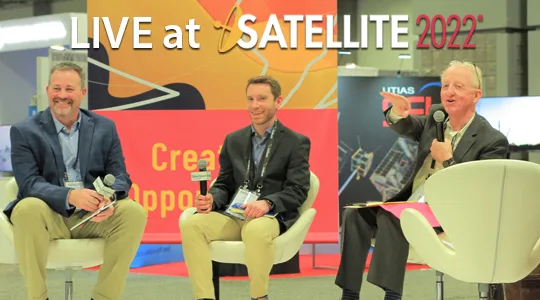
John Gilroy: Welcome to Constellations the podcast from Kratos my name is John Gilroy, and I’ll be your moderator. Today, we have Lluc Palerm, Senior Analyst at NSR, and Chris Boyd, Vice President of Product Management at Kratos. And where are we? We’re in Washington, D.C. at the Satellite show, right in the middle of the thick of things here. If you look around the room here, I think many people don’t realize that the satellite industry just makes up 1% of the much larger global telecommunications market. That’s what these gentlemen are going to talk about today, the telecommunications market. I think there’s a huge opportunity for satellite service providers to gain a large share of the market. If they adopt key technology enablers to seamlessly integrate with telecom carriers. So, that’s the topic today, telecommunications. Lluc Palerm, Senior Analyst at NSR, and Chris Boyd, Vice President of Product Management at Kratos.
John Gilroy: We’re going to talk about new market opportunities where satellites can extend today’s global communication network. The conversation will also focus on how satellite service providers can seamlessly integrate with telecom carriers to deliver these new services. This conversation builds on a recently released report from NSR titled “Telecom-Satellite Digital Network Integration: The Keys to New Market Opportunities.” So, let’s just jump right in here. We’re going to start off with our friend from Spain, Lluc. So looking in the past here, you’ve been in the industry for a while, what has limited the satellite industry from integrating with telecommunication systems in the past and what makes this integration much more critical moving forward?
Lluc Palerm: Thank you for the invite to be here. I think that’s a very good question to begin with because before we start analyzing how we can expand the satellite market, we need to understand what we were doing wrong. I think that the industry has changed a lot in the last five years, the first thing is performance and economics. So, if we think about the industry five years ago, the performance wasn’t as good as today in terms of throughput, in terms of capacity and the economics. The economics has changed a lot.
Lluc Palerm: So, prices of satellite capacity have gone down, prices of equipment have gone down, and it’s now possible to serve rural community, for example, with a much more economical solution via satellite. Now, what’s the next step? I guess the next step is making satellites easier to be adopted by the general telco ecosystem. And I think that there are a lot of things to do there in terms of how the mainstream telco can manage and check the SLAs and can integrate the networks in the satellite ecosystem as well. Also satellites require a lot of particular skills so if we can make satellite easier to go by all these telco ecosystems, the opportunities for sure are very, very big in the coming years.
John Gilroy: So Chris, from your perspective, what do you think was limited in the past?
Chris Boyd: So, certainly I think the limitations have been the stove piped and siloed type of operations that we’ve seen. There’s some proprietary system integration levels. And so what you had is essentially a boutique or a niche business that the telecoms really had some trouble. I mean, back in the day, they actually could do it pretty well. But as the telecom business has scaled, automation’s crept in and the satellite industry hasn’t really embraced a lot of the automation and the buzzword being orchestration. So, a lot of those tools I think were preventing it and I think Lluc hit on a good point, the skill sets were different but they’re now starting to converge. So, I think those things are starting to ease. The opportunity I think Lluc also hit on was the cost structure, right?
Chris Boyd: So, we’re seeing now a lot of bandwidth capacity coming online, which is driving the cost down. So, it’s making satellite attractive for certain businesses to provide use cases over satellite. So, that’s starting to get the attention of the telcos to say, I can now adopt that to the mainstream technologies, but only if I can integrate it with my current business, with my current workflows and orchestrations, and only if I can do it at scale. So, those are some of the, I think pieces, that we’re working on as an industry.
John Gilroy: Chris, if you looked at the telecommunications industry, when VOIP was broached about 15 years ago, they had to be dragged into it, kicking and screaming, not just the satellite industry that are stuck in siloes is it? I mean, they were stuck too.
Chris Boyd: No, and we’ve seen this three, four, five times. If you go back to the PBX to VOIP as you mentioned, you saw it in land mobile radio systems, you saw it in the mainframe to the computer, we’re now seeing it in cloud. Telco’s doing the same thing. So, to say we’ll avoid it in the industry is pretty naive actually.
John Gilroy: Lluc a question for you here. What market opportunities should satellite operators and telecom carriers jointly pursue in terms of service delivery? Especially with satellite strengths in serving remote and underserved locations. So, give us some examples of some of these services.
Lluc Palerm: Right, so nothing really totally disruptive and new. I think it’s going to be pretty much the same kind of applications that the industry serves today, but the scale is going to be totally different. So, we think, for example, in cellular back haul, and we do a lot of research on cellular back haul, we have done a very detailed analysis on the addressable market based on the distribution of the population that is not covered and the available income and so on. We think that there are 22 terabytes per second of addressable market, that’s huge. I mean we compare that with the 3 Terabytes per second of supply that we have today in the industry.
Lluc Palerm: It’s 10 times the capacity than the supply of today. So, there is a huge potential for improvement and that’s just for back haul, then you have other use cases like in-flight connectivity, maritime, all these kind of services that the telco industry is looking forward to serve. If you think about 5G, one of the key areas, one of the key focuses of 5G is expanding into enterprise services, and satellite can be a great partner for those telco operators wanting to expand into private networks, into rural areas, remote areas, and these kinds of services that the industry’s already serving today but the scale is going to be very different.
John Gilroy: Lluc’s from Spain and Chris, I think you’re from Boston, right?
Chris Boyd: Well, I live in Boston.
John Gilroy: You live in Boston, well in Boston they have this thing called the Red Sox and they hate the Yankees, and they’d never think of ever working together. So, when I think of satellite operators and telecom carriers jointly pursuing terms of service delivery, it seems like Boston Red Sox fans and Yankees fans getting together. Huh?
Chris Boyd: I don’t know if it’s that separated actually, I think they just want to play baseball, is kind of the way I look at it.
Chris Boyd: I think Lluc had a good point, I think you have to look at the net new opportunities. The satellite industry can’t disrupt necessarily what they’re doing. You know, as you were pointing out, there’s a lot of cellular back haul, maritime business, things like that and I think where it has to make sense for the telcos is where they can match that to their existing product suite. And so I think some of the opportunity here is to look at net new business together, not stealing from other markets that satellites already got good market share in and in places that were obviously the only people that can serve those types of services. So I think, net new opportunities where we can align the order management, the provisioning, right? The scale factor that Lluc mentioned, I think that’s really key. So, the telcos are going to look to that, that has both an operational configuration but also the actual technology alignment.
John Gilroy: Chris, earlier I talked about VOIP, voice over internet protocol. I think the term ethernet is kind of a malleable term and there’s all kinds of ways to slice it and dice it and change it up. If you go to Wikipedia, they have pages and pages of different types of ethernet. So, what is this carrier ethernet and how can it enable satellite and carrier networks to interoperate more seamlessly?
Chris Boyd: So, I like your analogy. That’s a great way to describe it. So ethernet is ubiquitous. Carrier ethernet is actually a very specific definition. Actually, it’s a set of standards managed by the Metro Ethernet Forum or the MEF, and specifically carrier ethernet 3.0 is the standard that’s currently available. What carrier ethernet provides is a standardized set of industry aligned methodologies to provide carrier class ethernet services, but also to map critical aspects of that Quality of Service, guaranteed bandwidth, etc. The other thing that’s critical about carrier ethernet is as a customer connects to even a terrestrial carrier ethernet. There’s a defined service architecture that they get when they ask for a particular service definition.
Chris Boyd: So, that defined service now becomes between the customer and the provider as a defined service. But now between providers, we can exchange services from one operator to the other on a similar or the same service definition or service architecture. So, it allows for a very specific way for us to then transport the customer’s traffic over a technology agnostic layer. So now, if you look at that as applied to satellite, the access layer doesn’t look any different to a telco than a fiber link or a terrestrial copper link, or what have you. So, it is an important movement, I think, within the satellite industry to align with the standards so that we’re all talking the same language.
John Gilroy: Chris, I’ve been around a while. And I remember in the early days of data centers, when you provisioned a data center, you went out and you bought a server and you physically hauled it in and hauled the bad one out. Provisionally means different things to different people so I’m going to apply this word provisioning to this carrier ethernet thing. If satellite networks become more flexible like carrier networks, how will services and resources need to be provisioned differently and much faster in the past? It’s not you going down and getting a server and plugging it in, is it? It’s much different.
Chris Boyd: And nor is it just provisioning a piece of fiber or copper, right? So, in our world with the satellite, there are lots of dynamics. Obviously the satellite has its configurations, the ground system has its configurations, the link budgets associated with the coverage are there. What we’re seeing in the industry now is a shift to software defined payloads, and we really need to take advantage of those because now instead of having to launch a satellite with a configured orbit service definition, now that can be adjusted, midlife span, or at any time, frankly. What we’re seeing is the need to align, now, the services to the satellite, and the satellite to the services, and to do that, we have to actually include the satellite in the resource planning.
Chris Boyd: And so what’s really critical is to have the… When you provision a service, to consider what is the satellite’s resource plan, does the satellite plan need to be adjusted, then the ground system would have to change to match. And so what we’re seeing then is a fully dynamic scenario where we might want to change the configuration of all of these elements. The key is to do this at scale. Earlier in the conversation about space domain awareness, it’s getting to the point where humans can’t be involved. So, now we’re needing to actually have these systems automated and have loops and feedbacks. Now the idea to have a satellite resource manager in the configuration of the service is actually quite critical.
John Gilroy: So Lluc, you’ve been in the business for a while and you’ve seen this change drastically from drive down and physically put in a cable or a server to something completed, actually looking at the end product, the software defined payload it’s changed drastically.
Lluc Palerm: I mean, I see the conversation revolving around technology, but I think that the business model itself needs to change a lot. So, we focus a lot on the infrastructure itself. But I think that the industry needs to think as well on how the offer changes to make it much easier to adopt for mobile operators, for the general telco ecosystem. So, that’s probably a point that is sometimes missing in the mind of the industry that I think we should pay more attention to as well.
John Gilroy: No, it’s a step by step process, this integration. Chris, question for you here. As operators consider adopting some of these steps, we discussed to better integrate with telecommunication networks. So, how do they start? What’s the first step? How do they start the process and what challenges should they be aware of to minimize risk and make sure they’re successful?
Chris Boyd: So, kind of like we were saying before, you can’t just wholesale apply this to this right out of the gate. We have to look at the markets and the use cases that make sense. We were talking about a few of those a few minutes ago in terms of selecting the ones. And then I think we have to look at the use cases and the business cases that make those opportunities close. I think that’s the key thing to understanding how we get there. The second is obviously we’re talking about telco and satellite integrations, so we have to have the right partners, right? We have to have a satellite provider who knows how to deliver these types of services. We have to have a telco who has a business need to serve the disconnected or remote applications. And then I think there’s a set of technology choices that have to go along with that.
Chris Boyd: And so we need to look at, what are the right technology sets to adopt to be able to facilitate this? What are the business arrangements between the two companies in terms of service level agreements? So, I think there’s a number of steps that have to happen from the business, focusing on the opportunities and then the technology. And I think those things you will automatically start to see the ones that boil up pretty quickly to the top as those that will make a lot of sense right out of the gate. And then I think the rest of the industry will learn how to apply those things to other vertical markets.
John Gilroy: You know, Lluc, you have a good international perspective in America here when you’re meeting with a company, before you leave the room, you say, “okay, what are the next steps?” And then I write something down and Chris writes and we figure what the next steps are to implement this. So, from an international perspective, what do you think about these next steps to minimize risk and ensure success?
Lluc Palerm: I think that the very first step for the industry is taking a holistic view of the things, right? So, we still see many of the satellite operators thinking just about the satellites and not about the ground segment. So, that’s not possible in the future with software-defined satellites, with all the orchestration, integration with the telco system. So, infrastructure alone doesn’t have a difference in its own value in that future of the industry. So, you need to take this holistic approach where you think about your satellite and how this integrates with the ground segment and how this integrates with the partners on the telco side of the equation.
John Gilroy: So Chris, let me get this straight. So, people like you have to step back and think about the payload-as-a-service and every step long way, right down to the ground station. I mean, this gets a pretty long checklist. You have to have several Excel pages of checks on this, don’t you?
Chris Boyd: And all the way out to the terminal. Let’s not forget about that part. And you can’t have pages of checklist. You need to automate it.
Chris Boyd: So, this is part of the problem. I think you guys were hitting it right? The other thing I would caution is, so as you were mentioning, like the satellite is going software defined, right? The payloads are adjustable. The ground systems have to keep up. And so there’s a couple aspects of that we absolutely have to embrace. So, obviously the satellite industry has already embraced virtualization from a technology perspective. And everyone says, well, why did that cost me more money? Well, virtualization never was intended to be free. It certainly has its cost. The next thing in order to achieve the scale that you’re mentioning, if I’m going to connect the satellite to the ground dynamically, then I have to be able to very quickly change the ground system.
Chris Boyd: And that includes the IF, so the second part of that is really digitization. So, there’s a number of things going on in the industry now to take the IF from analog to digital. And that’s really critical because as you re-groom the satellite, we need to re-groom the IF up links and down links to match and those processes are what’s going to drive the changes. So again, just like virtualization is not free, digitization won’t be free either. That’s why I was saying, going back to the business cases, the satellite being dynamic and the ground needing to change, those are going to force automation. And to do that, you’ve got to take the humans out of the loop and you have to be able to do this through automated processes. So again, I think it’s important for people to understand those are investments that are made and we have to look at the ROIs of those things and what the total cost of ownership of those things are to understand. And again, back to my earlier point, figure out what market use cases make sense to attack first.
John Gilroy: Yeah, Lluc talked about a holistic view.
Chris Boyd: That’s right. So, it’s a business, the whole business cycle, but also the technology cycle. And now we’re at a point where to achieve some of this dream that we have about integration. We have to follow what the telco industry’s also done. They have also automated their digital layers, the software, the software radios. So they’re already expecting that from us to be on the level playing field or we’re going to be playing in your analogy farm ball, right?
John Gilroy: Yeah. Lluc, I teach in this school a few miles from here. I always ask my students, well, where do you see yourself in five years? And I try to structure lectures based on where they see themselves. So, how about looking in the future for you? That’s part of your job at NSR, isn’t it? So, how do you think the role of satellites will have changed in terms of telecommunication service ecosystem in the next five years?
Lluc Palerm: So, I think we are in a very good time. I’m very positive about the future of the satellite industry. We think about all the players that are now getting interested in the satellite industry. You see all the big telco operators now signing partnerships with the satellite industry. So, that’s very encouraging and we see a lot of growth in vertical, again, like back haul, mobility, private networks. So, we think that the industry is going to grow quite rapidly in the coming years. Again, we’ll continue to be a small chair of the total telco ecosystem, but even if you grow from 1% to 3% or 5%, it’s a massive opportunity for the satellite industry.
John Gilroy: Yeah. Chris, what do you think?
Chris Boyd: I agree. I mean, if you look at the telco industry, they have a long set of standards and technologies that they’ve rallied around. Five years ago, satellite would not have been even considered in those, those standard bodies. So, for example, in the MEF, Metro Ethernet Forum, I mentioned there was not a satellite performance tier, so you actually could not achieve a certified service through the MEF using satellite because the latency profiles of the GEO satellites in particular. So, it was actually a satellite operator that pioneered some of the addendums and changes to those standards. And similarly in 3GBP, which is the driver behind 4G and 5G standards, they have also adopted things to accommodate satellite like non-terrestrial network, which is a part of release 17. So what we’re seeing is now the telco standards bodies accommodating satellite as a technology because of the inherent issues with our particular physical attributes.
Chris Boyd: So, I think that’s really key to having them start to acknowledge that we’re coming viable to their space and then starting to align. And again, I think the key to the satellite industry, back to your first question, is I think adoption of standards and reduction of proprietary systems are really what the telcos want from the industry, because they’ve already started to disaggregate the rest of the business. So, they’re going to see some of that here as well.
John Gilroy: You know, I mentioned my students earlier. I tell my students that free is not a four letter word because we have a free report for you. There’s a table down here and it’s report that NSR put together. It’s called, ‘Telecom-Satcom Digital Network Integration.’ So, if you want to pursue this further, maybe in a written printed manner, it’s right here. We’ve got a couple minutes for questions from the audience before we close it up here. Any questions for our guests, gentlemen, up front here?
Audience Member: Hi there. My question is, do you reckon that high altitude pseudo satellites could pose a challenge to sort of satellites in like cellular back haul and whether they’ll take any of your guys’ market?
John Gilroy: Okay.
Lluc Palerm: We don’t see them as a competitor rather its more a compliment. So maybe the high altitude platform will communicate with the end device and the back haul will be all through satellite. So, there are opportunities there, I think there is room for all these kinds of solutions to work together. It doesn’t need to be a substitute, but it can be a compliment.
Chris Boyd: Yeah, I totally agree. That’s a good point on the high altitude platforms utilizing satellite. Obviously there’s some people in this room thinking about ways to use satellite to relay different orbits together. So, I absolutely agree. I don’t think it’s necessarily a competitive threat. Well, each orbit will find its critical use.
John Gilroy: Each orbit will find its critical use. So, he’s put that in a T-shirt or something, it’s pretty good. Well, in the movie back to the future, there’s a car and it had a license plate and the license plate was out of time and I’m afraid I’m out of time here with this individual podcast. I’d like to thank our guest, Lluc Palerm, Senior Analyst at NSR and Chris Boyd, Vice President of Product Management at Kratos.
Chris Boyd: Thanks John for your time.