Transcript:
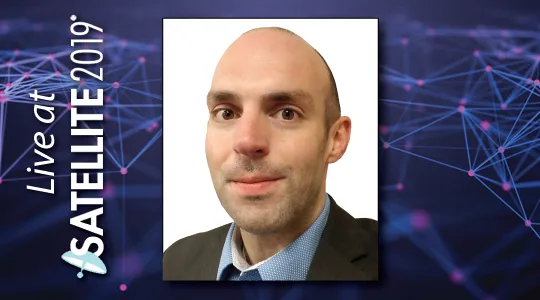
John Gilroy: Welcome to Constellations, the podcast from Kratos. My name is John Gilroy and I’ll be your moderator. Our guest today is Jeff Hill, conference chair and executive editor at Access Intelligence and yes he’s the chair of this conference we’re at now. We’re on the floor of SATELLITE 2019. Jeff how are you?
Jeff Hill: I’m doing well John. How you doing?
John Gilroy: All kinds of people floating around me. All kinds of exhibits. Lots of stuff floating around. This is really a fun conference. I’ve had a lot of fun here the last couple of days.
John Gilroy: Jeff, you have been producing the SATTELITE Show for a number of years now and I think that you’ve seen a lot of the changes in the industry, what’s undergoing here. And the industry’s experiencing all kinds of changes, you have personnel composition, geographic influence and increasing business reliance on satellites. Let’s take these three general concepts and just focus in on them.
John Gilroy: Let’s talk about the first one, personnel composition. So different people floating around this conference than 10 years ago?
Jeff Hill: Yeah, around 30% of our attendees are attending for the first time in their career. When I first took over the role of chairman, the show about five years ago, my mission was to invite more young people to the show, get the show a bit younger. Whether they’re young professionals, entrepreneurs, college students, I wanted to make the show more accessible to them. Because when I first joined the industry there weren’t many young people in the industry and I think the average age of somebody in the aerospace industry was in their late 50’s. And a lot of these people were about to retire and there weren’t a lot of people left to take over for them.
Jeff Hill: So thanks to some STEM education programs and the efforts of the industry, I really think the industry’s done a fantastic job, we have been able to get more young people involved in the show. And then on the conference side, I wanted to get more women and much more diverse lineup of speakers involved with the show. So that’s what we’ve been doing over the past few years and there’s a few programs we’ve had that have been a real success. But we still have a long way to go.
John Gilroy: We have a mutual friend in Rebecca Cowen-Hirsch and I noticed that, I think she gave this presentation at the conference here, titled Our Collective Role in Empowering Women and Cultivating Diversity in Aerospace. That’s the exact topic we have here isn’t it?
Jeff Hill: Yeah, that was our opening general session this morning. And we had eight fantastic speakers talking about what they’re doing at their own companies to encourage a diverse group of decision makers. Also to encourage diverse entrepreneurship. And I say diverse because it’s not just gender, but it’s also culture, religion, age. So it wasn’t, even though all of our speakers were women, and by the way, it was like the first time in our show’s history ever that we had a panel of all female executives on a general session. So we were pretty happy about that, to have this discussion lead by a group of women.
Jeff Hill: My first year coming to SATTELITE there were less than a dozen female executives on the entire program. And this year we have more than 60 and 50 speakers under the age of 35. So Rebecca, when I came into the industry 10 years ago, was a person who helped mentor me by educating me about the government MilSatCom market and some of the government acquisition processes. She spent some time at DISA so she was an incredible help in terms of educating me about what was going on in her world.
John Gilroy: You know I think if we got in a time machine and went back 10 years and just randomly picked people from the show, you’d get a lot of hardware type people I’d think. Now increasingly, speaking of workforce, lots more software people, software defined networks, software defined antennas. Much more emphasis on developmental skills like this isn’t there?
Jeff Hill: Yeah, well the industry’s becoming more software defined. So it really is getting a lot closer to what you see in Silicon Valley of the typical software company. I mean we’re integrating the same technologies to improve efficiencies in our industry like machine learning, we’re improving, we’re making satellites cheaper, faster, we’re launching them faster. We’re becoming as quick and agile as the software industry.
John Gilroy: What about the other way around? How have the younger people affected the satellite industry.
Jeff Hill: Well I think simply they bring new ideas and they bring that speed and agility. You tell a young person to wait more than three minutes for anything and they get upset. Where the millennials are a generation that were raised, throughout their whole life they had access to internet. If they want anything they can look up a video of anything and have access to it instantly. So when they come into the space industry, which they’ve been raised in STEM education programs, so they’re ready to go to Mars and they’re ready to go to the moon and they want to get there tomorrow not in three years, not in five years. So I think it’s just driven by millennial’s natural impatience, in a good way. It’s really challenged some of the norms that we’ve seen.
Jeff Hill: But also, I think it’s come both ways. I think the people who’ve been in the industry have also benefited from it, because it keeps those ideas fresh. It also provides an opportunity for them to mentor the young people coming in and making sure that we’re producing technology responsibly. So I think there’s been benefit both ways.
John Gilroy: And I’ll bet when you were an undergraduate on your to-do list it wasn’t, “Go to Mars.”
Jeff Hill: I wanted to cover politics and I did for about a year in Philadelphia. And then I started getting involved with broadband policy, bridging the digital divide, which I am very passionate about, still am. I mentioned that in my opening remarks on Tuesday, how we’re still very disconnected. And that’s actually what brought me into the industry was working on a broadband stimulus package feature for a publication I was writing for in Philadelphia. And then seeing the tie in with the satellite industry when the Obama administration was introducing their stimulus package. So politics brought me into the satellite industry, so I’m grateful to now be in an exciting technology driven industry, not something as frustrating as policy. Though the policy still frustrating here.
John Gilroy: I want to bounce back to my little idea of a time machine. Go back 10 years, you’re not going to see as much personal diversity as we see here. But also if you go back 10 years, you think about this, it was like United States and Russia and that was it. But today, geographically, Europe and Asia are big players in this whole game aren’t they?
Jeff Hill: Yeah, well I mean Europe is the home of some of our industry’s most innovative launch and manufacturing companies. And now a lot more new entrants and startups coming from Europe.
Jeff Hill: And Asia, in addition to also being home to some of the most innovative satellite companies in the world, I mean Asia is also a very lucrative market for a lot of our operators in terms of … I mean, DTH is still a very healthy and growing market. I mean, 4G LTE, 5G, I mean Asia is a big market for a lot of our industry. So, naturally we see a lot more people from those regions come to SATELLITE.
John Gilroy: People from all over the world, racially, gender diversified. So what impact has this different international aspect had on the satellite industry?
Jeff Hill: Well it’s interesting, because even though we are more diverse in terms of raw numbers for our show this year, we used to have programming that was specific to regions, but because we’re now so globalized and especially our industry, we just naturally have these … Like we’ll have a launch panel, we’ll have speakers representing companies from Asia, from the United States, from Europe. I mean it’s just natural to have that diversity now. It’s not something that we have to segment. Well these are just the European players, or these just the Asian players.
Jeff Hill: On the flip side of that, we still have challenges being diverse today. A lot of people have trouble getting visas into the United States these past few years, which has been frustrating. We want to get more people from Asia involved with the show. We’re seeing that improve a little bit this year, but we’re hoping the whole trade tensions and some of the travel ban stuff kind of goes away sooner than later.
John Gilroy: I want to talk a little about India. I had a sister that just spent six months there. And a lot of innovation and launches coming out of India. And if you combine that with the sizes of satellites getting smaller and smaller and you could actually come … Students can put together small satellites. And so I think that the flexibility that small satellites and new launch experiences have can enable people in India and places we never thought of, to join in and bring just a whole different perspective that we never think of.
Jeff Hill: Absolutely, absolutely and we could do a whole podcast on going country to country and how to get people from that country involved in the show. But India’s also another country it’s challenging to get into that country and invite people into the United States to come and participate. But we’re trying, we’re making progress and … ISRO for example, I mean it’s a hugely influential organization in satellite and space industries. And they attend, we know that. We love to have them here and like to get them to speak next year.
John Gilroy: You know Jeff, thousands of people from all over the world, Israel, India, China, Japan, they listen to this podcast. If you are listening now and there’s snow on the ground, or different time of year and you’d like to get alerts when new episodes are available, go to Google, type in Constellations podcast, click on Kratos and give us your email and we’ll let you know when we have the next Jeff Hill. Maybe Jeff Hill next year, talking more about what’s new.
John Gilroy: Another key demographic in this whole topic is different types of businesses. I have a friend in Ohio who earns a living as an agriculture journalist. And then it dawned on me, a lot of farmers in those big combines, guess what, they’re all tied into satellite information aren’t they? They’re listening to podcasts and they’re tied information. And they’re probably more aware than some people working in MIT. And so there’s this whole aspect that I never thought of, new business aspects for satellites.
Jeff Hill: Absolutely. And you mentioned agriculture and specifically smart agriculture. Satellites produce data today that will help farmers sustain their businesses in the future. There’s so much information you can grab from satellites. You can get temperature of soil, you can get crop health, all from satellite imagery and advanced data. And it’s not just imagery satellites either. I mean just pure satellite connectivity, remote connectivity, is drawing a lot of these different types of attendees.
Jeff Hill: And in terms of the enterprise verticals we’re also seeing a lot more diverse end users. People coming from, and in agriculture you have people like John Deere and in insurance markets you have State Farm Insurance, I’ve seen a few of their members here. Our closing session today has a speaker from Merck, DuPont, Siemens, IBM Watson, MasterCard, they’re coming because they all have a tie-in with the satellite industry in one form or another. And this is a big trend we’ve seen in the last three years here at the show, is how diverse, from a vertical perspective, that our audience has become.
John Gilroy: So, we’ve got people walking around the floor here that are geographically diverse, all kinds of different age levels and gender and Spanish speaking and Italian speaking, all kinds of folks I’ve seen here. Businesses are diverse. Also I think of first responders, it’s the spring of 2019, we really haven’t seen any bad events or any kind of hurricanes or any kind of tornadoes, but I would say first responders are another group that are interested in satellite technology.
Jeff Hill: Absolutely, and as we notice that especially during hurricane season in Puerto Rico where the entire island lost connectivity, there were no cell phone towers available and satellite connectivity was the only option for a good period of time. We just brought a conference manager on our team Rachel Leshinsky who came from the first responder, emergency, first response world and firefighters. And she recognized the language that we were using immediately. And so yeah, we’re seeing a lot more from that community come into our show as well.
John Gilroy: And that’s pressure and that’s time sensitive. It’s pressure, it’s got to be accurate, lives matter.
Jeff Hill: And available, yeah.
John Gilroy: Yeah. Well if you look at, just if I walked around the show today, I’d look at themes here. I’d look at small sats, new launch capabilities and also investor funding that people don’t talk much about. Which of those three are going to have the most impact in the next five years here?
Jeff Hill: So I’ll start with investors. Yesterday we had the startup space competition here on the show floor. It’s our third year that we’ve been doing it and I mean it was packed. It’s been packed all day long for three years. And reason being is that it provides the beginning of a pipeline of new ideas into our industry. Those ideas will get funding, they’ll become companies and then you’ll see them exhibit on the show floor. It grows our industry from the other end and replenishes it.
Jeff Hill: Investors are very much into space based assets right now. This closing session today, one of the moderators Jeff Matthews at Deloitte, I mean one of his jobs is to educate his Fortune 500 clients on what satellites can do for them. That’s all he does. He walks around, and I’ve seen him here, he’s walking around, he’s got somebody under his arm here and he’s saying, “This is what this does, and this is what this … ” And these are all investors just looking, not only to invest in startups, but invest in satellite capabilities.
Jeff Hill: Small sats, new launch capabilities, all of these things, I mean they’ve been having an impact on our industry for years and represent just new waves of innovation coming in. We’re just getting a lot faster, a lot more instant. I asked a question to an attendee the other day, what keeps us from launching everyday? I asked the question as a joke, but she came back to me and said, “You know, I really don’t know. I guess government policy.” And it’s true, we really could just be putting satellites in orbit everyday with the speed of production. I guess we will need to with tens of thousands of Constellation satellites on paper ready to get launched.
John Gilroy: I’m going to try to put myself in the role of a person in the satellite industry living in Long Beach California. And a lot of stuff going on there in space, you know that. And I noticed that Jeff Hill, the guy right next, Jeff Hill, he brings in over 250 speakers to this conference. So if I’m sitting in Seattle or Houston and I want to become one of those speakers … So what do you look for?
Jeff Hill: Well we have a call for presentations. This is the one thing that a lot of people don’t realize. This show is actually put together by industry suggestion. So everybody participates in some way in influencing the program. We open a call for presentations in the summer and we get more than 400 proposals for panels, topics, people. And I spend, when most people are spending their August maybe watching baseball or going on vacation, I’m reading these proposals and then passing them along to three other people who read all of those proposals. And it’s the most difficult aspect of this job because they’re all very good. Like you could have 400 panels.
Jeff Hill: But we try to pick the ones based on, we look at some surveys, some people who’ll attend this year, we ask them what would they like to see next year. We match them up and we do it by demand. We put the panels together based on what people want to hear about. So if you want to see a specific speaker talk or you want a specific topic, submit it through that CFP, tell us why we should host it and we read every one of those. And that’s the way to do it.
John Gilroy: Well we are on a podcast now and I think you are starting your own podcast. Tell us about the podcast you’re starting please Jeff.
Jeff Hill: Well in my role with Via Satellite I will be producing and hosting a podcast which is, it’ll just be an audio version of some of the features that we publish with Via Satellite Magazine. It’s called On Orbit and it’s going to be focused on, I mentioned my friend Jeff Matthews, it’s actually kind of inspired by that role and educating people both inside and outside of our industry about the value of space assets, including satellite and also the value of solving problems, or technical challenges associated with space.
Jeff Hill: So it’s trying to bring Via Satellite to a much more general public audience and kind of demystifying space a little. So I’m really excited about that and I’m trying to interview people who are passionate about it and trying to make it a little bit more informal so that it can reach a wider audience. And we’ll be launching that in, actually about a week from today, we’ll have the first few episodes up ready for download. But it’s an audio extension of what we’ve been doing with Via Satellite for the past 35 years.
John Gilroy: Well it makes perfect sense. It’s a great way to reach new audience. People are walking, they’re on their exercise bike, they’re cutting their lawn, it’s a great way to reach people that you can’t reach with a video. And that’s what people don’t understand, you can’t reach with video.
John Gilroy: Well Jeff, unfortunately we are running out of time. I’d like to thank our guest Jeff Hill, conference chair and executive editor at Access Intelligence. Thanks Jeff.
Jeff Hill: Thank you so much John.