Transcript:
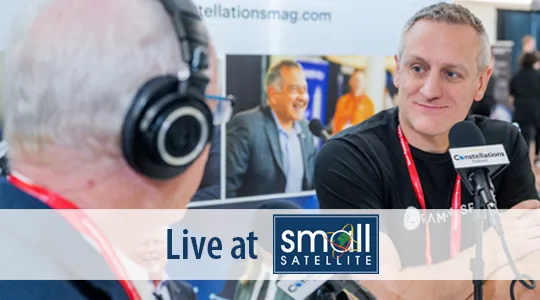
John Gilroy: Welcome to Constellations, the podcast from Kratos. My name is John Gilroy, and I’ll be your moderator. Today, we are recording this from the floor of the SmallSat Conference in lovely downtown Logan, Utah. Our guest is Steve Good, Chief Business Officer at Ramon.Space. At Constellations, we talk a lot about the evolution of the space layer driving an evolution of the ground layer of satellite communications. Satellites have traditionally been built for one mission, including the computing necessary just to fulfill that mission. During today’s podcast, we’ll discuss how advanced onboard computing is transforming fixed satellites into flexible ones, how it’s possible to deliver Earth-like computing on orbit, and how a smart satellite can leverage artificial intelligence and machine learning to contribute to humankind’s knowledge in space operations. Steve Good, we’re going to expect some good answers out of you today.
Steve Good: I’ll do my best.
John Gilroy: Sounds good. Let’s start at the beginning. What’s happening in the space industry that’s driving demand for fundamental change in onboard satellite computing?
Steve Good: That’s a very good question, John. We, as an industry, are very good rocket scientists, we’re good at getting there. We’re not as good at doing things once we get there. I like to say that we’re good rocket scientists, but we’re not good data scientists, and that’s through computer science. So what I say to folks that want to join the space industry, bring on the computer scientists, bring on the data scientists, because the big data is not getting smaller, that’s for sure, big data is getting bigger. But the real point is how to pull big insights out of that big data, and that’s going to require onboard processing and storage. At the end of the day, you do three things with data, you process it, you store it, and you move it. And you need to do that gracefully and harmoniously, otherwise, you’re going to be limited in some form and not be able to maximize the functionality of spacecraft, which are very expensive. Spacecraft are not cheap, so the ability to maximize return on a spacecraft and CapEx is very important.
John Gilroy: Well, Steve, let’s not be too tough on all the people at this conference here, because data scientists haven’t been around that long. It’s only been since the advent of cheap storage that you can actually have a little job title of data scientist on your LinkedIn profile, huh? So I think most of the people here have been inside a data center and know exactly about servers and how most computing serving works. So how does computing work onboard a traditional satellite? Let’s go back to the beginning.
Steve Good: Onboard a traditional satellite, there’s a lot of yes or no answers, one or zero answers, checks on health, TT&C information that’s being transferred back. There’s limited amount of storage capability. A lot of times, the entire sensor data, or the entire optic picture, is stored and then forwarded over the teleport whenever those satellites go over the teleports. In the GEO space, there’s still a lot of analog bent pipe connectivity. We’ve seen the advent of software-defined satellites. Software-defined means the ability to via software, not hardware, and that’s going to be a theme, and that’s what’s happening in this industry, we’re moving from being very hardware based to software, and that allows us to have many different vertices on what we can do with our data, gathering those insights from the data. So traditional satellites, because of linear TV, because of the broad reach of satellites, the three GEOs to cover the world, have been simple to date. But what we’ve seen is an advent of being able to define a satellite, to being able to use those resources, those spectrum resources, those satellite resources, because there still is a budget on power. We are in a SWaP game, size, weight, and power, and the bigger you are, the more difficult it is to launch, the more power you draw, the more difficult it is to actually do things with the data. So you want to be small, small and small, very small, actually, because power is an absolute finite resource. So the angle that we need to come from is, how do we maximize the use of that power to leverage the assets? The assets in our world are not the satellites themselves, they are the spectrum that’s being used. So we’re moving from the traditional analog into digital beamforming channelized capacity, and once you digitize data, you can do a lot with it.
John Gilroy: So making a transition to software-defined satellite software-defined networks, we know that one. So this is advanced computing. So in what ways can advanced onboard computing transform our traditional satellites?
Steve Good: They can do many things, and from a simple standpoint, there’s the ability to chop up bandwidth and to dynamically assign that bandwidth where it’s needed. I use a flashlight versus a laser approach analogy. A flashlight can cover a wide area, but it really doesn’t focus a lot of energy into one area. So the ability to channelize, beamform, use smart antennas, I like to call it smart physics. So using the very finite amount of resource, remember, each satellite has a finite amount of resource, in terms of size and power, the ability to dynamically allocate those resources where that capacity is needed, when it’s needed, and that’s where the software-defined satellites are taking us.
John Gilroy: So the big picture here is software-defined operations. So give us just some general building blocks required to enable software-defined operations on a satellite.
Steve Good: The first one is space is hard, you need a foundational element on which you’re processing, on which you’re making decisions. So commercial off-the-shelf options can be an option, they can be used, but for five, seven, 10, 15 year missions, you really need something that’s been radiation-hardened. Reprogrammability, there’s a big fear in this industry that, once a satellite is launched, it’s obsolete immediately. The ability to be reprogrammable, the ability to upload new AI, machine learning apps, the ability to store data, or provide data centers in space, the ability to make decisions in space. I call it cloud computing above the clouds. Once you’re above the clouds, you can only have a cloud computing function if you have a very reliable cloud that connects the satellites, via OISLs, that has the ability to store data. Everybody needs more storage than they think, so we start at one terabyte, some people don’t think they need it, but a lot of people need much more than one terabyte as they grow. So storage is becoming a main driver as well.
John Gilroy: Steve, earlier, you mentioned power, and I want to maybe come back to that topic. Power, especially on a satellite, is a precious resource. So does Earth-like onboard computing require Earth-like power?
Steve Good: It depends on how you define power. So power is, we as an industry like to say, we have powerful satellites, meaning the emulation to Earth, the receiving from Earth, or Earth-like computing. I also talk to people about data centers in space. What is a data center in space? If I talk to 10 people, I get 20 ideas on what a data center in space could be. So to say that we’re going to take Earth-like computing, the ability to have gigawatts of power supplied to these processors, is incorrect. So Earth-like computing is the processes that are used, but satellites still have a finite amount of power, so we need to really manage that power budget. The Earth-like computing can be done within a limited set of walls, if you will, but you still want to draw the minimal amount of power for those apps.
John Gilroy: Well, here we are at the SmallSat show, there’s people walking by us, and I’m going to maybe pick one of them and bring up a scenario, and maybe you can make an observation on that scenario. So let’s say we grab someone walking by here. It would seem to me that maybe every five or 10 minutes, their phone is telling them that their storage is limited. And they’re not going to stop taking pictures or selfies or whatever, what they’re going to do is normally just add memory storage on the phone. So the other scenario is a satellite. So satellites typically move data to the ground as quickly as they capture it, the old hot potato scenario. What is the argument for storing more data on orbit, and how much data are we talking about? Should we expect to get a notification soon?
Steve Good: That’s a good question. Notifications are good. I get the notifications on my phone every day that I’m running out of storage. When you’re doing processing onboard, when you’re looking for big data, big insights, out of that big data, there is an increasing need for storage. We drew the line at one terabyte. We believe that any serious application is going to require at least one terabyte, and we scale up from there, very gracefully. So storage is big. If you can imagine a cloud computing environment around the moon, on the moon, decisions need to be made there, the analyses need to be made there, they can’t all be sent back down to Earth. Another application is in LEO. LEO satellites are only over teleports for a fraction of the time, so if you’re only able to gather so much data, you have seven, maybe eight minutes to download your data over a teleport, so you want to be very selective in the data that you send down. So you’re going to be storing much more data, you’re also going to be processing it in-flight. Instead of taking one big picture, if you will, you take the picture, you analyze the data, you take another picture, you analyze that data, you take another picture. So you’re increasing the good data that’s coming back down to Earth, and to do that, you need storage to house that data while you’re analyzing it.
Steve Good: And then, you go to the space station folks, the people that are going into deep space, one of the challenges is, how do we take care of our people in space? So storage is important. Having data available at our fingertips, could be AI fingertips, machine learning fingertips, so I’ll use the word, “Our” very broadly, because the world of human and machine are combining. But the bottom line is, everybody needs more storage than they think.
John Gilroy: Let’s go back to that hot potato. I think we’ll still be moving much of the data down to Earth. So how does this concept of software-defined network and advanced computing, how does that on a satellite help with that transmission?
Steve Good: It helps by, if you only have a limited amount of time to download your data, you want to have your duty cycles be maximized or minimized, depending upon your load balancing. You want to make sure that you’re storing the good data and you’re removing that other data. So the ability to intelligently, and back to my point of some satellites are obsolete by the time they’re launched, the ability to upload new algorithms, there may be activity in a certain portion of the world that you really want to take a look at. It gets into tipping and queuing as well. Instead of having the ground involved in tipping and queuing satellites, sibling satellites, the ability to have an autonomous network that says, “There’s a lot of activity in this area. Take all of the pixels you have and really focus them in on these GPS coordinates.”
Steve Good: So there is a hot potato, but that potato, you want to be maximized, or the fill of that potato shell or skin, you want it to be the best potato it can be. Not a good analogy, but instead of sending down wholesale potatoes, you’re sending down french fries, and that’s what we’re all here for, right?
John Gilroy: So we’ve been dancing with this concept of advanced computing and SDN, software-defined networks. So one of the good things about advanced computing is, the more you collect, the greater your ability is to predict the future from the past. Let’s take another scenario at the Small Satellite Conference here, we grab someone walking by, we did that earlier, grab another person walking by. And so, let’s say they get up tomorrow morning, it’s possible that their phone may realize they’re driving to work and automatically offer traffic updates, that’s possible. So let’s go back up to the satellite. If we’re storing data on orbit, can you explain some ways that machine learning and AI could be similarly leveraged?
Steve Good: Yeah, collision avoidance is a big issue. So space is getting more crowded, and it’s only going to take one event to create a very difficult situation. So the ability to understand where you are, where other things are, where your sibling satellites within your constellation are, can give you the ability to predict what future maneuvers you might need to make, the ability to predict and analyze that you’re seeing an increased amount of cloud cover over some area, for instance, so if I’m just doing optics, I know, well, I can’t take a picture there. I can save my battery life, my storage, for areas that are sunny, without clouds, if that makes sense. And then, analyzing those cloud patterns on where important areas of interest are. So that would be just one example.
John Gilroy: I was thinking about the phones and people walking by, and when they were first released, they were smartphones. No one ever calls it a smartphone anymore because they expect it to be that way.
John Gilroy: So maybe 10 years from now when your son is sitting in this booth, it’ll be of course it’s a software-defined satellite, of course. And they don’t realize that, the early stage, it’s really difficult to accomplish that task, huh? Smart satellite. Yeah, of course it’s a smart satellite. What do you think? Spent a lot of money on that, huh?
Steve Good: Is your satellite software-defined? Of course it is. They all are.
John Gilroy: Well, let’s focus on this word, “Smart.” Smart satellites need smart ground systems. So what are some characteristics that would make a ground system a perfect match for a satellite with advanced onboard computing?
Steve Good: Yeah, that’s a great question. We all operate within an ecosystem, so you can have the best satellite, but if your ground system can’t keep up, then what’s the point? And vice versa. So it’s very important that we, as an industry, and I come from the ground network space, so it’s very important that the ground system works with the spacecraft to route data to intelligently look at the next steps. And what that means is, protocols are very unique. So IP is IP, but the way that we, in this industry, transmit and receive data, encapsulate data, is very different. So what the OBP providers, like ourselves, need to do with the ground providers and this is going to become more prevalent with 5G networks. There is a question on, what is 5G over satellite? What is that going to look like? Can you make money with it? But the ability to port waveforms, if you’re going to do a routed network, if you’re going to do a deep packet inspection in space, you need to be routed. And we do processors. It’s very important that the processors have the same protocols as the ground equipments. So we, as an industry, need to work together, if we’re really going to route in space and have cloud computing, to make sure that we’re using the protocols of choice, the ones that make sense.
Steve Good: But one thing I talk about is multiservice satellites. So we’re moving from the single service or single serve satellite, to satellites with multiple applications. Why is that good? Because it reduces commercial risk, the ability to port multiple waveforms. Will 5G over satellite be a groundbreaking technology? Absolutely. Will it be a groundbreaking commercial success? That’s to be determined. So the ability to do multiple things with your spacecraft, and these things are up there for five, 10, 15 years. So in traditional space, I, as a product manager at a satellite operator, had to look into my crystal ball and say, “Where’s my demand in 15 years?” My crystal ball wasn’t always accurate, right? So after 10 years, after five years, the demand may be a bit different than you thought it was, so what do you do? Do you just say, “Oh. Well, that satellite’s a lost cause.” Or do I repurpose that satellite, load new AI, new machine learning, load new waveforms, and dynamically allocate spectrum on these new revenue streams that come up? So the ability to work across the ecosystem is key, everything from ground equipment, to terrestrial tier one connections, the internet, antennas, RF, the radio folks, and we, in the onboard processing space, all need to work together.
John Gilroy: Did you know you can get this podcast and more straight to your inbox? Sign up for the Constellations newsletter to learn about what’s driving the space industry forward, through recent articles on the impact of multi-orbit on ground stations; 5 takeaways from the recent World Satellite Business Week; and an update on testing ground to space optical. Visit ConstellationsMag.com and sign up today. Well, the ladies and gentlemen listening to this podcast don’t realize I actually have a crystal ball in front of me, you mentioned one earlier. And I’m going to look into the ball, and I think you’re going to recognize who said this quote, because this is the part of the podcast where I use a quote by a famous luminary, and you have to identify who said it. Are you ready?
Steve Good: I’m ready.
John Gilroy: Okay, here’s the quote. “Lots of problems to be solved in space.” Now, who said that, Steve?
Steve Good: I think that was me.
John Gilroy: That was you. We look around here, with so many small companies and universities and all kinds of young people, and I think they’re chomping at the bit to solve those hard problems.
John Gilroy: And they’re bringing it on, aren’t they? It’s amazing.
Steve Good: Yeah, this is one of my favorite shows. The new ideas, the number of students here with new ideas. What if we did this? Could you do that? Why are we limited by that? The questions of the youth, right?
John Gilroy: Yeah.
Steve Good: I’m not in that category, but I’m here to help. So bring on the computer scientists, the data scientists, bring on the tough problems. I mentioned before, space is hard. We need to make it easier. We need to make it easier with purpose-built solutions. What I like is when people say, “What is the killer app in five years, 10 years?” And some product managers, I was a product manager as well, I had to worry about what is that killer app? That crystal ball you say you have, which I’d like to borrow, by the way. What we say is, it doesn’t matter. If you have a reprogrammable payload, you’re dynamically allocating your resources, you’re using smart physics to close the technical and commercial budgets, then it really doesn’t matter. Bring on the new ideas, bring on the new algorithms, and AI machine learning, there’s a new algorithm every day, and a lot of the students walking the show here, a lot of the companies working here, we do demos on our processor, and the number of folks writing AI algorithms to do neat things, machine learning algorithms to process data, is simply amazing. And I feel proud that we, as an industry, are enabling and increasing our reach into the non-space folks.
John Gilroy: I want to talk about hard problems, but I don’t want everyone to turn off the podcast. So let’s talk about other people solving hard problems. And if space were easy, everyone would be doing it. Sure, third-graders would be doing it, it’s no problem at all. And today, it may not be easy to fix advanced tech on Earth, but at least it’s possible to drive up to a data center and fix something here. So maybe you can walk our listeners through the process of what it takes to know that a computer will work in space. Do you simulate a radioactive environment? But how do you know it’ll work in space?
Steve Good: Yeah, that’s a good question. So space is hard, I use that at least 10 times each talk, so purpose-built solutions are important. There are areas where you can use commercial off-the-shelf products that work here on Earth. Risk reduction, not only commercially, but more importantly, technically, is very important. So there’s a number of ways that you design around the radiation environment into which you go. So we have gone into the solar system, then we’ve designed around 300 krad, which, for those that don’t know krads, I didn’t know krad before I came to Ramon, that’s a big number. There’s a heavy radiation environment around Jupiter, around Mars, jumping on asteroids, but here at LEO, not so difficult in terms of radiation. MEO and GEO, those are very difficult neighborhoods, so it’s very important that you have a purpose-built solution. But at the software level, fault detection, isolation and resolution are just as important. So not only do you need to be radiation-hardened, you need to be smart enough to find those errors, to find them, detect them, isolate them, and recover them. So the ability to have a very graceful software ability programming, let’s say, on top of a radiation-hardened processor, really allows you to reduce that risk. Because if you’re a product manager and you say that, “I need five years of operation from this satellite,” let’s say you’re in a LEO constellation, if that fails after two years, one, you have to accelerate your CapEx spend. And like I said before, satellites are not cheap. They’re getting cheaper, hats off to many people at this show, but they’re still expensive. You’re overburdening the rest of your network. If you have 100 satellites, the other 99 now have to work harder. And you’re lowering your service level. So it’s very important to use purpose-built, we call it space off-the-shelf, not commercial off-the-shelf. You like that? We call it SOTS, if you will. Something that is purpose built for space.
Steve Good: And for those that want to do pathfinders, that want to do testing, the satellite’s going to last a year or two, commercial off-the-shelf is okay. You roll the dice and you hope that it works for a year or two. But we really focus on the mission- critical operation satellites that last five, 7, 10, 15, and if they’re going to the solar system, 30 years. So we can design around the fault tolerance that is needed.
John Gilroy: Earlier in this interview, we talked about on orbit Earth-like computing, on orbit Earth and LEO, pretty close. Let’s go to the other end of the galaxy here, let’s talk about deep space. So what are some examples of how advanced computing can support what humanity is doing out there?
Steve Good: There’s always a question of what are we going to learn in space that we can’t learn here on Earth? Well, a lot. There’s a lot that we can learn about our solar system that we can leverage here, and that’s what I tell my kids. I go to work because, they say, “Why are you going to space, Dad?” Well, we’re learning a lot about our universe that we can leverage here on Earth. So a couple of applications are taking pictures, if you will, of the different planets, to find out if there is the ability for habitable life. If the asteroids that fly around us daily, some come closer than we think, if you can imagine an asteroid, the minerals on that asteroid, the commercial value of an asteroid is insane, so the ability to go there and make decisions. We’ve all seen the movie The Martian, right? So the Martian, what if something happened to Matt Damon, other than what happened to him? What if he broke an arm? What if he was having chest problems? You can’t send all that data back to Earth. It took eight minutes to come back down. You need EKG equipment and algorithms, you need X-rays, you need to take care of your astronauts, no matter where they’re going into the solar system.
Steve Good: We’re on our way to Jupiter. It’s going to take eight years to get there, but we’re going to look at the ice moons of Jupiter and find out what’s there. We’re going to the sun to see what the future holds for us. So in that case, those are very difficult environments. It’s not like you can fly there and fix things. We didn’t get into the satellite servicing world, but servicing a satellite at LEO, MEO, GEO, is a thing, and folks are doing great things there. That takes remote processing and storage. But if you’re going to Mars, if you’re habitating the moon, you don’t want every bit of data from the moon coming back to Earth to be analyzed. There is the necessity for a constellation around the moon, decision making on the moon, to accelerate what we’re doing in space to leverage here on Earth. So the solar system is huge, but commercial off-the-shelf solutions are certainly not going to be able to be used. And with agencies backing off and having the commercial world push the envelope, we’re very happy to be a part of that, and that’s where our industry is going, which is an exciting time. And I tell my kids that every day.
John Gilroy: Steve Good, it’s good that I’ve not put away the crystal ball, it’s right in front of me, because I’m going to ask you to gaze into the crystal ball here and tell me what you see on the technology horizon for computing in space.
Steve Good: Good question. And I think that, as we talk to customers, the early adopters in our industry are getting it. Those that we talk about cloud computing in space, edge processing, IP routing at layer three, a lot of neat things that the non-early adopters don’t quite get yet. So we do have a hurdle to educate, as an industry, what is possible in space. It needs to be done reliably. But if you can imagine the uploading of, let’s say there’s a college course that… there’s a lot of students here, right? Write your code and we’ll put it on a satellite overnight and we’ll see how it works. That’s cool. You could make it a consumer offering, where you can upload your own code and see your code ping a satellite. Those are neat applications. But if you look at the example I used before, the ability to analyze EKG data, X- rays, things like that, that takes a lot of computational power. So those that are working on the low power solutions, the very graceful software designs that analyze data, and really pull out those insights. Right now, we’re sending a lot of data back down to Earth that we just don’t need to because we have to, or people have said, “It’s not possible to do processing in space.”
Steve Good: So I’m going to answer that question with I don’t know, and that’s okay, because if you have the right foundation, you’re able to upload these new applications daily. You’re truly a software enabled satellite, not just a software-defined satellite. We’re enabling all kinds of AI, machine learning, data centers in space, storing data in different areas, because the data needs to be local, you don’t want to have to access data here on the Earth. So the applications are infinite, if you want to say.
John Gilroy: There we go, that’s the right word. Well, Steve, in this podcast, we’ve talked about COTS, SOTS, and crystal balls. In spite of all that, I think what you’ve been able to give our listeners is a better appreciation of the value of purpose-built onboard processing. I’d like to thank our guest, Steve Good, Chief Business Officer at Ramon.Space.
Steve Good: Thank you, John. It was a pleasure to be here.