Transcript:
John Gilroy: Welcome to Constellations, the podcast from Kratos. My name is John Gilroy, and I will be your moderator. During this episode of Constellations, we’ll talk about the problem of space debris, including what it is, and how it’s impacted by recent technology advancements, such as the launch of LEO megaconstellations. We’ll also talk about the global regulatory landscape as well as the technology solutions currently available to solve the problem.
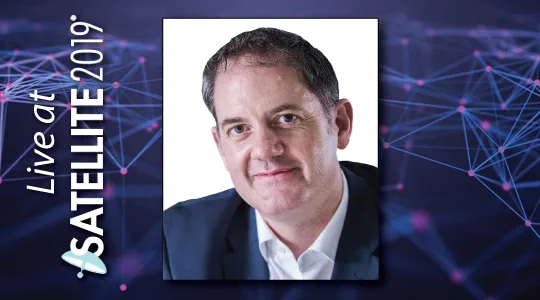
John Gilroy: Chris spent a number of years at NASA where he served as the NASA attaché for Asia as a senior space policy official in the US Embassy Tokyo. He also is a leader in forging international cooperative partnerships around the world in the fields of earth science, space science, and human space exploration. What a modern guy you are, huh?
Chris Blackerby: How kind of you, John, yeah.
John Gilroy: Plus, MBA from Georgetown, boy, you got, the perfect background here.
Chris Blackerby: I hope so. I try.
John Gilroy: Well, here we are at SATELLITE 2019. We’re surrounded by all kinds of companies and all kinds of things. Very few of them are talking about space debris, so tell us about the origin of this problem, and then what are we looking at really?
Chris Blackerby: Space debris is, basically, prior to the first launch of a satellite, 60 something years ago, 70 years ago, there was no space debris. It’s all human-made, and it comes in all sizes. It comes from things as small as a paint chip that might have fallen off a satellite, to things as large as an upper-stage rocket body or a failed satellite. We’re looking at literally hundreds of millions of pieces of debris up there in all of those sizes.
Chris Blackerby: For the stuff that we’re really concerned about at this point now are things that are larger than about 10 centimeters. Of those pieces, we’re talking about 20 to 30,000 pieces of debris that are larger than a tennis ball, which could, a baseball, which could basically destroy a satellite is what we’re talking about.
John Gilroy: If I drive from here to Kansas City, and I’m on an interstate road, I could have 10,000 pieces there that could derail my car instantly.
Chris Blackerby: That’s basically the analogy we like to use. The orbital highway is just another highway.
Chris Blackerby: The way I also like to look at it is it’s kind of like a natural resource. We’re trying to clean up what is a natural resource. Just like on land, we have natural resources like rivers and oceans and mountains and forests, the orbital environment is another natural resource that we need to protect, and that’s what we’re out there to try to do.
John Gilroy: Now, if I drive to Kansas from here, not a great chance of me getting hit by lightning, I mean it’s possible, it could happen. What is the likelihood of a collision with debris with today’s launches or future launches and even, like you could get hit by lightning, or is it probable?
Chris Blackerby: Yeah, so, it is a low probability, extremely high-impact event. We recognize that there’s unlikely to be a major collision that destroys the orbital environment any time in the near future. But, the possibility exists, and we know it’s happened before. Everyone’s familiar with, of course, the Iridium collision that happened about 10 years ago. It’s a proof that it does happen. It can happen.
Chris Blackerby: What we want to do is we want to be the prevention, not the cure. We want to be able to fix this problem before it happens, because if you try to cure it after it happens, it’s going to be too late. If you get to the point where there’s multiple collisions and each collision creates additional possibilities for a collision, then you’re looking at an orbital environment that can’t be used.
Chris Blackerby: To answer your question, yeah, it’s not going to happen. I don’t want to be an alarmist saying, “Oh, tomorrow, our orbital environment’s going to be destroyed, and you can’t use your cell phones anymore.” That’s not what we’re trying to say. We’re saying that the possibility exists, and the possibility is only going to keep increasing.
John Gilroy: Well, when you talked about this domino effect, of one collision causing another collision, this is Kessler syndrome. Many, many years ago, like 1978, he started talking about this.
Chris Blackerby: Yeah, it’s been 40 years that people have talked about this problem, and Dr. Kessler was prescient in what he was saying. At that time, the orbital environment was pretty empty. There weren’t a lot of satellites up there. But, in the last 40 years, that number has grown significantly.
Chris Blackerby: When we look at how many satellites are up there now, there’s about 2,000 active satellites right now. Since the launch of the first satellite, Sputnik, there’s been about 8,000 satellites launched into orbit. There’s been a steady increase in the amount of assets, amount of things in space that humans have made.
Chris Blackerby: Yes, Dr. Kessler talked about this 40 years ago and looked forward and said, “If we keep doing this, and we don’t take some action to mitigate this problem, there could be a substantial increase in debris, an exponential increase,” as one piece hits another piece, and it creates 10 pieces, and those 10 pieces could hit more pieces that create 100, could create 1,000, and then it gets to the point where that orbital environment is unusable.
John Gilroy: Well, when I think of space debris, I think of trying to control it, and then I think of regulation, which is kind of a nasty word here in Washington DC. But, there’s some regulatory policies associated with this, but it’s such an open area out in space. It’s hard to even talk about regulation. Is it?
Chris Blackerby: Yeah, people call it an orbital commons, some people like that term, some don’t, but that’s basically what it is. Nobody owns the orbital environment. How do you regulate something that nobody owns? It’s a huge issue.
Chris Blackerby: We’re a technology company, and we’ll talk about that later, I’m sure, but we’re trying to develop a technology to solve this problem. Most of our team, I’d say 70% or 80%, are engineers, so we’re a technology-focused company. But, if we just develop the right technology, that doesn’t guarantee that we’re solving the problem, and it doesn’t guarantee that we have a sustainable business.
Chris Blackerby: We need to focus also on the policy side which is what you’re referring to here, John. We need to focus on the policy aspects, the technology aspects, and the business aspects, the who’s going to pay for it aspects, which, again, I’m sure we’ll get to later in the discussion.
Chris Blackerby: On the policy side, we are focused on talking to both domestic governments, so, governments, the US, European governments, Japanese governments, as well as international organizations like the UN or World Economic Forum. We need both of those to come together to try to influence a solution. There’s a lot of complex discussions happening right now, but the interest is increasing, and you see it both domestically and in international organizations.
John Gilroy: Well, you hinted at the topic, and I’m going to have to dive in here, I’m going to give you the Tom Cruise question here, and the Tom Cruise question is, show me the money-
Chris Blackerby: Show me the money.
John Gilroy: Show me the money, who’s going to pay for this? If I have a rocket that goes up there, am I responsible for it? Am I responsible for a rocket that was sent up 20 years ago by another country? Who’s responsible for what? Human beings are not going to pay to clean up an environment that’s not their own environment.
Chris Blackerby: It is a thorny question, and it’s a difficult one that we are thinking about all the time. We have people on our team who are basically economists who are looking at this and thinking, “Okay, how do we frame this issue? How do we make people understand the concern? And, how do we find the people to pay for it?”
Chris Blackerby: Basically, we’re looking at two business streams. We’re looking at one which is focused on governments, and one which is focused on commercial side.
Chris Blackerby: Starting with the government side, governments have been, the majority of launches in satellites have been government launches in satellites in the past 70 years. For the stuff that’s up there now, we think the governments should be putting some money in to bring some of that down. Some of the old failed satellites, some of the upper-stage rocket bodies that are up there.
Chris Blackerby: A government’s primary interest is protecting its citizens. Citizens are reliant on the space environment, so we think that it should be the governments that start bringing down a few of these pieces. Now, if you bring down a couple pieces a year, let’s say three to five pieces a year, we start bringing down, we’re going to drastically reduce the risk that there’s going to be an accident.
Chris Blackerby: We’re talking to governments right now about potential missions where we go up and bring down a large upper-stage. Develop that technology, start working on those regulations where we can go up and grab a piece and de-orbit it, and then make the environment cleaner. That’s one of our business lines.
Chris Blackerby: The other one is we’re looking at the commercial side. The commercial side is basically what this podcast is named the Constellations Podcast. We’re looking at these new, large constellations that are out there. So many satellites are going to be launching. I mentioned earlier that there’s been about 8,000 launched since the start of the Space Age. Over the next 10 to 15 years, you know, John, there’s going to be potentially 15 or 20,000 satellites that are planned to be launched over the next decade or more.
Chris Blackerby: If we’re looking at that massive increase in the amount of things in space, we’re talking to companies and saying, “It’s in your best interest not just from an environmental perspective, not just to clean up your trash like we tell our kids all the time, ‘Pick up what you throw on the ground.’ That’s great. You should do that from an environmental perspective but, also, from a business continuity perspective.”
Chris Blackerby: If I’m launching 1,000 satellites into a similar orbit, I don’t want to take the risk that one of those fails and then becomes a danger to my other satellites. In order to prepare for that, what we’re saying is put on something, a docking plate before you launch your satellites, kind of like the hitch on the back of a car, so if your car fails on the highway, a AAA can come and attach to it and pull it out of the way. We’re saying put one of those things on your satellite, so if it fails, we can go up and grab it and pull that out of the way.
Chris Blackerby: A long answer to your question, John, but we’re looking at two different business lines. One talking to the governments about investing and bringing down some debris that’s already up there. Two, talking to the commercial sector about preparing to mitigate any potential future debris.
John Gilroy: Cars, hitches, I was thinking about my first car, a 1963 Corvair. I paid $300 for it.
Chris Blackerby: How about that.
John Gilroy: Probably the most dangerous vehicle on the planet, unsafe at any speed, if it would even start, it would be unsafe, if I get out of the driveway. But, it had no airbags. It had no seat belts. If I went out to buy a car today, seat belt, airbags, safety warning systems, everything else, it’s mandated. Should that be part of your objective, is to mandate? Okay, so, if you are Company ABC about to put up a satellite, guess what? You mandatory have to have a way to decommission the satellite. I think that’s got to be part of the approach.
Chris Blackerby: Governments are talking about that. For any company to launch a satellite, you need to get a license, a mission license. Those mission licenses come from authorizing states, governments. Governments now are talking about, saying, “If you launch a satellite, if you want a mission license from us, from this country, then you should have a back-up de-orbit mechanism.” That’s some of the things that people are talking about.
Chris Blackerby: You’ve seen that there was a notice of proposed rulemaking by the FCC, for example, where they’re saying, “Let’s look at some new regulations for how we license these satellites going forward.” One of the things that’s on that potentiality is, “Do we say you have to have a back-up de-orbit mechanism? You have to prepare yourself for safe de-orbit once your mission is done.”
Chris Blackerby: Other countries are looking at the same thing. We have offices in Japan and the UK as well. Both of those countries are looking at similar types of legislation, so there is domestic focus on mandating that there is some kind of rules for how you launch.
Chris Blackerby: The commercial sector sees this. They, of course, like to get ahead of some of these regulations and say, “Hey, we’re already preparing for this kind of stuff.”
Chris Blackerby: There’s, for example, a group called CONFERS, and CONFERS, C-O-N-F-E-R-S, and this group is focused on developing standards for in-orbit servicing. It was initially funded by DARPA. Now being, it’s being organized or led by Secure World Foundation, and we’re a part of this group, an industry-led group that’s saying, “Let’s start talking about how we can develop these standards for in- orbit servicing ahead of any kind of regulation, so we can show we’re prepared for this new world.”
John Gilroy: Thousands of people from all over the world have listened to this podcast, even in Japan, believe it or not.
Chris Blackerby: I’m one of them.
John Gilroy: If you’re listening and want to get alerts when new episodes are available, simply go to Google, type in Constellations Podcast, click Kratos, and sign up. Maybe even more of Chris somewhere down the road, who knows?
John Gilroy: Well, here we are at SATELLITE 2019, and we’re talking about space debris, which most people here aren’t, I don’t think.
John Gilroy: ELSA-d can take and go up and bring back debris. What about the stuff that’s already out there? Are there organizations that try to go out there and recover debris right now?
Chris Blackerby: There aren’t really any out there that are trying to go up and bring down debris. There’s a lot of talk, and there’s been a lot of talk. You go to different conferences, and you hear a lot of talk about it. I know at the IAC or Space Symposium, there’s always a significant amount of discussion about space debris. But, there’s nobody that’s up there trying to bring down stuff that’s there now.
Chris Blackerby: You mentioned ELSA-d, ELSA-d is our first technology demonstration mission, End-of-Life Services by Astroscale demonstration. This is going to launch next year, and this is going to be proving our capabilities to find and attach to a piece of debris.
Chris Blackerby: With that mission what we’re going to do is launch up two satellites together, and then we’re going to separate them in orbit. One is going to be a larger satellite, our servicing satellite, and the other’s going to be a piece of dummy debris, our client satellite. We’re going to separate them and then connect several times using a magnet.
Chris Blackerby: Now, that dummy debris, that client satellite is going to have on it that docking plate that I mentioned, so that hitch, it’s going to have on that, and we’re going to connect using a magnet. We’re going to connect using a magnet. We’re going to separate three different times and do three different demonstrations of how we can connect to debris.
Chris Blackerby: The second time, we’re going to tumble the debris, move it around, so it will simulate an out-of-control piece of debris. We’ll move around and map our tumble to the debris and attach to it.
Chris Blackerby: The third time, we’ll lose the debris. We’ll go farther away and then, using both ground-based and onboard sensors, find it and attach to it again, so demonstrating the capabilities to attach to that.
Chris Blackerby: Now, all those capabilities, those GNC, guidance, navigation, and control capabilities that we use for ELSA-d, we can use those for other missions. We would use those for the missions that, for the debris that’s already up there.
Chris Blackerby: The big difference is the capture mechanism. The debris that’s up there is not magnetic. We can’t use that magnet to grab on to an upper-stage rocket or a failed satellite right now. We have to think about a different way to capture it. We’re looking at other opportunities or possibilities for capturing, including robotic arm or some others. We’re looking at the different possibilities.
Chris Blackerby: There are other companies that are talking about doing this. There was a mission that used a harpoon and a net called RemoveDEBRIS. But, there’s not anybody else that’s doing this big picture or doing it as a full business, the way we’re talking about doing it.
John Gilroy: I tell you, I read about that Airbus harpooning thing. I thought, “If I call my son, Kevin, and said, ‘Okay, Kevin, I’m going to send you out in space, and you’ll harpoon.’” He’d go tomorrow. What a fun thing to do up there, “Harpooning stuff, Dad, it’s great.”
Chris Blackerby: It could be fun. It could be a little bit difficult for Kevin up there, but that’s why I think they’re using robotic technology. But, it’s one possibility, a harpoon is one possibility. A net is another possibility. We initially were looking at a gecko material, an adhesive. That’s another possibility.
Chris Blackerby: These are all technologies that are being discussed and considered. We’re probably focusing more on the potential of a robotic arm, but we’re keeping those options open as we take step by step, incremental steps toward developing a solution.
John Gilroy: Douglas Brinkley wrote this book called Space Barons, I just finished it, oh, last week. It brings up a four-letter word, and the four-letter word is fail, F-A-I-L. There’s been a lot of failures with Elon Musk, a lot of failures with Jeff Bezos. They are on the front page.
John Gilroy: If Company A puts something in orbit, and it fails and blows up, are they going to be responsible for cleaning that up? This has to be built in, what’s going to happen, because we’re not going to have 100% success for the next 10 years. 8,000, 20,000 more, some of these are going to fail.
Chris Blackerby: John, that’s exactly our point. We know that nobody is planning to fail. We know that nobody expects to fail, right?
John Gilroy: Yeah.
Chris Blackerby: Nobody wants to. But, this is the space business, and these things happen.
Chris Blackerby: We think that companies should be prepared for that potentiality. Of course, everybody is building their satellites to the highest standards, and the technology has improved. It’s gotten; of course, much better on all levels, but the possibility still exists.
Chris Blackerby: Prepare yourself before you launch, first on the technical side, prepare yourself before you launch, put on that plate, and make sure that just in case something happens we’re there to help you clean it up. A third-party is there to help you clean it up. On the technical side, yeah, we’re preparing for that.
Chris Blackerby: On the policy side and the business side, that’s the discussions that are happening now in governments, and why there’s legislation and regulations that are being considered that can say, “If these things happen, you Company A are responsible for taking care of it.” Those discussions are currently underway, and they’re difficult, but they have to happen. We have to get there.
John Gilroy: You’re a pretty international fellow, and your company is everywhere it seems. There’s an organization called ESA, and they have this thing called the Clean Space Initiative. It seems like it plays right exactly what you’re talking about. Is it?
Chris Blackerby: We’re working with ESA closely, and you mentioned our offices. Yeah, we have our, our headquarters is in Tokyo, Japan where we have about 45 people. In the UK, we have an office out in Harwell where we have about 20 people. We have a couple people in Singapore, and we just opened an office in the US in Denver, Colorado last month. We are looking at the three main areas, the space legislative and business areas that we’re looking at: Europe, Japan, US. We now have all three of those covered.
Chris Blackerby: We’re a global company right now, and this is a global problem. It needs to have input from all the space agencies, all the governments, all the commercial companies. You mention ESA, we’re working with ESA. We’re working with JAXA, the Japan Space Agency. Our US efforts are more nascent, but we’re now talking to US regulators, and we’re talking to NASA and other companies and agencies here. We have to cover the globe to solve this problem.
John Gilroy: Here’s a question that students will ask. How long is this going to take? How long will it take to reduce the amount of space debris? Will your kids see it, or your grandkids see it? How long is this problem going to take?
Chris Blackerby: It’s hard to put a number on it. What we want to be able to do is just start addressing the problem, and that’s what we haven’t done yet. You reference our kids, our grandkids, that’s what we’re trying to do this for. We’re a company, we’re a for-profit company, and we think that there’s a business case here for this.
Chris Blackerby: But, we’re also an environmental company. We don’t want to have our kids 50 years down the line saying, “Man, I wish my father or grandfather had helped solve this problem when it was a solvable problem. Not when there’ve been accidents, and now we can’t use the orbital environment. Now, we can’t use GPS and cell phones and everything that we rely on satellite data for.”
Chris Blackerby: Sorry, I’m not trying to dodge your question, John, but it’s hard to put a distinct number on it. The issue is, let’s start solving it sooner. Let’s start mitigating the potential for future debris sooner, so our kids don’t have to deal with the dire consequences later.
John Gilroy: I just, I was thinking of a headline, breaking news here, but breaking news would be, “Can’t use your GPS, because there’s too much debris.” That will get people to act. Think about it, walk up to anyone on the street and go, “Hey, by the way, you can’t make any telephone calls today, and you’re going to get lost.”
Chris Blackerby: Can’t use your GPS. Can’t do your online banking. Can’t call your daughter in Africa. Can’t call your friends in Europe. Can’t watch the World Cup or Olympics game on TV, because the orbital environment has been too contaminated to use.
Chris Blackerby: The amount of use that we have of satellite data, the average person doesn’t even recognize how significant it is. What we want to do is let people know how significant it is. Make sure that they’re aware that this is a problem, and that it needs to be solved.
Chris Blackerby: People here in this community generally are aware of the problem. Outside of it, the awareness is growing, and we want to make sure that people continue to stay aware.
John Gilroy: Two minute drill here, Chris. I want you to look into the future and are there any, maybe at the show floor here 2019, are there technologies maybe on the show floor here or on the horizon that could solve this problem?
Chris Blackerby: This is what we’re working on every day. We have our, I mentioned ELSA-d, but that’s just the first step, that’s just the first step. We’re doing technology road mapping within our company. We have a team that is right now assessing, “Okay, what are the technologies out there that are needed in terms of propulsion, in terms of the guidance, navigation, and control?” AI, we want to make sure that the human doesn’t have to be in the loop on all this, that we can automate a lot of this stuff. That’s the kind of thing that’s going to change the game when we do this. And, capturing, what are better ways to grab onto something and make sure that we’re able to de-orbit it?
Chris Blackerby: We have team right now that is looking at all of these types of future technologies, assessing where we can find the best value and the best use for these, and then apply those down the line. ELSA-d is the first step. It’s an important step, but it’s just the first step, and we’re going to keep evolving those technologies as we go forward.
John Gilroy: Well, I’m looking forward to see this happen, because I’m going to have grandkids too, and I want them to at least call me.
Chris Blackerby: Exactly John.
John Gilroy: That’s a big motivation, huh?
Chris Blackerby: Yes.
John Gilroy: A human motivation. Chris, unfortunately, we’re running out of time. I’d like to thank our guest, Chris Blackerby, COO, Astroscale.