Transcript:
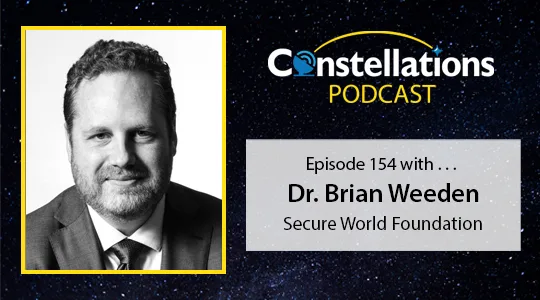
John Gilroy: Welcome to Constellations, the podcast from Kratos. My name is John Gilroy and I’ll be your moderator. Our guest today is Dr. Brian Weeden, Director of Program Planning, Secure World Foundation. Today we’ll be talking about space domain awareness and the changing face of space sustainability. The mission of the foundation is to work with governments, industry, international organizations, and civil society to develop ideas and actions to achieve secure, sustainable and peaceful uses of outer space, benefiting earth and all its peoples. So jump right in here, Dr. Weeden. You’ve been in this industry a long time, so how has your view on space sustainability changed?
Dr. Brian Weeden: Thank you for inviting me. I’m very glad to be here and happy to talk about this. It’s changed quite a bit. I got into this industry as an officer in the United States Air Force. My second job was working for the squadron at then that point in time located inside Cheyenne Mountain, Colorado doing, what we call now, space domain awareness mission, tracking all the stuff in orbit. That really opened my eyes as to what’s up there, what we’re doing. Then we started to see all this debris and more satellites and security issues and threats. That set me on this path of focusing on space sustainability.
John Gilroy: So let’s talk about this Secure World Foundation. So what is Secure World Foundation doing regarding this concept of space sustainability?
Dr. Brian Weeden: Well, we’re a little bit unique in that we are a privately funded foundation based here in the United States, although we do work all over the world and we’re the only ones that we know of that are dedicated to this mission of space sustainability. We believe that space has been used for all these great benefits and capabilities for commercial, national security, civil, and science. We want to make sure we can continue to do that into the future as we find even new and better ways to use space. So all of our projects, all of our focuses are on that question of how do we ensure the long-term sustainability of space. Within that, there’s a lot of things that we do. We have a whole set of programs focused on space sustainability enable itself. So dealing with things like space debris and space traffic management, and how do we provide oversight of all this new and amazing commercial stuff coming along? How do we enable it? And also, all the security issues. What do we do about potential conflict in space and a satellite testing? We also have some other programs that are focused on how to better use space to our benefit. How can we help to solve global challenges using space data? So what I do in the foundation focuses more on the sustainability of space itself, and we have a couple of others that focus more on how we use space for sustainability on earth.
John Gilroy: Well, this is the Constellations Podcast, so I got to ask about constellations of course. So with the proliferation of LEO constellations, how do you see space domain awareness changing?
Dr. Brian Weeden: Yeah, that’s a great question. When I was doing that mission in the Air Force back in the early 2000s, there were 1,200 or so active satellites in orbit, and today I think we’re over 7,000 active payloads. If you plot those out on the curve, that is growing very, very rapidly when there are projections of tens of thousands in the next 5 to 10 years. It’s really grown dramatically. I think on the one hand, we’re a little bit better than we may have thought we were going to be. I know when the large constellations were first proposed, there were a lot of concerns. Is this going to screw up space? How can we even manage constellations of thousands? And to their credit, organizations like SpaceX with Starlink, OneWeb, and a couple others have done a pretty good job of managing what’s up there already. Of course, that doesn’t mean that it’s going to be that good forever. We’re still going to have lots more and to me, one of the really big questions is how are the different constellations that are going to be operating close to each other, how do they interface, especially if they each have their own autonomous maneuvering systems that may have different decision-making criteria. How that all works out is a big challenge. Going back to the way we’re managing this, one of the real challenges is that the U.S. military is still the central focus point for the data on what’s in orbit and providing the alerts about close approaches and potential collisions. Unfortunately, the systems they had to do that were antiquated and ancient when I was there 15 years ago and even more so today. So there’s a whole conversation going on about what part of that mission do we transition away from the military to some of the Department of Commerce? What is the role for international cooperation? What is the role for international coordination? What role can commercial companies play in helping provide better data, better analytics, better algorithms to handle this task? Because the problem is right in front of us. We’re seeing the growth in debris and constellations, and we have to improve our domain awareness, space situational awareness capabilities to deal with it.
John Gilroy: Let’s drill down on this commercial concept here. So how do commercial SDA providers enable transparency?
Dr. Brian Weeden: Well, it’s a great question, and I would say this is something new to this segment of the space industry. Prior to 2013 or 2014, really the only source of data was the governments, both the United States and Europeans a little bit with a couple of others. Then you started to see the commercial companies starting to play a bigger role, and that was in part enabled by the technology getting cheaper and getting better and coming down in cost. It turns out you can do some pretty amazing things with relatively low cost, almost off the shelf telescopes and some interesting new ways to build radars. Couple that with some really fancy software and cloud services and analytics. There’s some pretty amazing stuff you can do. One of the advantages is it’s coming from a commercial company and there’s not necessarily the same concerns there about geopolitics or about national security as there would be if a military is providing this data. Of course, the U.S. military is having to look out for some really serious threats out there. Some of the same sensors they use for things like missile warning are also being used to track stuff in space. There is a legitimate concern about providing those data from those sensors that might reveal something about those other national security missions so having the commercial entities and also other scientific entities coming out there, providing the data, I think is a good thing from the industry because it makes more data available, it diversifies the sources of data and helps provide a little bit more insight into how that data is being generated, which hopefully is going to enable some more transparency in what’s going on in space.
John Gilroy: So Brian, before the interview started, we were going back and forth on the NFL. The local team, of course, drafted a defensive back. Now defensive backs have to have good awareness of what’s going on in the field, don’t they? The same applies for the interview today with space situational awareness. It’s important for the military, we know that, but with this increased commercial activity, I think SSA has to be involved in civilian space as well.
Dr. Brian Weeden: Yeah, absolutely.
John Gilroy: A few companies and nation states have the resources to fund or operate their own SSA network. So how do you resolve this push and pull?
Dr. Brian Weeden: No, that’s exactly correct. By the way, space situational awareness is the term we use for this broader issue about knowledge and space activities. Space domain awareness is the term the military has started using recently to talk about the national security angle on that. You’re absolutely right, this started as mostly a national security function because that’s who was interested and that’s who had the ability. But now we need this same data to protect the International Space Station, to protect NASA earth science missions, to protect commercial activities, to provide oversight and licensing of commercial activities. So it’s a much broader mission set, and you’re absolutely right. There are a lot more countries that are starting to think about this and starting to develop their own capabilities. I’ll just highlight a couple. South Korea, Japan, and India, are all countries that we’ve actually worked with over the last several years to help them think through what their national policies should be on space situational awareness, dealing with debris and sustainability. What kinds of indigenous capabilities are they going to develop to be able to contribute, collaborate, and share with the other countries. Because this is an area where no one country can do this all by themselves. There has to be a level of data sharing and collaboration.
John Gilroy: When I drove here today, I noticed there were stop signs and stoplights and I abided by the standard rules for traffic. I mean, you know and I know, they didn’t originate 150 years ago. They evolved over a long period of time. We don’t have enough time. We’ve talked about the number of payloads going to be out there next few years, we just can’t wait for things to evolve. So how do you establish international norms and rules for this space traffic? The U.S. Department of Commerce has been tasked with developing space traffic management, really, but what about other countries? How do you set up standards and regulations outside the United States and possibly in the United Nations?
Dr. Brian Weeden: Yeah, this really is the question of our time, and as you said it’s a pressing matter because of the growing use in space. So we’ve been doing activities in space for several decades, and there is some learned experience there on how you operate on the best practices to detect potential close approaches, avoid collisions, and do some other things. Part of the challenge is there’s a lot of new actors coming in, both governments and companies. How do you get all those new drivers to use your analogy up to speed on things. There’s not really a lot of global consensus on these. There’s the best practices that one government or one country has and the best practice somebody else does. So what we’re seeing now is a few different things that are happening. Within the United Nations there was an effort that ended in 2018 to develop a set of recommended guidelines for long-term sustainability and part of this includes this topic of debris and avoiding collisions. Now there’s a mechanism for countries to share their best practices and share advice with each other on how they’re doing this. And then, yes, we’re talking about space traffic management. That’s a little bit hard to get your hands around because there are some really big differences between traffic management for cars, for aircraft, for ships and for space. The big one is orbital mechanics is really different for how stuff in space moves, but we’re talking about it. In the United States in 2018, there was a presidential policy directive giving the beginnings of this task to the U.S. Department of Commerce, and they are currently developing a set of civil SSA capabilities and data sets to take over part of that mission from the Department of Defense. They’re also thinking about what comes next in terms of creating some space traffic management rules, although they don’t quite have all the authority to do that, but you’re right, it can’t just be the United States. There are multiple countries that are thinking about this, and the way I see it evolving is a bit the way we do for air traffic control. In the air traffic world, there is an international organization called ICAO that sets the global standards for how aircraft operate and how they interact. Then each country has a national administration, in the U.S. it’s the FAA, who implements and regulates our aircraft activities. I think some elements of that makes sense. In the space world, that means we need to not only talk about a set of global standards, but then have national ways to implement those.
John Gilroy: The Constellations Podcast was launched back in 2017. It was a small step for man, but a giant leap for podcasting. Today, thousands of people from all over the world listen to Constellations and thanks to you, we’ve grown into more than just a podcast. Sign up for the Constellations newsletter to receive articles on current industry issues, podcast summaries and contributed blog posts at constellationspodcast.com. Well, Brian, you’re living in the Washington D.C. area, so it’s fair game for me to refer to a past president. I’m talking about President Truman. President Truman would get advice from economists all the time, and he said, “Give me a one arm economist”, because he says, “On one hand, we have this. On the other hand, you have that. Give me a one arm economist.” So I want you to find me a one armed person to answer the question. On the one hand, everyone wants this transparency. On the other hand, it’s possible that the military may be using dual use capabilities, dual use. So how can transparency in space enable the responsible deployment of dual use capabilities? You’re getting pushed and pulled into directions here, aren’t you?
Dr. Brian Weeden: Yeah, no, and this has been a long-running debate in the space world since we started. There are so many capabilities, including rockets themselves that could be used both for military purposes, delivering nuclear payloads, and for civil peaceful purposes, launching scientific satellites and launching astronauts. And how can you tell what something is being used for in space, whether it’s being used for military purpose or whether it’s being used for a civil, peaceful purpose is extremely difficult, especially with the new technologies coming down the pipeline such as Rendezvous, Proximity-Operations, satellite servicing. That could be great in terms of enabling sustainability, enabling be able to clean up space, but they also have a lot of potential military applications. So what’s happening now is a discussion among countries around how do you define responsible behaviors in space? And the reason they’re talking about behaviors is because that is easier to identify and monitor than trying to define whether a certain thing or a certain technology is a weapon or is not. Because we all know cars, scissors, pencils, lots of things around us could be used in nefarious ways and the same thing in space. So in order to do that focus on responsible behaviors, you need to then be able to monitor what’s going on in space. So that ties back into this need for better global monitoring of what’s going on, space domain awareness, space situational awareness as sort of the cornerstone of then being able to say, “Oh, we see that entity operating outside of the agreed norms, outside of what we think is the responsible behavior.” We then can then take the next step. We can sanction that behavior. We can call it out, maybe even if it’s a military threat, take other actions.
John Gilroy: I was having coffee with my son last week and I said, Kevin, there’s a lot of action with satellite and space outside the United States. We don’t have a monopoly on smart folks. A lot of stuff is going on outside the United States. And so as commercial tracking capabilities expand, how do you see the usage of these capabilities versus indigenous native systems?
Dr. Brian Weeden: No, it’s all going to be used together. As I alluded to earlier, no one country can do this all by themselves. Even the United States with all the money we spend on space in the military is struggling to have a global network to track everything all the time. So the United States is relying on data and partnerships with other countries using commercial services. So the commercial companies are going to be part of this. There’s a lot of countries out there that, as I mentioned, that are getting into this space. A lot of them have a couple of radars or a few telescopes or a little bit of ability to do this. They’re looking to augment that by buying some commercial data or making partnerships. So a great example is New Zealand. New Zealand is now a launching state. They have a company that is launching rockets. They have satellites. They’re responsible for as a launching state. They want to know what’s going on. So they have a partnership with a company called LEOLabs, where LEOLabs put a commercial radar in New Zealand, and in exchange for those rights, they have a relationship with the government where they’re providing the New Zealand government with a platform where they can monitor New Zealand licensed objects in space. And that’s the kind of example we’re seeing happen across the world with multiple governments and multiple companies.
John Gilroy: Multiple governments, multiple countries. Let’s talk about some of these other countries. As commercial satellites are openly threatened by other countries, how do you see the SDA environment having to change and adapt?
Dr. Brian Weeden: Yeah, this is a really new and emerging question, in part coming from what’s happening in Ukraine where commercial satellites are playing a pretty big role in that armed conflict. You have commercial satellites being used by Ukraine for imagery, for intelligence of what’s going on, in some cases for communications with battlefield troops or even targeting, you have communication satellites being used. It’s raising a lot of big questions. Unfortunately, I don’t have any answers here. This is a question that the U.S. and many other governments are currently grappling with. To what extent is a government responsible for protecting its commercial activities? And again, this is not new to space. We had the same debate when it comes to airlines or ships or other people, and how much does that mean a proactive versus a respond if something bad happens? But it’s a topic that is coming to the forefront, given what’s going on in Ukraine and likely to happen in future conflicts as well.
John Gilroy: The Secure World Foundation publishes a report every year on global counterspace capabilities. And the latest version just came out in April. The first version was printed over five years ago. It seems like five decades in the space world, doesn’t it? And what’s changed? What dynamic or technology is influencing the development of counterspace activities now versus back 50 years ago, five years ago? It’s changed so much.
Dr. Brian Weeden: It’s a great question. So by counterspace, we mean all the various technologies that can be used to interfere or attack satellites. So we’re talking about not only destructive anti-satellite weapons, but also jamming, electronic warfare, direct energy, and we include space situational awareness as part of that, because you need those SSA capabilities to either detect threats or to target other satellites yourself. So we track that as part of this. Honestly, the biggest change we’ve seen is more countries are doing this. We’ve gone from tracking five or six countries in the first edition to, I think we’re up to 11 or 12 in the most recent edition, as more countries announce policies for offensive defensive counterspace capabilities, as more countries have dedicated space domain awareness or SSA programs to develop those capabilities. So that is a noticeable trend we’re seeing. On the positive side, we are not seeing destructive attacks being launched against satellites and places like Ukraine and Syria and other military operations, armed conflicts, we’re seeing non-destructive attacks, cyber attacks, electronic warfare that are being used. But so far, we’re not seeing those destructive attacks that many of us fear because the problem there is destroying a satellite creates a whole lot of space debris, which stays up there for years or decades afterwards, and that poses a real problem for space sustainability.
John Gilroy: Dr. Weeden, you studied at the International Space University, Space Studies Program in Beijing. So do you think your time in Beijing impacted your perception of other cultures and their interpretation of this global space universe?
Dr. Brian Weeden: Yeah, that was quite an interesting opportunity. So the International Space University has a master’s program at their campus in France, but they also do this summer studies program at a different location every year. And I happened to have a chance to do it back in 2007 when it was in Beijing, and there were about 135 participants from over 30 countries that were there, and we were all living and studying and working together space 24/7 for about nine weeks. And it was really incredible as a intercultural experience, which is the term that ISU likes to use, because I was on a team project on space traffic management, which is not unusual given what I focus on. And we had people on that team from not only United States and China, but also multiple European countries, and I think maybe 15 different countries on there, and getting that group just to think through these same problems and talk about how they approach it and the different ways, different cultures approach these issues. It was quite eye-opening. And in fact, I’ve maintained quite a lot of relationships and friendships with some of the people that were in that program. And if anybody has an opportunity to do ISU, either the main campus Masters or the SSP program, highly recommend it. It’s a really great intercultural interdisciplinary experience.
John Gilroy: Yeah. Brian, I think you’ve given our listeners a pretty good idea of space situational awareness and this idea of counterspace capabilities as well. Now, if you are interested in learning more, the fifth Summit For Space Sustainability is a high level, multi-day event focused on developing solutions for space sustainability. And it’s hosted by guess who, Secure World Foundation. It’ll be held June 13th and 14th, New York City. I’m sure you can go to the website and register. I’d like to thank our guest, Brian Weeden, Director of Program Planning, Secure World Foundation. Thank you, Brian.
Dr. Brian Weeden: It was my pleasure. Thank you.