Transcript:
John Gilroy: The views expressed in this podcast or on www.constellationspodcast.com, do not officially represent the views of the U.S. Military or the United States government. The appearance of U.S. Department of Defense, DoD visual information, does not imply or constitute DoD endorsement.
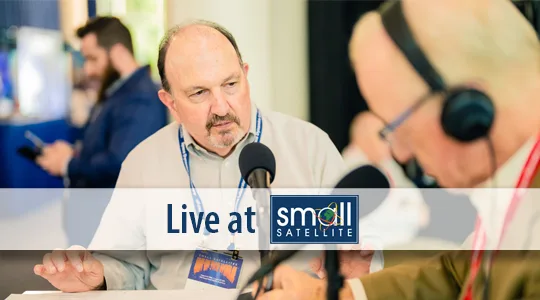
John Gilroy: Welcome to Constellations, the podcast from Kratos. My name is John Gilroy and I’ll be your moderator. We are here in lovely downtown Logan, Utah, at the SmallSat Conference. Our guest is Dr. Frank Turner, Technical Director of the Space Development Agency. In the world of space and satellite, the SDA is small but powerful. The way I understand it, Frank, what you folks do is you quickly deliver needed space-based capabilities to the warfighter to support terrestrial missions. The way I understand it from your website, it looks like you’re going to be delivering an MVP, a minimal viable product, every two years by employing spiral development methods. How did I do? Is that close?
Dr. Frank Turner: That is absolutely right on the money. You’re doing great.
John Gilroy: How do you differ from the other federal agencies?
Dr. Frank Turner: I think the real difference in SDA is the model that we use in the way that we approach acquisition. We believe that schedule is king. Schedule is all-important and we will hold schedule and we will trade capability because when you do things on two-year centers so that we are putting out a new tranche of satellites, a new capability every two years, then the warfighter only has to wait for that next level of capability for 24 months. It’s better to give them an 80% solution on time that they can depend on than wait for that next 10% or 5% or that next really exquisite capability that will be the greatest thing, but it still takes you five years, and for five years they don’t have anything to work with.
John Gilroy: I guess from 40,000 feet up, your customer is the warfighter.
Dr. Frank Turner: Our customer is absolutely the warfighter.
John Gilroy: And so what you’re trying to do is solve problems for the warfighter. What is the biggest problem your agency is trying to solve for a typical garden variety warfighter?
Dr. Frank Turner: As we move into Joint All-Domain Operations as a concept that the Department of Defense wants to employ, to enable sensor to shooter, to enable the data that needs to be at the tactical edge to get there on tactically relevant timelines, and what we have to do is lower the latency of that data by moving it as fast as
Dr. Frank Turner: we possibly can. We also have to make sure that there aren’t barriers to go from data wherever it’s created to wherever it’s needed. And that’s the key thing that we’re working on for the warfighter, getting the latency of that data down and enabling that transmission, that transport from point A to point B, so that it’s enabling decision making at the absolute tactical edge by virtue of the data that they have available to use.
John Gilroy: Feds at the edge, it sounds like, huh? That’s what it is. I’ve had many conversations with software developers, and I learned the term agile software development, lean software, and all kinds of stuff. At your website, you talk about spiral development, maybe you can differentiate for the software developers listening here.
Dr. Frank Turner: The whole idea behind spiral development is that you want to put out a capability and you want to do it on time, and you want to have something that the warfighter can count on. I’ll give you a couple of examples. Our Tranche 0 satellites, which are going to launch in seven weeks at the end of September, is going to be the first set of satellites where we’re going to put Link 16 in space. Link 16 is a very prolific tactical data link that the military uses to fight wars. That’s the way they communicate, that’s the way they move data. There are 35,000 Link 16 terminals, out there that everybody uses, not just the U.S., but our allies and partners. So, we’re going to demonstrate that we can move data over Link 16 with T0.
Dr. Frank Turner: Well, the next spiral, our Tranche 1 capability which will begin launching in September of 2024, will take that Link 16 capability that we’re going to demonstrate starting this year and it will turn it into a global access capability that the warfighter from any point on the globe can use and will be able to support one regional conflict. We’ll have regional persistence in our Tranche 1. Then in Tranche 2, we’ll fill out that capability with a global persistence so that we can do multiple regional conflicts if necessary. So, in T0, we do the demonstration, we get it up there the first time. In T1, we make it globally accessed but regionally useful. And in T2, we make it globally accessed and globally useful. So, it’s that constant next capability on two year centers the warfighter can depend on, and that gives us those spirals as they come out.
John Gilroy: The software folks talk about continuous development, but in a warfighting environment, you don’t have a choice. I mean, it has to be continuous and all the time, doesn’t it?
Dr. Frank Turner: Yes, it absolutely does. For the software that we’re building for the command and control software, for the mission integration, for the network maintenance, and all of those things that we’re doing, we’re doing exactly the same agile continuous development as everyone else is doing in the software world. And we’re also extending it, if you will, to a hardware model where we’re constantly bringing out those spirals.
John Gilroy: What is interesting is that you’re applying it to large mission critical projects, where a lot of people would apply maybe an agile software development, something small, but this is serious business. This is a serious military application and so it’s kind difficult to accomplish those goals, I would think.
Dr. Frank Turner: It is but one of the things that we really depend on is our industry partners to bring us capabilities that we can actually do, we can actually deploy. One of the things that we pride ourselves on is we are looking for technology readiness level, TRL 6 or better, by CDR so that we know that technology is ready to go to space. It may not be a 9 because it may not have been to space, Link 16 is a great example, but we know it’s ready to go to space and we feel very comfortable that we can actually get it up there and it will accomplish the mission it’s intended to do.
John Gilroy: I was at your website and I was reading. There’s a lot of good stuff there. What it looks like is you are working on something called a transport layer that will be comprised of a network of small satellites in LEO. Maybe at the same time, you’re working on something called a tracking layer. Is there a relationship between these two or how do they help your customer, the warfighter?
Dr. Frank Turner: The transport layer has been called by the Joint Staff the backbone of JADC2, Joint All-Domain Command and Control. The transport layer is that mesh network in space that will enable low latency, resilient movement of data for the warfighter from point A to point B on a global scale. We’re building a mesh network in space that’s optically enabled, we’re putting optical inter-satellite links on our space vehicles so that data can move at light speed.
Dr. Frank Turner: The tracking layer is going after a very specific warfighter problem, which is next generation advanced missiles. So, we’re going to contribute to the hypersonic fight. We’re going to contribute to the warning, tracking, and defeat of the advanced missiles that our adversaries are developing and deploying that will change the 21st century battlefield completely. We’re contributing to that. The data from the tracking layer will actually move over the transport layer so that we reduce the latency in that data as well and we get that information into the fight as fast as possible. So, the transport layer, think of that as the backbone, as the key thing that holds it all together, kind of the linchpin. The tracking layer is a specific capability going after missiles. And then we’ve got another couple of capabilities that go along with it, but it’s all enabled by the transport layer.
John Gilroy: Frank, it may surprise you, but people from all over the world listen to this podcast. So, you’re going to be famous all over the world soon. I think earlier today, we had a guy from Poland walk up here and he said, “Yeah, I listen just to keep up with what’s going on.” And so what happens is when we use vocabulary words, I try to make them accessible to everyone.
John Gilroy: Earlier, you used the word tranche, T-R-A-N-C-H-E. And so, if you’re listening in Poland, Japan, or wherever, it just means a portion or a section or a group, right? I mean, that’s what a tranche is.
Dr. Frank Turner: What we call our tranches, they are our spirals. So, it’s a capability and to be honest, the term tranche was coined by SDA before I got there so I’m not sure exactly where it came from. But you could call it something besides a tranche if you really want to, but just think of that as one of our spiral capabilities.
John Gilroy: Within spiral development. Now it all makes sense. That’s great. Let’s talk about tranches, as you say. It looks like the SDA will be introducing satellites in the constellation every two years in tranches. At some point, it’s a very sensitive point for me, the first satellites launched will be technologically old. What’s the plan to deal with these old satellites?
Dr. Frank Turner: Well, we’re only designing satellites for a five-year lifespan anyway and we’re making sure that satellites have a capability to de-orbit. We are good stewards of the orbital realm. We’re not going to leave trash up there, we’re not going to leave junk up there. The ability to de-orbit those satellites and get them out of the planes that we’re operating in is very important to us. So, if we assume that at the end of five years and they’re up there, they’re going to de-orbit anyway. The other thing is, if we reach a point where we need to, we will de-orbit a functional satellite because it’s time. It’s outlived its usefulness, there’s a new tranche coming, there’s a new capability coming, and we’ll literally de-orbit it.
Dr. Frank Turner: The idea here is we want to transition space to think of it as an automotive model or to think of it as an electronics model. When your iPhone gets old, you just throw it away or you trade it in or something like that, even if it still works. And that’s exactly what we want to bring to space. We’re lowering the price points and when they’re no longer useful, we’ll get rid of them.
John Gilroy: Kind of an interesting question about this transition, so all future tranches have got reconstitution aspects to them? In other words, maybe Tranche 2 will include acquiring more Tranche 1 satellites as spares. So, they work together in different segments, right?
Dr. Frank Turner: For the most part, no. As you do something like an SDA construct, the idea of replenishment and reconstitution literally becomes something that you have to think of in a different way. If one of the things that we’re doing with each tranche is increasing capability a little bit, affordably, and that we can get on a very defined schedule, then we actually don’t have, frankly, the ability to do a lot of replenishment and reconstitution because we’re already building and launching new satellites about as fast as we can.
John Gilroy: Wow. In my world of cloud computing, everyone talks about vendor lock-in. It’s really a tough word. Let’s just take it over to your area here. How do you create or support a competitive marketplace where you can avoid vendor lock-in or proprietary systems taking over?
Dr. Frank Turner: A number of ways actually and I’ll quote our director, Dr. Derek Tournear, hashtag capitalism. SDA does not believe in incumbents. SDA does not believe that just because a company or companies provide Tranche 0 satellites, that they should provide Tranche 1 satellites, Tranche 2 satellites, Tranche anything satellites. Everybody has to compete every single time and they have to compete on, as much as we can make it, a completely level playing field at that point.
Dr. Frank Turner: As an example, we have four primes in Tranche 0. We added a couple of different companies in Tranche 1 as we’re building out what Tranche 1 is going to look like. We’re up to 3, 4, 6… We’ll probably end up with a total of maybe eight or nine prime contractors building Tranche 1 or affiliated sets of space vehicles. But the goal always is that it’s a level playing field. Each acquisition is independent and folks bid if they want to. But what we’re trying to do is send enough demand signal and make sure the people understand the schedule so that if a company wants to invest in being able to win a contract from SDA, it’s up to them.
John Gilroy: Well, sitting on the floor here of the SmallSat show, there’s hundreds of companies that want to hear that, aren’t there? We want to hear that and say it again. I mean, that’s good news for people sitting behind us, in front of us, all over the place. Frank, thousands of people from all over the world have listened to this podcast. Go to Google and type in “Constellations Podcast” to get to our show notes page. Here, you can get transcripts for all 100 plus interviews. Also, you can sign up for free email notifications for future episodes. Let’s look up in space a little bit now. Take our eyes off of Utah, look up in space. It seems that the government wants commercial companies to send data directly to their constellations, to SDA satellites. Instead of going vertically, they want to go horizontally. Why is that and what makes it so difficult?
Dr. Frank Turner: Just like the government has multiple networks for its data, there’s the basic completely open internet, and many government personnel use the completely open internet for all kinds of different things. And then you get to the level where the government closes the internet just a little bit, but the information is still unclassified. And then you get to SIPR, the secret internet, if you will. And then finally up to a full-blown top-secret level with JWICS.
Dr. Frank Turner: So, the government has multiple networks terrestrially to enable the data that it needs to send depending on the security requirements of that data, depending on the latency the data can stand, depending on the importance of the data. The space environment will be identically the same. Let’s take some of the emerging multi-satellite constellations. There’s plenty of information the government can and should use those constellations to send. There will be opportunities for those companies to have contracts with the government to move government data, to make lots of money. That’s exactly what should happen. Again, hashtag capitalism. Then by the same token, there will be information that the government needs. It needs the security, it needs the dependence on that set of satellites, and that’s what SDA is doing. We’re putting that infrastructure in place that will be owned by the warfighter, used by the warfighter and if we actually have to go to war and use a space-born layer to prosecute that war, that’s what SDA is providing.
John Gilroy: And that is again, music to the ears of all the people here in this conference. This is the right place and the right time, Frank. You’re at the right place here. Let’s switch topics here. Let’s talk a little bit about optical inter-satellite links, what we just mentioned. I think your agency is used to creating these mesh networks. Have you changed strategies to have found a different way for the transport layer to quickly move data? Anything new?
Dr. Frank Turner: Well, I spent time over my career at AFRL, at NRL, and at DARPA. I apparently cannot keep a job. But I was at all of those places, and I know beyond a shadow of a doubt that they’re working on something faster than the speed of light, but I don’t think we’ve found it. So, we are actually all-in on optical inter-satellite links, and the Tranche 1 satellites as an example, will have four optical inner- satellite links on them to make sure that we can go cross-plane and we can go in-plane so that we can build that mesh network in space. And as we move into Tranche 2, Tranche 3, our goal is that we reach a point where we can actually put up to six, potentially, so that not only can we go cross-plane and in-plane, we can go up so that we can connect to satellites in MEO or Medium Earth Orbit, GEO or Geostationary Earth Orbit, and we can actually go to the ground all the time from each vehicle.
Dr. Frank Turner: So, we are all-in optically. We’ve published a standard, it’s on our website. It’s completely open so people can go look at it. The goal being that we are trying to help the DoD and industry understand this is where the warfighter’s going, and we are going to make it such that the warfighter can communicate optically globally.
John Gilroy: When you said the speed of light, I was reflecting on this guy named Vint Cerf. We interviewed him a couple years ago. He’s working on deep space internet. I said, “Well, Vince, what is your biggest challenge?” And he said, “Well, my biggest challenge is the speed of light.”
Dr. Frank Turner: That’s exactly right.
John Gilroy: He said, “That’s a little over my pay grade.” I mean, he’s very well-known in many communities. Your agency, the SDA, recently issued a solicitation for the National Defense Space Architecture Experimental Testbed satellites. What will they do differently?
Dr. Frank Turner: One of the things about SDA is we have been labeled by the Department of Defense as the constructive disruptor in acquisition. We have a completely different model, we’re doing things differently. We’re doing things on different timelines, at different speeds, you name it. We’re just doing different stuff. Well, one of the ideas behind disruptive technology is that it’s always, always a good idea. So, the SDA, we’ve gone through now a total of I think we’re up to eight or nine acquisitions. We’ve done them all the same. They look a lot alike, the proposals look a lot alike. But by the same token, what we need to do is we need to think about, “Well, how do we, the SDA, disrupt our own model? What is it that we can do to do something different in space?”
Dr. Frank Turner: The idea behind NExT, the NDSA Experimental Testbed, is that we’re actually looking for ways and means to provide new capabilities to a proliferated Low Earth Orbit, proliferated LEO set of constellations. And we kind of want to do a try before you buy, if you will. So, what we’re doing is buying space vehicle buses off the ends of assembly lines and we’re then taking those buses, we’re going out to government mission partners looking for payloads. And then we’re going to launch those satellites and operate them with our mission partners, looking for those next capabilities that we would then proliferate in Tranche 2, Tranche 3, Tranche 4, so that we have already identified the next set of capabilities the warfighter needs.
John Gilroy: Well, here we are in Salt Lake, Utah, and I see people in uniforms floating around, I see a lot of students, and I think there’s a lot of startup companies too, which means a lot of new ideas. You have been quoted as saying that the SDA is open to new ideas and want to have a conversation about those ideas. So, where can someone maybe at the conference or someone listening to this, where can they go to discuss what they have to offer you?
Dr. Frank Turner: Well, there’s a number of ways. Let me start by saying that you can always send an email to [email protected], but that’s a blind email box. It comes in, we take a look at it, then we’ll respond. I know for most folks, they say, “Well, if I send an email, nothing’s going to happen.” I promise you something will happen, but I can understand where that’s not a great thing to do. If you happen to know the folks at SDA, people at SDA are very, very willing to talk to you. So, if you know the right person to talk to, by all means, send them an email, give them a call. We’re looking for those capabilities.
Dr. Frank Turner: If you don’t know the right person to talk to and you don’t want to just send an email, I’ve said it before in open forums and I’ll say again, I’m always willing to talk to people. Just give me a call, send me an email. I spent too many years in
Dr. Frank Turner: industry where the government wouldn’t talk to me, and I swore when I came back into the government, I would not be that person. I wouldn’t be the one that just because I’m a government person and a government organization, I would say, “Well, I don’t have to talk to industry anymore.” That’s not the idea. It’s a partnership. We can’t be successful unless industry’s successful. I’ll always talk to folks.
John Gilroy: Wow. Well, Frank, thanks for giving our listeners a greater understanding of the complex software development projects to assist the warfighter. I’d like to thank our guest, Dr. Frank Turner, Technical Director for the Space Development Agency.