Transcript:
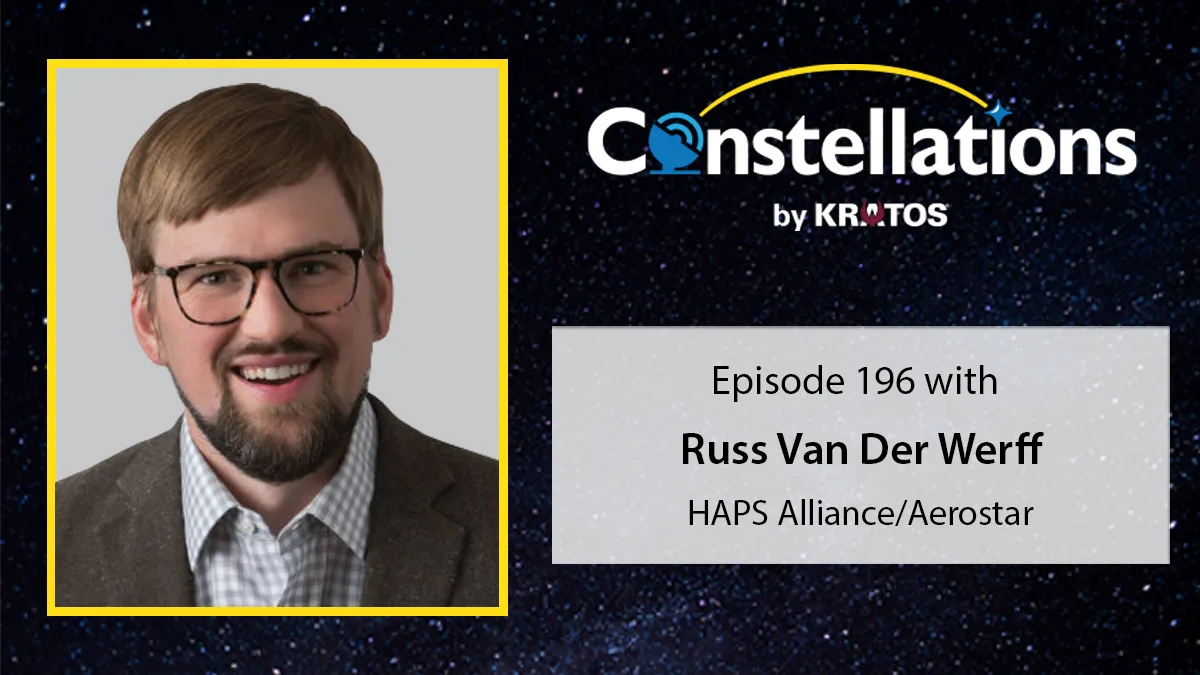
John Gilroy: Welcome to Constellations, the podcast from Kratos. My name is John Gilroy and I’ll be your moderator. Our guest today is Russ Van Der Werff, Vice President of the HAPS Alliance and VP of Stratospheric Solutions at Aerostar. While LEOs may be getting all the attention, an emerging story continues to rise to the stratosphere in the form of high altitude platform stations, H-A-P-S, HAPS. HAPS offer the potential to unlock the Earth’s stratosphere to enhance connectivity around the globe. HAPS have the potential for substantial opportunities to advance many industries spanning telecommunications, high- res Earth observation, weather prediction, modeling. LEOs and HAPS are both technologies used for communication, surveillance and data collection, but also have distinct differences in design, functionality and use cases. Here to share some insights into the similarities and differences between LEOs and HAPS is Russ Van Der Werff, Vice President of the HAPS Alliance and VP of Stratospheric Solutions at Aerostar. Russ is an expert in HAPS technologies and has over 15 years of engineering and leadership experience in the industry. He serves as the stratospheric ambassador, spreading the gospel of ballooning. Give me some of that good news there, Russ. Give me the good news. So what the heck is this HAPS thing? Can you explain what high altitude platform stations are? I’m confused.
Russ Van Der Werff: Sure, thanks, John. It’s quite an introduction. High altitude platforms are, simply put, anything that flies that’s in a higher altitude than traditional aircraft. And so when you think about normal aviation, we’re talking about, forgive me for using U.S. units but that’s what’s in my head, up to maybe 30, 40,000 feet typically of elevation. When you think about a commercial passenger plane or a drone or something like that, and when you think about satellites, you’re thinking things that are 100 miles way out there. And LEOs, lower Earth orbit, which you mentioned, is a lower band of satellites than traditional geostationary spacecraft, which are way out there, farther away from the Earth, but still much further than a high altitude platform. A high altitude platform, we’re talking typically in the stratosphere. The stratosphere is on the order of 40 to 70 to 100,000 feet, kind of in that range. It’s a band of the Earth’s atmosphere that is quite a bit closer than those spacecraft you’re referring to.
John Gilroy: That could be a distinct advantage, and we’ll talk about that in a few minutes. You pick up the newspaper, you pick up your phone, LEO this, LEO this, satellites and all kinds of stuff going on here. What is the vision here? What’s driving all this HAPS technology?
Russ Van Der Werff: One thing is we’ve developed platforms and technologies that can fly at these altitudes and we can talk about there’s various types, whether it be lighter-than- air or fixed-wing aircraft, different things. Those technologies didn’t exist before, so there wasn’t an option to operate in that space. Satellites have been around for a long time, obviously, aircraft have been around even longer. This is something that’s actually newer. There’s been people up there, but not with effective platforms. So it’s opened up a new opportunity. As you mentioned, there are various benefits to being closer to the Earth than a satellite. You don’t have to be a rocket scientist or balloon scientist to understand. This is a basic physics. When you’re looking down at the Earth, you can see things better when you’re closer. When you’re communicating, communicating with something further away takes a lot more energy. It takes bigger antennas and everything like that in comparison. And so the reason this is getting traction is, number one, there are technologies available to exploit this layer of the Earth’s atmosphere. Number two, there are just advantages to being closer to the ground than a satellite would be. Now, there are disadvantages too and like anything else, there are applications where it’s better and applications where it’s worse, but it’s definitely a piece of the puzzle. That’s why we’re seeing it show up in lots of communication and Earth observation and other kind of publications, and research and things like that recently.
John Gilroy: It sounds like that you may not be competitors. You could complement each other. So are LEO and HAPS complementary or competitive to one another? I think you’re saying complementary, huh?
Russ Van Der Werff: Yeah, no, absolutely. I think just like traditional aircraft and spacecraft serve different roles and have different strengths and different applications, the same thing is true with HAPS. When you think about LEOs in particular, there’s a lot of focus on communications, and lately you hear a lot about direct-to-device communications, which means I can pick up my cell phone and I can connect directly to satellite, which is really cool. The challenge that you’ve got is the distance from here to that satellite is, relatively speaking, if this is the Earth, my HAPS platform is right here, right over the edge of the Earth, that satellite is still way over there by the window in my office in relative terms. And so like I said, that creates challenges technically. Most of the services that are out there today where your phone connects directly for satellite communication, those services are allowing you to do things like send a text message in the case of an emergency. It’s really low data rate information. You can’t watch, for example, a YouTube video on that kind of a connection. Now, there are high altitude platforms available where that link budget, that distance, is a lot closer. The data will flow a lot faster because you just have less distance to cover, and that’s where you get more bandwidth, better coverage when you’re closer to the ground. It’s just basic physics stuff.
John Gilroy: So it could be a situation where it’s use HAPS in one situation hand off to LEO in another. It’s almost like going back and forth just depending on the unique situation?
Russ Van Der Werff: Yeah. I mean, at the end of the day, and there are other technologies on the horizon. With LEO satellites, they’re talking about putting much larger satellites up to get better connections, but you’re still putting a lot more energy into getting that same connection than something closer to the ground. There are other challenges. The space for low altitude satellites is getting more congested. People are starting to have concerns. The larger you go on the satellite, the bigger the visual footprint of that, so there’s a lot of concerns about things like astronomy and stuff that are, as these things are whizzing by, there’s a lot of light pollution in the sky. There’ll be a discussion and there is an ongoing regulatory discussion about how much of that we allow to proliferate and how large we allow those things to be. Of course, the more you want to increase the bandwidth, the connection from your phone to that satellite, the larger the satellite needs to be. That’s just another basic physics thing. There are technologies out there. There will be places where satellite-to-device is the right answer, but there are a lot of places where the high altitude platforms fill a gap as well.
John Gilroy: So I’m taking notes here, just like a dedicated little student here. So, lower latency. Okay, we know that. Increased bandwidth, okay, maybe a little more flexibility, but the phrase that pays here is reduced cost. That’s a big motivator for people?
Russ Van Der Werff: Yeah. Well, it’s not inexpensive to put a constellation of satellites in the sky, and just to talk orbital mechanics a little bit, because I know that’s what gets everyone really excited. LEO satellites, low Earth orbit satellites, in order to maintain their orbit, they have to move very quickly around the Earth, and so the reason … The big one that’s gotten all the press recently is Starlink, and it’s amazing what Starlink can do. We use it all the time around here for lots of different things. It’s a great technology, but they put a lot of satellites, thousands of satellites in the air to accomplish that. Now, that can work when you have a very universal and standardized problem. If I want to cover the whole Earth with a certain kind of connectivity, that can work pretty well. Again, though, you have to have the right equipment on the ground. So you put your Starlink terminal out. It is not very big, but compared to the antenna in your handset that’s in your pocket, it’s quite large. And so it’s just not practical to serve all the different kinds of applications that are out there with LEO satellites. And it certainly isn’t practical to do that for, again, that direct-to- handset connectivity. The thing we should talk about is altitude platforms. You mentioned flexibility. Compared to putting a satellite constellation up that covers the whole Earth, a high altitude platform can serve temporary or regional needs. I can put a platform up over a certain part of the Earth, or maybe I have reduced coverage and put one or two platforms up and maintain coverage over that area, whereas I have to launch a whole fleet of satellites that are orbiting past that point on the Earth to keep that coverage. Another example would be temporary need. So, disaster response. After Hurricane Maria hit Puerto Rico, I think it was about eight, nine years ago, Project Loon, which was a project of Google X Labs, put a series of balloons up over Puerto Rico, and they reconstituted cellular coverage to people’s handsets for a period of multiple weeks until that infrastructure could be repaired. Obviously, launching a fleet of satellites to do that would not be practical. Again, cost-effective, flexibility, higher bandwidth, lower latency, all the things you just mentioned.
John Gilroy: Yeah. Last year, Mira Aerospace conducted a 5G HAPS trial from stratosphere where they delivered connectivity for 73 minutes and even enabled a 5G video call. What do you think is on the horizon for HAPS and 5G?
Russ Van Der Werff: When you talk about traditional cellular communication, we talk about the 3GPP and 5G, 6G, kind of the normal technologies you think about that make your cell phone go. There’s a lot of work being done to enable HAPS as part of a solution. Like you said, it’s a piece in the puzzle. It’s a player. So when you think about non-terrestrial networks, or NTN, that is a technical track that’s being driven down that standards body. The idea of that is that your handset is not just roaming to terrestrial towers, but it might be able to roam up to a high altitude platform, out to a satellite and back depending on the coverage that’s available, which again, that’s driven by what the needs are and the flexibility of these different systems. And so I think you’ll see more and more adoption of these things. The kinds of places you’ll see at first are underserved areas where either infrastructure is difficult to build or it’s not cost-effective to build terrestrial infrastructure. Think remote islands, shipping routes. Think Sub-Saharan Africa where there hasn’t been as much infrastructure investment. Places like that. And then as it ramps up, you’ll see it fill out to meeting gap needs. For example, transient high population areas, maybe events where there’s a lot of people and there’s a temporary need for a lot of bandwidth. And you’ll see the high altitude platforms filling those kinds of gaps where the satellites will be, again, filling the global coverage but at that lower bandwidth, these new technologies in 5G and 6G, as they get baked into handsets that everybody owns, they’ll enable that to work seamlessly. So you as the user, you don’t have to care if you’re roaming to a tower or to an access point that’s strapped to the side of a building near you or to a satellite or a high altitude platform. That should be a transparent user experience. We’re also working hard on the frequency allocation piece, which is another thing that might sound boring, but it’s a lot of work, and the HAPS Alliance puts a lot of energy into making sure that the right frequencies are allocated for all those pieces to communicate seamlessly. So we work with the World Radio Council and the Federal Communications Commission, those kind of folks, to make sure that all those regulations and pieces that nobody thinks about are in place. You pick up your phone, it’s remarkable how many different pieces of technology have to work together to make that video call that you referenced, and you don’t think about it. And so as we see 5G and 6G develop, this NTN technology develop, that’s going to start to become more seamless to where you as the user won’t even know it, but you’ll be leveraging these new technologies and platforms.
John Gilroy: Everything has challenges and barriers. I recently read a biography of Elon Musk, and he had some challenges and barriers there. So what are the barriers here to HAPS becoming a viable mainstream solution?
Russ Van Der Werff: There are some barriers. I think we’re knocking the technical barriers down in different platforms or different levels of maturity. At Aerostar, we fly lighter- than-air balloons, which is one kind of HAPS technology, and we’re flying those things hundreds of flights a year now. We’re flying for millions of hours. So it’s fairly mature. And then some of the more advanced technologies that are leveraging some developing tech, they’re coming. They’ll be coming. They’re starting to fly. The tech piece will mature because a lot of the things that are needed for technology, whether it’s machine learning for wind modeling or better solar tech, better battery tech, those things are being driven by other industries. They’re advancing at a very rapid pace independent of HAPS. So that’s the technical piece. Then there’s the regulatory piece and the safety piece. Those are important pieces too. On the regulatory side, there’s a lot of work going into airspace deconfliction. Deconflicting what’s at what altitude and what’s at what place in the airspace is not something that’s been hammered out, it’s been a problem at 60,000 feet in the past. The Federal Aviation Association, ICAO, which is the International Civil Aviation Organization, you’ve got NASA, they’re all doing work on how do we, as platform builders and providers and operators, work together to deconflict that airspace. That needs to mature. It’s a blocker, but it’s not a huge blocker, and it’s working. We mentioned the frequency stuff. I’d say the frequency allocations so that these things can talk to each other. That’s really had some big breakthroughs in the last few years. So the barriers are disappearing. But one of the things that HAPS Alliance is focused on is knocking those barriers down. A lot of that is working those different regulatory bodies, those different committees, those different technical standards to make sure this all interoperates seamlessly and safely. I think the other piece, as we work through really anything in the autonomous airborne space, drones in all kinds of places. Whether you talk about delivery drones and things like that, there’s a lot of safety regs that are being written and being built right now within FAA and other organizations. And so as those things all mature, I think you’ll see more and more of these platforms in the sky. It’s happening. It’s what we’re working on. It’s just part of the process of making sure we’re a good global citizen in all those areas.
John Gilroy: Russ, earlier you mentioned an acronym that many of my listeners understand. NTN, non-terrestrial networks. I got a question about that for you. A company called SKY Perfect JSAT, they recently announced advancements in their Universal NTN multilayered network that includes GEOs, NGSOs and HAPS. Can you help us understand how HAPS integrate with LEOs and GEOs to deliver connectivity across these networks? You just mentioned it indirectly there.
Russ Van Der Werff: Yeah, certainly. A lot of the larger cellular carriers or data providers, however you want to think about those services, across different nationalities. You mentioned SKY Perfect in Japan, but we’re working with Deutsche Telekom in Germany and with U.S. carriers, both satellite operators and cellular. All of them are working together on these standards. And again, it really just comes down to, at a very technical level, making sure that your phone and the network that’s powering the data flowing to your phone, know how to track where you’re at, what the best connection for your user device is at any given moment, and then how to hand you off between these different assets. Again, traditionally that’s been a little simpler because in the traditional cellular model, all of those stations, all of those base stations or towers, they’re at fixed locations. They don’t move. They have a fixed transmit power. They have fixed antennas, et cetera. When you add satellites and high altitude platforms, now those things are moving relative to you moving. And so just the algorithms and things of coordinating that handoff and determining what the best connection is, what frequency to use so that nothing interferes, it’s all a little more complicated. But again, that’s why we have these technical committees. And I think when you see within 5G, and especially now as they’re starting to work the 6G standards, that’s where those NTN technologies, node to node, so it may not be directly from your handset to the tower, it might be to a satellite or something else, come in. And that more intelligent routing, if you want to think about it that way.
John Gilroy: Back to LEO here. From a LEO standpoint, there are some well-established players such as Starlink and Kuiper. Who are the key companies driving HAPS technology and what are their goals? You mentioned a couple of them.
Russ Van Der Werff: Yeah. First off, just so I’m not being exclusive of anybody, I’d check out our website at HAPS Alliance. That’s our company website. You can see all the members that are listed there, and you’re going to see a broad diversity. Rather than calling out individual members, I’d say we have major cellular equipment providers, we have major carriers, we have satellite companies, and then we have technology companies who are building the pieces and parts to make this work from solar to battery. And then we have what I call the platform providers, platform operators, folks like us who make the aircraft that fly that actually are going to be doing these missions. Rather than calling out anybody in particular, I’d say there are a lot of big names on there. I’d encourage you just to go check out the website and see that list. I think it speaks for itself, and these are all people who are invested in breaking down those barriers you referred to. That’s what we work on within this group.
John Gilroy: You know, we’ve been recording podcasts here for, I don’t know, since 2017, a few years now, and I couldn’t have predicted this conversation. It would have been impossible to predict this, what, seven years ago. So I’m going to ask you to do some predicting here, Russ. I’m going to toss the burden over to you here. How do you see HAPS technology evolving over the next five years?
Russ Van Der Werff: Well, so as those barriers come down, what you’re going to see is the deployment of more systems. You’re going to see more things in the sky, and it’s just going to be proving out these CONOPS that we talked about. Sorry, that’s a little jargony. It’s just going to be proving out these use cases that we talked about with more platforms in the sky. As we figure out how to safely interoperate, as we figure out how to safely communicate, more and more aircraft, more and more balloons doing these kinds of missions. I’d also say that we’ve talked primarily about cellular and about data communications and handset communications here, but there are a lot of other applications you’re going to see developing. So that same set of advantages where communicating is easier than it is compared to, say, a satellite, because you’re closer to the ground, applies to things like remote sensing. We just carried out a few different things this year that are worth mentioning. At Aerostar, we worked with a company called ScepterAir and ExxonMobil to do methane detection and monitoring over extraction sites in Texas. We’ve worked to provide eyes in the sky over wildfires with the U.S. Forest Service. As we get more platforms up there, you’re also going to see proliferation of different applications besides just communication. And you’re going to see all the same kinds of things you might want to do with aircraft and satellites, but places where that low cost, that regional persistence, easy deployability, really are key advantages. You’re going to start to see HAPS playing in all those areas.
John Gilroy: Russ, you’ve really given our listeners a really, really thorough understanding of HAPS, HAPS Alliance and HAPS technology, and hope they’ll be able to put it in perspective when they see it referred to in the future. I’d like to thank our guest, Russ Van Der Werff, Vice President of the HAPS Alliance and VP of Strategic Solutions at Aerostar.
Russ Van Der Werff: Thanks, John. It’s been fun. Hopefully you gained something too.
Outro: Thanks for listening to Constellations, the podcast from Kratos. If you liked this interview, please subscribe, tell a friend, and give us a review.