Transcript:
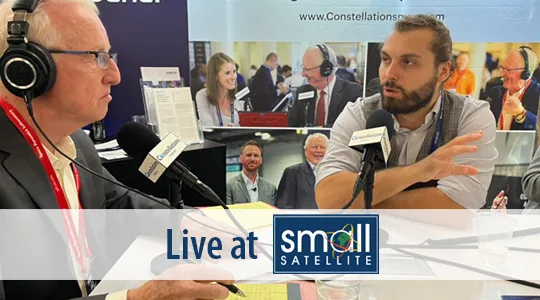
John Gilroy: Welcome to Constellations, the podcast from Kratos. My name is John Gilroy, and I will be your moderator. Today, we are recording this from the floor of the Small Satellite conference in lovely downtown Logan, Utah. Our guest is Giovanni Pandolfi Bortoletto. He’s the Co-founder and Chief Strategy Officer of a company called Leaf Space, L-E-A-F, Space. We’re going to start off with talking about the number of satellites out there and talk about how you can help everyone at this conference manage those satellites. Now Giovanni, you probably realize this, but there are over 20,000 smallsats being launched over the next decade driven by growing demand for data and services across the globe. All of these new constellations need scalable, flexible, and on demand ground services. This is driving the growth of something called ground segment as a service. The market grew by 8.5%, compound annual growth rate the last five years, and will continue to grow at a slightly slower pace over the next five years. At least that’s according to Euroconsult. The prospects for the market are bright, but there are also hurdles to overcome. To delve deeper into this market, this ground segment as a service market, we have with us today Giovanni Pandolfi Bortoletto, Co-founder and Chief Strategy Officer of Leaf Space and is a company that focuses on just exactly this topic. Let’s jump in here real quickly. First, the as a service model has existed in the IT industry for some time, but much newer in the satellite industry. Can you define what is meant by ground segment as a service?
Giovanni Pandolfi B.: So basically it’s having infrastructure and a ground station network to communicate with satellites but also adding up all the software parts to make it easy for customers to assess it and not actually to own any asset, but to use it as much as they can to support their missions. So yeah, it’s right, you said it. It’s really a lot of years that we have seen that in IT, it’s not that much that we’ve seen that in the space sector, but I believe it’s just really an indication of the maturity of the ecosystem that now we have more companies providing from mission operations to ground segment as a service to data analytics. So it’s a good way to say it’s a good market. It’s growing, it’s actually consolidating, and it’s getting more and more mature.
John Gilroy: Now Giovanni, some of the people here are thinking about as a service and they think they’re behind the… No. In the IT world, it took 15 years for that to catch on. It took a long time to convince people that. I think what happened was, I think the technology allowed it to be easier. They tried it, but the technology couldn’t handle it. But the longer we progressed, we got more and more cloud services, more security, and finally, they could do as a service for many different applications.
Giovanni Pandolfi B.: Absolutely, we couldn’t have done it without internet, without cloud services. So that is all the backbone that is actually allowing us to do what we do. But really the thing at the end is really find a way for customers to use someone else’s asset in an easy and flexible way. So that’s what we’re trying to do. But yeah, the concept is not new, it’s the use of that concept in this industry at least.
John Gilroy: Exactly. Well here we are at Small Satellite Conference walking around meeting people. I went into the conference room and heard all kind of great speakers this morning, and it seems like there’s a lot of smallsat constellations going to be launched over the next decade. So what opportunities do you think that will bring to the ground segments of service market?
Giovanni Pandolfi B.: The good thing about where we operate is that all of these constellations in some way, they need to get their data down because we don’t have yet the value creation in space. So we need to actually sell that data at some point on the ground to the end users. So in order to have that, you need a ground station network and you need ground segment as a service. So the more the constellations, the more the new applications, the better it is for us. And at the end of the day, it’s a positive loop. So the more constellations, more capacity to us, we can build up better networks, more expansion, can provide more capacity, and then the customer can provide more data to their end users. So it’s definitely a positive loop. We are also seeing quite a lot of new applications. So it’s not just EO, we have a lot of technology administration, communication, IoT, direct to device. So there’s a lot of new stuff and not just the EO. That is typically the main focus or the hot topic here.
John Gilroy: I went to your website and you folks are all over the world. Constantly changing, fast-paced, industry, complex new technology, and so I’m just trying to guess and I can’t guess. So what are the challenges we can expect with this expansion?
Giovanni Pandolfi B.: So the thing is the challenges are typically you have multiple operators. So you need to be sure, in our case at least, that we are able to use efficiently the same infrastructure for multiple users because it’s the only way that we can really go down with the unit economics and provide a cost-effective solution to our customer that then they can provide a cost-effective solution to their customers on their hand. So really the main thing is orchestrating and making it easier for the satellite operator to actually communicate with their asset without the need for them to do any custom integrations, spend time actually finding out how to connect it to a ground station or building a ground station. So we do all that part and really the main thing is getting a more and more easy customer experience for our users. And that’s the old thing. Then you can do that with different things. You can do that with a number of ground stations, with just software connect, different stations, but the focus for us is really to make it easier and easier to actually communicate with the space asset.
John Gilroy: Well, Giovanni, in Italy, what we say is, “Red flag, red card,” because you used the word orchestration. You stole that from the IT world, didn’t you? That’s what they use in the IT world. In fact, last four years they started to use it. And so it fits very well with what you’re trying to accomplish, doesn’t it?
Giovanni Pandolfi B.: Yeah. So for ground segment as a service, really the antenna part is a commodity. Of course you need to select the antenna part, the baseband, whatever, to make sure that everything works throughout, but at the end of the day it needs to be a commodity, how you use it actually then makes things different.
John Gilroy: So what has your experience been in this growth in this market? Do you see it maybe regional or is it just with one certain specific segment or what have you seen in this growth?
Giovanni Pandolfi B.: So coming from Europe, of course, in the US it’s a much more mature market, let’s say. So our customers are already on the commercial phase of their endeavors. While in Europe maybe… We have really good examples, but we’re still a little bit, I believe a couple of years behind. But in terms of originality, not really. So we have quite distributed revenues from all over the world, and there is not even a specific need for specific location for specific customers. Also, the way that we operate our distributor network is really to try to accommodate as much capacity to our customers as possible. So trying to use the highest number of stations for each customer. So I will not say it’s really just the terms of, I think of maturity. I said the US is much more mature, more constellations, more data production in orbit. In Europe, we were a little bit more conservative. So you can find a lot of service providers like us, like mission operations as a service and this kind of thing. I believe it’s a good distribution on the market by sense.
John Gilroy: But Giovanni, you don’t have gray hair yet. When you have gray hair, it could be a transition to Europe and maybe Africa. The services are just at the early stages now, aren’t they?
Giovanni Pandolfi B.: Well, I hope much before I have gray hair.
John Gilroy: Maybe in two years instead of when the gray hair comes up. You mentioned this earlier, I want to come back to an earlier question. Most ground segment as a service providers are focused on EO, Earth Observation and TTNC. That’s kind of their bread and butter. So you mentioned other services. So do you see new services being offered in the market? You mentioned IoT, anything else?
Giovanni Pandolfi B.: Yeah. So for us, it doesn’t really change anything. If it’s for EO, for direct to device or whatever, the main thing for us is really to provide connectivity in some way or the other. Then what kind of data passes through our network? We don’t care because really the underlying thing is always getting back to that. We’re providing a secure, reliable, flexible way of providing connectivity, then the rest comes from that. But yeah, so initially there was a lot of push from the EO market of course, because it’s the simplest probably endeavor that you can actually understand. But then there are more and more connectivity solutions. Direct to devices, we’re seeing quite a lot of requests in the last couple of years. So it’s growing. IoT, also with different kinds of IoT, with low power or a little bit more wideband communication. And then there are, for us, also a good part is all the orbit transportation. So all the new classes of OTVs for example, et cetera, they always need to communicate there. So also launch vehicles is a new market for us too.
John Gilroy: I think you’re positioned very well because this whole idea of IoT and remote devices, it’s so popular in the Washington DC area. There’s a podcast called Feds at the Edge. Edge computing is making this big transition now. And I think you’re positioning yourself right to have that secure and rival service because the sensors can be on railroad tracks, they could be on buoys and they could be on satellites. It’s a very difficult horse to corral and wrangle it in there. All kinds of these IoT devices. Very difficult. The Constellations Podcast was launched back in 2017. It was a small step for man, but a giant leap for podcasting. Today, thousands of people from all over the world listen to Constellations, and thanks to you, we’ve grown into more than just a podcast. Sign up for the Constellations newsletter to receive articles on current industry issues, podcast summaries, and contributed blog posts at constellationspodcast.com. Let’s look around at your competition. It’s maybe uncomfortable here. We can talk about that. So do you think there’ll be more ground segment as a service providers entering the market or do you see potential consolidation? So who’s going to win, who’s going to lose five, six years from now?
Giovanni Pandolfi B.: That’s a good question. I hope we win.
John Gilroy: Before you get gray hair.
Giovanni Pandolfi B.: Exactly. Definitely before, I hope. Yeah, so there is quite a bit of competition. I would say not a huge number, but there is competition. There are different ways of providing this kind of connectivity. There are also some newcomers, new players also. There are maybe some players that are focusing more on hosting capabilities, for example, or others like RBC Signals, Infostellar, using third party asset and apply services like that. We have our solution. So we really believe in property infrastructure so that we can actually control the full chain of our assets so that we can deliver the service levels that our customers request. And using our software infrastructure that is based on what we call the network cloud engine that is a set of microservices running in the cloud that actually orchestrate the entire network activity, and to use that to get to that customer experience that we were telling before. So really trying to solve all that stuff. Not really just from a technical point of view, but also contractual point of view, customer support point of view. We really want to see ourself as a connectivity provider, and to do that, we really need to detach from the standard antenna renting thing. It’s another thing, it’s really a service for connectivity. And on that, we have been quite successful on our journey. Right now we are providing service to more than 80 satellites with more than 12,000 passes per month. And we’re growing quite a bit. So the last three years we’ve grown like 2.53 times per year. So it’s been quite good. And the competition is there. Absolutely. That’s also what will push us, so we need to get better. So we’re working on that.
John Gilroy: Well obviously you speak Italian, so I’m going to give you an English vocabulary lesson now, and don’t get upset, but the word is coopetition. I don’t know if you’ve ever heard that word before, but it’s a funny word in English, isn’t it? Coopetition. So my question is from a ground segment as a service perspective, do you see teleport operators as partners, competitors, coopetition? One week you’re in their lane, one week you’re partnering. So it’s kind of confusing, isn’t it?
Giovanni Pandolfi B.: From the teleport point of view it’s definitely cooperation. So all our ground stations are mainly on teleport sites. We have some stations that are directly on data centers, but I would say mainly on teleport, and there is totally collaboration. We need some good places with reliable connectivity, reliable power, good customer support there, and then we can put antennas there and use that. So no, it’s definitely a good cooperation there.
John Gilroy: Good, good, good, good. I went to your website and did some research on your company earlier today. Think you’ve been around for about a decade more or less, something like that.
Giovanni Pandolfi B.: We’re old.
John Gilroy: So in these 10 years, what lessons have you learned about this evolution of ground segment as a service?
Giovanni Pandolfi B.: A lot of stuff. So first thing, don’t do the stuff that you can avoid doing. We started by actually building our own antennas.
John Gilroy: Physically manufacturing them?
Giovanni Pandolfi B.: Physically manufacturing and physically turning the balls. So I actually personally went around for I believe five locations actually turning balls around. And it was a mess, but it helped us really understand what were the important things. And actually from one day to the other say, “okay, let’s give this shit away. Let’s buy proper antennas.” We still do some outer assembly inside, but we’ve really seen that the antenna stuff was not really providing that much value. So we needed to focus where the value creation was and it was on the software and orchestration side and on the service. And I believe that was one of the main things that we needed to learn. Really focus on where you are actually putting much more impact on the market and other stuff that is fancy or like an engineer. We like building stuff, but sometimes it doesn’t make sense.
John Gilroy: Well, this is a podcast where people can’t see this, but years ago you were wearing a technician hat and now you’re wearing a chief strategy officer hat. You just changed hats.
Giovanni Pandolfi B.: Yeah, the thing is that I joke about that, but the “S” of strategy is mainly for chief shit officer sometimes.
John Gilroy: Whoa, whoa, whoa, whoa. Well, let’s change topics here. This market, the ground segment as a service market is highly dynamic and ever evolving to keep pace with space. So what approaches such as artificial intelligence, cloud, orchestration are you applying to keep this pace active in space?
Giovanni Pandolfi B.: So as I said before, cloud is definitely one of the enablers that we needed to use to actually be sure that we were providing a flexible service. So we use quite a lot of that. Maybe not like either IT industries yet, but it’s definitely a good part of this. Orchestration is definitely the hot topic for us. We are the only ground segment as a service provider using an automatic scheduling algorithm that actually optimizes the network activities. So we take customer emission constraints on one hand and the availability of the ground station on the other hand, and we have an optimizer so that we are able to guarantee the capacity that our customer needs and we commit on that. And this is done really from automation because without automation, without orchestration, we cannot scale. It doesn’t make sense to scale to 200, 300 people to actually just follow a few satellites. That doesn’t make sense. So that’s definitely a thing. Artificial intelligence, we’re seeing it not maybe right now, even though we are doing some studies and have a Guidewire team actually presenting a paper afterwards on where we could use machine learning to do an anomaly detection on the equipment that we use. So it’s coming, okay. I prefer to call it machine learning instead of artificial intelligence, but it’s definitely coming. And there is a lot of other stuff, but the main thing is for connectivity in space, we’re decades later than the terrestrial ones. So there’s a lot of stuff that we can actually use from the terrestrial networks, for example, and we need to adopt and all these virtualization things and so on, it’s definitely the case because it’s not going to happen that we need to add tens of different hardware to support tens of different satellites. It doesn’t work.
John Gilroy: Speaking of decades, 10 years ago, if you walked up to a chief information security officer or a CIO and said, “We’re going to automate with megabytes,” they said, “No.” It was too scary back then, but now with petabytes you don’t have a choice. It’s like, “Well Giovanni, you can’t do it manually. There’s too much going on. You have to automate.” And that is the rub because it’s very risk involved. But if you have the automation down and you have success with it, that’s good, but the number of satellites coming up, the amount of information, it’s the P. It’s the P word, petabyte now. And you don’t have a choice, do you?
Giovanni Pandolfi B.: Yeah, exactly. But that’s the thing also on our side, we really needed to design the service with automation in mind. If you don’t do that and we start with something and then you evolve, it doesn’t work because you will find out that to support your customer, you need to scale faster with human resources than actually automation. It’s tricky.
John Gilroy: Yeah. So if you look at the market segments that are out there and trying to list different people who offer ground segment as a service, you can look at AWS Ground, Microsoft Orbital, KSAT and more. So what’s the special sauce? What differentiates you from the other providers?
Giovanni Pandolfi B.: So for the first two we actually operate, so we have customers.
John Gilroy: So coopetition or cooperation or something, huh?
Giovanni Pandolfi B.: Yeah, KSAT is definitely our main competitor and they’re doing an incredibly good job. And it’s been a few years that we’ve been trying to catch up to their capacity. We are still doing an eighth or seventh of their capacity, but we’ll go on that. And actually with KSAT, we are collaborating on a lot of missions. What we typically say to our customers is that, “It doesn’t make sense to go with one single provider because anything can happen.” So go at least with two providers differently. And that’s what we’re doing with KSAT. We have some customers using also AWS together with us, Microsoft, but then there are a lot of other good operators like RBC Signal, Atlas Space Operations, and Infostellar for example. So there’s competition. In some cases we collaborate. On our side, the added value that we want to bring is really the flexibility and how we can provide a reliable service in a fast and flexible way. And I can make a lot of examples, but in some cases we had customers coming to us and we were activating the service in a matter of hours. Of course, where we can do that with the licensing. But that’s a good point actually to remember. So a lot of different stuff, but the automation, the orchestration, the flexibility and the customer experience are the key.
John Gilroy: Earlier we were just playing around and talking about vocabulary, but there’s idiomatic expressions that I think you understand completely. And one idiomatic expression in the United States is, “Show me the money.” And you got that down. I know you do. And that’s what I talk about now a little bit about money. Your organization recently received $22 million in funding to expand your global network of ground stations as well as add several locations worldwide. So where are you at in these new ground stations to grow your business?
Giovanni Pandolfi B.: So in different locations, right now we have a quite distributed network. We still have some holes in the globe, so we’re not covering yet the North American and South American side. So that will be the focus for the upcoming months. Actually, we have seven new antennas that we’re installing before the end of the year in, if I remember correctly, like four or five new locations. So yeah, we have a lot of demand and we need to cover and reduce the latency over some original interest that our customers are requesting. So the main thing that we will do with this money is really expanding the network, not just in terms of new locations, new antennas, but also capabilities. We are adding up the first KA band antenna for Earth observation and we have already a customer for that. And then we will scale up the R&D because we really need to continue to improve our product continuously. That’s the main goal of the team. Also connecting back for customer experience, how we support our customers from pre-launch to actually commissioning and then your nominal operation. That’s the main part. So as much support as we can provide to our customers in an efficient way, the better it is.
John Gilroy: Well, Giovanni, I think you’ve given our listeners a greater understanding of ground segment as a service. I’d like to thank our guest, Giovanni Pandolfi Bortoletto Co-founder and Chief Strategy Officer at Leaf Space.