Transcript:
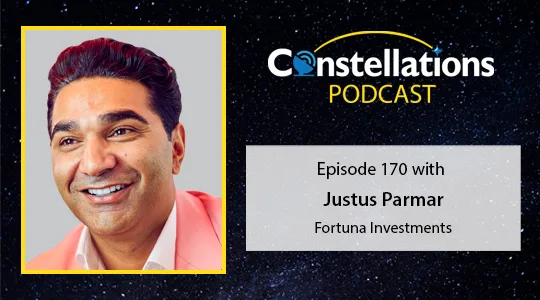
John Gilroy: Welcome to Constellations, the podcast at Kratos. My name is John Gilroy, and I’ll be your moderator. Our guest today is Justus Parmar, founder and CEO of Fortuna Investments. Today, we’ll be discussing venture capital and finding profitability in the space sector. Space Investments fell in 2023, but many venture capitalists expect significant growth in the next few years. Join us as we look back on the state of the space sector in 2023, and we look forward to potential future trends in 2024. Here for our discussion is today’s guest, Justus Parmar, Founder and CEO of Fortuna Investments. In the past, Fortuna has invested in all kinds of things, electric vehicles, metals and mining, robotics, clean tech, ag tech, and most recently, space. With an initial investment earlier this year in Starfighters Aerospace, a Florida based company that launches small satellites from its fleet of supersonic aircraft. Having a fleet of supersonic aircraft, wow. Fortuna plans to have a dozen more space companies in its portfolio over the next three to five years. So Justus, I’m going to jump right in here. I mean, if you look, and people who invest, generally speaking, they say that space technology investments are traditionally seen as risky with payoffs that are often longer term than other investments. So what led you starting to invest in space anyway?
Justus Parmar: Absolutely. So I’ve been forewarned by many friends and colleagues to even stay away from the space industry for some of the reasons that you articulated there, John. But the reality is risk is in the eye of the beholder. I view risk totally different in a certain way. I actually believe the bigger the risk, the bigger the opportunity. And because of the new commercial space economy and some of the amazing things that are starting to happen in the sector, for us, it’s too big of a bet not to take.
John Gilroy: So I’m going to ask you personally, would Warren Buffet agree? That’s the question. He is kind of the hero in your world, isn’t it? He’s the guy who can make money out of anything.
Justus Parmar: Well, I mean, it all depends. There’s a lot going on there, so let’s unpack that. So Warren Buffet is one of the most legendary value investors. So he’s looking for value, and that’s why he buys Coca-Cola, Gecko Insurance, and things that are very valuable over the long term.
Justus Parmar: So he stays away from speculative markets. So I think the better barometer would be the Jeff Bezos, the Elon Musk, the inventor innovators of the world. Not the value investors, but the inventor innovators of the world, and the Richard Branson’s of the world.
John Gilroy: Yeah.
Justus Parmar: So these once in a lifetime type of Albert Einstein individuals have really changed their life in a certain way. I’m down here in Miami Beach. Jeff Bezos, for example, just moved. I could probably throw baseball from where I currently am to where he has bought two houses. So this is a guy who spent 27 years in Seattle, being the founder and CEO of one of the most successful companies that the world’s ever seen, a trillion-dollar company called Amazon. He’s no longer the CEO of Amazon, and he’s moving down to Miami to be close to a space company that he’s CEO of, for example.
John Gilroy: Wow. Wow. That’s fascinating to know. So this investment environment, this investment environment has been up and down the last few years. 2021 saw a record amount of private investment in space. That fell significantly in 2022. And while many people were talking about a rebound, this year, it looks like 2023 may come in even slightly under last year, then 2022. So how do you explain the trend in private space investments since the peak year of 2021? And what headwinds and tailwinds do you see impacting space industry growth next year in 2024?
Justus Parmar: Yeah. So space, as you mentioned, it is an extremely high growth industry. And if you take a step back, every growth industry over the past two years has absolutely been crushed. The valuations are down anywhere from 70 to 90%. So it’s not just a space thing, it’s a growth thing. So growth has been really punitively hammered for the last two years. Fortunately, at Fortuna, we’ve been monitoring the industry for the last several years, even as you mentioned, 2021, we were offered from Citibank and large financial institutions to do SPACs and transactions. We just didn’t think the market was right at that point in time. So we actually steered clear of the space and SPAC boom. Looking in retrospect, that was obviously the right call. So if you fast-forward, as you mentioned, John, a couple of years now, so what we’re seeing is we’re actually seeing the technology being the furthest it’s ever been in space and the space economy. And we’ve seen the valuations being some of the lowest. So for us, having a lot of dry power and avoiding some of the mess, we actually think it’s the most opportune time in a lifetime to jump into the space business with our money, our mind, and our capital.
John Gilroy: Wow. What a good perspective. Let’s talk about perspective here. So looking back on 2023, what would you say was the single biggest development in the space sector in 2023?
Justus Parmar: Oh, 2023 had a lot of stuff going on, John. The biggest development is unequivocally Elon Musk and the progress that SpaceX was able to make and show. The early projections where the company was going to do a few billion dollars in revenue, which is a… Think about it, it’s almost so big of a number, couple billion, it’s hard to kind of fathom. But the projections where he was going to be in that kind of range. It looks like he’s going to finish the year close to 10 billion dollars in revenue. To give you context or perspective, a company like Walgreens, which is on every corner who sells diapers and cucumbers, they’re doing less revenue than SpaceX is doing. And the revenue that SpaceX is doing, one would argue, is a lot more complex and more valuable than selling broccoli, in a certain way. So that’s how the numbers are shaking out. Elon’s done a couple fundraisers this round, and these are just tender offers. They’re not fundraisers into treasury where the company needs the capital. It’s just some of the existing early engineers and folks in the company are looking for some liquidity on their shares. So the round they did in the summertime was $150 billion valuation. They’re doing one in the next handful of weeks. It’s going to come in probably around 175 billion, give or take. So if you take a step back, this space company that was peripheral space company only a handful of years, it’s now the second most valuable private company in the entire planet. So to me, that’s extremely interesting, and it’s a huge development, not only for SpaceX and what they’ve been able to do and achieve, but the greater ecosystem as a whole in terms of what is potentially possible in the industry.
John Gilroy: Your company named Fortuna harks back to classical civilization, and here, we have the month January coming up, and the name harks back to Janus, the god that looked forward and backwards. So we just look backward. Now, January, we look forward, here, 2024. So what’s the number one thing you are watching in the space sector in 2024?
Justus Parmar: So what we’re looking for in 2024, I mean, there’s going to be a lot of things. But the one, I guess, company I would keep an eye on, it’s a private company, so you can’t invest in it, but it’s going to be one to really keep your eyes on. And I think it’s going to be a transformative year for Blue Origin. And I only say that, because… So SpaceX is going to be a tremendous success. It already is. The question is, how much of a clip can they continue to keep growing on? So let’s see what that looks like. But the other kind of horse on the top side of the space market is Blue Origin. So they’ve had reasonable success. They’ve had great success compared to most of the other peers, the relativities, the fireflies, I mean, all these other early stage space companies. They’re way ahead of those companies in terms of their launch game, their profile, their revenue. But I think it’s something a little bit bigger.
Justus Parmar: So what we’re looking for in this coming year is… Again, so Jeff Bezos has left after 27 years in Seattle. The only reason is his family and to be close to his space company. And listening to Jeff speak, he, unlike Elon who says he can do many different things at once, and clearly, his track record and his portfolio companies has proved that, Jeff says, “I can only do one thing at once really, really good and strong.” So given that he’s now officially removed himself from Seattle and Amazon and he’s going to be beside his space company full-time to grow the space company… Keep in mind, Jeff Bezos was the richest guy in the world. He went through a divorce with his wife, and that’s the only reason he’s dropped to number two or three. But this is a guy who knows how to build a company. So he’s going to spend all of his time building the space company now, he’s handpicked a new CEO in the last few months from Amazon, he’s an extremely brilliant entrepreneur. So I’m personally curious to see how big of a leap can he make in this company because he’s got a little bit of catch up, or a lot of catch up to do to SpaceX.
John Gilroy: Yeah, yeah. Well, Justus, from your perspective as an investor, what space technologies, not companies but technologies now, what space technologies do you see as most exciting or most promising? Is it all about launch and Starship putting mass on orbit or on orbit capabilities, like AI, edge computing and private space stations, or maybe even advances in teleport and antenna capabilities. So what gets you excited?
Justus Parmar: So I mean, the beautiful thing is, as you articulated, it’s untapped, it’s virgin. The companies like SpaceX are just starting to lay the groundwork, call it the infrastructure or the railroads for the train in a certain way. So this is like the internet was in ’99 or 2000, so it’s wide open. So we can sit here and conjure and cook up all sorts of things that what’s possible, but I think the reality is nobody truly understands the extent of what is possible. However, what we believe at Fortuna is, what we know is SpaceX has done a tremendous job, they’re ahead of the pack, they’re the leader. One day, I think they’re actually going to be the most valuable company in the world. As we mentioned, they’re the second most valuable private company. But as a matter of practice, we think it’s smart not to compete directly against Elon. We think it’s smart to fund companies that are ancillary.
Justus Parmar: And we talk to the SpaceX folks all the time. We talk to the Blue Origin folks. So if you look at the companies like that, these world-class companies and what Jeff and Elon and these guys are saying, they don’t want to do it alone, nor can they do it alone. So it’s going to take a team of individuals to plug in different areas of this ecosystem to do this as a group. So obviously, that’s financial allocators, like myself, and company builders, we’ll step up where we can. But that also extends to parents who have kids in high school debating what they should do. Maybe they shouldn’t be lawyers and doctors. Maybe they should look at aerospace. And spending time with senior statesmen in the industry. I had the pleasure of sitting down with Fred Gregory, who was the first African astronaut, and he used to run at NASA, a couple weeks ago. And this guy, he gave me two, three hours of his afternoon. So people like that, spending the time and wisdom to pass down some of this information. So what I think in terms of this ecosystem, it’s really, really untapped. If I were to pin it into one specific bucket, I think the aspect of refueling is extremely intriguing. Elon has demonstrated the ability to take rockets up and down and reuse the rockets. 90% of the cost of the rocket is getting that rocket off the ground because of something called gravity. So in the future, I think it’s conceivable to have refueling stations, think of it as gas stations, in the lower earth orbit, whereby the rocket might not have to come down to Earth anymore. It can refuel in the depot and continue on its mission into the Moon or Mars and beyond. So I think that’s one area that we’re really honing in on, because we think it’s valuable. It’s not going to happen overnight. But we think it’s a logical next step, much like having an electric car and having a charging station.
John Gilroy: Let’s maybe double deeper into investment portfolio and what Fortuna is looking at here. From what I’ve read, it looks like your company Fortuna is targeting maybe a dozen space companies in its portfolio in the next few years. So in growing this portfolio, is there a particular corner of the space industries that you’re interested in investing in? Maybe work alongside or ancillary to other companies, is that just in general? Anything more specific?
Justus Parmar: Well, even our first corner store investment where we’ve committed $50 million to Starfighters Aerospace, they’re at the John F. Kennedy Space Center, NASA, Cape Canaveral, they’ve been there for almost 10 years. As you mentioned, at the beginning of the program, they’ve got a fleet of hypersonic fighter jets. They’ve got nine of them. Originally from Canada, I’m born and raised in Canada. I don’t know if our entire country of Canada has nine fighter jets, to put it in perspective in a certain way. So the company has amassed a really strong asset base. They’ve got great technology. What they’re going to be doing with our funding is launching small payload rockets into outer space. And I see smaller payloads, if you understand the space business, the satellites are actually getting smaller and smaller and smaller. 10 years ago, they were the size of an army tank or a big van. Now, they’re literally the size of a pizza box or an iPhone. So what Elon’s doing, he’s actually taking very heavy and very big payload up. Think of it as a freighter, that’s what he’s doing. So our company, Starfighters Aerospace believes that the smaller satellite, the nano SATs, the cube SATs, the stat SATs, that side of the market might be neglected in a certain way. So even the company Starfighters Aerospace, which we’re backing and building, is extremely complimentary to the stuff that Amazon and Blue Origin and SpaceX is doing. So that’s just an example of some of the ways that we think… Again, we are very keen in looking deeper into the refueling, the hydrogen aspect of space travel and exploration. And, yeah, we’re totally open. I mean, our door is open, we’re looking for great companies and great entrepreneurs to back. So please reach out if you’ve got a very exciting opportunity in the industry.
John Gilroy: Earlier in the interview, I was kind of teasing and playing around with Warren Buffett, his quotes and about long-term commitment, long-term investments, and I think you handled that pretty well. Let’s go back to that. So investing in space is a long-term commitment. So how do you evaluate whether investment will pay off in the long-term, even if it doesn’t in the short term? So what do you look for in this ideal investment?
Justus Parmar: Yeah, you nailed it. So first of all, you have to have a long-term view in the industry. So let’s step back 20 years ago. If you had a long-term view of fax machines or telephone books, so the Yellow Pages, it doesn’t matter what company you’re backing in that industry, it is just not going to work.
John Gilroy: Yeah.
Justus Parmar: Because the world’s moving on without you. So I actually think the opposite in the space business where this thing is just only starting to open up. So I think there’s going to be an abundance of opportunities in this industry. So when we evaluate these companies, we have to, one, have a long-term secular view in the industry, which we have, for obvious reasons we just discussed. But beyond that is we’re looking for great entrepreneurs who show a tremendous amount of grit. So these could be men or women that really believe in their business. They’ve either put their money and time where their mouth is, they don’t have side projects, they’re literally all in. Because the reality is markets go up and they go down, as we talk about. And inherently in life, we would love to have life without challenges, but the challenges hit you hard when you least expect them. So you have to have tremendous grit and resilience, and you might have to be sick in a certain way to keep plowing forward, because there’s a lot of pain and punishment. But you need to have that raw grit and tenacity to work through these things. Because as you pointed out, if you’re in it for the long haul, there’s going to be all sorts of things, whether they’re in your control or out of your control that come up that you’re going to have to deal with.
Justus Parmar: So we try our best to spend as much time as we can with the entrepreneur before we make our initial backing and partnership. And it’s not a perfect science, but we want that unwavering confidence and conviction and capability in their business. And we will unequivocally go to bat and war for you along the journey.
John Gilroy: You’re in Florida, I’m up in the DC area, so got to talk about the government. That’s mandatory here. So it sure seems like government investment space continues to grow in the United States and globally. Like everything, I don’t know, from defense to sovereign space capabilities, to programs for universal broadband connectivity, I’m thinking about Alaska. So how are you looking at government spending as you assess the potential of different space startups?
Justus Parmar: Yeah. So I had the pleasure of spending the day with Secretary of State, Mike Pompeo, two weeks ago up at NASA. He was also the head of the CIA. So Mike’s the guy who knows a lot about the nuances of the government in DC. He still lives up in DC where you’re at, in your neck of the woods. So we had a really meaningful conversation about how important this government private partnership is in the space industry. The takeaways were really what’s good for the space industry in America. And again, we at Fortuna only back American companies, so what’s good for the space industry in America should generally be good for the government. We’re in a really difficult time now where China’s trying to eat our lunch. They’re ramping up their space program like crazy. As we see from a defense perspective, the very first thing that Russia did when they attacked Ukraine, for example, was they went after their satellites. So they went after their space capabilities. So modern warfare is actually going into space as well. So it’s imperative from the defense aspect that we really spend time and money into our space economy, much like we do in hospitals and schools and things of that nature, because our existence as a country really depends on that.
John Gilroy: But Justus, when I did the intro for this interview, I gave you the NPR intro, a couple sentences, and I mentioned the company had invested in sectors like clean tech and robotics. We just talked that to be the top of the show here. So is there an overlap between clean tech and robotics and the space sector? Is there something that’s interesting or maybe worth investing in?
Justus Parmar: Yeah. I mean, we’re still so early in some of these technologies, so it is really tough to say. But at Fortuna, we are big proponents of mining clean technologies. We believe in wind, solar, critical metals, such as lithium battery technologies. So inevitably at some point in time, we’re going to have the capabilities to, one, mine the moon, mine different asteroids that are extremely valuable assets. So that’s going to come. I think it’s going to be five to fifteen years away. We’re still a really long time away from that. And another interesting aspect or application that will happen, it’s 10 years away maybe, but right now, there’s a big push for solar energy in America and on the planet. There is a future where these solar panels are going to be hosted above the Earth’s atmosphere. So if you close your eyes and you think about it, the suns ray are not going to have to go through the atmosphere and get diluted. So we end up getting a diluted product down here. But we’ll have pure, strong energy in the atmosphere that’ll be a thousand to 10,000 times more powerful that can potentially fuel the planet.
John Gilroy: Everyone’s talking AI, you go into fast food, they’re talking about AI. AI is everywhere, so I got to talk about AI in this world too. So what are your thoughts about artificial intelligence for this space industry? Is this one of the promising sectors we’re looking at for 2024?
Justus Parmar: It’s a promising area. I wouldn’t say for 2024. It’s too quick. If you really understand the AI industry, which we do, we’re investors of open AI, for example, in terms of a company, AI is going to take a really, really long time to develop. And when it develops, it’s really going to be powerful. It’s certainly not going to happen in 2024. If you look at these big companies, the Microsofts and all these people, they’re not even really developing the technologies. They’re just hiring engineers and people that can actually make this stuff. So we’re really in the infancy stage of AI. It’s going to take years to really build out. They’re building the infrastructure. It’s going to take years to do that. But inherently, there’s going to be tremendous value in the space industry, because if you really understand AI, it’s about compute and computing power. So a lot of the stuff that we’re doing in space are very tricky algorithms that are human and computer generated and having a stronger source to figure these things out as a tool are inherently going to be valuable in the industry.
John Gilroy: Well, Justus, go back to your company name again, fortune favors the bold. You’re a bold guy. And bold people, guess what? They make mistakes. I mean, it just happens. It’s going to happen statistically. So let’s talk about these few mistakes that you’ve made along the way. So maybe what’s the mistake you’ve made, or maybe a regret, even, if you look back on your VC career? And are you taking any lessons forward from a possible mistake in the past?
Justus Parmar: Well, John, this is only a half hour show. If I were to start going through all my mistakes, I would be here a lot longer than that. So that said, look, I think there’s something there just about the mistakes in the sense that I’ve made probably more mistakes than most or any. I’ve done so many stupid foolish things. I could go on and on and on about them. When I was younger in my life, in my career, I really used to get hung up on them, if something didn’t work or I made a misstep or something got screwed up.
Justus Parmar: As I’ve grown up and as I’ve learned, and I’ve had 20 years of experience in this industry, you actually want to make mistakes. You want to be a little bit foolish. You want to push the boundaries, legally and with good ethics and morals and things like that, but you want to push the envelope. You want to try and go into the unknown. You want to swing the bat, you want to miss, actually. If you look at the greatest home run hitters of all time, their batting percentages are 300. The best slugging percentages, or sorry, on base percentages is only at 400 points out of a thousand. So when you start to think about that, and let’s just say the Michael Jordans and Kobe Bryants, they’ve missed way more game winning shots than they’ve made. So my encouragement to young entrepreneurs or anybody listening is don’t be so hard on yourself for failure. Embrace failure, dust yourself off, get yourself up, and go at it again, and go at it again. And at some point in time, it’ll really open up for you.
John Gilroy: This is a crazy business to make predictions about, but I’m going to ask you to make a prediction anyway. Some people will look and go, “Well, geez, Justus, you don’t understand. There’s space debris out there. There’s a potential conflict and space. There’s situational awareness. Bad things could happen.” Let’s just keep it down here. Stick with our buddy, Warren Buffett, in the Midwest. So I guess it just sounds you’re optimistic about the future space sector, aren’t you?
Justus Parmar: I am exceptionally optimistic about the space industry, so much so where nobody’s paying me to be here to have these discussions.
John Gilroy: No.
Justus Parmar: We’re spending my time, my firm’s time. We’re almost 30 folks. I’ve got research analysts on staff. I’ve got all sorts of great more intelligent folks than even myself on staff. We’ve directionally changed the genesis of my firm, from going from battery technologies and different areas to outer space. So we’re all in. We’re putting our money where our mouth is. I have no assurance, no guarantee that any of this is going to work. But sometimes in life, opportunities come along. And sometimes it’s only a few opportunities in your entire lifetime. And when they come along, you have to be smart enough to realize that it is a huge opportunity. There’s no guarantee, there’s no insurance. But when you get that pitch, you have to swing the bat, because the opportunities really outweigh the risks.
John Gilroy: Wow. This has been just a fascinating discussion. I think Justus, what you’ve done is you’ve given our listeners a real thoughtful analysis of investing in space in the future. So I think they’re really going to appreciate it. I would like to thank our guest, Justus Parmar, Founder and CEO of Fortuna Investments. Thanks, Justus.
Justus Parmar: John, that was awesome. Pleasure is mine.