Transcript:
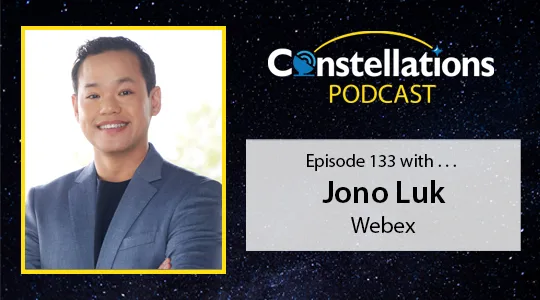
John Gilroy: Welcome to Constellations, the podcast from Kratos. My name is John Gilroy, and I’ll be your moderator. Today, we welcome Jono Luk, the Vice President of Product Management at Webex. Deep space communication is becoming an important topic, with the upcoming launch of NASA’s Artemis 1 mission to the moon. The mission will be the first test of video collaboration technology off planet. Future stages of the mission will have astronauts returning to the lunar surface by 2024, paving the way for a long-term lunar presence, and serving as a stepping stone on the way to Mars.
John Gilroy: Jono and I both watch TV shows, and TV shows make communication in space look easy. But the reality is very different. Engaging in visual collaboration with a spacecraft that is more than 240,000 miles away is a real challenge, and it requires extensive knowledge across networking and security encryption to ensure a successful experience. During this episode, Jono Luk, the Vice President of Product Management at Webex, will discuss the difficulties of video communication in deep space, and explain how these issues can be overcome to support NASA’s Artemis program. Jono, when you were a kid, you were watching Sci-Fi with your dad and dreamt of this job, didn’t you?
Jono Luk: I sure did. This is literally the dream project and dream job. I’m grateful to be working with all these people.
John Gilroy: Yeah, it sounds really fun. I’m jealous of you for being the spokesman for this whole topic. It’s great. NASA is just up the road from us in Washington, DC. Can you tell us a bit about NASA’s Artemis 1 mission, and the need for video collaboration in deep space?
Jono Luk: Absolutely John, and you actually already hit on this a little bit. The Artemis missions are about getting humans back into space with NASA. As part of this, we actually have what we’re calling the Callisto project that’s a technology demonstration. It’s an opportunity for us to bring what we might think of as everyday tech, something you might have on your phone, for example, and powering a whole new way of space exploration and video in particular. We’re social animals. For example, I need to see John and John needs to see Jono as we communicate, we have hand gestures. Video is a key part of that connection back home. If you threw that number out 240,000 plus miles, It’s a long way. Space is cold, and you want that visual to help create and maintain that connection with loved ones, you have support staff, and others.
Jono Luk: There’s more to it than just that. It’s not just seeing people, it’s seeing things. As we do science exploration and there are experiments happening, we want to be able to see what’s going on out there, so scientists here on earth can suggest the next idea, “Do this, rotate that,” so that the experiment can continue on. It used to take a day or two for a round trip to get information, but now that can happen nearly instantaneously thanks to things like video collaboration.
John Gilroy: That’s amazing. Before this podcast began I joked, “Earth to Jono, earth to Jono, are you still on Mars.” In the real world, it would take 15 minutes for that signal to get all the way to Mars. Just put that in perspective. We talk about communication and latency and delays, and it’s all a huge problem to overcome, isn’t it?
Jono Luk: Absolutely.
John Gilroy: This is a collaborative approach. Who else is working with you on the Callisto project?
Jono Luk: Callisto is actually a partnership with Lockheed Martin, Amazon Alexa, and Webex by Cisco. The three of us came together and created what is now a blue unit sitting at the front of the Orion capsule. In that unit is, first of all, Amazon Alexa, providing voice commodity. Instead of having to go to a panel, look through 400 data points, and find the rotational velocity of a component or the temperature of a particular module, I can now ask just by using voice. That reduces the time to get the information. It makes it easier, and I’m hands free as well, I can get more things done at the same time. Webex is the video and the connection between either the astronauts on the mission. In future missions, because Artemis 1 is unmanned, the astronauts on the mission and mission control. Or, as I said before, it could be classrooms connecting with the astronauts or scientists and seeing the experiments, or scientists seeing some artifact. That’s really how Callisto is, again, bringing what we think of as everyday technologies to make deep space exploration that much better.
John Gilroy: You mentioned Orion. How will NASA’s Orion’s spacecraft communicate with earth during this mission?
Jono Luk: I can’t take full credit. While Webex is the video platform that enables that communication, we are actually using NASA’s deep space network. You’ve probably seen these in movies, and this is a podcast, so you won’t see my arms, but they have very large dishes, 70 meter dishes in some cases, situated around the world firing off signals into space. That is the equivalent of our internet backbone, if you will, these huge satellites. What we’re doing is bring Webex into the mix, such that there’s Webex running sheer cable on earth, in Houston, and also running out there on the Orion payload. Those Webex endpoints are a special built version because this is space, it’s a special network which allows that communication back and forth. I, on earth, can see what’s happening up there in the Orion capsule and vice versa. When there will be humans in space, they’ll be able to see the various scientists, the engineers, and the VIPs. We will have people coming through mission control throughout the mission, saying hello to the crew. Again, reducing that loneliness, and keeping them in touch.
John Gilroy: Ever since COVID, everyone on the planet is familiar with video communication. We do it every single day, and I’m getting sick of it. I’m getting sick of Zoom myself. How is this video communication different in deep space?
Jono Luk: Two things. The first, and I always make this joke, when you and I are chatting right now, it’s probably happening over some very fat fiber optic cables laid across the country. There aren’t a million miles of fiber optic cable driving behind this capsule. This is happening over radio waves, that deep space network. That is one of the most fundamental differences in deep space exploration and communication compared to earth, the medium over which it happens. Fiber up optic cables are sheathed. There’s protection around it, so we maximize the reliability of that signal. When you’re firing radio waves over space, or in the vacuum of space, anything can happen that can be disruptive. That introduces the potential for data corruption and data loss. Those types of challenges are something we haven’t had to deal with here on earth for that long.
Jono Luk: Back in the day of the modem, you worried about the noise. When that noise came in, you suddenly lost your signal and your dial up was lost. For the last 10 to 15 years, that problem became non-existent. These are just simple realities, and the further you are, 100,000 to 200,000, even a million miles from earth, there’s that much more distance for these potential problems.
Jono Luk: The second thing is the speed of light or the speed of the signal. There are 250,000 miles of distance. It takes time, time that we don’t have to deal with. Even with latency, we don’t have to deal with that on earth. The way we compute, the way that we account and sync up the video and the audio signal is just fundamentally different because of those variables.
John Gilroy: A couple of years ago, we interviewed Vint Cerf, the father of the internet, and he’s working with NASA’s deep space internet project right now. I turned to Vint and I said, “Vint, what is your biggest challenge?”
John Gilroy: He said, “My biggest challenge is, the speed of light’s too slow.”
Jono Luk: Yeah.
John Gilroy: I said, “That’s above my pay grade, maybe Jono can configure this one out.” When you deal with those types of problems, you’re now at an advanced level. This is really advanced communication, isn’t it?
Jono Luk: It really is. The funny thing is I was talking to someone about this the other day. If I say something to you John, over a Webex call, if you don’t respond within a second, I go, “Did you hear me? Did I come through? Did I cut out?” We are normalized to this sub second latency. Here, we’re talking seconds, or eventually minutes, and all of those things just change. Again, those variables are just fundamentally different for us. Yes, this isn’t about stuff. Someday, somewhere, instantaneous communication would be fantastic.
John Gilroy: When I think of Vint, I think about the early days of the internet. Back in the mid-nineties, there were a group of people that got together in Paris and came up with a joint photographic experts group. They then came up with JPEG. It’s compression. People down the hall came up with, guess what? MPEG, a motion picture experts group. Are there compression standards now? Are they different from space, or are they the same kind of compression used here?
Jono Luk: Yeah, I would say that the core compression technology used for space, as we’re using it in Webex, compared to what we might be using on our regular internet, they’re actually not that different, because compression is compression. The problem is that you will need to compress harder. You need to achieve better rates of compression. The analogy I use for what we have to deal with is that we’re trying to take 2022 high definition video, and cram that over what some of us may fondly remember as 2004 internet speeds, the day of the modem. We’re taking one or two megabit per second video, and trying to make that work in 100 to 120 kilobit a second. That’s not the total bandwidth of the NASA deep space network, but that’s how much can be afforded to our part of this mission and payload. Those are the kinds of problems we are basing on the technology available today, and it’s really pushing us to do that much better, to do that much more.
John Gilroy: Jono, thousands of people from all over the world have listened to this podcast. Go to Google and type in “Constellations Podcast” to get to our show notes page. Here, you can get transcripts for all 100 plus interviews. Also, you can sign up for free email notifications for future episodes.
John Gilroy: In the Navy, they have this thing called a shakedown cruise. Captain Jono will take a ship out, and bring it back in, and have a list of corrections on there. I’m thinking about testing these video capabilities. I tell you what Jono, I’ll go to Mars tomorrow, and I’ll test out the link. What do you think? How can these video communications capabilities be tested to ensure they’ll work in deep space? I don’t know what the test bed is.
Jono Luk: Yeah, absolutely. It’s funny you mentioned that. First of all, please don’t go to Mars quite yet. I don’t know if we’re ready for that. I don’t know what to do for you if you’re stuck out there. Coming back to the immediate, what we actually do is, thanks to Lockheed Martin, our partner in the whole Callisto project, we have some very advanced test labs where they introduce, for example, high latencies into communication, to simulate that here on Houston, talking to the Orion capsule near the moon. We can create those conditions that require us to handle the latency, or they can introduce a variety of network conditions, jitter, loss, et cetera. Again, we have to handle those.
Jono Luk: That’s what we’re doing regularly, these true end to end tests. In the same way the shuttle itself sits there in Florida, and they do what they call their wet dress, that’s a physical, logistics, hardware test of the shuttle. We’re doing the same equivalent for what we’re doing with Callisto. That’s more of a software, a digital and a network. That is the closest we can come to simulating those constraints, if you will, or really, the reality of space travel, and seeing how well we do.
John Gilroy: I want to play around with a Tom Cruise quote. He famously said, “Show me the money.” In return, regarding this particular situation, it’s, “Show me the video.” Can you provide an example of how real time video would support the mission better in comparison to capabilities of the past? We’ve got new capabilities here, why is it better, and how can it improve the mission?
Jono Luk: Absolutely. I would maybe categorize this into two types of scenarios, where this will, hopefully, revolutionize space exploration. The first is… John, do you know where square peg/round hole comes from? Do you know where that saying comes from?
John Gilroy: Apollo 13.
Jono Luk: Apollo 13. The Tom Hanks rendition of this, which people are probably familiar with, they saw this on their screen, but when they had to switch capsules, the components were just fundamentally different. There was a square peg, there was a round hole, and the carbon dioxide scrubbers just didn’t fit. Back in the day of Apollo 13, this was over voice. I was telling you in mission control this, that, and you couldn’t see. Imagine if we had video, imagine if people in Houston could see the component, could see as Buzz Aldrin, or someone else, was trying to make things fit, how much more effective that could be? Instead of you looking at a piece of paper, me looking at a piece of paper, and guessing if we’re talking the same thing. That’s one example of where seeing can lead to faster results, better results, ideally. That’s the goal.
Jono Luk: The second is, as I brought up earlier, this new generation of exploration, there have been 3000 plus science experiments performed in the ISS since it went up into space, or rather, was built in space. We can’t send all those scientists into space, nor do they all want to go. I would love to go into space, if anyone’s listening. However, not everyone does. Having video means that I, as a scientist on earth, can see what’s happening up there. I can see the interim results and we can course correct. “John, could you change this one component to this particular setting so that we can continue the experiment?” I can provide that guidance to you so that we can get the most out of what is a not so cheap science experiment. Those are two examples, really, of where being able to see just leads to better, and faster, results.
John Gilroy: The example is right in front of your eyes. I’m looking at you on a video right now, and I say, “I have a window behind me, you have a window behind you.” They’re completely different types of windows, and for me, to describe it verbally, it would take almost 20 minutes. We do it instantly by knowing, “No, this is completely different.” It’s verbal communication.
Jono Luk: That’s right. A picture is worth a thousand words is an overused statement, but it’s so true. Save me the 995 words, let me just show you this thing.
John Gilroy: Yeah. My motto is, “Don’t tell the story verbally, tell the story visually.”
Jono Luk: Absolutely.
John Gilroy: Let’s take a look and apply this back home here. Will any of these advances developed for the Callisto demonstration improve video back here on earth?
Jono Luk: Absolutely, we’re already seeing examples of this. Outside of the work that I do here with Callisto, and our partners Lockheed and Amazon, one of my personal missions in life is to bring equity to people around the world. Healthcare is an area of passion for me, underserved communities are an area of passion for me. I give you this intro on ramble because the compression technology we are doing to improve video is making it so very poor internet connectivity can now be leveraged for telehealth and education. We can take this and deploy it to the furthest, most remote regions of any country or continent. We can lift those people up no matter where they are and connect them to healthcare, education, or whatever programs and support they need.
Jono Luk: That’s just one really great example of how the work that we’re doing in pushing the envelope through Callisto is really going to drastically improve life here on earth, and I’m hoping that it’s just the beginning of some of these things. As we move forward, we will look into how we can leverage holographic technology for space exploration. Why can’t that make it better for deep sea exploration, when I’m 7,000 feet underwater? All of these things, I’m hoping, will really forever change the way exploration is done.
John Gilroy: Yeah. Earlier, I talked about JPEG and MPEG, but the compression we’re using right now is built on that, and the compression for Eclipse is built on that. Each stage, you learn better ways to enhance communication. I think your line is, “Make a million miles feel like one.”
Jono Luk: Like one, that’s right.
John Gilroy: Let’s look into the future, get out your crystal ball out. Jono, what are the implications for this technology demonstration in the Artemis program in terms of future goals for setting up a long-term presence on the moon, and even traveling to Mars?
Jono Luk: I think one of the fundamental things that we’re doing through this Callisto project, and what we’re demonstrating, is that we can reduce the time to outcomes with, in our case, video. Instead of snapping a photo, sending it back to earth, having a decision made, and then sending the result, that could be a two day round trip just because of the process. If we can make this near real time, waiting 14 minutes for a signal to show up, so I can see something and say, “Yes, no, left, right,” already reduces that by, I’m not a mathematician, 40 hours, let’s call it. We can shorten that time to the magic that can happen. That’s one example of where, if we’re going to have a presence on the moon, or traveling to Mars, anything we can do to reduce time to action, that’s just going to make things better.
Jono Luk: In one of the talks I gave in Vegas at the re:MARS conference, I spoke about bringing holographic technology in to drive exploration. By giving a three dimensional, holographic representation of a rock on the surface of the moon, or a component, it will just make things go faster. I can see, understand, and say, “Flip it,” or, “No, we’ve seen this one before.” You apply some of the AI that we have. For example, it knows your John and I’m Jono on this call, how about we use that computer vision and object recognition, and say, “This is a component we’ve seen before. This is a rock we’ve seen before, but that thing over there, that’s unknown.” Every element of what we may think of as everyday life down here just reduces that time to whoa, or realization, or discovery. That, I think, is the impact we can have.
John Gilroy: This has been a really great interview, Jono. I think you’ve helped our listeners take communications to infinity and beyond. This has been a great interview. I’d like to thank our guest Jono Luk, vice president of product management at Webex. Thanks Jono
Jono Luk: Thank you John.