Transcript:
John Gilroy: The views expressed in this podcast or on www.constellationspodcast.com, do not officially represent the views of the U.S. Military or the United States government. The appearance of U.S. Department of Defense, DoD visual information, does not imply or constitute DoD endorsement.
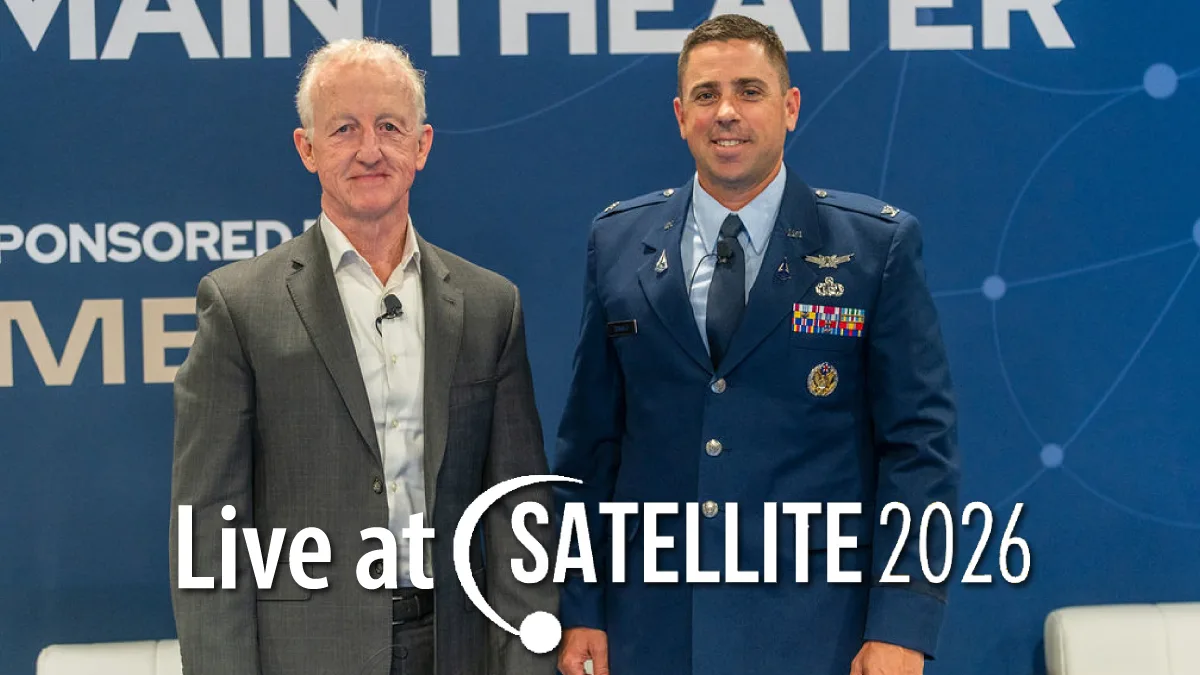
John Gilroy: Welcome to Constellations, the podcast from Kratos. My name is John Gilroy, and I’ll be your moderator. Today, we’re discussing how commercial industry is helping shape the next generation of space capabilities. We’re joined by Colonel Tim Trimailo, Director of the Commercial Space Office, or COMSO, the Space Force’s front door to industry. He leads efforts to integrate commercial capabilities directly into operational missions. Colonel Trimailo has played a key role in bringing commercial systems into military operations, strengthening resilience across constellations, and rethinking how the US and its allies operate in increasingly contested domains. We recorded this interview live on the made stage at Satellite 2026 in Washington, DC. Let’s jump right in. Colonel, ready to go?
Tim Trimailo: Ready to go.
John Gilroy: Good, good, good. From your vantage point, how is the Space Force redefining the relationship between military space operations and the commercial sector, and what principles are guiding that transformation?
Tim Trimailo: Yeah, it’s a good question. It’s really the reason that our office, the commercial space office, exists in the first place. I’ll frame the answer sort of around the need for speed. Speed is the name of the game today and really across all domains. So, space is not the only one that relies on speed. It’s really delivery of capability to the war fighter as quickly as possible. The reason that in the Space Force and commercial space in particular, we’re getting after speed is really twofold. The first piece is the threat. Our adversaries are moving faster than ever, and they are rapidly developing and fielding capabilities to deter and even defeat us in the next conflict. The second piece of that, sort of counteracting that or on the other side of the coin, if you will, is the commercial industry base is moving incredibly fast. And they’ve accelerated over the past really couple decades, but in particular over the past few years. And they’re backed by an incredible amount of private capital flowing into these companies and allowing these founders and these operators to build at a speed that the government, quite frankly, can’t match on its own. And so we need commercial space to be involved in that, and we need to leverage commercial space technologies and these great companies that are building these technologies if we want to counter that threat that’s moving that fast.
John Gilroy: Colonel, you’ve spoken about driving commercial integration and space. From your perspective, what are the most promising areas where DOD commercial space can co-develop capabilities where there might be maybe some friction?
Tim Trimailo: Yeah. So, I would contend that we, the United States government, can integrate commercial technology into every single space mission area that we have. So, it doesn’t matter if it is satellite communications, position navigation and timing, strategic missile warning even. No matter the mission set, we can integrate commercial capabilities. So, how do you actually do that? Not everything that we buy and deploy and deliver to the war fighter and integrate into the architecture and how we’re going to fight is X, Y, Z as a service. So, I’ll give an example where we can do that. SATCOM, we can leverage the amazing industrial base that’s out there providing commercial SATCOM today, we can use that for government mission sets. We do that today through the commercial SATCOM office, which is in our office or our organization. And we can do that purely as a service. So, it’s contractor owned, contractor operated. We lease or buy a terminal. We’re often running with that capability as a service. Now, other mission sets, we might not be able to buy or lease that capability as a service. So, we view commercial integration along this continuum, depending on mission risk, mission assurance needs. It also depends on the commercial technology and how robust the commercial marketplace is for these kinds of capabilities. But for other mission sets like missile warning, missile tracking, missile defense, for example, we can still take commercial off the shelf components and integrate those into our architectures, into our systems. That’s still a form of commercial integration. It’s just not all the way to that other end of the spectrum of commercial services. It’s buying components, it’s buying systems. It’s even in some cases mimicking how commercial operations are executed. So, we can government owned systems with contractor operations, that’s a commercial integration in and of itself. A lot of different ways we can do it all depends on the mission set.
John Gilroy: Currently, this is a tough world to be in all this innovation and constant change, hard to look into the future here. But how do you see the strategic importance of cislunar and xGEO domains evolving over the next decade? What role might commercial operators play in these regimes and this big change?
Tim Trimailo: Yeah. I mean, traditionally the Space Force has focused in on, not exclusively, but predominantly in low earth orbit, medium earth orbit, geosynchronous orbit, with some niche sort of orbits mixed in there for some specific mission sets that we execute. What we’ve seen over the last really few years is a focus on, well, what is beyond geosynchronous orbit and what else should we be responsible for when it comes to things like space superiority? And so, we saw an executive order recently come out from the administration. We’ve seen some of our senior Space Force officials just in the last couple of weeks even talk about the need for guardians or Space Force capabilities to extend beyond geosynchronous orbit. That will all start, in my opinion, with space domain awareness, understanding what is out there beyond geosynchronous orbit all the way to the moon and maybe even beyond that. Once we have space domain awareness figured out, we’re also talking to a host of commercial companies that are working on things like infrastructure and outposts to be placed on the moon. I think the Space Force probably has some role in that. I don’t know that we’ve fully defined what it’s going to look like just yet. But again, to me, it all comes back to understanding what’s out there first so that we can build that infrastructure for the future.
John Gilroy: We’re recording this from the satellite show in Washington, DC, and a lot of the booths here, a lot of the companies handle challenges that people have in space flight and even going to geo. So, one of the biggest challenges, technical or in policy, in achieving trusted interoperable space systems between different US services, allies and commercial vendors, it’s a tough problem.
Tim Trimailo: Yeah. I mean, the technical part of it I think is actually less of a challenge than some of the policy and even cultural roadblocks to interoperability. I would like to take a step back and think about systems interacting with one another in a little bit different way though, because I think interoperability between systems and mission sets looks different depending on what you’re actually talking about. As an example, data transport, we may look at interoperability, and we have on certain programs, as setting government standards for things like optical communications terminals. So, high throughput communication terminals we can put on our satellites that can talk to other networks, talk to other satellites, whether they are government, commercial, etc., to include our allied partners. The other way to do this is not to connect those networks and make that information or data compatible on the ground. So, I may not need to actually force our different constellations of satellites to talk to one another and be interoperable in space. I may, for some mission sets and some purposes, want to focus on the ground segment. So, things like remote sensing data, I might want to create some kind of template so that I know exactly the kinds of metadata that I’m going to have in those data streams so that I can do what I need to do for the particular mission set. So, interoperability is not just about physically tying systems together or even setting some of those standards. It’s also about setting the precedent of how we’re going to operate mission sets altogether.
John Gilroy: It’s almost like being context aware for the interoperability. It depends what the mission wants to be and then you can adjust based on that. Is that right?
Tim Trimailo: That’s exactly right. And I would just, I guess, put a point on that, that I’m not convinced that the government should always be setting those standards either. The commercial marketplace is robust. We have brilliant people out in the industrial base. Let’s let them drive some of those things based on trial and error and experimentation and what is actually working and selling on the commercial side. If we see those things, the government can likely adopt a lot of it and not have to invent its own and force industry into a cage there.
John Gilroy: Colonel, how is the space for shaping the commercial augmentation space reserve to ensure that commercial partners can be rapidly brought into operations when needed and what design principles are guiding how CASR will function in real world contingencies. We’re experiencing some contingencies now.
Tim Trimailo: Yeah. Yeah. CASR is something we’re really excited about. We started a couple years ago, just with sort of the initial analysis phase. Proud to say that this year we’re going to award our first operational contracts for CASR.
John Gilroy: Ah.
Tim Trimailo: That’ll be specifically for space domain awareness. I already mentioned that mission set. It’s an important one for the Space Force. And really what we’re doing there is we want to ensure that the companies that we are working with and buying capability from in peace time, that when we get to a crisis or a conflict situation in the future, that those same companies will stand shoulder to shoulder with us in the fight of the future. So, we have to do things like due diligence on those companies, understand where are they getting their funding, where are they sourcing some of their supply chain? We have to do all of that due diligence to make sure that we can truly trust some of those companies to be there with us. We also have to do some experimentation in war gaming. US Space Command, it was in the news I think over the weekend or late last week, US Space Command just this week did a commercial war game or exercise, and really what that purpose of that was to kind of stress test some of these commercial capabilities and how would they actually respond in a crisis situation, what can they bring to bear in a future conflict? So, we’re experimenting, we’re doing all those things. And in the background, we’re also setting the framework for other mission sets beyond space demand awareness after this year. So, we’re setting things like the special terms and conditions, the types of incentives that some of these companies want to be faced with as we’re building in some of these contracts. What are some of the red lines that they won’t cross when it comes to supporting the US government? They all have their own incentive and equities and all that that goes along with their particular business that we need to be cognizant of. There’s no one size fits all to CASR, but we’re setting all of that framework up now. We’re going to award those operational contracts this year, and then we’re going to build on that success for future mission sets and future concepts.
John Gilroy: Earlier in this interview, we talked about some technical challenges. Let’s maybe dive a little deep into that. Are there specific regulatory or acquisition hurdles that you believe are holding back commercial space contributions to national security emissions, and how can they be overcome, how can they be reformed?
Tim Trimailo: Yeah. Yeah. So, I talked to probably two dozen commercial companies a week on average, and it’s usually a new cycle of companies, some recurring ones too, of course. So, I get exposure to a lot of commercial companies from startups to very, very mature companies that are supporting us today. There are a couple common themes that we see, particularly for startups, as they’re looking to break into the government contracting side of the house. The first one is requirements. Our requirements traditionally have been too prescriptive. They’ve put our contractors in an industrial base in a box to go build a bespoke prescribed system, and it fundamentally changes the commercial capability that they set out to build in the first place. It also slows us down to deliver that to the war fighter, and it costs us a lot more money than just buying something outright. The second piece is security. Our programs are still probably overclassified in a lot of areas. I’ll get to the the bright side of all this here in a second, but security is the second piece. We can’t even get some of our commercial partners in the door to talk to us about what some of the threats are because they don’t have clearances. We can’t talk about some of our requirements for some of our programs because they don’t have clearances, they don’t have facility clearance licenses. And what we’re seeing a lot in some of our solicitations that go out to industry is you can’t get a clearance unless you have a contract and you can’t get a contract unless you have a clearance. So, it’s this never ending cycle that we’re trying to crack. The third piece, I would broadly call operational integration. And this is a piece that, again, I think US Space Command is taking very close interest in with things like this commercial exercise that we just had. We have to actually integrate the commercial capabilities we’re buying into how we’re going to fight the war. So requirements, security, and operational integration, I think are the three biggest challenges. Now, on the flip side of that, the positive. The Secretary of War put out acquisition transformation guidance in November of last year. That is changing the whole sort of paradigm and structure of how we do a lot of different things in this area. That’s specifically focused on redoing the requirements process. So, how do we get more min viable product? How do we include more of the industrial base in our source selections and in our evaluations for future capabilities, reduce those barriers to entry for things like requirements? JSIDS has gone away, so now we’re looking at really this generational opportunity to replace it with something that works best for each one of the individual services. On the security side, there are various organizations within the Space Force and really across the department that are looking at not only reducing the classification of some of our programs. We saw that on one of SSC’s programs recently, RGXX, reducing some of the classification, making more parts of the program actually unclassified, or at a lower classification than it was before. And then we’re also looking at options to get some of these commercial companies cleared sooner. And then on the operational integration side, I already mentioned our combat and command for space, the US Space Command, is actively working with commercial companies to war game and exercise how we’re actually going to use these commercial capabilities in the fight when we need them. So, we’re working across all of those barriers. It just takes a while.
John Gilroy: Well, let’s assume these barriers get overcome and let’s project a little bit in the future here. Let’s play around with the future. So, in the future where commercial constellations provide persistent data streams, what frameworks are needed to ensure secure data sharing without compromising national security? There’s the question, huh?
Tim Trimailo: It is a question. It’s a great one. I think there’s a balance we have to strike. With all these systems coming online, the amount of data available even today, not even in the future, but the amount of data today is so large that we have to find a way to keep up with that. We have to find a way to make sense of the data and to get it to the war fighter, get it to decision makers, and get it into the hands of those who need it when they need it, and in a way that makes sense to them so that they’re not parsing through massive amounts of data that’s going to end up falling on the cutting room floor. So, the balance here to strike to me is how much do we control that data flow versus the speed at which we need to move to get that data into the hands of the war fighter? So, we can control it through things like encryption and cybersecurity. Those things are very important. Zero trust architecture, making sure that we understand where the data is coming from, it’s pedigree, and making sure that we can ultimately rely on those pieces of information to make informed decisions. That’s important, but if you dial that up too much, you’re going to absolutely bring the speed to a halt. So, we need to include and increase things like artificial intelligence, machine learning, to be able to parse through that data. We need things like data tagging to make sure that all the metadata associated with those data types is accurately reflected. We need to tag it so we know post event where it came from and sort of how it got to us. So, we need all of that sort of custody of how the data is flowing into our architecture, but I’m very leery of how much we control that data flow and at what impact it will have at the end of the day on the speed of information that is useful to the war fighter when they actually need it.
John Gilroy: You mentioned zero trust. From my perspective, when the federal government makes this change to zero trust, it’s a huge physical change, technology, mental change, it’s a huge change. So, my question is, what skills and mindset shifts do you think the next generation of space professionals, military and industrial, will need to have to thrive in this integrated ecosystem all around us?
Tim Trimailo: Yeah. Yeah. And that’s another key piece of the acquisition transformation, acquisition reform guidance that we’ve gotten is we have to build acquirers and operators, Space Force Guardians and really all department staff that thinks a little bit differently. We have to be able to take informed calculated risk. In some cases, we have to be okay with the outcomes of taking risk too. We’re not going to be 100% successful. We’ve gone down that path in the past. We’ve built space systems that were near perfect. You’re never going to get all the way to perfect, but we’ve built them near perfect and we’ve delivered yesterday’s technology to tomorrow’s war fighter, and we’ve done them in injustice by doing that. In the meantime, we’ve spent decades and billions and trillions of dollars largely going over budget on a lot of those programs as well. So, speed really does matter a whole lot. So Guardians, especially Space Force staff that think in terms of informed risk and decision making and being okay with some failure, learning, and then moving on is going to be really important. That was not the way it was when I was growing up in the Air Force and Space Force. The other piece of it, and we’re pretty excited, we just started a pilot effort at Space Systems Command that we called COMET. It’s the Commercial Orientation and Mentorship for Enterprise Talent, so very long acronym. We call it COMET. And what we’re doing there is we’re bringing in more of the junior workforce from SSC, and we’re giving them targeted courses and tours of commercial companies. And we’re talking to them about what drives commercial industry, what are their interests, how do they operate, how are they different from the big traditional primes? Because I do a lot of my engagement at the more senior levels to our senior Space Force leadership and to the program executive officers and program office leadership, but that’s not good enough. The folks who are going to be future senior leaders and you’re actually going to be, quote, pun intended, but in the trenches, doing the work and building those acquisition strategies for our future programs, they are the company grade officers and junior civilians and junior contractors who we work with day in and day out. And we need them to understand this culture shift as well, move faster, take risk, learn, repeat, and continue to improve as we move forward.
John Gilroy: You talked about hurdles earlier and one of the hurdles was operations. Let’s maybe move it up a level to an international level here. So, how important is coalition integration in space constellations and what lessons have you seen from early efforts?
Tim Trimailo: Yeah. I mean, traditionally it has been a challenge. Again, getting back to security, in getting some of our, particularly our bespoke capabilities and outcomes of those capabilities, data or whatever it is, into the hands of our allied partners. So, a lot of it comes back right back to the security limitations. What I think we have as an opportunity for commercial space is really, if we’re going to go after allied by design as a service and start from the ground up with some of our mission sets, thinking alongside of our allied partners and getting them capabilities to fight with us, commercial space is the perfect avenue to do that because it’s largely unclassified, we can sell it through foreign military sales. We can partner on buying some of these capabilities and not have some of the traditional security issues that we’ve had in the past. So, I think commercial space from the outset is a perfect avenue to get after allied partnerships. And we’re still going to have some of those challenges. But I think some exemplars that we’ve had, the joint commercial operation sell, or JCO at Space Systems Command in the Space Force, is one great example where they’re providing unclassified commercial data with partners, allied partners as well. And so we’ve got some of these pockets where we’re doing that today. We can certainly scale that up in the future for different mission sets, but we’re starting to see more and more of it across the enterprise.
John Gilroy: This is always a tough question to ask someone involved in your world of technology and change, but let’s try to look out. Maybe if you can, maybe a decade, maybe 15 years down the road, if possible. So you, what is your vision for space operations in a world full of these mega constellations? So, what will be the defining technologies or strategies in this new world?
Tim Trimailo: So, I’ll start this by prefacing I am not a technologist and so take this for what it’s worth, but I have been around in operations and acquisitions for certainly the Air Force and Space Force for a couple of decades now. And I’ll start kind of by explaining, my first assignment was at Schriever, then Air Force base, now Space Force base. And I was a satellite command and control operator. And so, we were sending commands to satellites, doing things like states of health to make sure that the satellites were healthy and maneuvering satellites, all of those kinds of things. I was on the ops floor and we were operating maybe, let’s call it a dozen satellites. And we had a crew of about a dozen as well, right? So, one-to-one ratio of human being to satellite.
John Gilroy: Wow.
Tim Trimailo: You look at how we do operations today and in particular how commercial companies do operations today where there is no more human in the loop, it’s human on the loop. If anything, they’ve got ops floors that are running 24/7. We’ve got commercial operators who are running satellite ops from their phone at home if they need to.
John Gilroy: Wow.
Tim Trimailo: We started to get some of that automation while I was at Schriever just in my four-year assignment there by getting something called a task automated operation script. So, this was mind-blowing up until that point we had to calculate hexadecimal commands before we sent them to the satellite. We would type them in on a keyboard and then hit enter and have two person verification and all those things. We got to the point where we’d actually be able to click a play button and it would run through all that script by itself.
John Gilroy: [inaudible 00:24:26] yeah.
Tim Trimailo: And that was mind-blowing at the time. But where we are today, particularly where on the commercial side is so far ahead. So, as we look a couple decades from now, I think you’re going to see obviously more automation, more artificial intelligence and machine learning, not only satellites that can heal themselves and take themselves out of commission and put themselves back in, which we have a lot of that today, but actual networks that can do that too. And so as we look at proliferation as it’s started to happen over the past several years, the ability to have networks that come in and out and actually networks that connect to one another, and the ability for operators, whether they’re Space Force or on the commercial side, to be able to hop between different networks, whether it’s through things like optical comm terminals or RF systems or different networking protocols, all of that is going to be in play. Edge processing is going to continue to be a big driver. I personally think that data centers in space are coming at some point. We have to figure out what the real business case is for that and if the cost is worth that benefit, but I think that that is a technology that’s on the rise as well. I think in our remote sensing, we’re not only looking down at Earth, we’re looking across all domains. We talked about cislunar earlier, being able to not only look at what is happening on earth and in some of our sort of typical orbital regimes, we’re going to be looking out towards the moon, all kinds of different remote sensing capabilities with new phenomenologies that continue to come on board. It’s not just about electro-optical pictures anymore. It’s also about radar and other phenomenologies that we can use to really interrogate and understand what’s happening in space and on earth. So, all of that is in play and probably a lot more.
John Gilroy: Colonel, in 200 interviews for the Constellations podcast, I’ve never used the word hexadecimal before. So, I’m sure there’s people typing it and not trying to figure out, “What is that colonel talking about?”
Tim Trimailo: I couldn’t do it anymore, but I kid at one point.
John Gilroy: Yeah, yeah.
Tim Trimailo: It’s a wonderful old concept.
John Gilroy: Well, you’ve given us a real good idea of what’s going on in the Space Force here and we appreciate your time today. I’d like to thank our guest, Colonel Tim Trimailo, who is the director of COMSO at Space Force. Thank you, Colonel.
Tim Trimailo: Thank you.